
Coming up with business ideas is usually the easy part. The harder part is figuring out which idea deserves your time, energy, and money before you start buying supplies, paying for software, ordering packaging, or investing in equipment.
That is where learning how to use AI to compare business ideas can actually be useful.
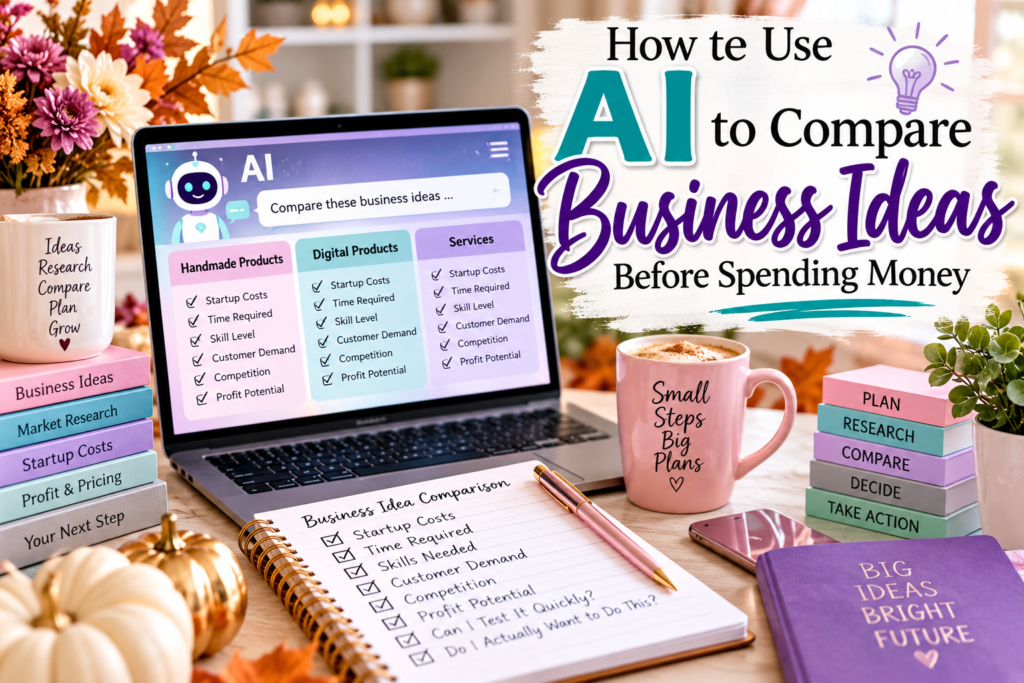
AI cannot tell you which business is guaranteed to succeed. It cannot promise that customers will buy from you, and it should not replace real market research. What it can do is help you organize your thoughts, compare several ideas using the same criteria, spot questions you may have forgotten to ask, and slow you down before you spend money just because an idea feels exciting.
That last part matters. A lot of people do not lose money because the original idea was terrible. They lose money because they committed too much before they knew enough.
Why Use AI to Compare Business Ideas?
One of the biggest advantages of using AI to compare business ideas is that it can help you look at several options side by side instead of getting emotionally attached to the first one that sounds good.
Maybe you are deciding between a handmade soap business, a beaded-accessories business, and a local cleaning service. Those businesses are completely different, but you can still compare them based on startup cost, time required, customer demand, repeat-purchase potential, profit margins, competition, regulations, and how easy they are to test on a small scale.
The goal is not to let AI choose for you. The goal is to make sure you are asking better questions before making a financial commitment.
If you are still deciding whether you want to sell a physical product, digital product, or service, start with BSL’s guide on Physical Products, Digital Products, or Services: Which One Should You Start With?. It walks through the differences in startup costs, time, customer interaction, storage, and how quickly each type of business can be tested.
Do Not Start With “What Business Should I Start?”
That question is too broad to give you much useful information.
If you ask an AI tool, “What business should I start?” it can easily give you a long list of trendy ideas. The problem is that those ideas may have nothing to do with your actual budget, skills, available time, or the kind of work you want to do.
A better approach is to give AI some real context.
For example, you might say:
I have $300 available to start a business, about 15 hours a week to work on it, and experience with customer service and social media. Compare a handmade soap business, a cleaning service, and a social media support service based on startup cost, learning curve, recurring customer potential, competition, and how quickly I could realistically test each one.
That is a much stronger question because it forces the comparison to fit your situation instead of giving you a random list of businesses.
Compare Startup Costs Before You Buy Anything
This is one of the first places where AI to compare business ideas becomes useful. Before you buy anything, ask AI to help you build a startup-cost checklist for each idea.
That checklist might include equipment, supplies, packaging, website costs, marketplace fees, software, insurance, licenses, permits, marketing, and anything else the business may need before the first customer buys.
Then take that list and verify the actual prices yourself.
This part is important because AI can help you remember categories of expenses, but it should not be treated as the final source for current pricing or local legal requirements. The U.S. Small Business Administration recommends calculating startup costs before launching and using market research to understand customers and competition before making bigger commitments.
You can also use BSL’s 10 Steps to Starting a Business Without Feeling Overwhelmed to work through startup costs, customer research, demand, and a small test before trying to build the whole business at once.
Compare Time, Not Just Money
A business can look inexpensive and still cost you a huge amount of time.
That is something people often miss when they are comparing ideas. One business may cost only $100 to start, but if every product takes 45 minutes to make, package, and ship, that time becomes part of the cost too.
Ask AI to compare how much time each business could require for production, customer service, marketing, bookkeeping, packaging, delivery, and learning new skills. You may discover that the lowest-cost business is actually the most demanding one.
This matters even more if you already work full-time, have children, care for family members, or are building the business around another responsibility. A business has to fit your actual life, not just your budget.
Compare the Customer Problem
A business idea becomes much more useful when you can clearly explain who it helps and why someone would pay for it.
Ask AI to help you think through questions such as who the likely customer is, what problem the product or service solves, how often someone might need it, what alternatives they already have, and what could make your offer worth paying for.
Then take those questions into the real world.
The SBA advises entrepreneurs to define their target market and make sure they are solving a problem customers are actually willing to pay for. It also recommends validating business ideas with real customers before investing heavily.
BSL’s How to Research Whether Your Business Idea Will Actually Sell Before You Spend Money goes deeper into this exact process. It covers customer reviews, pricing, competition, marketplaces, and small-scale testing before making a larger investment.
Use AI to Compare Competition
Competition is not automatically bad news.
Sometimes competition is proof that customers are already spending money in that category. The real question is whether you can enter that market with a reason for customers to notice you.
When you use AI to compare business ideas, ask it to help you build a competitor-research checklist. You might look at pricing, customer reviews, product options, delivery times, complaints, branding, customer service, and what buyers seem to value most.
Then do the research yourself on Google, Etsy, Amazon, social media, or local business directories, depending on the type of business you are considering.
AI can help organize the information, but it should not invent competitor facts for you. Current prices, products, reviews, and customer experiences need to come from current sources.
If you are still figuring out what to sell, BSL’s Create Products & Services to Sell section can help you think about creating something around real customer needs instead of simply chasing a trend.
Ask AI to Challenge the Idea
Most people use AI to confirm that an idea sounds good.
I think one of the most useful things you can do is ask it to challenge the idea instead.
Try asking:
What could make this business difficult to start or grow?
Then ask:
What assumptions am I making that I should verify before spending money?
That can surface issues you may not have considered. Maybe the business requires insurance you did not think about. Maybe shipping is more expensive than expected. Maybe the market is crowded. Maybe the product has a short shelf life. Maybe the work is more time-intensive than it looks. Maybe customer acquisition is going to be the hardest part.
The goal is not to scare yourself out of starting. The goal is to find the weak spots while they are still inexpensive to fix.
Compare How Each Business Gets Its First Customer
A business can look great on paper, but eventually someone has to buy something.
Ask AI to help you compare how each business could realistically get its first five customers. A local service may depend on referrals, Google Business Profile, neighborhood groups, local networking, or direct outreach. An online product may depend more on search traffic, Etsy, social media, email, or marketplaces.
This comparison matters because some businesses are easier to launch than others, even when the startup costs are similar.
Once you narrow down the idea, BSL’s How to Find Your First Customers Without Spending a Fortune gives practical ways to start getting customers through referrals, local events, QR codes, simple marketing materials, and direct conversations without immediately paying for ads.
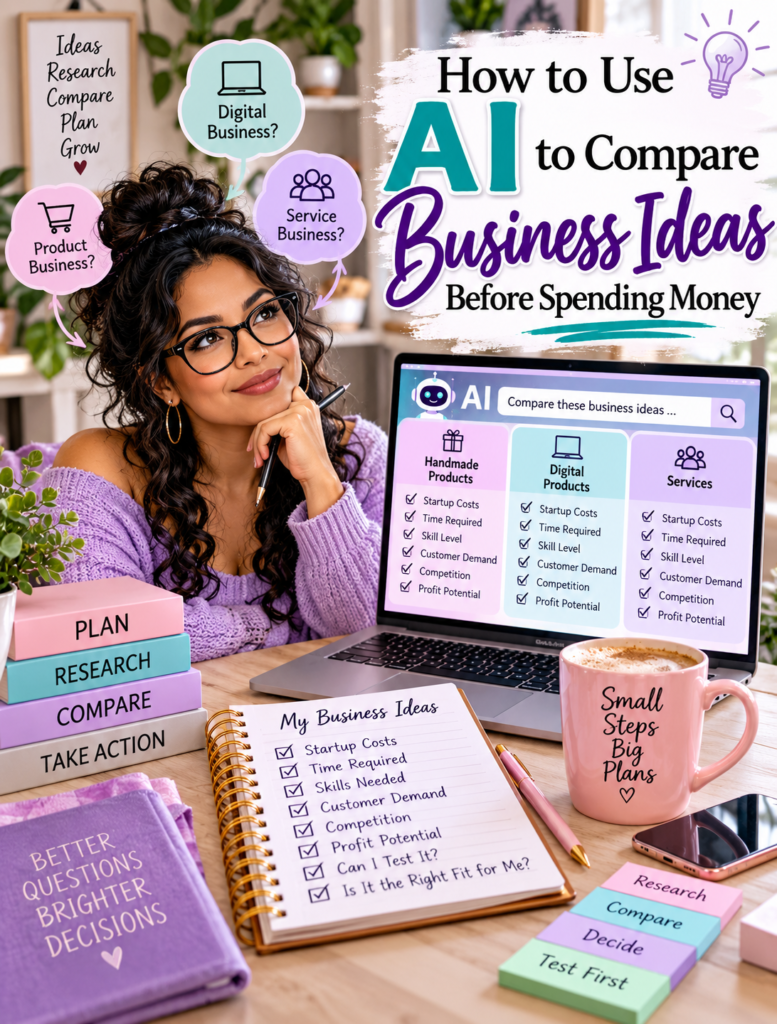
Create a Simple Business Comparison Scorecard
You do not need a complicated spreadsheet to compare ideas.
Give each idea a score from 1 to 5 based on the things that matter most to you. You can ask AI to help organize the scorecard, but the final scores should come from your research and your own situation.
| Area | Idea A | Idea B | Idea C |
| Affordable startup cost | |||
| Fits my current skills | |||
| Fits my available time | |||
| Repeat customer potential | |||
| Customer demand | |||
| Easy to test cheaply | |||
| Profit margin potential | |||
| Room to expand later | |||
| Licensing or regulation complexity | |||
| Do I actually want to do this? |
That last question belongs on the list.
A business can look strong financially and still be a terrible fit for the person running it. If the business requires work you already know you would hate doing every day, that matters just as much as startup cost and profit potential.
Example: Comparing Three Business Ideas
Let’s say someone has $300 available and is deciding between a melt-and-pour soap business, a beaded-accessories business, and a residential cleaning service.
The soap business may require molds, soap base, fragrance, packaging, labels, testing, and more attention to product claims and safety requirements. It may also offer good opportunities for gift sets and repeat customers if the products are well made.
The beaded-accessories business may have a lower startup cost and allow the owner to create bracelets, keychains, phone charms, bag charms, and other products using many of the same materials. The challenge may be standing out in a crowded market and making sure the time spent producing each item still leaves enough profit.
The cleaning service may require fewer product-development costs and could create recurring customers more quickly, but the work is physical, local, and heavily dependent on scheduling, reliability, transportation, and customer trust.
AI can help organize those differences, but it still cannot tell you which one will succeed.
What it can do is help you see what you need to research next.
Test the Idea Before You Build the Business
This may be the most important part of the entire process.
After you use AI to compare business ideas, do not assume the highest-scoring idea is automatically ready for a full launch. The next step should be finding the smallest responsible way to test it.
For a handmade product, that might mean making five instead of fifty. For a service, it could mean offering one clear package to a few customers before buying expensive software. For a digital product, it may mean creating one useful product before building an entire store.
The SBA recommends testing ideas with actual customers because customer behavior provides better evidence than assumptions alone. BSL makes the same point in its business-research guide: compliments are encouraging, but purchases, deposits, repeat customers, inquiries, and preorders provide much stronger evidence.
That is where research turns into real information.
Do Not Spend Money Just Because AI Says the Idea Looks Good
This is worth repeating.
AI can compare information, organize your research, help you think through scenarios, and point out possible risks. It cannot guarantee demand, profit, customer loyalty, or business success.
Before spending heavily, verify your costs, check the competition, look at customer behavior, and test the smallest version of the business that gives you useful feedback.
The goal is to reduce guessing.
Not eliminate uncertainty completely.
Use AI Without Sharing Sensitive Information
You also do not need to give AI your bank account numbers, passwords, customer names, tax records, contracts, or confidential business documents just to compare ideas.
General information is usually enough.
Instead of uploading a bank statement, say that you have approximately $500 available to invest. Instead of sharing customer records, describe the type of customer you are trying to reach.
You can still get a useful comparison without handing over information that has nothing to do with the question.
A Better Prompt for Comparing Business Ideas
You can use a prompt like this:
I am comparing three business ideas: [IDEA 1], [IDEA 2], and [IDEA 3]. I have approximately $___ available to start and ___ hours per week to work on the business. My current skills include ___. Compare these ideas based on startup cost, skills required, time commitment, likely customer, repeat-purchase potential, competition, risks, how cheaply I can test the idea, and what I should research before spending money. Do not choose the business for me. Give me questions I should answer before deciding.
The last part is important.
You are asking AI to help you think, not asking it to make the decision for you.
Sometimes the Best Result Is Eliminating an Idea
Using AI to compare business ideas does not always mean you end up with a clear winner.
Sometimes the biggest benefit is realizing that one of the ideas is not right for you right now.
Maybe one requires equipment that is outside your budget. Maybe another takes more time than you actually have. Maybe another involves regulations or risks you are not ready to handle.
That is useful information.
Eliminating a bad fit before you spend money is still progress.
Liz’s Note
One thing I see people do all the time is spend money because starting the business feels exciting.
They buy equipment, packaging, supplies, software, logos, and subscriptions before they have really answered the most basic questions. Who is going to buy this? What will it cost me to produce? How much time will it take? Can I test it cheaply? What happens if customers do not respond the way I expect?
I would rather see someone spend a week asking those questions before spending $1,000 trying to fix a rushed decision later.
That is where AI to compare business ideas can be helpful. Use it to organize your thoughts, challenge assumptions, compare options, and build your research list. Then step away from the screen and do the part AI cannot do for you.
Before spending money on a business idea, it helps to calculate your startup costs and research your market first. The U.S. Small Business Administration recommends doing both as part of the business planning process.
Talk to people. Look at real competitors. Check actual prices. Test the idea.
The computer can help you compare possibilities.
The customer still gets the final vote.
Frequently Asked Questions
Can AI tell me which business will make the most money?
AI can help compare business models and identify factors that may affect profitability, but it cannot reliably predict how much your business will earn. Your costs, pricing, customer demand, competition, location, marketing, and execution all affect the result.
How many business ideas should I compare?
Two or three is usually enough to make the comparison useful without turning the process into endless research. If you compare too many ideas at once, you may end up more confused than when you started.
Can AI research competitors for me?
AI can help you decide what information to collect and organize what you find. Current competitor prices, reviews, products, locations, and customer feedback should still be checked using current sources.
Should I spend money after AI gives an idea a high score?
No. A score should tell you what deserves more research, not what deserves your credit card. Verify the costs, test demand, talk to potential customers, and start with the smallest responsible version of the idea.
Should I use AI before writing a business plan?
Yes, it can help you brainstorm questions, organize information, compare options, and identify areas that need research. The final plan still needs to be based on verified information and real-world evidence.
Before You Spend the Money
The next time you get excited about a business idea, give yourself a little time before buying anything.
Use AI to compare business ideas against one or two other options. Look at startup cost, time, customer demand, competition, risk, and how easily you can test each idea without making a large investment.
You may still choose the idea you started with.
The difference is that now you will understand why you chose it.