
You make a product for $6 in materials and sell it for $20. At first glance, it looks like you made $14. Then you remember the packaging, payment-processing fee, supplies you used while making it, the vendor-event fee, the product that had to be remade, and the time it took you to create everything. Suddenly, that $14 does not look like $14 anymore.
This is one of the biggest problems beginners can run into with handmade product pricing. Many sellers calculate the obvious material cost, add an amount that feels reasonable, and call the difference profit. The problem is that a handmade business has costs hiding in places that are easy to overlook, especially when you are new.
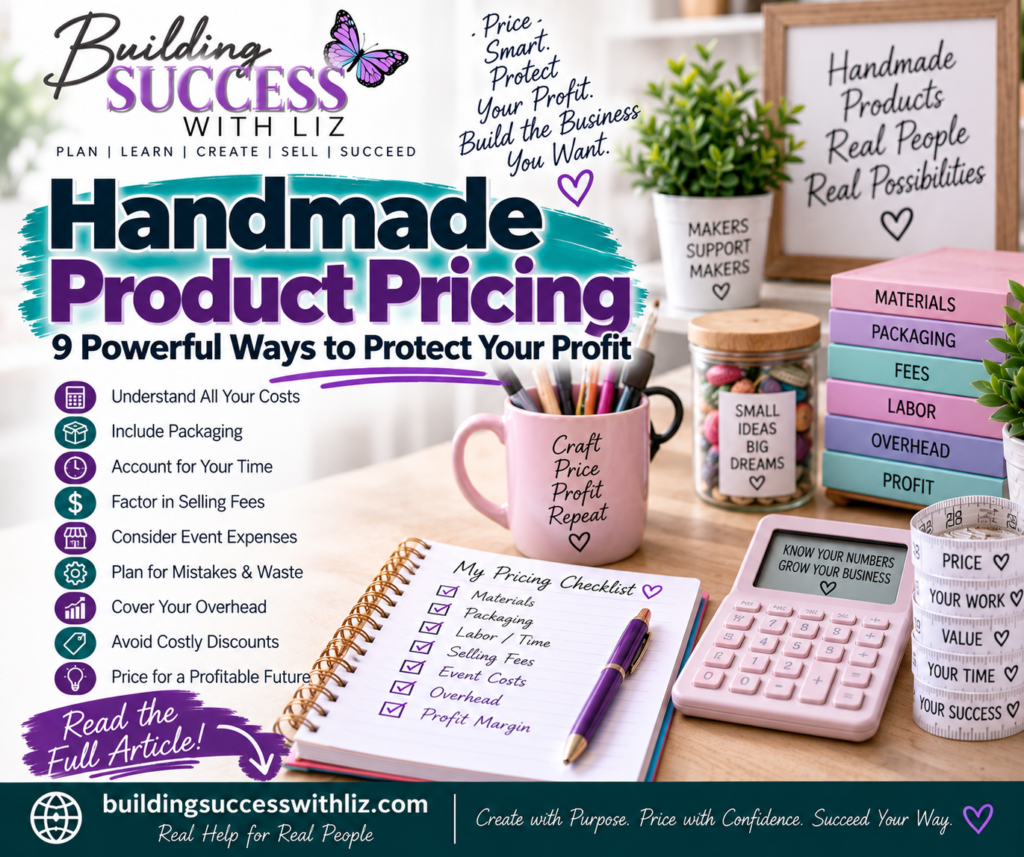
You do not need complicated accounting formulas to start understanding your numbers. You do need to stop looking only at what the blank, vinyl, paper, beads, wood, fabric, transfer, or other main material cost. If you want your business to survive, your price has to support more than the item sitting in the customer’s hand.
Why Handmade Product Pricing Is More Than Materials Plus Profit
The cost of making a product and the amount you charge for it are only the beginning of the pricing conversation. A business also spends money preparing products, packaging orders, reaching customers, attending events, processing payments, replacing supplies, maintaining equipment, and operating behind the scenes.
The IRS explains that businesses selling or producing goods may have costs that include materials and supplies, certain labor, freight-in, and manufacturing overhead when determining cost of goods sold. It also explains that gross profit is determined after subtracting cost of goods sold from net receipts. Review IRS Publication 334 for small businesses
That is why looking only at your most obvious material is not enough. Handmade product pricing needs to reflect what it actually costs you to put a finished product in front of a paying customer.
1. The Materials You Forget to Count
Most handmade sellers remember the big material. If you make a shirt, you remember the shirt blank and transfer. If you make a keychain, you remember the acrylic blank. If you make stationery, you remember the paper.
It is the smaller materials that quietly disappear from the calculation. Tape, adhesive, ink, laminate, ribbon, protective sheets, blades, backing cards, jump rings, clasps, tissue paper, labels, sealant, thread, transfer paper, printer ink, and similar supplies may only cost pennies or a few cents per product, but those pennies are still leaving your business.
Imagine that the smaller materials add only 60 cents to each item. If you sell 100 products, that is $60 you used but never included in your pricing. As sales increase, small forgotten costs become much larger numbers.
You do not have to measure every drop of glue. The goal is to create a reasonable system that accounts for the supplies you regularly consume instead of pretending they are free because you bought them months ago.
2. Packaging Is Part of the Product Cost
Packaging is another expense beginners commonly underestimate. A bag, box, tissue paper, backing card, thank-you card, sticker, label, protective sleeve, bubble mailer, or other packaging item may seem inexpensive when you look at each one separately.
Add them together and the number changes.
Suppose your product costs $5.50 to make and your packaging adds another $1.25. Your product did not cost $5.50 to prepare for the customer. It cost at least $6.75 before you even considered your time, payment fees, selling expenses, or overhead.
Packaging can absolutely improve the customer experience, but it still has to make financial sense. You do not need luxury packaging on a low-priced product simply because another seller on social media uses it.
BSL’s guide on finding your first customers discusses the importance of knowing your product cost, packaging cost, payment-processing fees, event expenses, labor, and minimum acceptable profit before discounting a product. Read How to Find Your First Customers Without Spending a Fortune
3. Your Time Cannot Always Be Free
This can be uncomfortable for new handmade sellers because many begin as hobbyists. When you were making something for yourself, spending 45 minutes creating it may not have mattered. Once you start selling, that time becomes part of operating the business.
Think beyond production time too. You may spend time answering customer questions, preparing personalized designs, printing labels, packaging orders, taking photographs, creating listings, purchasing supplies, preparing for events, setting up a booth, and handling messages after a sale.
You may not be able to pay yourself the hourly amount you eventually want from your first day in business. That is different from pretending your labor has no value at all.
Good handmade product pricing requires you to know approximately how much time a product takes to create. If one item takes ten minutes and another takes ninety minutes, they should not be treated as though labor is identical just because their material costs are similar.
4. Selling Fees Can Change the Profit
Where you sell matters.
An online marketplace may have listing, transaction, payment-processing, advertising, or other fees. A payment processor used at an in-person event may charge a transaction fee. A website may involve hosting, apps, subscriptions, payment processing, or other operating costs.
Those costs can change over time and vary by platform, which is why you should review the current fee schedule for wherever you actually sell instead of building permanent prices from an old screenshot or social-media video.
This is also why selling the same product in different places does not always produce the same profit. A $20 sale at a local event and a $20 online sale may have very different expenses attached to them.
BSL’s Sell guide explains that sellers have several options, including vendor markets, marketplaces, websites, and other sales channels. Choosing where you sell should include understanding what each option costs you, not only how many people might see your product. Explore the Building Success with Liz Sell guide
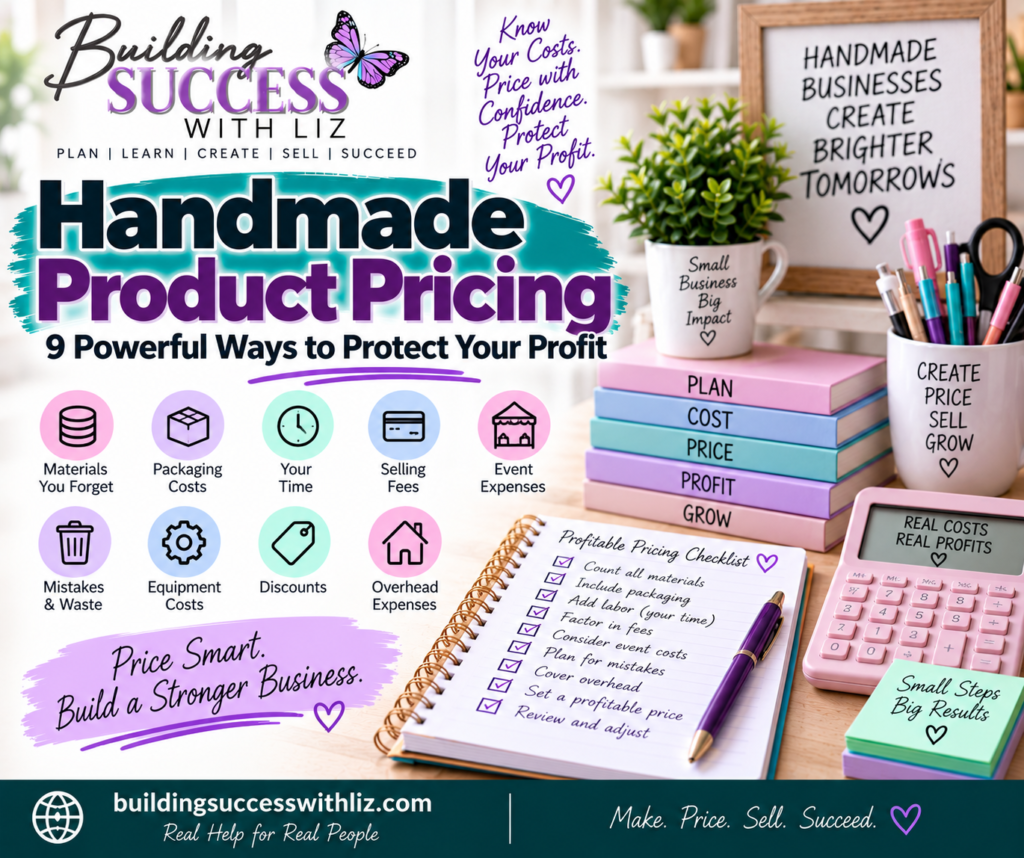
5. Vendor Fees Do Not Disappear After the Event
Vendor events create another pricing challenge because the event fee is paid before you know how many products you will sell.
Suppose you pay $100 to participate in an event. You also spend money on transportation, bags, payment processing, signs, displays, food, parking, or other event-related expenses. You cannot automatically place the entire $100 fee onto one product, but you also should not pretend the event was free.
This is where tracking your results becomes important. If you spend $150 participating in an event and sell $700 worth of products, that gives you information. If you spend the same $150 and sell $75, that tells you something very different.
This is also one reason vendors should research events instead of assuming that a full vendor list guarantees customers. Event organizers need to promote their events, and sellers should look at attendance history, location, audience, marketing, and previous results when deciding whether the fee makes sense.
Your booth does not have to be the most expensive booth at the event. Your numbers matter more than whether your setup looks like someone else’s social-media video.
6. Mistakes, Waste, and Test Products Cost Money Too
Not every material you purchase becomes a sellable product.
A transfer may apply incorrectly. A sheet of paper may print badly. A resin piece might cure incorrectly. You might cut something at the wrong size, make a spelling mistake, damage a blank, test a new design that does not work, or create a sample that never gets sold.
That is part of creating handmade products.
The problem begins when your handmade product pricing assumes that every dollar of materials will become perfect sellable inventory. Real production includes some level of waste, testing, mistakes, and replacement.
You do not need to punish customers for every mistake you have ever made, but your overall pricing needs enough breathing room that one damaged $3 blank does not erase the profit from several successful products.
A business with no room for mistakes has very little room to grow.
7. Equipment Has a Cost Even After You Buy It
Your printer, heat press, cutting machine, laser, sewing machine, binding equipment, computer, camera, or other tools may already be sitting in your workspace. That does not mean using them costs nothing.
Equipment wears down. Blades need replacing. Printers need ink. Machines need maintenance. Tools eventually break or need upgrading. Some equipment also uses electricity or requires additional supplies every time it operates.
You do not necessarily need to divide the purchase price of every machine down to a fraction of a penny for every product when you are just beginning. What you do need is an understanding that equipment replacement and maintenance are real business expenses.
This is one reason I encourage beginners not to buy every machine before they have customers. BSL’s guide about startup costs explains why it is important to separate what you truly need from purchases that can wait. Read How Much Money Do You Really Need to Start a Business?
The equipment should support the business. The business should not exist just to support the equipment payments.
8. Discounts Can Quietly Remove Your Profit
A customer asks for a discount. You are having a slow event, so you take $2 off. Then someone buys several products and you offer another deal. Later you run a sale online because everyone else seems to be running one.
Discounts can be useful, but only when you know what you are discounting.
If you sell an item for $20 and your true cost after materials, packaging, labor, fees, and other expenses leaves you with $5 of profit, a $5 discount does not mean you “still made $15.”
You may have just removed your entire profit.
This does not mean never offer a sale. It means know the lowest price you can reasonably accept before creating the promotion.
A discount should be a business decision, not a panic response because someone looked at your price and hesitated.
9. Overhead Still Exists Even When You Work From Home
Some expenses do not belong neatly to one product.
Website costs, software subscriptions, internet used for the business, insurance, advertising, office supplies, bookkeeping services, equipment maintenance, storage, signage, business registration, and other operating expenses may support the entire business rather than one particular item.
These are the kinds of costs that are easy to forget when calculating handmade product pricing.
The SBA’s break-even guidance explains that businesses should consider fixed and variable costs when estimating how much they need to sell. Contribution margin reflects the difference between the selling price and variable cost, while fixed expenses still have to be covered by the business overall. Review SBA business planning and break-even guidance
You do not need to panic and add ten dollars to every product because you pay for a website. What you need is a pricing system where the business as a whole generates enough margin to pay its operating expenses and still leave something behind.
Revenue Is Not Profit
This is one of the most important things I want beginners to understand.
If you attend an event and sell $800 worth of products, you did not automatically make $800. That $800 is sales revenue. You still have to account for the products you sold, packaging, fees, event costs, and other business expenses before you know what the business actually earned.
The IRS similarly distinguishes business receipts from cost of goods sold when determining gross profit for businesses selling products.
This difference matters because social media often celebrates revenue numbers without showing what it cost to produce those numbers. Someone saying, “I made $2,000 this weekend,” does not tell you whether $1,200 of expenses were required to generate those sales.
Your business cannot pay bills with impressive revenue screenshots if the profit is not there.
A Simple Way to Review Your Handmade Product Pricing
You do not have to make this complicated. Start by choosing one product you currently sell and write down every reasonable cost associated with getting that item into a customer’s hands.
Begin with the main materials and add smaller supplies, packaging, selling fees, and the approximate time required to make the product. Then think about the business expenses that are not tied to one item but still have to be covered by your overall sales.
Once you see the full picture, compare that number with your selling price. Ask yourself whether enough remains to make the product worth continuing.
If the answer surprises you, that does not mean you failed. It means you finally have information you can use.
You may decide to raise the price, reduce unnecessary packaging, buy materials more efficiently, redesign the product, create it faster, change suppliers, stop selling it, or keep it because it brings customers who later purchase more profitable products.
Those are business decisions based on numbers rather than guesses.
Do Not Price Handmade Products Against Walmart or Temu
This is another struggle handmade sellers face.
A shopper may compare your handcrafted product to something mass-produced by a major retailer or imported in enormous quantities. That comparison does not mean you should immediately lower your price.
A small maker is not purchasing millions of pieces, operating massive factories, or negotiating the same supply costs as an international corporation. Your business has different economics.
This does not mean customers are required to pay whatever you ask. Your product still has to provide enough value for the right customer. But trying to match mass-production prices can create a business where you work constantly and still do not make enough money.
Focus on the value your customer actually receives, whether that is personalization, craftsmanship, convenience, local availability, unique design, quality, customer service, or something they cannot easily get from a mass-produced item.
Then allow the customer to decide whether that value is worth the price.
Liz’s Note
I see beginners worry so much about whether customers will say their prices are too high that they sometimes forget to ask whether the price is high enough for the business to survive.
You cannot build a healthy business by being afraid to make money.
That does not mean charging ridiculous prices. It means understanding what the product costs you, knowing what the customer receives, researching the market, and choosing a price that makes sense for both sides.
And please do not compare the beginning of your handmade business to a large retailer or even to a creator who has been selling for ten years. Their supply costs, equipment, buying volume, customer base, and production system may look completely different from yours.
Start with your numbers.
If the numbers do not work, fix the numbers before trying to make up the difference by working harder.
Working harder on an unprofitable product just helps you lose money faster.
Frequently Asked Questions
How do I calculate a price for a handmade product?
Start with the direct cost of materials and supplies used to create the product, then consider packaging, labor or production time, selling fees, and other appropriate business expenses. You should also research comparable products and what your target customer is willing to pay rather than choosing a price using costs alone.
Should labor be included in handmade product pricing?
Your production time matters because your time is one of the resources required to create the product. How you calculate and compensate labor will depend on your business, but assuming your time is permanently worth zero can make it difficult to determine whether a product is truly profitable.
Should packaging be included in my product cost?
Packaging should be accounted for somewhere in your pricing and business expenses because your business pays for it. Even inexpensive bags, cards, labels, tissue paper, and protective packaging can become a significant expense as sales increase.
What if customers say my handmade product is too expensive?
Not every customer is your customer. Review your costs, comparable products, quality, presentation, target audience, and value before automatically lowering the price. Sometimes a pricing problem exists, but sometimes you are simply presenting the product to someone who is shopping primarily for the lowest possible price.
Is revenue the same as profit?
No. Sales revenue is the money collected from sales. Profit requires accounting for the costs associated with producing and operating the business. A high sales total does not automatically mean the business earned a high profit.
Take One Product and Check the Numbers Today
You do not have to reprice your entire shop tonight.
Choose one product.
Look at your handmade product pricing honestly. Calculate the materials, smaller supplies, packaging, fees, time, and other costs you may have ignored when you originally chose the price.
Then ask one simple question: If I sell more of this product, am I actually helping my business make money?
That question matters more than likes, views, compliments, or how busy your order table looks.
Now I want to hear from the handmade sellers reading this. What expense surprised you the most after you started selling? Was it packaging, vendor fees, supplies, marketplace fees, equipment, or something else?
Share your experience in the comments. Your answer may help another beginner catch a cost before it becomes an expensive lesson.
If you are still building your product collection, continue with the BSL Create guide to learn how to turn your skills and ideas into products people can actually buy. Explore Create Products to Sell on Building Success with Liz