
If you have $1,000 available to start a business, it can feel like you finally have enough money to do something serious. That can be exciting, but it can also lead to spending too much before you know whether customers actually want what you plan to sell. Some of the smartest business ideas under $1,000 begin by using only part of the available money, testing the idea with real customers, and keeping the rest of the budget untouched until the business shows you what it truly needs.
A $1,000 budget can give a beginner more flexibility than starting with $100 or $500. You may be able to purchase basic equipment, create a stronger product collection, prepare for a vendor event, improve product photography, or buy supplies that allow you to deliver a professional service. The goal, however, should not be to build the biggest business that $1,000 can buy. The better goal is to build the smallest version of the business that can prove people are willing to pay for it.
Before You Spend $1,000 on a Business
Before choosing from a list of business ideas under $1,000, separate what your business actually needs from what would simply be nice to have. A new machine, premium packaging, custom shelving, expensive software, and large amounts of inventory can all look useful when you are excited about starting, but they are not automatically necessary for your first sale.
The U.S. Small Business Administration recommends calculating startup costs before launching because expenses can include equipment, supplies, licenses, permits, insurance, inventory, marketing, websites, and other costs depending on the business. Understanding those expenses also helps you begin thinking about profitability and when you may eventually recover your startup investment. Review the SBA’s startup-cost guidance.
It is surprisingly easy for $1,000 to disappear. A $300 machine, $200 in inventory, $150 in packaging, a few software subscriptions, and some advertising can consume most of the budget before one customer has purchased anything. That is why research should come before shopping.
Before investing heavily, take time to find out whether people are already buying similar products or services and what customers still need. BSL’s guide, 7 Smart Ways to Research Whether Your Business Idea Will Sell, walks beginners through practical ways to study demand before putting too much money into an idea.
1. Build a Focused Handmade Product Business
A $1,000 budget can give a handmade seller enough room to create a thoughtful product collection without trying to fill an entire store. Depending on your existing skills and equipment, you might consider personalized gifts, stationery, home décor, accessories, keepsakes, seasonal products, apparel, or another product category you already understand.
The important part is staying focused. Instead of spending $900 creating twenty unrelated products, you might spend $300 or $400 creating three or four products that appeal to the same type of customer. That gives you enough variety to test without tying up nearly all of your money in inventory.
For example, someone creating gift products might launch with a coordinated group of keychains, bookmarks, ornaments, and greeting cards instead of adding tumblers, shirts, planners, tote bags, candles, and everything else at the same time. Once customers begin buying, their choices can help you decide what deserves more inventory and what should be discontinued.
Starting smaller also leaves money available for the things you cannot predict in advance. You may discover that one product sells much better than the others, that customers prefer a different size, or that your original packaging does not work as well as expected. Keeping part of the budget available allows you to respond to real customer behavior rather than spending everything based on guesses.
2. Create a Small Vendor-Market Business
Vendor markets can be a good way for product sellers to reach customers face-to-face, and a budget under $1,000 can be enough to create a basic setup. You may need a table, table covering, signs, simple displays, packaging, payment supplies, event fees, and enough inventory to give customers a reasonable selection.
Where beginners can get into trouble is trying to create the booth they see established sellers using online. Your first setup does not need expensive shelving, custom walls, elaborate lighting, or hundreds of dollars in décor. Customers need to understand what you sell, see the prices clearly, move around the booth comfortably, and purchase the product without confusion.
Researching the event matters just as much as preparing the booth. A sold-out vendor list does not automatically mean hundreds of shoppers will attend. Look at how the organizer promotes the event, whether the event has an established audience, what previous vendors have said, where the event is located, and whether the people attending are likely to buy what you sell.
If vendor markets are part of your plan, BSL’s Sell guide can help you compare in-person selling with websites, marketplaces, social media, and other ways to reach customers. The goal is not to be everywhere at once. It is to find the selling methods that make sense for your products and your available time.
3. Start a Personalized Apparel or Gift Business
Personalized apparel and gift products can fit within business ideas under $1,000, especially if you already own some of the equipment required. Shirts, tote bags, mugs, ornaments, keepsakes, and other personalized items can all create opportunities, but the business should begin with the product and the customer rather than the machine.
Beginners sometimes buy equipment first because they saw another creator using it and then try to figure out what to make afterward. That can turn a business budget into an equipment collection very quickly. A better approach is to decide what you want to sell, calculate what it costs to produce, research customer demand, and then determine whether buying equipment or outsourcing part of the process makes more financial sense.
Outsourcing can be especially useful when you are testing demand. If purchasing printed transfers, finished components, or certain production services allows you to sell the product without making a large equipment investment, you can learn what customers want before buying another machine.
There is nothing wrong with eventually bringing more production in-house. The difference is that the purchase should solve a real business need. A machine that helps you fill consistent orders is an investment. A machine purchased because everyone else seems to own one can become an expensive decoration.
4. Build a Mobile Service Business
Service businesses are some of the strongest business ideas under $1,000 because they often require less inventory. Instead of buying products and hoping customers purchase them later, you are primarily selling your time, skills, experience, or labor.
Possible services include home organization, basic cleaning, yard cleanup, pet care, errand assistance, event setup, administrative support, or technology help for beginners. Your startup money might go toward essential supplies, protective equipment, transportation needs, simple marketing materials, or any registration, insurance, or licensing requirements that apply to the specific service.
The strongest way to start is usually with one clearly defined offer. “I help people organize their homes” is very broad, while “I offer two-hour pantry organization sessions” tells the customer exactly what they can hire you to do. The same applies to technology services. “I help with computers” is vague, while “I help beginners organize digital photos and learn basic smartphone features” solves a recognizable problem.
A specific service also makes it easier to learn your costs and determine how long the work actually takes. Once you know that, you can improve your pricing and decide whether additional services make sense.
5. Start a Stationery, Planner, or Savings-Product Business
A $1,000 budget can also support a small stationery or organizational-product business. Depending on your skills and equipment, you might create planners, savings challenges, budget binders, notebooks, journals, notepads, bookmarks, business trackers, or other products designed to help people stay organized.
One advantage of this type of business is the ability to combine physical and digital products for the same customer. Someone who purchases a physical savings binder may also want printable savings trackers. A customer purchasing a business planner may also need inventory sheets, expense forms, vendor checklists, or goal-setting pages.
The important question is not, “What else can I make?” It is, “What else does this same customer genuinely need?” That keeps the business focused on solving related problems instead of filling a shop with unrelated products.
This also makes marketing easier. When several products serve the same audience, your content, product photography, listings, and promotions can speak to a much clearer customer rather than trying to attract everyone.
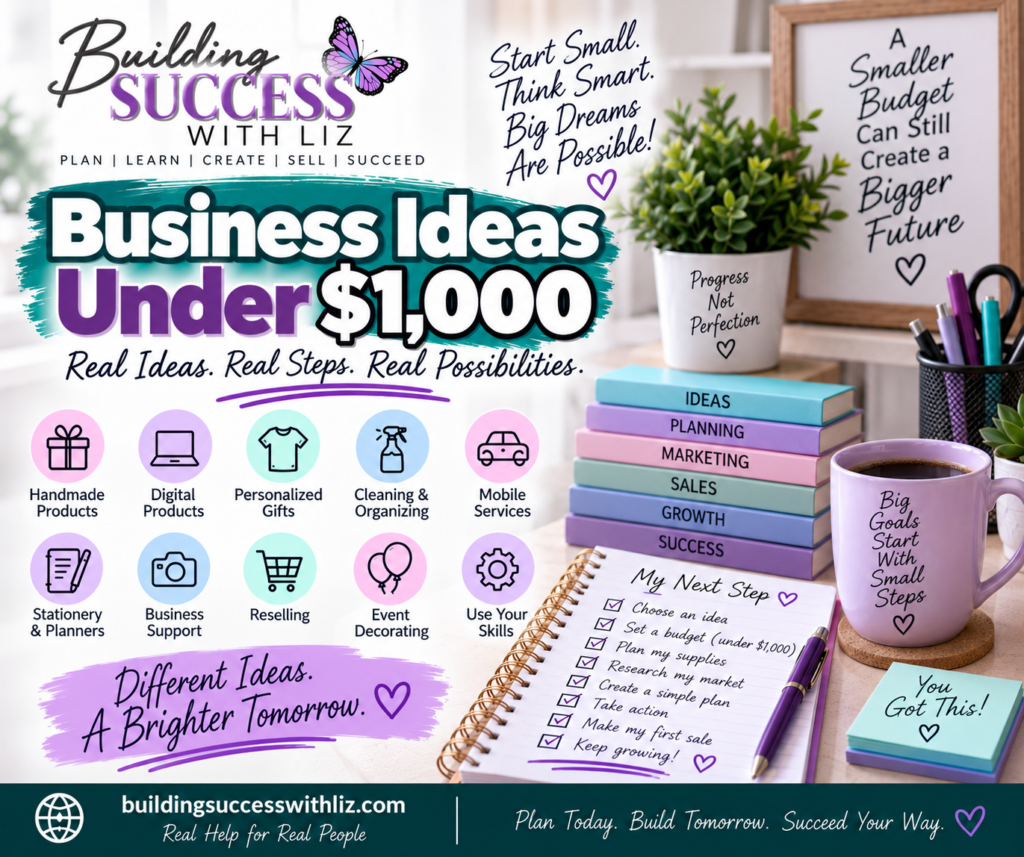
6. Create a Small Digital Product Business
Digital products can be started for far less than $1,000, which is part of what makes them attractive. You might create planners, templates, worksheets, checklists, educational resources, budgeting tools, business forms, event printables, organizational systems, or other downloads that solve a specific problem.
You may spend a small amount on design tools, properly licensed graphics or fonts, marketplace fees, mockup resources, or other necessary expenses. The remaining startup budget can stay available instead of being tied up in physical inventory.
However, digital products should not be treated as effortless income. A useful file still needs research, good design, accurate instructions, strong mockups, a clear listing, customer service, and marketing. Uploading fifty products that nobody needs does not create a stronger business than carefully creating five products that solve real problems.
Research what customers are asking for and pay close attention to reviews of similar products. Complaints can sometimes reveal opportunities that product titles alone will never show you.
7. Offer Support Services to Other Small Businesses
Many small-business owners need help with tasks but are not ready to hire a full-time employee. That creates opportunities for someone who can solve one specific business problem reliably.
You might help with product photography, menus, price sheets, spreadsheets, inventory organization, basic business documents, product listings, vendor-event preparation, customer lists, or simple administrative work. If you already own a computer and smartphone, you may need very little of your $1,000 budget to begin.
Instead of purchasing several software subscriptions immediately, create a few strong samples that show exactly what you can do. A local business owner is much more likely to understand “I create organized price sheets and menus for small food businesses” than a vague offer saying you provide “business support.”
Your first clients also do not have to come from expensive advertising. Referrals, networking, local events, community connections, and direct conversations can all help you find early customers. BSL’s How to Find Your First Customers Without Spending a Fortune gives beginners several practical ways to start reaching people without creating a large advertising budget.
8. Start a Small Resale Business Carefully
Reselling can fit within a $1,000 startup budget, but inventory can consume that money faster than almost anything else. A product appearing inexpensive does not automatically mean it will produce a profit.
Before purchasing inventory, research what similar items have actually sold for whenever that information is available. Asking prices tell you what sellers hope to receive. Completed sales give you much better information about what buyers may actually pay.
You also need to think about marketplace fees, shipping, packaging, transportation, storage, returns, damaged products, and the amount of time your money could remain tied up in inventory. Having $700 worth of merchandise sitting in a room does not mean you have a profitable business.
A safer approach is to test with a smaller portion of the budget. If $150 or $200 worth of carefully chosen inventory sells consistently, you now have information that can guide your next purchase. If it does not sell, most of your original budget is still available.
9. Build Around a Skill You Already Have
Some of the best business ideas under $1,000 may require nowhere near $1,000 because you already own the most valuable part of the business: your knowledge and experience.
Think about what people regularly ask you to help them with. Maybe you know how to sew, organize paperwork, create spreadsheets, prepare decorations, tutor students, use certain technology, photograph products, help at vendor events, design invitations, or perform another skill that solves a real problem.
Write down several things you already know how to do, and then look at that list from the customer’s perspective. Which of those skills solves a problem that people already pay someone else to handle?
Starting with an existing skill can dramatically reduce the amount of money required. Instead of spending $1,000 learning a completely new business, you may be able to spend $100 or $200 packaging, promoting, and improving something you already do well.
A $1,000 Budget Is Not a $1,000 Shopping List
One of the biggest lessons in this entire series is that your available budget is not your required spending amount. If you can responsibly test your idea for $450, there is nothing wrong with keeping the remaining $550.
For example, you might spend $200 on essential equipment, $125 on initial materials, $50 on packaging, $50 on business materials, and $75 on a carefully researched selling opportunity. That would use $500 while leaving another $500 available.
That reserve gives you options. Maybe a particular product sells faster than expected and you need more materials. Maybe customers ask for something you did not originally plan to offer. Maybe you discover that your packaging needs to change, or perhaps you decide that the idea is not performing well enough to deserve another investment.
Money you have not spent can still help your business. Sometimes keeping it is one of the smartest decisions you can make.
Understand Your Break-Even Point
Once you begin investing several hundred dollars, you should have some idea of how many sales are required to recover that investment. The SBA describes the break-even point as the point where total costs and total revenue are equal, and its guidance explains how fixed and variable costs affect that calculation. Review the SBA’s break-even guidance.
You do not need advanced accounting knowledge to understand the basic idea. If you spend $600 starting a business and earn $10 in actual profit from each product, you need many sales before recovering that initial investment.
This is also why selling price and profit are not the same thing. If a product sells for $30, you did not automatically make $30. Materials, packaging, transaction fees, event fees, shipping supplies, advertising, and other expenses may all reduce what remains.
Understanding that difference early can prevent you from celebrating sales while the business is quietly losing money.
Track Every Dollar From the Beginning
The more money you invest, the more important recordkeeping becomes. The IRS explains that good records help businesses monitor progress, identify income sources, track expenses, prepare financial statements, and support information reported on tax returns. Read the IRS guidance on business recordkeeping.
You do not necessarily need expensive bookkeeping software on your first day. You do need a system that allows you to see what is coming in and what is going out.
Record the $28 supply purchase. Record the $75 vendor fee. Record the $45 sale. Record the $16 packaging order. Individually, those amounts may seem small, but together they tell you whether the business is actually becoming profitable.
Do Not Build Your Business for Social Media
Social media can make beginners feel behind before they even begin. You see someone with a beautiful workroom, another person with expensive equipment, someone else with an elaborate vendor booth, and another seller showing shelves filled with inventory.
What you cannot see is the full financial picture behind those videos and photographs. You do not know how long the business has existed, whether the equipment was purchased gradually, whether the seller has debt, or whether the business is actually profitable.
Your first $1,000 should not be used trying to look like someone else’s established business. It should help you deliver a product or service that customers believe is worth paying for.
A customer will remember whether your product was useful, your service was professional, your order was accurate, and you treated them well. They are unlikely to care whether your craft room looked like something from a YouTube studio tour.
Liz’s Note
If I gave a beginner $1,000 today, I would not tell them to go shopping for a business. I would tell them to protect that money and spend only enough to properly test the idea with real customers.
One of the biggest mistakes beginners can make is trying to purchase the appearance of an established business before they have established customers. Your first table does not need to be your forever booth, your first packaging does not need to be your forever packaging, and your first machine does not need to be the most expensive machine available.
Start with what allows you to do the job properly. Pay attention to what customers actually buy rather than what people simply compliment. Then let sales help pay for the next level of the business.
That is a much healthier way to grow.
Frequently Asked Questions
Can you really start a business for less than $1,000?
Yes. Some businesses can be started or tested for less than $1,000, particularly service businesses, digital products, small handmade collections, and businesses where you already own some of the necessary equipment. Other businesses may require considerably more because of equipment, facilities, licensing, insurance, inventory, or regulations.
What are good business ideas under $1,000 for beginners?
The best choice depends on your skills, customer demand, available time, existing equipment, and local requirements. Service businesses, digital products, stationery, small handmade collections, personalized gifts, local business support, and carefully researched resale businesses are examples worth exploring.
Should I spend the entire $1,000?
No. Treat $1,000 as your maximum budget, not a spending goal. If you can responsibly test the business for $300 or $500, keeping the remaining money gives you flexibility when you learn more from actual customers.
What should I buy first?
Prioritize whatever is necessary to legally, safely, and professionally deliver the product or service. Essential equipment, supplies, licensing, insurance, or materials should usually come before decorative upgrades and optional equipment.
How do I know when it is time to invest more?
Look for real evidence such as paying customers, repeat purchases, profitable pricing, consistent inquiries, customer requests, and a clear need for additional capacity. Those signals are much stronger than social-media trends or the feeling that your setup needs to look more professional.
Which Business Could You Start With Less Than $1,000?
There are many business ideas under $1,000, but the purpose of this series is not to convince you that you must have $100, $500, or $1,000 before you can begin. Different businesses have different startup costs, and sometimes the smartest business is the one that allows you to begin for far less than you expected.
What matters most is knowing what you are selling, who needs it, what it truly costs to deliver, and how little you can responsibly spend to test whether customers will pay for it.
So here is today’s question: If you had $1,000 available to start a business, how much would you actually spend before making your first sale? Would you spend $250, $500, the full $1,000, or as little as possible?
Share your answer in the comments and tell us what you would start. Someone reading may have the same skill or idea and simply need to see that they do not have to spend everything before beginning.
When you are ready to move from the idea to finding buyers, continue with the Building Success with Liz Sell guide.