
Getting your first paying customer is a big moment. Someone who was not simply cheering you on decided that what you were selling was worth their money. Whether you sold a handmade product, booked your first service, downloaded your first digital product, or received your first online order, that sale gave you something more valuable than a little revenue. It gave you evidence that a real customer was willing to buy.
Now comes the part many new business owners are not prepared for: how do you get more customers after your first sale? It is easy to spend so much time trying to make sale number one that you have no plan for what happens afterward. You celebrate the order, package it beautifully or complete the service, and then return to social media hoping another customer somehow appears.
That means you are starting from zero every time.
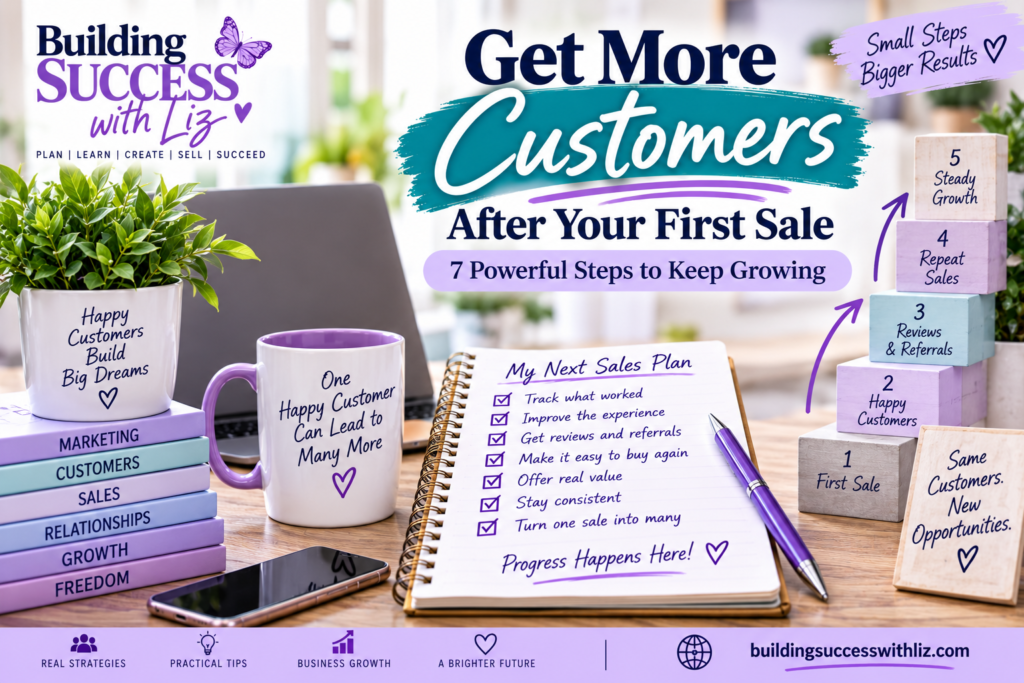
You do not want to build a business where every sale feels like finding customer number one all over again. Your next goal is to study what worked, improve what did not, and create a simple process that can help one customer lead to customers two, three, four, and five.
If you have not made your first sale yet, start with our guide, How to Find Your First Customers Without Spending a Fortune. That article focuses on finding those early buyers without immediately throwing money at advertising. This guide starts after that first customer says yes.
Step 1: Find Out Exactly Where Your First Customer Came From
Before you rush off looking for customer number two, stop and investigate customer number one.
How did that person find you?
Maybe they saw your product at a vendor event. Perhaps someone handed them your business card. They may have found you through Etsy, Google, Facebook, Instagram, a referral, an email, a community group, or simply because they met you somewhere and remembered what you sold.
This matters because your first sale contains marketing information.
Imagine that you have been posting on Instagram every day because you believe Instagram is where your customers are. Then your first five customers all tell you they discovered you at local events or through referrals. That does not necessarily mean you should abandon Instagram, but it should make you question where your marketing time is producing actual results.
Start tracking the source of every sale from the beginning. You do not need complicated software. A spreadsheet or notebook can work when the business is small. Record the customer, date, product or service purchased, amount spent, and how they found you.
As your sales grow, patterns may begin to appear.
Those patterns can tell you where to put more effort and where you may be wasting time.
Step 2: Learn Why They Chose You
Knowing where a customer came from tells you how they discovered the business. Knowing why they bought it tells you something even more valuable.
Do not assume you already know.
A handmade seller may think a customer bought because of the design when the customer actually loved the personalization. A cleaner may believe price won the job when the customer actually cared most about weekend availability. A digital-product creator may think people want a huge planner when customers are really buying because one particular page solves a frustrating problem.
After the customer receives what they purchased, ask a few simple questions when appropriate. You might ask what made them choose the product, what they liked most, or whether there was anything that almost stopped them from ordering.
This should not feel like an interrogation. You are listening for clues.
Customer language is particularly useful. Pay attention to the words people use when explaining why they bought. Those words can help you write clearer product descriptions, website copy, social-media posts, and future offers because you are learning how customers describe the value, not just how you describe it.
The SBA recommends that businesses use market research to understand customers, demand, competition, and other market conditions. That research does not stop once you launch. Your actual customers become another important source of information as your business grows.
You can review the SBA’s free market research and business-planning guidance here:
https://www.sba.gov/business-guide/plan-your-business/market-research-competitive-analysis
Step 3: Make the Second Purchase Easier Than the First
Think about everything your first customer had to do before buying.
Could they immediately find the price? Did they understand what was included? Was the ordering process simple? Did they know how long production or delivery would take? Did they have to message you several times before figuring out how to pay?
Every unnecessary obstacle gives a customer another opportunity to leave.
If you want to get more customers after your first sale, use that first transaction as a test of your buying process. Fix confusing instructions, missing prices, broken links, difficult navigation, unclear shipping information, or anything else that created unnecessary work for the customer.
This applies offline too.
At a vendor event, shoppers should be able to understand what you sell and how much it costs without asking you the price of every item. If you accept multiple payment methods, make that clear. If an item can be personalized, explain how the customer orders it.
A beautiful booth or website is nice.
A business that is easy to buy from is better.
This is also why I don’t recommend that beginners delay selling for months trying to create the “perfect” setup they see online. You need enough professionalism for customers to trust you, but real customer transactions will reveal improvements you could never have discovered by endlessly preparing.
Step 4: Give Customer Number One a Reason to Remember You
A sale should not necessarily be the end of your relationship with the customer.
Think about what happens after the transaction.
Does the customer receive a thank-you message? Is your business name easy to remember? Does your packaging include information about where they can find you again? If they bought from you at an event, do they have a card or QR code that leads to the correct website or social page?
These small details matter because people forget.
Someone may absolutely love what they bought from you and six months later be unable to remember your business name.
That is a lost opportunity.
You do not need to bombard customers with marketing. The goal is simply to make it easy for a satisfied customer to find you again.
If email marketing makes sense for your business, build your list properly and obtain permission rather than automatically adding customers to promotional emails. If your business relies more heavily on local sales, make sure your packaging, receipts, inserts, business cards, or thank-you materials make your business easy to find.
The first transaction introduces the customer to your business. What happens afterward can determine whether they ever return.
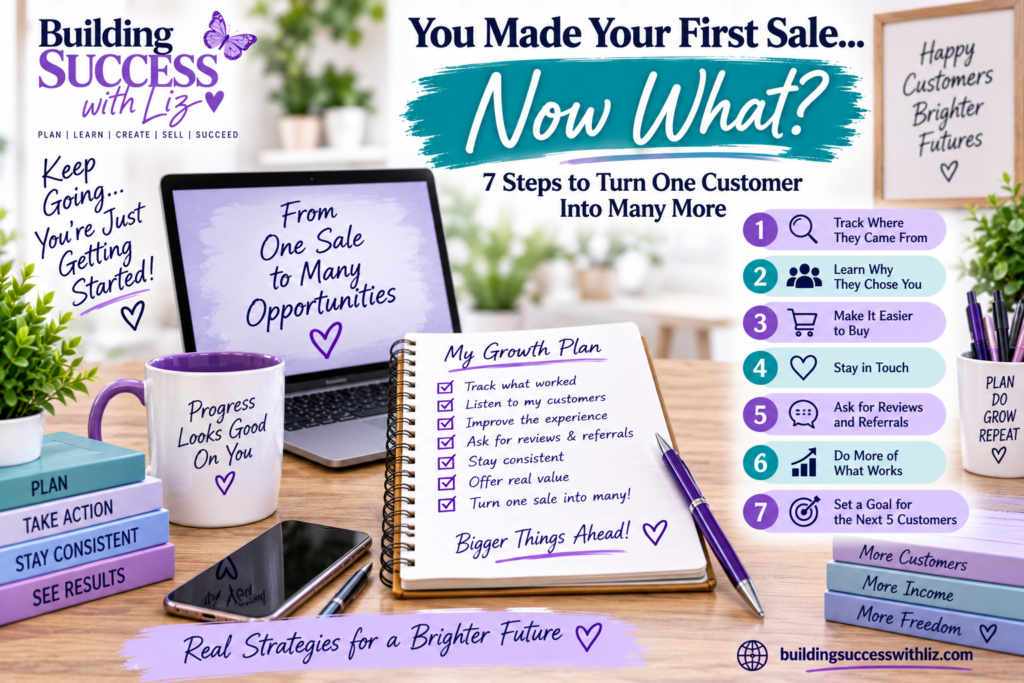
Step 5: Ask Happy Customers for Reviews and Referrals
One of the hardest things about being brand new is that nobody knows whether they can trust you.
Customer number one can begin changing that.
Once you have delivered what you promised and the customer is satisfied, ask for an honest review. You are not asking them to write a fake five-star review or exaggerate their experience. You are asking a real customer to share what it was like doing business with you.
That review gives the next potential customer something you could never write about yourself: independent proof that someone trusted your business and received what was promised.
Referrals can be equally powerful.
A customer who loves your work may know someone else who needs it. That does not mean you should aggressively pressure every buyer to send you five friends. A simple, polite request is enough.
For example, a service provider might say, “I’m glad you’re happy with the finished project. If you know someone else who could use this kind of help, I’d appreciate you passing along my information.”
That feels very different from begging for another sale.
The Federal Trade Commission also has rules and guidance concerning reviews and endorsements. As your business grows, learn what is allowed rather than offering incentives or manipulating reviews without understanding the requirements. You can read the FTC’s official guidance on reviews and endorsements here:
https://www.ftc.gov/business-guidance/advertising-marketing/endorsements-influencers-reviews
Step 6: Don’t Respond to One Sale by Making 20 New Products
Creative business owners, this one is especially for us.
One product sells and immediately our brain says:
MAKE MORE THINGS.
That is not always the answer.
Suppose you take a handmade product to an event and sell 12 of one design while several other products barely move. Before rushing home to create five entirely new product categories, investigate why that particular product sold.
Was it the price? The design? The usefulness? The size? Personalization? The season? Where was it displayed? Was it an impulse purchase? Did customers buy it as a gift?
That information can help you make a smarter decision about what to produce next.
The same principle applies to digital products and services. If customers consistently choose one service package, you may not need six additional packages yet. If one printable solves a specific problem and begins selling, consider whether customers need complementary products before creating something completely unrelated.
Growth does not always mean more different things.
Sometimes growth means doing more of what customers have already shown you they want.
If you are still deciding what type of offer makes sense for your business, our Physical Products, Digital Products, or Services: Which One Should You Start With? A guide can help you compare the options before expanding in too many directions.
Step 7: Create a Simple Plan to Reach Customers #2 Through #5
Now we get to the real goal.
You are not trying to find 10,000 customers this week.
You are trying to figure out whether the process that produced customer number one can produce another customer.
Look at what you learned from the first transaction and create a small experiment.
If the customer came from a vendor event, research another appropriate event instead of signing up for every market you see. If they came through a referral, make sure future customers know referrals are welcome. If they found you through Google, learn what search led them there. If an Etsy listing produced the sale, study which search terms, photographs, product details, or other factors may have helped.
Then set a manageable goal:
Find customers #2 through #5.
This changes the way you think about growth. Instead of asking, “How do I make thousands of dollars?” you are asking, “Can I repeat what worked?”
If you can repeat it, you are beginning to build a system.
If you cannot, you have another round of information to study.
Either way, you are learning.
Your First Five Customers Can Become a Mini Business Study
Once you reach five customers, sit down and compare them.
Where did each one come from? What did they buy? What questions did they ask? What objections did they have? Did any return? Did anyone refer another customer? Which product or service generated the best profit rather than simply the highest sale price?
Now your decisions can begin moving away from assumptions.
This is especially important when money is tight. A beginner may not have hundreds or thousands of dollars available to test advertising campaigns, inventory, equipment, subscriptions, and new products. Information from actual customers helps you decide where limited money should go.
SCORE offers free mentoring to small-business owners and entrepreneurs who need help working through marketing, sales, business planning, and growth decisions. Before assuming you need an expensive business coach or marketing course, you can explore free SCORE mentoring here:
https://www.score.org/find-mentor
You can also use the SBA’s free local assistance network to locate Small Business Development Centers, Women’s Business Centers, SCORE mentors, and other business resources:
https://www.sba.gov/local-assistance
Don’t Confuse Revenue With Proof That Everything Is Working
There is another lesson I want beginners to understand early.
A sale is exciting.
A profitable sale is better.
Suppose you sell a handmade product for $20. That does not mean you made $20. Materials, packaging, selling fees, transaction fees, equipment, event expenses, advertising, shipping supplies, waste, and your time can all affect what remains.
The same applies to services. A $300 job that takes 20 hours and creates $100 in expenses tells a different story from a $300 job completed efficiently with minimal expenses.
As you get more customers after your first sale, begin tracking the money behind those sales. You are not only trying to prove that people will buy. Eventually you need to prove that the business can make enough money after expenses to be worth continuing.
That is when customer growth becomes business growth.
Liz Note: Don’t Start From Zero After Every Sale
I think new business owners sometimes put so much emotional energy into getting that first customer that once the sale finally happens, they feel like the mission is complete.
Celebrate it. You earned that moment.
Then pay attention.
That customer just gave you information about your business that you did not have before. They showed you how someone found you, what caught their attention, what they were willing to pay for, what questions they had, and what the buying experience was actually like.
Don’t throw that information away and start from zero looking for the next stranger.
Learn from customer number one.
Improve for customer number two.
Listen to customer number three.
Track customer number four.
By customer number five, you should know more about your business than you did when you launched.
That is progress.
Not perfection. Progress.
Frequently Asked Questions About Getting More Customers After Your First Sale
How do I get more customers after my first sale?
Start by identifying exactly how the first customer found you and why they chose your offer. Then improve the buying process, ask satisfied customers for honest reviews and appropriate referrals, and repeat the marketing activities that produced real customer interest. The goal is to turn one successful transaction into information you can use again.
Should I offer my first customer a discount to come back?
You can use promotions strategically, but repeat business should not always depend on discounts. Consider whether the customer naturally needs the product or service again, whether you have a complementary offer, and whether good service alone gives them a reason to return.
Should I create more products after my first sale?
Not automatically. First determine why the original product sold. One sale is useful information, but it is not enough evidence to invest heavily in a large new inventory. Continue testing before making major spending decisions.
When should I ask for a review?
Generally, ask after the customer has had enough time to receive and experience the product or service. Keep the request simple and ask for an honest review rather than telling customers what rating or comments to provide.
What if my first customer never buys again?
That does not automatically mean something went wrong. Some products and services are naturally purchased infrequently. A satisfied one-time customer may still leave a review, recommend your business, purchase a different product later, or simply provide useful information about what attracted them.
Your Next Goal Is Five, Not Five Thousand
If you made your first sale, you have already crossed an important line. Someone paid for something your business created.
Now resist the temptation to immediately chase enormous numbers.
Your next milestone can be five customers.
Learn where they came from. Learn what they bought. Learn why they chose you. Track the money. Improve the experience. Ask for honest reviews. Pay attention to referrals. Then look at what those five customers have in common.
That information gives you something much more useful than another viral business video.
It gives you your own evidence.
And that is how you begin building a business that does not have to start from zero every morning.
Let’s Talk About It
If you have already made your first sale, where did that customer find you? Was it a referral, social media, Google, Etsy, an event, a friend, a business card, or somewhere you never expected?
And here’s the bigger question: Did you track it?
Share your experience in the comments. Someone who is still waiting for their first few customers may learn something useful from the way your first sale happened.tep 5: Make It Easy for Someone to Become Your First Customer
Sometimes the problem isn’t finding interested people. The problem is what happens after they become interested.
Imagine someone sees your product on Facebook and wants to buy it. They click your profile but cannot find your website. They finally locate the website, but the product is difficult to find. They send you a message asking for the price. Six hours later, you respond with the price but don’t explain how to order. By then, the customer has moved on.
That is not necessarily a product problem. It is a buying-process problem.
If you are trying to get your first customer, walk through the buying process as though you have never seen your business before. Can someone quickly understand what you sell? Can they find the price? Is there a clear way to purchase, book, contact you, or request information? Does your QR code go to the correct page? Does the checkout work? Are shipping, pickup, turnaround times, or appointment expectations clear?
You do not need an expensive website to make buying simple. You need a clear path from “I’m interested” to “Here’s how I buy.”
Ask someone you trust to test the process without helping them. Watch where they get confused. Those little problems can quietly cost sales.
Step 6: Don’t Assume “Nobody Bought” Means “Nobody Wants It”
You post your offer on Facebook twice and nobody buys. You attend one vendor event and sales are disappointing. You list a product online and it gets five views. It is tempting to conclude that the idea failed.
Slow down.
There is an important difference between no demand and not enough qualified people seeing the offer. If 20 people saw your post and only three were potential customers, you do not have enough evidence to declare the business dead. At the same time, you should not keep spending money indefinitely while telling yourself that customers will eventually appear.
Create a controlled test.
Choose a specific product or service, a specific type of customer, a reasonable period of time, and one or two ways to reach them. Then track what happens. How many qualified people saw the offer? How many asked questions? How many clicked? How many almost purchased? What objections did you hear? Did people understand the value? Was the price the problem, or did nobody even reach the price?
This is where how to get your first customer becomes less about motivation and more about evidence.
If nobody knows your offer exists, you do not have enough information to call it a sales failure. But if many qualified customers repeatedly understand the offer, see the price, and decide not to buy, you have information worth investigating.
Do not panic. Study what happened.
Step 7: Turn Customer #1 Into Customers #2, #3, #4, and #5
Your first sale is exciting, but the money from that sale is only part of its value. Your first customer can help you understand why someone chose you, what part of the buying experience worked, what nearly stopped the purchase, and what you should improve before reaching more people.
After the sale, pay attention to how the customer found you. Was it Google, Facebook, Instagram, a referral, an event, a business card, a QR code, an Etsy search, or another business? Track it. If you eventually discover that most of your customers come through referrals and local events, that information should influence where you spend your marketing time and money.
When the customer has received the product or service and is genuinely satisfied, ask for an honest review. Reviews help future buyers see that someone else trusted your business and received what was promised. You can also politely ask satisfied customers for referrals when appropriate.
SCORE currently maintains resources specifically for businesses trying to attract their first customers, including networking, referrals, prospecting, partnerships, sales, and early customer loyalty. SCORE also offers free business mentoring, so before spending hundreds of dollars on a sales course, consider whether a mentor can help you identify a practical customer-acquisition strategy for your particular business.
You can explore SCORE’s free First Customer resources or request free SCORE mentoring.
A Simple 7-Day First Customer Challenge
Knowing how to get your first customer is useful, but knowledge without action can turn into another week of watching business videos instead of working on the business. For the next seven days, give yourself one small assignment each day.
On Day 1, write one clear sentence describing who your customer is and what problem your product or service solves. On Day 2, study three businesses serving a similar customer and pay attention to prices, reviews, complaints, and what customers appear to value. On Day 3, choose one product, service, or starter offer to promote instead of trying to sell everything you can make.
On Day 4, identify at least 10 realistic places, people, organizations, businesses, or communities that could connect you with potential customers. On Day 5, begin real conversations and listen carefully to the questions and objections you hear. On Day 6, make sure an interested customer has a clear, simple way to buy. Finally, on Day 7, review what happened. Write down how many people you reached, what they asked, what interested them, what confused them, and what you will change during the next test.
Notice what this challenge does not require: buying another machine, ordering more inventory, redesigning your logo, opening three more social media accounts, or purchasing an expensive business course.
It requires talking to customers.
Before You Spend Money on Advertising, Check This First
Paid advertising can absolutely have a place in a marketing strategy. The mistake is assuming that advertising will fix an offer that has not been tested.
Advertising sends more people toward what you already created. If the offer is confusing, advertising can send more people toward a confusing offer. If the wrong audience is being targeted, you may simply pay to reach more people who were never likely to buy. If your checkout process is broken, additional traffic does not repair it.
Before paying for advertising, make sure you can answer four questions clearly: Who is this for? What problem or desire does it address? Why should the customer consider my solution? What exactly should the customer do next?
Once those answers become clearer and you begin seeing evidence of customer interest, paid advertising becomes something you can evaluate strategically rather than something you buy because sales are slow.
Your First Customer Does Not Have to Come From Social Media
This deserves its own reminder because many beginners now believe a business cannot exist without thousands of followers.
Followers can help. They are not customers.
A business with 400 followers and 40 paying customers can be healthier than a business with 40,000 followers and very few buyers. Your first customer may come through a referral, networking conversation, Google search, local event, community organization, email, partnership, marketplace, former coworker, or someone who sees your product while you are helping another customer.
The objective is not to become internet-famous.
The objective is to build a business.
If social media helps you reach the right people, use it. If another channel produces better customers, pay attention to the evidence instead of chasing follower counts.
Liz Note: Don’t Hide in the Preparation Stage
There is a stage of starting a business that feels wonderfully productive. You can make products, design graphics, choose colors, buy supplies, research equipment, organize inventory, create a website, and spend hours improving everything.
Eventually, though, you have to let customers see it.
That part can be uncomfortable because customers get to decide whether they want what you created. But staying in preparation mode for another six months will not answer that question.
You do not have to launch perfectly. You do not have to know everything. You do not have to have hundreds of products waiting on shelves.
You need enough of a business to responsibly test your idea with real people.
Start small enough that you can afford to learn. Listen carefully. Make adjustments based on evidence. Protect your money while you figure things out, and do not mistake a slow beginning for proof that you cannot build something successful.
Your first customer does not need perfection.
They need a reason to trust you and a reason to buy.
Free Help Before You Pay for a Sales or Marketing Course
If you are struggling with how to get your first customer, paying hundreds of dollars for a course should not automatically be your next move. There are credible free resources available to small-business owners, and using them first can help you understand what kind of additional help you actually need.
The U.S. Small Business Administration provides free business planning, market research, marketing, and counseling resources. SCORE mentoring is free for aspiring and established U.S. business owners, and mentors can help owners work through marketing, customer acquisition, business planning, and other startup challenges.
Free information will not build the business for you, and there are situations where paying an experienced professional is worthwhile. The point is to understand your problem before paying someone to solve it. If what you really need is help identifying your target customer, do that first. If you need someone to review a marketing plan, look for free mentoring. If you later decide you need specialized advertising, legal, accounting, or industry expertise, you will be in a much better position to choose the right professional.
Frequently Asked Questions About How to Get Your First Customer
How do I get my first customer if I have no followers?
You do not need a large social media following to get your first customer. Start by identifying the people most likely to need your offer and then look for ways to reach them through referrals, networking, local organizations, online search, complementary businesses, community events, marketplaces, relevant groups, and direct conversations. Social media is one marketing channel, not the entire business.
Should friends and family be my first customers?
They can be, but they do not have to be. Friends and relatives who genuinely need your product can become good first customers, but someone should not buy simply because they feel obligated to support you. Friends and family can also help by referring people who are a better match for your target market.
Should I lower my price to get my first customer?
Not automatically. If customers hesitate, first determine why. The problem could be price, but it could also be unclear value, the wrong audience, lack of trust, confusing ordering instructions, poor presentation, or an offer customers do not need. Continually lowering prices without understanding the problem can leave you with sales that are not profitable.
Do I need paid advertising to get my first customer?
No. Paid advertising is one option, but many businesses begin through referrals, networking, direct outreach, local opportunities, partnerships, marketplaces, organic search, and community connections. Advertising makes more sense when you understand the customer and have an offer worth sending additional traffic toward.
How long should it take to get the first customer?
There is no responsible universal answer. The timeline depends on the product, price, industry, customer, competition, sales channel, season, existing network, and amount of marketing activity. Instead of comparing your timeline with someone’s social media claim, measure whether you are consistently reaching qualified potential customers and learning from their responses.
Your Next Step Is Not Another Business Idea
If you already have a viable product or service, your next move may not be searching for another side hustle. It may be finally learning how to get your first customer.
Choose one offer. Identify the customer. Find where that customer already is. Start conversations. Make buying easy. Track the results. Improve what does not work. Then take what you learn from customer #1 and use it to reach customers #2 through #5.
You do not need 10,000 customers today.
Start with one.
Let’s Talk About It
Where are you right now? Are you still deciding what business to start, preparing to launch, or already open and struggling to find the first few paying customers?
Share the part that has been hardest for you. If you have already made your first sale, tell us where that customer came from. Your experience could help another beginner see a customer opportunity they have been overlooking.
And if you know someone who has the products, website, business cards, supplies, and social media ready but is still waiting for that first order, share this guide with them.
Sometimes they do not need another idea.
They need a clear path to customer number one.