
When you’re trying to keep product costs under control, buying overseas can look like the obvious answer. You find the same type of blank, packaging, component, container, or finished product for $1.25 overseas that costs $3.50 from a U.S. supplier, and your first thought may be, Why would I pay almost three times as much?
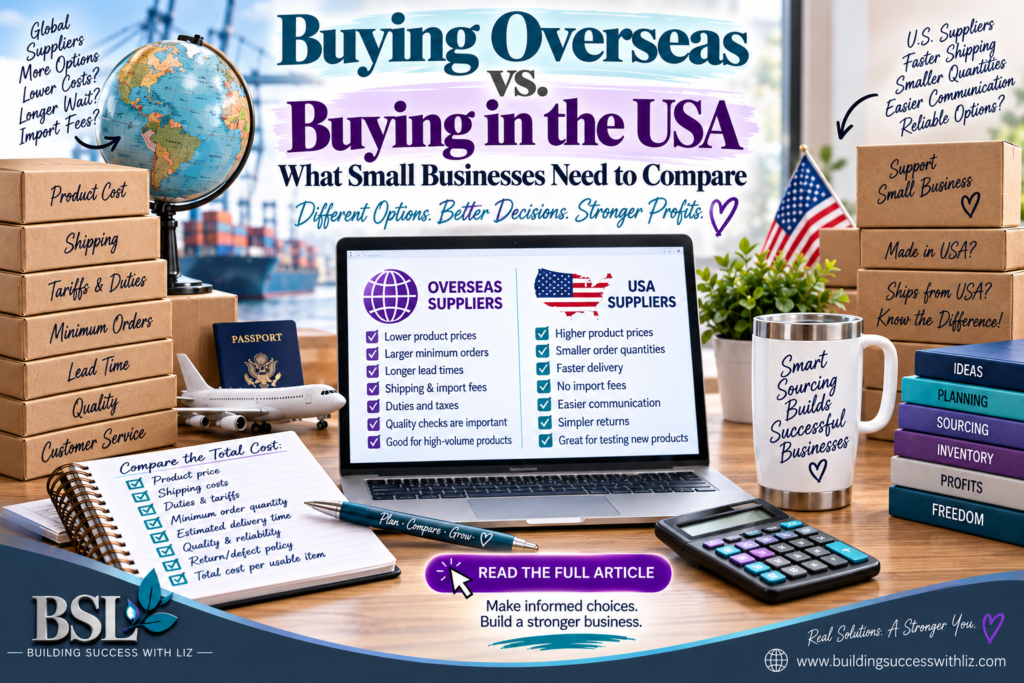
But comparing overseas vs USA suppliers isn’t as simple as comparing two prices on a screen. The cheaper product can become much more expensive once you add shipping, duties, taxes, minimum order quantities, damaged merchandise, longer delivery times, and the money sitting in inventory while you wait for those products to sell.
The opposite can also be true. A U.S. supplier isn’t automatically the better financial decision just because they’re closer. Sometimes the overseas supplier really does give you a better total cost.
The goal isn’t to choose a side. The goal is to know what you’re actually paying.
If you haven’t already compared your current suppliers carefully, read my guide on how to find better suppliers without destroying your profit. Today we’re taking that decision one step further and looking specifically at domestic versus overseas sourcing.
Overseas vs USA Suppliers: Start With More Than the Product Price
Imagine you’re comparing two suppliers for 100 pieces of the same product.
Supplier A in the USA
Product cost: $3.25 each
100 pieces: $325
Shipping: $30
Total: $355
Cost before other business expenses: $3.55 each
Supplier B overseas
Product cost: $1.60 each
100 pieces: $160
At first glance, Supplier B wins easily.
But we’re not finished.
What will international shipping cost? Are there duties, taxes, brokerage or other import charges? Is there a minimum order? How long will delivery take? What happens if ten pieces arrive damaged? What does a replacement cost, and how long will you wait for it?
Until you know those answers, $1.60 is not your true cost.
1. Calculate Your Landed Cost
One of the biggest mistakes a new product-based business can make is treating the supplier’s unit price as the cost of the product.
Your actual cost may include:
Product cost + shipping + duties/tariffs + taxes + brokerage or processing charges + other import costs = landed cost
Then you still need to consider damaged or unusable products.
Suppose your overseas order costs $160, international shipping is $85, and applicable import-related charges add another $35.
Your $160 order is now $280.
If 10 of your 100 pieces arrive unusable, you really have 90 sellable products.
$280 ÷ 90 = $3.11 per usable product.
Suddenly the difference between $1.60 overseas and $3.25 domestically doesn’t look nearly as dramatic.
That doesn’t mean the overseas supplier is bad. It means you finally have numbers you can actually compare.
2. Don’t Assume Small Overseas Orders Are Automatically Duty-Free
This is particularly important now because some older small-business articles, videos and social-media posts contain outdated information.
Previously, many low-value shipments entering the United States could qualify for duty-free treatment under the $800 de minimis threshold. However, U.S. Customs and Border Protection says that effective August 29, 2025, imported goods from all countries valued at or below $800 are no longer generally eligible for that de minimis duty-free treatment and can be subject to applicable duties, taxes and fees.
That means a video from several years ago telling you, “Keep your order under $800 and you don’t have to worry about duties,” should not be the basis of a purchasing decision today.
Before placing an international order, verify the current rules that apply to your particular product, country of origin and shipment.
Check current U.S. Customs and Border Protection import information
And don’t guess at tariffs. They can depend on the product’s classification and country of origin.
3. Compare Minimum Order Quantities
Here’s where that beautiful low overseas price can get you.
You find exactly what you need for $1.10 each.
Then you see:
MOQ: 1,000 pieces.
That’s $1,100 worth of merchandise before you’ve added shipping or anything else.
Meanwhile, the U.S. supplier charges $2.75 each but allows you to purchase 25.
For a proven bestseller, buying 1,000 pieces might eventually make financial sense. For a product you haven’t tested, it could leave hundreds of dollars sitting on a shelf.
If the product itself is still an experiment, start by reading How to Research Whether Your Business Idea Will Actually Sell Before You Spend Money.
A lower unit cost isn’t helpful if you have to buy far more inventory than your business can reasonably sell.
4. Compare Delivery Time, Not Just Shipping Price
How quickly do you need the merchandise?
A domestic supplier may cost more but get your products to you in several days. An international order could take considerably longer depending on the supplier, production schedule, transportation method, customs processing and other disruptions.
For a small business, time has a financial value.
Imagine your bestselling item is out of stock during your busiest season. Saving $50 on supplies isn’t particularly impressive if you lose $400 in sales waiting for the shipment.
Ask yourself:
How much would running out of this product cost my business?
That number belongs in the decision too.
5. Consider How Much Cash Will Be Tied Up in Inventory
Small businesses don’t have unlimited money.
If you spend $2,000 on inventory today, that’s $2,000 you can’t use for packaging, event fees, advertising, equipment, insurance, another bestselling product, or an unexpected business expense.
This is why I don’t automatically consider a large order a good deal simply because it lowers your unit price.
Suppose buying 500 pieces saves you 35 cents each.
That’s $175 in potential savings.
But if it takes you two years to sell those 500 pieces, was tying up all that cash really worth saving $175?
Sometimes yes.
Sometimes absolutely not.
Your cash flow matters just as much as your cost per unit.
6. Think About Quality Control and Replacements
Samples matter regardless of where you’re purchasing.
Before moving a major product to a new supplier, order samples whenever possible. Check measurements, material, color, durability, packaging and anything else that affects the finished product you sell to your customer.
Then ask what happens when something goes wrong.
If 20 pieces arrive damaged, will the supplier replace them? Refund them? Give you store credit? Ask you to return them? Who pays the shipping?
A supplier that’s 20 cents more expensive but consistently sends usable merchandise may ultimately cost you less than the cheapest supplier you can find.
Cost per usable item matters more than cost per item ordered.
7. Compare Communication and Problem Resolution
Communication doesn’t appear on an invoice, but it can become expensive when it’s poor.
Before placing a large order, pay attention to how a potential supplier handles simple questions.
Do they answer clearly? Are specifications documented? Can they explain production and shipping timelines? Are their policies easy to understand? What happens when there’s a mistake?
This becomes especially important when you’re ordering customized merchandise. One misunderstanding about a size, color, material, logo placement or packaging requirement can turn an inexpensive order into an expensive box of products you can’t use.
8. “Ships From the USA” Does Not Necessarily Mean “Made in USA”
This distinction is worth understanding.
A company can sell imported merchandise from a warehouse located in the United States. That may give you some advantages, such as faster shipping, smaller quantities or easier returns, but it doesn’t automatically make the product American-made.
The FTC says an unqualified “Made in USA” claim generally requires that a product be “all or virtually all” made in the United States. The final assembly or processing must occur here, and all or virtually all significant ingredients or components must also be made and sourced in the United States.
That’s different from:
Ships from USA
U.S.-based company
Designed in USA
Assembled in USA
Those statements can mean different things.
This isn’t about saying one is good and another is bad. It’s about knowing what you’re paying for.
If you’re paying considerably more because you specifically want an American-made product, verify that claim rather than assuming a U.S. address means the product was manufactured here. The FTC has continued enforcement around questionable Made in USA claims, including warning companies in 2026 about products that appeared to be imported in whole or significant part.
9. Look at Reliability, Not Just One Order
Your first order can be perfect.
The real question is whether the supplier can do it again.
If this becomes one of your bestselling products, can the supplier consistently provide it? Does the product change between batches? Are colors consistent? Do prices fluctuate dramatically? Does inventory disappear for months at a time?
This is also why having a backup supplier for an important product can be valuable.
You don’t necessarily have to split every order between two companies. But knowing where else you can purchase a critical supply gives you options when your primary supplier suddenly runs out.
When Buying Overseas May Make Sense
Overseas sourcing can make excellent financial sense when you’ve already proven demand, need larger quantities, have enough cash for the order, understand your complete landed cost, can tolerate the lead time and have verified the product’s quality.
The savings can become substantial as volume increases.
But the decision should come from your numbers, not simply from seeing a dramatically lower price per piece.
When Buying From a U.S. Supplier May Make Sense
Domestic sourcing may make more sense when you need smaller quantities, faster replenishment, easier communication, simpler returns or less money tied up in inventory.
It can also make sense when reliability is more valuable to your business than squeezing every possible penny out of the unit price.
And if you specifically want to locate domestic manufacturers rather than simply U.S.-based resellers, the SBA now offers a free onshoring resource that connects businesses with verified U.S. manufacturers, producers and suppliers through sourcing platforms such as Thomasnet, IndustryNet, CONNEX and IQS Directory.
Explore the SBA Make Onshoring Great Again portal
Create an Apples-to-Apples Supplier Comparison
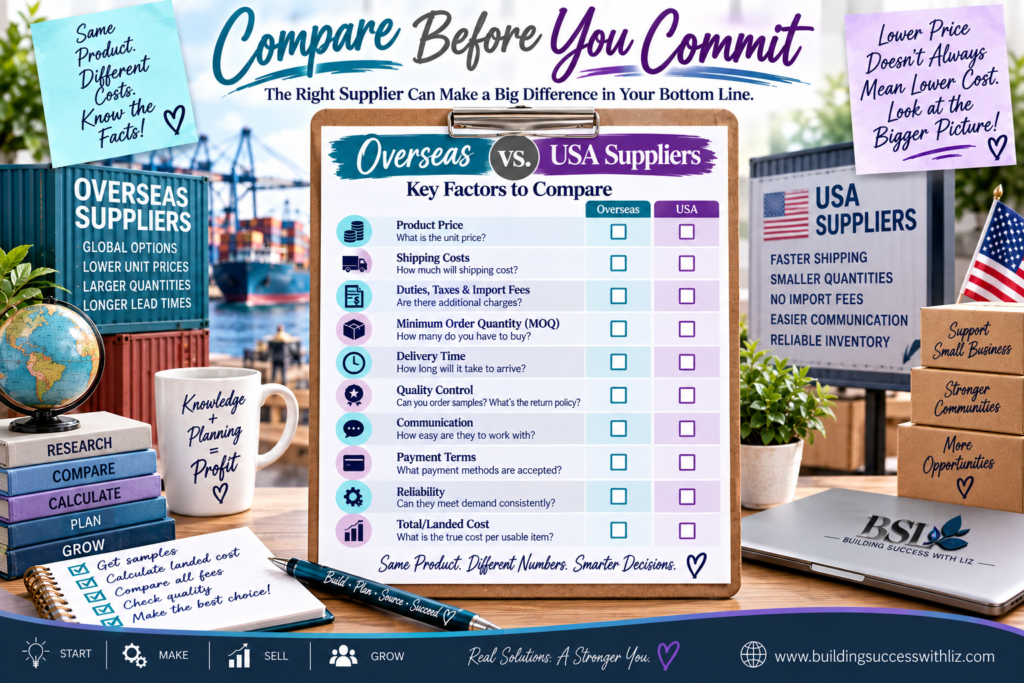
Before choosing between overseas vs USA suppliers, put the offers next to each other and compare the same information.
| Compare | Supplier A | Supplier B |
| Unit price | ||
| Minimum order | ||
| Product total | ||
| Shipping | ||
| Duties/taxes/import costs | ||
| Sample cost | ||
| Estimated delivery | ||
| Defect allowance | ||
| Replacement policy | ||
| Payment terms | ||
| Cost per usable item | ||
| Cash required upfront |
That last part is important.
Don’t ask only:
“Which supplier has the cheapest product?”
Ask:
“Which supplier gives my business the best combination of cost, quality, reliability and cash flow?”
Those are two very different questions.
Liz’s Note: Cheapest Doesn’t Always Mean Cheapest
One thing I’ve learned from making and selling products is that it’s very easy to get excited when you see a lower supply price.
I understand it. If I’m paying $3 for something and suddenly find it for $1.50, my calculator is already out.
But I’ve also learned to keep calculating.
What is shipping? How many do I have to buy? How long will they take to arrive? What happens if they’re damaged? Are there import costs? Will I actually use 500 of them? And most importantly, what does each usable product really cost me once everything is included?
I don’t care whether the winning supplier is in Maryland, California or halfway around the world.
The numbers have to make sense for the business.
Frequently Asked Questions
Is buying overseas always cheaper?
No. The unit price may be lower, but you need to calculate shipping, applicable duties and taxes, minimum quantities, defects and other costs before comparing suppliers.
Are overseas orders under $800 still automatically duty-free?
No. CBP says duty-free de minimis treatment for qualifying imports valued at $800 or less was suspended for goods from all countries effective August 29, 2025. Applicable duties, taxes and fees can therefore apply.
Does “ships from the USA” mean a product is made in America?
No. A product can be imported and then stored and shipped from a U.S. warehouse. The FTC has a much stricter standard for an unqualified “Made in USA” claim.
Should a beginner order a large quantity to get a lower price?
Not automatically. If demand hasn’t been proven, a smaller order at a higher unit cost can sometimes be the safer financial choice because less cash is tied up in inventory.
Should I have a backup supplier?
For an important or bestselling product, identifying at least one backup source can reduce the risk of losing sales if your primary supplier has a shortage, major price increase or shipping delay.
The Better Supplier Is the One That Works for Your Business
There isn’t one universal winner in the overseas vs USA suppliers debate.
A domestic supplier could be the better choice for one product while an overseas manufacturer makes far more sense for another. Your answer may even change as your business grows and your purchasing volume increases.
Compare the entire transaction, not one attractive number.
Once you know the landed cost, minimum quantity, lead time, quality, reliability and amount of cash required, you’re no longer guessing.
You’re making a business decision.
Let’s Talk About It
If you sell physical products, which part of sourcing gives you the biggest headache: prices, shipping, minimum orders, finding reliable suppliers, or figuring out import costs?
Share your experience in the comments. Your answer may help another small-business owner realize they’re not the only person staring at a shipping quote wondering how the “cheap” supplies suddenly became expensive.
And if you know another maker or product-based business owner comparing suppliers right now, save or share this article with them before they place that giant order.