
Finding a cheaper supplier sounds like an easy way to make more money.
If you’re paying $3.00 for a blank and another supplier sells something similar for $2.25, switching seems obvious. Save 75 cents on every product, sell the same number of products, and keep more profit.
Except small-business sourcing rarely works that neatly.
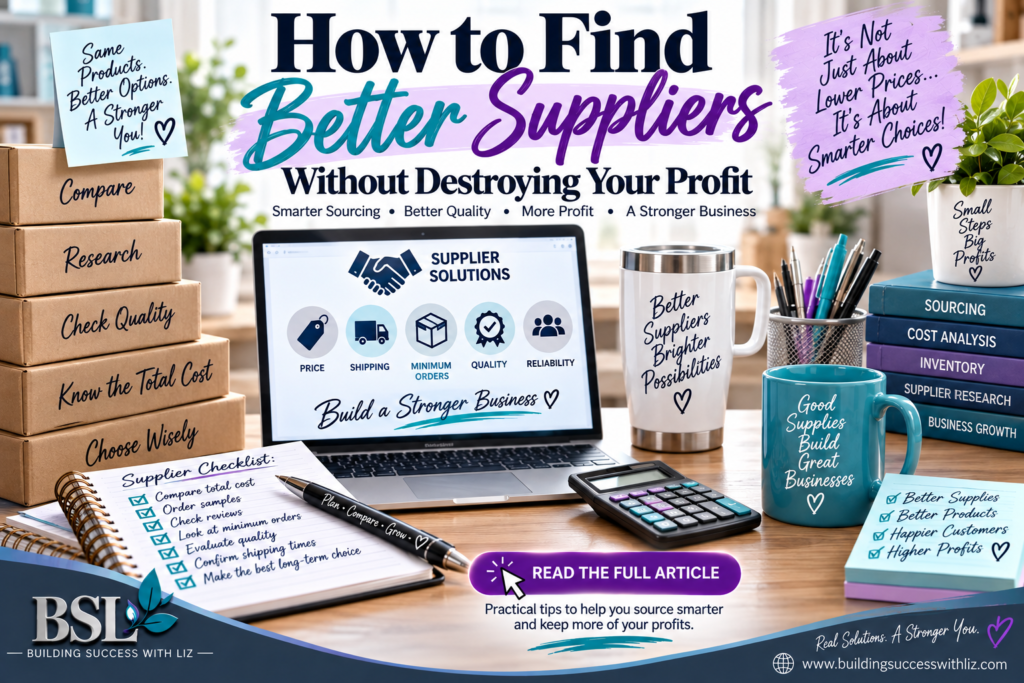
The cheaper supplier may charge more for shipping. You may have to order 100 pieces instead of 20. The quality may be inconsistent. Orders may take longer to arrive. A great introductory price may disappear on your second order. And sometimes the supplier that looks expensive at first is actually costing your business less.
Learning how to find better suppliers isn’t simply about finding the lowest price. A better supplier should help you protect your quality, cash flow, customer experience and profit.
So before you abandon your current supplier because somebody else is selling the same material for less, let’s compare the numbers that actually matter.
1. Start With What Your Current Supplier Is Really Costing You
Before looking for a replacement, establish your starting point.
Pull up a recent order and calculate what you actually paid to get those supplies into your business.
Don’t stop at the product price. Include shipping, handling charges, minimum-order requirements and other costs that apply to the purchase.
For example, Supplier A might charge $2.50 per item while Supplier B charges $2.10.
Supplier B immediately looks better.
But if Supplier A lets you order 20 units with reasonable shipping while Supplier B requires 100 units and charges considerably more to ship them, the cheaper unit price may require you to put much more cash into inventory.
That’s important for a small business.
Saving 40 cents per item isn’t automatically a win if you have to spend hundreds of additional dollars to get the savings.
This is why how to find better suppliers starts with understanding your current numbers rather than immediately searching for somebody cheaper.
2. Compare Total Cost, Not Just Unit Price
Here’s a number I want small-business owners to start using:
Your real cost per usable item.
Suppose you order 50 blanks at $2 each.
That’s $100.
Then you pay $25 for shipping.
Your cost is already $125, or $2.50 per item, before you’ve turned those blanks into finished products.
Now imagine five arrive damaged or unusable.
You didn’t really receive 50 usable blanks. You received 45.
Your $125 order now costs about $2.78 per usable item.
That is the number that belongs in your product-cost calculation.
And that doesn’t include the time you may spend photographing defects, contacting the supplier, requesting replacements, waiting for another shipment or adjusting customer orders because the materials didn’t arrive as expected.
The cheapest price on a supplier’s website tells you very little by itself.
3. Decide What “Better” Actually Means for Your Business
Before learning how to find better suppliers, define what you’re trying to improve.
Maybe your current supplier is too expensive.
Maybe the quality changes from order to order.
Maybe shipping takes too long.
Maybe items are frequently out of stock.
Maybe the minimum order is too large.
Maybe communication is terrible.
Or maybe the supplier is actually good, but your business has grown enough that you need wholesale pricing that wasn’t necessary when you started.
Write down the problem before searching for the solution.
Otherwise, you can easily replace one supplier problem with another.
A better supplier could mean better pricing, but it could also mean faster turnaround, lower minimums, better consistency, easier communication, more reliable inventory or fewer defective products.
The goal isn’t simply:
Find cheaper supplies.
The goal is:
Find the supplier combination that helps the business operate profitably and reliably.
4. Compare at Least Three Suppliers Using the Same Numbers
Don’t compare Supplier A’s product price with Supplier B’s sale price and Supplier C’s price after shipping.
Put them on equal ground.
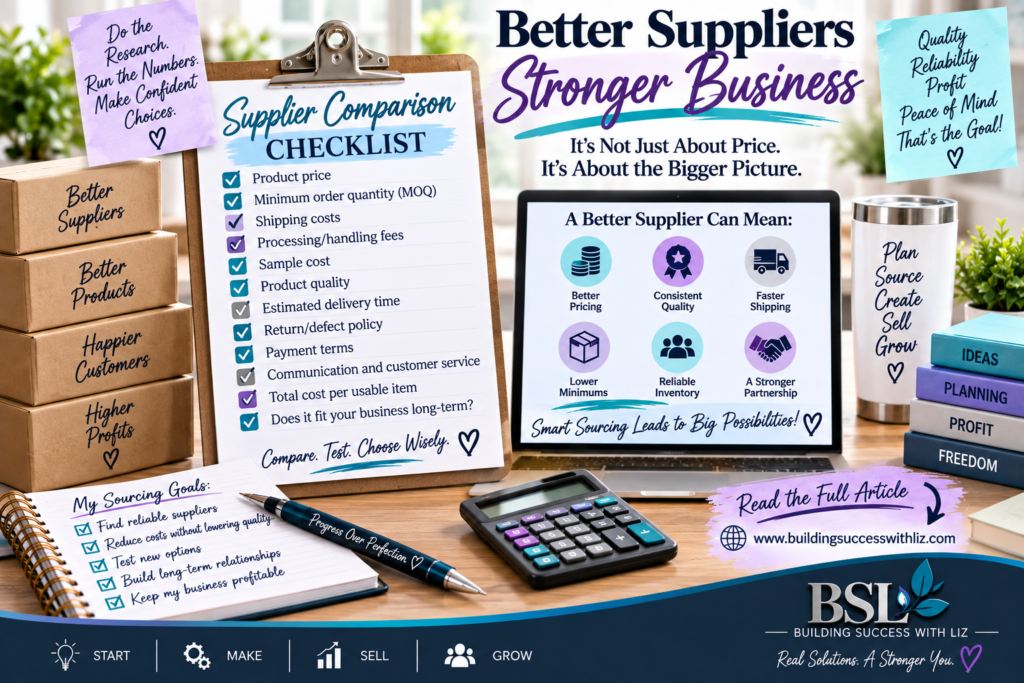
Create a simple supplier comparison and record the same information for each company:
| What to Compare | Supplier A | Supplier B | Supplier C |
| Product price | |||
| Minimum order | |||
| Shipping | |||
| Processing/handling | |||
| Sample cost | |||
| Estimated delivery time | |||
| Defect/replacement policy | |||
| Cost per usable unit | |||
| Payment terms | |||
| Communication |
Now you have something useful to compare.
You may discover that the supplier with the second-lowest product price actually gives you the best overall deal.
This also protects you from making supplier decisions based on somebody else’s business. A supplier that works beautifully for a seller ordering 1,000 units every month may make absolutely no sense for a beginner ordering 25.
5. Order Samples Before You Move a Major Product
A photograph is not quality control.
If the material will affect the finished product your customer receives, test it.
Suppose you make shirts and find a dramatically cheaper blank. Before switching your entire product line, order a small quantity.
Check the fabric. Wash it. Press it. Measure it. Compare sizing. See how your design looks on it. Pay attention to shrinkage and anything else that matters to your finished product.
The same principle applies to packaging, acrylic blanks, tumblers, paper, ribbon, jewelry components, soap ingredients, fabric and other materials.
The test may cost a little more per unit than a bulk order.
That’s okay.
You’re purchasing information.
A $30 test that prevents a $600 bad order is money well spent.
This connects directly with our BSL article on how to research whether your business idea will actually sell before you spend money. We used the same principle there with products: test small before committing big money.
It works with suppliers too.
6. Research the Supplier, Not Just the Product
A beautiful website does not automatically mean you’re dealing with a reliable supplier.
Before placing a significant order, research the company itself.
Look for independent information about the business. Search the company name along with words such as complaint, scam, shipping, quality and reviews. Look at how long the business appears to have been operating and whether its contact information and policies make sense.
The Federal Trade Commission specifically advises businesses to research unfamiliar companies before doing business with them, including searching the company’s name with terms such as “scam” or “complaint.”
FTC: Scams and Your Small Business
Don’t let an incredible price pressure you into skipping due diligence.
A supplier doesn’t become a bargain because its website says WHOLESALE in giant letters.
7. Read the Minimum Order Carefully
Minimum order quantity, often called MOQ, can completely change whether a supplier makes sense for your business.
Imagine your current supplier sells something for $3 with no large minimum.
You find a wholesale supplier offering it for $1.75.
Fantastic.
Then you discover the $1.75 price requires purchasing 500 units.
That’s an $875 inventory commitment before shipping and other applicable costs.
If you’re consistently selling hundreds of those products, that could be an excellent move.
If you’ve sold 14 of them this year, we need to put the credit card back in the purse.
Inventory sitting on a shelf is money your business cannot use somewhere else.
Don’t buy six months of something simply because the price per unit made you feel like you were saving money.
8. Don’t Forget the Cost of Running Out
There’s another side to supplier pricing that gets overlooked.
Reliability has financial value.
Imagine Supplier A costs slightly more but consistently ships within three days and rarely runs out.
Supplier B saves you 30 cents per item but frequently goes out of stock for weeks.
If those shortages prevent you from fulfilling customer orders during your busiest season, the cheaper supplier may cost you far more than 30 cents.
Ask:
How frequently is the item available?
How quickly are orders processed?
Does the supplier communicate delays?
Do they provide realistic inventory information?
What happens when something arrives damaged?
A dependable supplier can protect revenue.
That deserves a place in your comparison.
9. Be Careful When a Deal Feels Too Good
Small businesses need supplies, which unfortunately makes business owners targets for supplier and invoice scams.
The FTC has documented schemes involving businesses being charged for merchandise they didn’t order, unexpected quantities, inflated prices and pressure to pay unauthorized invoices. The agency recommends keeping records of regular vendors and checking that the goods, quantities and prices on invoices match what was actually expected.
FTC: 5 Steps to Help Protect Your Business From a Supplies Surprise
For a small business, losing several hundred dollars to a bad supplier can hurt.
Don’t allow urgency to override research.
10. Know When Paying More Is Actually Cheaper
This may sound backward in an article about how to find better suppliers, but sometimes the better supplier costs more.
Imagine Supplier A charges $1.90.
Supplier B charges $2.15.
Supplier B consistently sends better-quality materials, ships quickly, replaces defects without a fight and allows you to order smaller quantities.
That additional 25 cents may save you money elsewhere.
You may have fewer defective products, fewer remakes, fewer customer complaints and less cash tied up in inventory.
The correct question isn’t:
“Which supplier has the lowest price?”
Ask:
“Which supplier gives my business the best combination of cost, quality and reliability?”
That’s a much better business question.
11. Don’t Change Suppliers Without Checking Your Product Price
Finding a better supplier is only part of protecting profit.
You also need to know whether the product itself is priced correctly.
If your materials increase by 40 cents and your profit was already extremely small, the supplier may have exposed a pricing problem rather than created it.
That’s why we just covered the difference between selling price, fees, product costs, labor and actual profit in our BSL article “Are Etsy Fees Really Too High? How to Know If the Problem Is Fees, Pricing, or Profit.”
Once that article is live, link it here using its exact published URL. Do not publish a guessed permalink.
And if you’re considering adding a different product because your current supplies have become expensive, read Should You Add Another Product? 7 Questions to Ask Before Expanding Your Product Line before making that decision.
Changing products isn’t always easier than fixing sourcing.
Should You Have More Than One Supplier?
For important materials, sometimes yes.
You don’t necessarily need to split every order between several companies. But knowing where you could purchase a critical supply if your primary supplier is unavailable can protect your business.
Think of it as a backup plan.
You might have:
Primary supplier: best overall combination of quality, price and reliability.
Backup supplier: slightly more expensive but dependable when needed.
Test supplier: a company you’re evaluating through small orders before trusting it with larger purchases.
That gives you options without constantly jumping from supplier to supplier every time somebody advertises a sale.
Create a Supplier File
Once you find good suppliers, keep records.
You don’t need complicated software.
For each supplier, record the company name, website, products purchased, contact information, typical shipping time, minimum order, last price paid, problems you’ve experienced and whether you would order from them again.
The FTC also recommends keeping a central record of regular vendors so unfamiliar invoices or unexpected orders are easier to spot.
That simple record becomes increasingly valuable as your business grows.
Six months from now, you shouldn’t have to say:
“Wait…where did I buy those really good blanks?”
Liz’s Note: Cheap Isn’t the Same as Profitable
One thing I’ve learned from talking with other small-business owners is that supply costs are frustrating right now.
You can find something cheaper and then discover the shipping erased the savings. You can find a domestic supplier and realize the price is much higher than expected. You can look overseas and see an attractive unit price until you start considering the rest of the costs and logistics.
That’s why I don’t think small-business owners should automatically choose cheap or automatically choose expensive because it must be better.
Neither one is a business strategy.
Run the numbers.
Order a sample.
Check the quality.
Look at the minimum.
Research the company.
Calculate what the item actually costs once it reaches you.
Then decide.
A supplier should help your business make money, not simply give you a lower number to look at on a product page.
And we’re going to go deeper into the domestic-versus-overseas part next, because that deserves its own conversation.
Frequently Asked Questions
How do I find better suppliers for my small business?
Start by identifying what is wrong with your current supplier, then compare several alternatives using the same criteria. Evaluate product price, shipping, minimum orders, quality, delivery time, policies, communication and your final cost per usable unit.
Should I always choose a wholesale supplier?
No. Wholesale pricing can be valuable, but minimum-order requirements may make a wholesale supplier inappropriate for a small or newer business. Compare the total investment and how quickly you realistically expect to use or sell the inventory.
Should I order samples from a new supplier?
When product quality affects what you sell to customers, a sample or small test order is usually a smart risk-management step. It lets you evaluate the product and supplier before making a much larger commitment.
Is the cheapest supplier usually the most profitable?
No. Shipping, minimum quantities, defects, delays and inconsistent quality can make a low-priced supplier more expensive overall. Compare your total cost and reliability rather than only the advertised unit price.
Should my business have a backup supplier?
For materials that are essential to your best-selling products, having a researched backup supplier can reduce disruption if your primary supplier has shortages, delays or other problems.
Better Suppliers Should Make Your Business Stronger
Learning how to find better suppliers isn’t about winning a contest for the cheapest materials.
You’re trying to build a supply chain that allows your business to deliver a good product at a price customers will pay while still leaving enough money for the business and the person doing the work.
Compare the complete cost.
Protect your quality.
Watch your inventory.
Research unfamiliar companies.
Test before making large commitments.
And remember that sometimes paying a little more for reliability is the decision that protects your profit.
Let’s Talk About It
What’s the biggest supplier problem you’ve dealt with lately?
Higher prices? Shipping costs? Minimum orders? Products constantly being out of stock? Quality changing from one order to the next?
Share your experience in the comments. Other small-business owners may be dealing with the exact same problem.
And if you’ve found a great supplier, you don’t have to give away your source. Tell us what makes that supplier worth staying with. That information can help another business owner know what to look for.