
You spend an hour making a product, package it carefully, take it to a vendor event, put your price on it, and eventually someone picks it up and says:
“I can get something like this cheaper on Temu.”
Or Walmart. Or Amazon. Or another large retailer.
And sometimes they’re absolutely right. They probably can find something that looks similar for less.
But that doesn’t automatically mean your handmade product is overpriced.
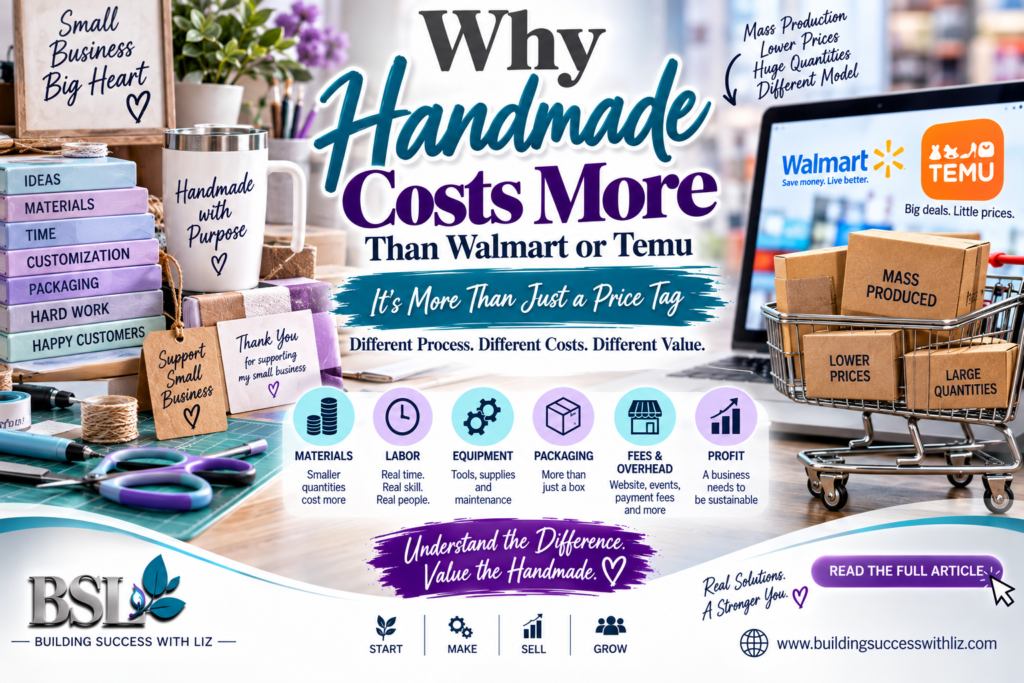
Understanding why handmade costs more starts with recognizing that a small handmade business and a mass retailer aren’t operating under the same business model. One person purchasing materials in small quantities, making products individually and selling dozens or hundreds of items cannot usually achieve the same costs as a company sourcing or manufacturing enormous quantities.
At the same time, customers aren’t wrong for having budgets. If someone needs the $5 version instead of your $18 handmade version, that’s okay.
Your job isn’t to make your product affordable for everybody.
Your job is to understand what it actually costs to make, price it so your business can survive, and communicate its value to the customers who want what you’re offering.
Why Handmade Costs More Starts With the Numbers
One of the biggest mistakes new makers make is looking only at the materials.
Let’s say you make a product that uses $4 worth of materials.
It can be tempting to think:
Materials: $4
Selling price: $10
Profit: $6
Unfortunately, your business doesn’t get to keep that entire $6.
You may also have packaging, labels, payment-processing fees, marketplace fees, equipment, damaged materials, advertising, event fees, website expenses and other overhead.
And we haven’t even paid the person who made the product yet.
That’s you.
This is why calculating your actual business costs is so important. I discuss those early expenses in The First 10 Steps to Starting a Business Without Feeling Overwhelmed.
A product isn’t profitable simply because the selling price is higher than the material cost.
1. Handmade Businesses Usually Buy Smaller Quantities
Large companies have something small handmade businesses generally don’t have:
purchasing power.
A major retailer or manufacturer may purchase thousands or millions of units or components. The larger the order, the more negotiating power a company may have over manufacturing, materials, packaging and transportation costs.
A handmade seller may need 25 tumblers.
A large company might order 250,000.
Those businesses aren’t going to receive the same price per item.
Even when a maker buys wholesale, they may still be purchasing relatively small quantities compared with a large commercial operation.
That difference eventually shows up in the customer’s price.
2. You’re Paying for Someone’s Actual Time
Labor is one of the most overlooked reasons why handmade costs more.
Suppose a product uses only $5 worth of materials but takes 45 minutes to make.
If you sell it for $10, you haven’t made $5 in profit.
You still need to pay yourself for those 45 minutes.
And production time isn’t always just the time your hands are physically making the item.
A handmade seller may also spend time preparing materials, creating the design, setting up equipment, pressing, cutting, sewing, assembling, cleaning, packaging and correcting mistakes.
If personalization is involved, there may be additional communication and design work before production even begins.
Your time isn’t free simply because you’re the business owner.
3. Equipment Has a Cost Too
That Cricut didn’t magically appear on the table.
Neither did the heat press, sublimation printer, sewing machine, laser, tumbler press, 3D printer, commercial mixer or whatever other machine your business uses.
And don’t look at the 3D printer too long. We don’t need anybody suddenly deciding they need another hobby.
Equipment costs money to purchase, maintain and eventually replace.
There are also blades, mats, ink, filament, needles, tools, replacement parts, electricity and other operating supplies.
You don’t necessarily add the entire cost of your machine to one product. Instead, equipment and operating costs become part of the overhead your business needs to recover through its sales.
If your prices never contribute toward those expenses, eventually you’re personally funding the business instead of the business supporting itself.
4. Small Businesses Have Waste and Mistakes
Every handmade item doesn’t become sellable inventory.
Vinyl gets cut incorrectly.
Sublimation doesn’t transfer properly.
A shirt gets scorched.
Resin doesn’t cure correctly.
A print comes out wrong.
A candle doesn’t behave as expected during testing.
Fabric gets cut incorrectly.
A product arrives from a supplier damaged.
And sometimes you stare at what you made and think:
Nope. I’m not selling that.
Those losses don’t disappear simply because the customer never sees them.
A healthy product price has to leave enough room for normal business waste, testing, mistakes and defects without destroying your profit.
5. Packaging Is Part of the Product Cost
Customers often see the finished product but not everything surrounding it.
There may be a box, bag, tissue paper, label, sticker, thank-you card, protective packaging, shipping mailer or insert.
A few cents here and 50 cents there can quickly turn into another dollar or two per order.
If you’re shipping the product, there may also be postage, shipping materials and the time required to prepare the package.
Packaging shouldn’t be extravagant just because social media says every order needs to look like a luxury unboxing experience. But whatever packaging you actually use needs to be included in your numbers.
6. Selling the Product Costs Money
Making something isn’t the only cost.
You still have to sell it.
An online seller may pay marketplace, transaction, payment-processing or advertising fees. A business with its own website may have hosting, platform, payment-processing, app or marketing expenses.
An event vendor may pay for a booth, gas, parking, food, payment processing and supplies.
That’s why a $20 sale isn’t necessarily $20 in the owner’s pocket.
This is also where sellers can get themselves into trouble when they price based solely on what someone else charges. You don’t know that seller’s costs, supplier relationship, equipment, volume or profit margin.
Their $15 price doesn’t automatically mean your product should be $15.
7. Handmade Often Includes Customization and Flexibility
Mass production works well because companies repeatedly make or purchase large quantities of the same thing.
Small handmade businesses often do the opposite.
A customer may want a different color.
A different name.
A different size.
A special saying.
A memorial date.
A specific ribbon color.
A breed of dog that wasn’t in the original design.
Suddenly a product that normally takes 20 minutes requires additional design work and communication.
That flexibility can be part of the value of buying from a small business.
But customization also costs time.
If your business offers it, make sure your pricing reflects the additional work instead of automatically giving it away.
8. Handmade Businesses Still Need Profit
This one sometimes makes people uncomfortable.
A handmade business is allowed to make money.
Profit isn’t something shameful that you add after apologizing for your price.
A business needs profit to grow, replace equipment, build inventory, survive slow periods, cover unexpected expenses and eventually pay its owner more than enough to simply replace what was used.
The U.S. Small Business Administration emphasizes the importance of understanding business finances, including expenses, cash flow and financial projections, because revenue alone doesn’t tell you whether a business is financially healthy.
If you continually sell products for barely more than they cost to make because you’re afraid someone will say you’re expensive, you may have created a very busy hobby instead of a sustainable business.
9. Handmade and Mass-Produced Products Aren’t Always Direct Competitors
This is probably the biggest mindset shift.
A handmade seller doesn’t necessarily need to beat Walmart or Temu on price.
Those businesses compete heavily through scale, selection, convenience and low prices.
A handmade business can compete differently.
Your advantages might be personalization, craftsmanship, small-batch production, local availability, customer service, unique designs, specialty products, faster customization or simply the experience of buying directly from the person who made something.
That doesn’t mean every customer will care about those things.
And that’s okay.
When you’re looking for customers, you’re looking for the people who value what your business does well. That’s something I discuss further in How to Find Your First Customers Without Spending a Fortune.
You don’t need every shopper.
You need enough of the right shoppers.
“But I Can Get It Cheaper on Temu.”
So what should you actually say when a customer tells you this?
First, don’t get defensive.
You don’t need to explain your electricity bill, supplier invoices, equipment payments and entire life story while they’re standing at your booth.
A simple response might be:
“Absolutely, there are lower-priced mass-produced options available. Mine is handmade in small batches, and I price it based on my materials, time and the quality I want to provide.”
Then stop.
You don’t need to debate them.
If they prefer the cheaper option, they’re allowed to choose it.
The worst thing you can do is panic and immediately slash your price because one person said they saw something cheaper elsewhere.
Their budget doesn’t determine your cost.
Don’t Use “Handmade” as an Excuse for Any Price
There’s another side to this conversation that sellers need to hear.
Calling something handmade doesn’t automatically make any price reasonable.
You still need to know your market.
You still need to produce good-quality work.
You still need to understand what comparable products sell for.
You still need to control unnecessary costs.
And you still need to make sure your finished product gives the customer enough value for the price you’re asking.
If your product costs $40 to make but customers consistently value it at $25, simply raising the price to $60 doesn’t solve the underlying business problem.
You may need to reconsider your materials, supplier, production process, product design or even whether that particular item belongs in your product line.
That’s why product research matters before you invest heavily. This BSL guide on researching whether a business idea will actually sell can help you test demand before committing too much money.
Stop Competing With Prices Your Business Cannot Sustain
Imagine your true cost to produce an item is $11.
After labor, fees and overhead, you determine that you need to sell it for $24 to earn an acceptable profit.
Then you find something visually similar online for $8.
You have three choices.
You can sell yours for $8 and lose money.
You can stop selling the product.
Or you can sell it for the price your business needs and find customers who value the difference.
What you cannot sustainably do is lose $3 every time someone buys something and hope volume eventually saves you.
More sales don’t fix a product that loses money.
They multiply the problem.
Explain Value Without Attacking the Competition
There’s another mistake I don’t want small-business owners making.
You don’t have to insult Walmart, Temu, Amazon or another seller to explain why your product costs more.
And you shouldn’t make claims about another company’s product quality that you can’t substantiate.
Instead, talk about your own product.
Explain what you control:
Your materials.
Your process.
Your craftsmanship.
Your customization.
Your customer service.
Your quality standards.
Your story, when it’s relevant.
Your customer doesn’t need a speech about why somebody else’s product is terrible.
They need a reason to understand why yours is worth considering.
Liz’s Note: I Shop for Deals Too
Let’s be realistic.
Running a small business doesn’t suddenly mean I stop caring about prices when I’m the customer.
I compare prices too.
If two products meet my needs and one costs considerably less, of course I’m going to look at the difference.
That’s why I don’t think customers should be made to feel guilty for saying something is outside their budget.
But there’s also a difference between:
“I can’t afford that.”
and
“You shouldn’t charge that.”
The first is a personal financial decision.
The second assumes the seller’s costs, time and business are identical to a mass retailer’s.
They aren’t.
As a seller, you don’t need to take either statement personally. Know your numbers, know the quality you’re offering and know the lowest price at which your business can responsibly sell the product.
Then let the customer decide.
Frequently Asked Questions
Why handmade costs more than mass-produced products?
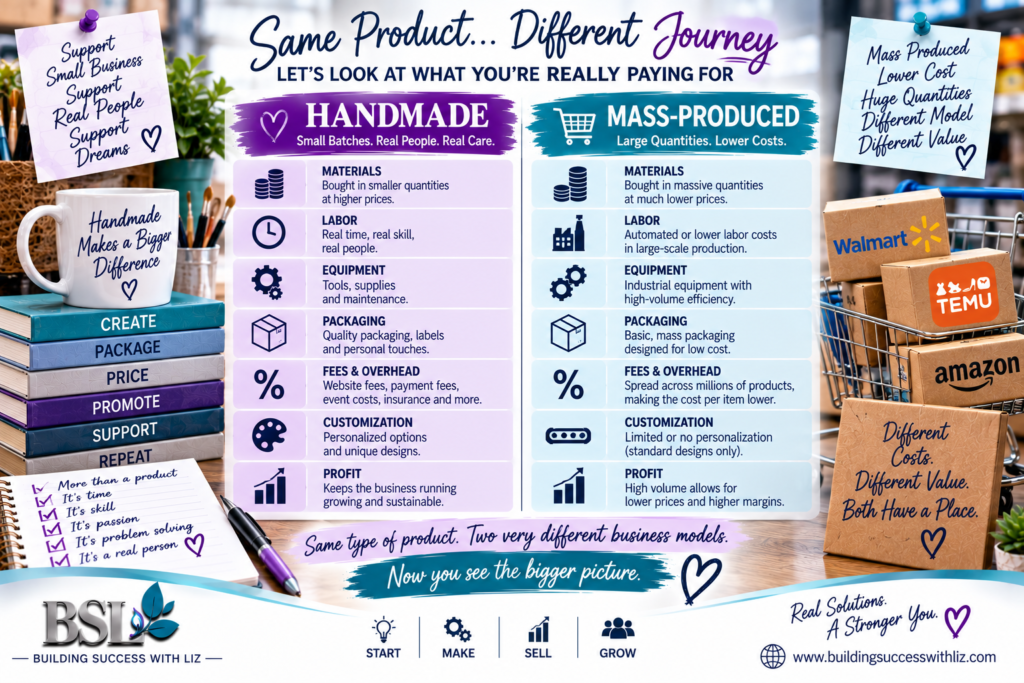
Handmade businesses often purchase materials in smaller quantities, use more hands-on labor per item and have costs for equipment, packaging, selling fees, waste, customization and overhead that large-scale manufacturers can spread across much larger production volumes.
Should handmade sellers lower their prices to compete with Temu or Walmart?
Not simply because a mass retailer sells something similar for less. A handmade seller should calculate their own costs, labor, overhead and required profit before setting a sustainable price.
How much should I charge for my labor?
There isn’t one universal hourly rate for every handmade business. Your rate should account for your skill, production time, market, business expenses and financial goals. The important part is not treating your labor as automatically worth $0.
What if customers keep saying my handmade products are too expensive?
Don’t react to one comment. Look for patterns. Review your product quality, target customer, competitors, actual sales, production costs and profit. If shoppers repeatedly reject the price, investigate why before deciding whether the solution is lower pricing, lower costs, stronger value communication or a different product.
Is handmade always better than mass-produced?
No. Handmade and mass-produced products serve different customers and needs. Handmade shouldn’t automatically be described as superior simply because it was made by a small business. Quality, value and customer needs still matter.
You Don’t Need to Be the Cheapest Business
Understanding why handmade costs more doesn’t mean putting an enormous price on something and expecting customers to pay it simply because you made it yourself.
It means understanding the economic reality of running a small product-based business.
Know your materials.
Know your labor.
Know your overhead.
Know your selling costs.
Know your customer.
And know your profit.
Then price from your numbers instead of from fear.
Because the goal isn’t to build a business where everybody says:
“Wow, that’s cheap!”
The goal is to build one that is still around next year.
Let’s Talk About It
Handmade sellers, what’s the comment you hear most often about pricing?
And shoppers, what makes you willing to pay more for a handmade or small-business product: customization, quality, uniqueness, customer service, buying local, or something else?
I’d really like both sides of this conversation because understanding each other is far more useful than another argument about who charges too much.
If you know a maker who’s constantly second-guessing their prices because they’re comparing themselves with mass retailers, save or share this article with them.