
You see the post on Facebook: “VENDORS WANTED!” The event looks cute, the location sounds good, and the organizer says spaces are filling quickly. The vendor fee is $75, and before you know it, you’re reaching for your card because you don’t want to miss your chance.
Knowing the questions to ask before paying a vendor fee gives you a simple process to follow before excitement, urgency or fear of missing out takes over.
Not so fast.
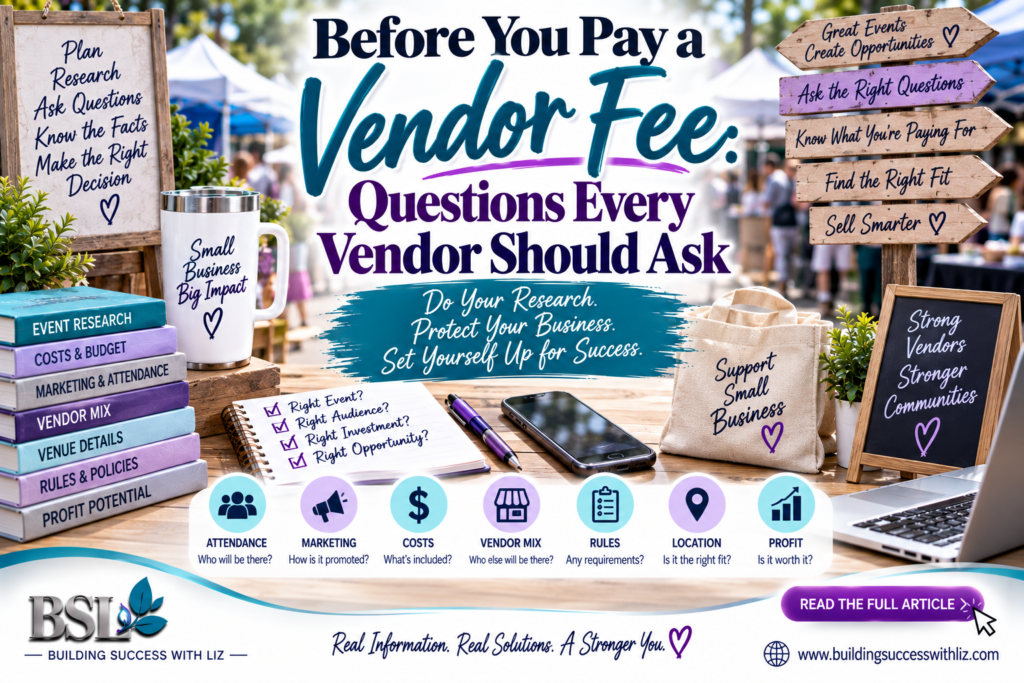
One of the smartest habits you can develop as a vendor is learning the questions to ask before paying a vendor fee. You’re not simply purchasing a 10×10 space for a few hours. You’re investing money, inventory, transportation, preparation time and probably most of your Saturday. Before you send a payment, you deserve enough information to decide whether the opportunity makes sense for your business.
That doesn’t mean every organizer needs to guarantee you’ll make money. No legitimate organizer can promise sales. It does mean you should know what you’re paying for and have enough information to make an informed decision.
1. Who Is Organizing the Event?
Start here before worrying about how many vendor spaces are left.
Who is actually running the event? Is it a business, nonprofit, school, church, community organization, experienced event company or someone organizing their first market?
A new organizer isn’t automatically a bad organizer. Everyone has a first event. But if you’re considering sending money to someone you don’t know, do some basic research first.
Search the organizer’s business or organization name. Look at its website and social media accounts. Search for previous events. Look for photos showing actual shoppers, not only vendor booths. See whether previous vendors tagged the event or left comments about their experience.
This is especially important when an unexpected organizer contacts you through social media and immediately asks for payment. The Federal Trade Commission recommends researching unfamiliar businesses before paying them, including searching the company’s name along with terms such as “scam” or “complaint.” The FTC also warns that scammers often create urgency because they want businesses to pay before checking the claim.
FTC: Scams and Your Small Business
Verify the Person Collecting the Vendor Fee
Researching the event itself is only part of protecting your business. You should also make sure the person asking you for payment is actually authorized to collect vendor fees for that event. A legitimate event can have a real date, real venue, real organization and professional-looking flyer, but that doesn’t automatically verify the person who contacted you.
I learned this while researching a breast cancer event I was interested in attending. The event appeared legitimate, but I wanted to go one step further before sending my vendor fee. I independently verified that the person collecting the money was actually authorized to collect vendor payments for the event. Everything checked out. The event and the organizer were completely legitimate, and the experience became a positive learning lesson for me because it showed me that doing extra research doesn’t mean you’re accusing someone of being dishonest. It simply means you’re protecting your business before sending money.
That lesson became even more important when I encountered a completely different vendor opportunity. In that situation, the person was pushing me to make a payment quickly and offering me a discount on future events as another incentive to pay. Instead of allowing the urgency and the possibility of saving money to rush my decision, I kept researching. That situation actually turned out to be a scam.
Those two experiences taught me why I don’t believe vendors should rely only on a flyer, Facebook post or message from the person requesting payment. Research can uncover a scam, but it can also confirm that an opportunity is legitimate and give you greater confidence about moving forward. Either way, the few extra minutes you spend checking can be valuable.
If you have any doubt, independently locate the organization or event’s official contact information instead of relying only on the phone number, email address or payment link sent by the person requesting money. Ask whether that individual is authorized to register vendors and collect payments. Also check whether the name receiving your payment makes sense based on the organization or business you’re dealing with.
Legitimate organizers can certainly have registration deadlines, limited spaces and early-bird discounts, so urgency or a discount alone doesn’t prove something is a scam. The concern is when you’re being pressured to pay before you’ve had a reasonable opportunity to verify the information. The Federal Trade Commission warns that scammers commonly use urgency and pressure to get people to act before they have time to investigate.
The biggest lesson I took from both experiences is simple: don’t let excitement get ahead of your research. Sometimes your research will confirm that everything is legitimate, just as mine did with the breast cancer event. Other times, it may be the very thing that keeps you from sending money to a scammer. Either result makes the research worthwhile.
Verify first. Pay second.
2. Has This Event Happened Before?
If this is an established event, ask about previous years.
How many years has it been held? Approximately how many shoppers attended last year? Is attendance growing, declining or staying about the same?
Then do a little investigating yourself.
If someone tells you 5,000 people attended last year but every photo shows twelve shoppers wandering around a huge field, I’d have a few more questions.
Remember that vendor attendance and shopper attendance are two different numbers. An event having 100 vendors doesn’t tell you whether 100, 1,000 or 10,000 customers will walk through the gate.
If it’s a brand-new event, that’s okay too. Instead of previous attendance, you need to pay closer attention to the organizer’s marketing plan, location and strategy for attracting shoppers.
3. Who Is the Event Trying to Attract?
A busy event isn’t automatically a good event for your business.
Imagine selling $25 handmade home décor at an event attended primarily by families looking for children’s activities and $2 snacks. There could be thousands of people there, but that doesn’t necessarily mean they’re your customers.
Ask about the intended audience. Is this a craft market? Community festival? Holiday shopping event? Car show? Women’s expo? Pet event? Food festival? School fundraiser?
The goal isn’t simply to find people.
It’s to find people who might reasonably want what you sell.
If you’re still learning how to identify potential buyers, my guide on How to Find Your First Customers Without Spending a Fortune can help you think about where your actual customers spend their time.
4. How Is the Organizer Advertising the Event?
This is one of my biggest questions.
Ask specifically:
How are you promoting this event to shoppers?
You’re looking for an actual answer.
Social media advertising, community calendars, email lists, local publications, signs, partnerships, radio, flyers, local groups, previous attendee lists or other promotional channels are examples of an actual marketing plan.
“We’re asking all vendors to share the flyer” is not the same thing as an organizer having a marketing plan.
Should vendors promote events they’re attending? Absolutely. I think vendors should share events with their audiences when appropriate.
But vendors shouldn’t be expected to create the entire audience.
An organizer’s job includes attracting shoppers to the event. A vendor’s social media followers may live all over the country. Even local followers aren’t automatically available Saturday between 10 and 4.
Followers do not equal foot traffic.
That’s why one of the most important questions to ask before paying a vendor fee is how the organizer plans to reach actual shoppers, not simply how many vendors have already registered.
5. What Exactly Does the Vendor Fee Include?
Don’t assume.
If the booth fee is $100, ask what you’re receiving for that $100.
Does the fee include only the physical space? Are tables and chairs provided? Is electricity available? Is Wi-Fi included? Is there overnight security for multi-day events? Is parking free? Are admission passes included for helpers? Are there additional fees for corner spaces, electricity or extra staff?
The $75 event that requires another $40 for electricity and $20 for parking is no longer a $75 event.
Before evaluating whether an event is affordable, calculate the real cost of participating.
The SBA recommends identifying business expenses such as supplies, insurance, inventory, advertising and marketing and then looking at the full financial picture rather than evaluating expenses individually.
When you’re working through the questions to ask before paying a vendor fee, don’t stop at the advertised booth price. Ask about every additional expense that could change the true cost of participating.
SBA: Plan Your Business and Expenses

6. What Size Is the Vendor Space?
A standard outdoor vendor space is often described as 10×10, but don’t assume every event uses that size.
Ask for the exact dimensions.
Also ask whether you need to bring your own tent, tables, chairs, tent weights, extension cords or lighting.
If you’ve planned a beautiful 10×10 setup and arrive to discover your space is 8×6, you’re going to become a professional furniture rearranger at 7:15 in the morning.
Get the measurements before event day.
7. How Many Vendors Will Be There?
The total number matters because it helps you understand the size and layout of the event.
But don’t stop there.
Ask whether the organizer limits similar vendors.
Twenty-five jewelry businesses at a 40-vendor event creates a very different selling environment from three jewelry businesses among 100 vendors.
This doesn’t mean you should demand category exclusivity. Competition isn’t automatically bad. But you should understand the vendor mix before deciding whether the opportunity makes sense.
8. Are Resellers Allowed?
This can matter tremendously for handmade businesses.
Ask whether the event is handmade-only, juried, mixed retail and handmade, or open to resellers.
There’s nothing inherently wrong with an event allowing different types of sellers as long as the rules are clear. The problem comes when a maker believes they’re entering a handmade market and arrives to discover they’re competing against tables full of mass-produced products sold at prices they can’t realistically match.
Know what kind of marketplace you’re paying to enter.
9. What Happens if the Event Is Canceled?
Read this part before you pay.
What happens if there’s rain? Extreme heat? Severe weather? Venue problems? Low registration? An emergency?
Is the event postponed? Does your payment transfer to another date? Is the vendor fee refundable? Is it nonrefundable under every circumstance?
Also ask what happens if you need to cancel.
A professional policy doesn’t necessarily have to favor the vendor. Some events legitimately have nonrefundable fees because the organizer has expenses too. You simply need to know the policy before handing over your money.
Save a copy of the rules, application and payment confirmation.
Cancellation and refund policies belong on your list of questions to ask before paying a vendor fee because once you’ve paid, discovering that every payment is nonrefundable is a little late.
10. What Are Setup and Breakdown Rules?
An event advertised from 10:00 AM to 4:00 PM doesn’t mean your workday is six hours.
Setup may begin at 6:30 AM.
You may need to arrive by 7:00.
Vehicles may need to leave the vendor area by 8:30.
And vendors may be prohibited from breaking down until 4:00 even if business is slow.
Ask for the full schedule before committing.
Your time is part of the event investment too.
11. Where Do Vendors Park?
This sounds small until you’re carrying three totes, two tables, signs, a tent and inventory across half a mile of grass.
Ask where vendor parking is located, whether you can drive to your booth during setup, when vehicles must be moved and whether parking costs extra.
If you have mobility limitations or heavy products, this information becomes even more important.
12. Are There Permits, Insurance or Special Requirements?
Some events require vendors to provide a certificate of insurance. Food vendors may have additional health department or fire-safety requirements. Certain venues may have restrictions on generators, cooking equipment, tent weights, signage or product categories.
Don’t wait until the week of the event to discover an additional requirement that costs money or prevents you from participating.
Ask before paying.
13. How Many People Are You Expecting Versus How Many Attended Previously?
Notice those are two different questions.
An organizer may say:
“We’re expecting 10,000 people!”
Okay.
How was that number calculated?
If 8,000 attended last year, a 10,000-person estimate may be reasonable.
If this is the first event and 10,000 is simply the organizer’s goal, treat it as a projection, not an attendance record.
Goals are fine. Just don’t build your inventory budget around somebody else’s optimistic estimate.
14. What Does “Sold Out” Actually Tell You?
Very little about customer attendance.
“Only three vendor spots remain!”
That tells you the organizer has successfully sold most of the vendor spaces.
That’s good for the organizer.
But it doesn’t tell you how many shoppers bought tickets, saw the advertising, plan to attend or even know the event exists.
A sold-out vendor roster and a well-attended shopping event are not the same thing.
Don’t let scarcity alone rush you into paying.
15. How Much Do You Need to Sell to Make the Event Worth It?
This final question isn’t for the organizer.
It’s for you.
Suppose the booth costs $100.
Then you spend:
- $35 on gas
- $20 on food
- $15 on parking
- $10 in processing fees
- $120 replacing inventory that sold
You made $350 in sales.
Did you make $350?
No.
Your sales total is not your profit.
You need to subtract the costs associated with producing those products and participating in the event. You also spent hours preparing, loading, driving, setting up, selling, breaking down and unloading.
This is why I encourage small-business owners to look beyond the exciting sales number. My article What to Do When Sales Are Slow explains why the same amount of sales can produce very different results depending on expenses.
Do the Math Before Event Day
Before paying the fee, calculate a rough break-even target.
If your average profit contribution after product cost and payment fees is $10 per item and you expect $200 in event-related costs, you need roughly 20 sales just to cover those event costs.
That doesn’t automatically mean you shouldn’t attend.
An event can also produce repeat customers, custom orders, email subscribers, wholesale contacts and future opportunities.
But be honest about why you’re going.
“I made $600!” sounds exciting.
“I made $600 in sales, spent $475 getting there and worked 14 hours” tells you considerably more about whether the event deserves another Saturday.
The questions to ask before paying a vendor fee aren’t only about the organizer. Some of the most important questions are the ones you need to ask yourself about costs, sales goals and profit.
Red Flags Before Paying a Vendor Fee
Not every poorly organized event is a scam, and not every new organizer is inexperienced. But certain situations deserve extra investigation.
Be cautious when an organizer pressures you to pay immediately, won’t provide written event information, gives vague answers about the venue, can’t explain its marketing plan, refuses to provide cancellation terms, changes payment information unexpectedly or contacts you from an account that doesn’t match the organization supposedly hosting the event.
The FTC specifically warns businesses about urgency tactics, impersonation and unusual payment demands. If someone insists you must pay immediately through cryptocurrency, gift cards or a wire transfer, stop.
A Vendor Fee Is an Investment, Not a Lottery Ticket
Vendor events always involve some uncertainty.
You can research an event carefully and still have a slow day. Weather changes. Customers change. Traffic patterns change. Another local event may compete for attendance.
The goal of asking questions isn’t to eliminate every risk.
It’s to stop making blind investments.
You should know enough about the organizer, audience, promotion, costs, rules and history to make a reasonable business decision.
Then after the event, record what actually happened.
How much did you sell? What did the event cost? Which products are sold? How many new customers did you meet? Did anyone follow you afterward? Did you receive custom orders? Would you attend again?
That’s how experience becomes useful business data.
Liz’s Note
I don’t believe vendors should expect an organizer to guarantee sales. Nobody can promise that people walking through an event will buy from your booth.
But I also don’t believe vendors should hand over money without asking questions because a flyer says “Vendors Wanted” and somebody added three fire emojis. 😂🔥🔥🔥
You are running a business.
It’s okay to ask how your money is being used. It’s okay to ask how the event is being promoted. It’s okay to research previous events. And it’s okay to decide an event isn’t right for you.
Saying no to the wrong event leaves money available for the right one.
Frequently Asked Questions
What are the most important questions to ask before paying a vendor fee?
Start with who is organizing the event, previous attendance, intended audience, marketing plans, vendor count and mix, what the fee includes, cancellation policies and the full setup requirements. Then calculate your own expected event costs and break-even sales target.
Does a high vendor fee mean an event will be better?
No. A higher fee may reflect a larger venue, advertising, staffing, entertainment or expected attendance, but the price alone doesn’t tell you whether the event will be profitable for your business. Research what you’re receiving for the fee.
Should vendors promote the event too?
Yes. Sharing an event you’re attending can help both you and the organizer. But vendor promotion shouldn’t replace the organizer’s own plan for reaching shoppers.
Is a first-time event worth attending?
It can be. Every successful event had a first year. Because there’s no attendance history, evaluate the organizer, venue, target audience, marketing strategy and cost more carefully.
Should I attend an event with competitors selling similar products?
Possibly. Similar vendors don’t automatically make an event bad. Consider the number of competing vendors relative to overall attendance, how differentiated your products are and whether the audience matches your customer.
Before You Send the Payment
The best questions to ask before paying a vendor fee aren’t designed to interrogate an organizer. They’re designed to help you make a business decision.
You don’t need a perfect event.
You need enough reliable information to decide whether the potential opportunity justifies your money, inventory and time.
And sometimes the smartest vendor decision you’ll make isn’t booking another event.
It’s knowing which one to skip.
Let’s Talk About It
Vendors, what is the one question you wish you had asked before paying for an event?
Was it about attendance, advertising, parking, duplicate vendors, refunds, setup or something completely different?
Share what you learned. Your experience might save a brand-new vendor from making an expensive mistake.