
October has a funny way of making us feel like we still have plenty of time. Christmas is not here yet, Thanksgiving still feels a little far away, and the holiday sales have not fully taken over. Because of that, it is easy to tell yourself that you will deal with the holiday budget later.
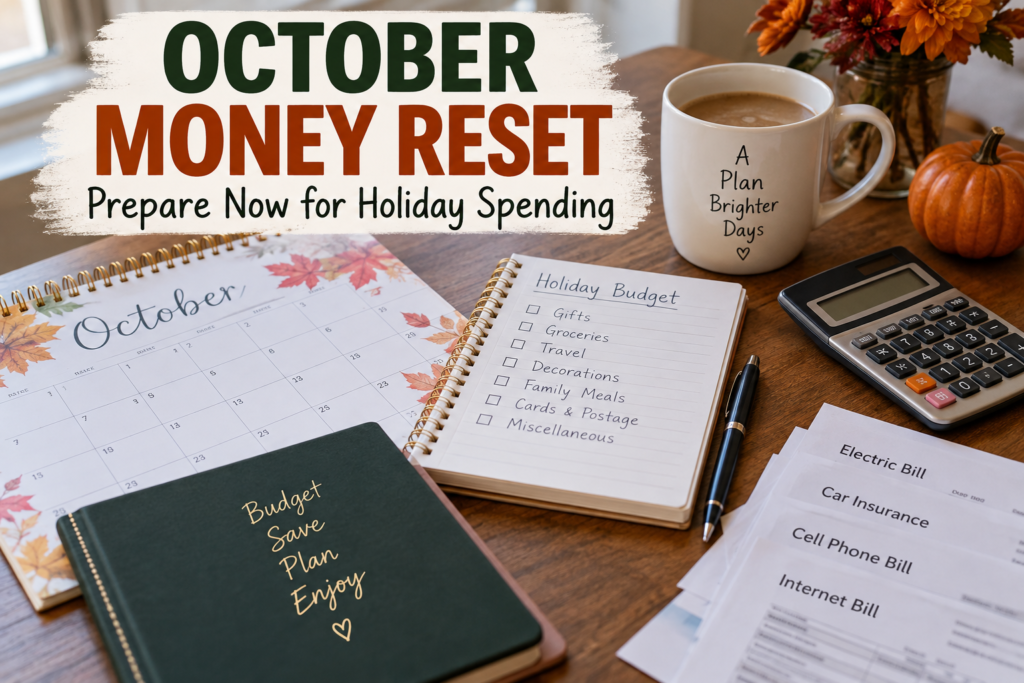
The problem is that “later” comes quickly. By the time November arrives, you may be thinking about gifts, groceries, family dinners, travel, school events, decorations, shipping, and all the other small expenses that show up during the holiday season. Those little purchases may not seem like much one at a time, but together they can put real pressure on a regular monthly budget.
That is why an October Money Reset can be so useful. It gives you a chance to look at your money before the season gets expensive, while you still have time to make changes. The goal is not to make the holidays feel restrictive. The goal is to make sure the holidays do not create a financial mess that follows you into January.
What Is an October Money Reset?
An October Money Reset is a simple financial check-in before holiday spending really begins. You are looking at where your money stands now, what regular expenses are still coming before the end of the year, and what the holidays are realistically going to cost you.
A lot of people jump straight into planning for gifts without first looking at the regular budget. That can create problems fast. If most of your income is already going toward bills, groceries, transportation, insurance, and other necessities, adding hundreds of dollars in holiday spending without a plan is going to make things harder.
If you have not reviewed your regular spending recently, this is a good time to go back through the BSL Monthly Money Reset. That guide walks through your income, bills, subscriptions, spending habits, and the other things that may have changed over the last few months.
Start With the Money You Actually Have
The first step is simple, but it is also one people tend to avoid when money already feels tight. Open your checking account, look at your savings, review your credit-card balances, and check any buy-now-pay-later accounts you are using. Then look at the paychecks you expect between now and the end of the year.
You are not doing this to judge yourself for what you spent last month. You are gathering information so you can make a realistic plan. Ask yourself one basic question: How much money do I actually have available right now?
Do not count a bonus that has not arrived yet, overtime you have not worked, or money you hope to make from something you are planning to sell. Start with what is real today. Once you know that number, you can make better decisions about what the next few months should look like.
Look at October and November Before You Look at Christmas
Before you start making the Christmas list, look at the expenses that are coming before Christmas even gets here. Maybe you have a car registration due, a birthday, a medical appointment, a school expense, a veterinary bill, an annual membership, or an insurance payment. Thanksgiving can also be a major expense if you are hosting or traveling.
Those expenses still matter even if the holidays are right around the corner. The Consumer Financial Protection Bureau recommends reviewing several months of spending because people often forget less-frequent costs such as medical bills, insurance, travel, gifts, and seasonal expenses.
That is exactly why this part of the October Money Reset matters. You want to see the whole picture before you decide how much room you really have for holiday spending.
Make a Complete Holiday Spending List
Once you understand your regular expenses, then it is time to look at the holidays. This is where I would encourage you to make a full list instead of only writing down gifts.
Holiday spending can include Thanksgiving and Christmas meals, extra groceries, travel, gas, hotels, decorations, family photos, cards, postage, school events, work parties, Secret Santa exchanges, donations, clothing, hair appointments, entertainment, wrapping paper, shipping, gift bags, and all those last-minute trips to the store. Even batteries count.
When you write everything down, the total may be higher than you expected. That is okay. It is better to see the number now, while you still have time to make changes, than to discover it in late December after the money is already spent.
The CFPB also recommends deciding what you can afford after your regular expenses are covered and planning for gifts, travel, and gatherings before shopping begins. You can review their holiday spending plan here.
Decide What You Actually Want to Spend
There is a big difference between saying, “Christmas is probably going to cost me $1,500,” and saying, “I am choosing to spend $1,500.” One sounds like the number is happening to you. The other means you are making a decision.
Go through your list and ask yourself whether each expense is truly important to you. Can you afford it without taking money away from regular bills? Are you buying something because you want to, or because you feel pressure to keep up with what other people are doing?
You are allowed to spend less than last year. You are allowed to change traditions. You are allowed to say no to an exchange or shorten the gift list. Your holiday budget should fit your life, not someone else’s expectations.
Three Steps to Start Saving Money Before the Holidays
One of the biggest mistakes people make is thinking saving only matters if they can put away a large amount. That is not true. Saving $10 or $20 a week can still make a real difference, especially when you are trying to avoid putting holiday expenses on a credit card.
Step 1: Choose an Amount You Can Repeat
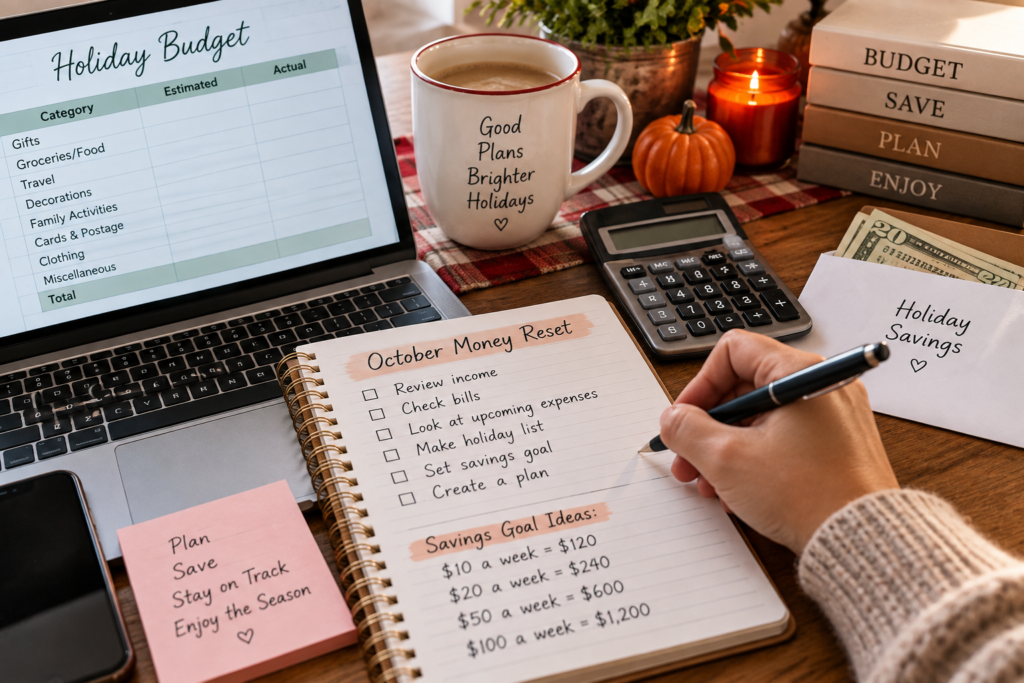
Start with an amount that works with your real budget. Maybe that is $10 a week. Maybe it is $20, $50, or $100. The goal is not to choose the biggest number. The goal is to choose a number you can keep doing without creating another financial problem.
If your income changes from week to week, you can also use a flexible approach. The BSL Realistic Savings Challenge is built around that idea. Saving should work with your life, not become another bill you cannot afford.
Step 2: Decide Whether Weekly or Biweekly Works Better
Some people prefer moving a smaller amount every week. Others would rather move money every time they get paid. Either approach works, and the total comes out the same if you stay consistent.
Here is what a 12-week savings period from the beginning of October through the week before Christmas could look like:
| Savings Level | Weekly Deposit | 12-Week Total | Biweekly Deposit | 6-Pay-Period Total |
| Small Start | $10 | $120 | $20 | $120 |
| Steady Start | $20 | $240 | $40 | $240 |
| Moderate Saver | $50 | $600 | $100 | $600 |
| Larger Saver | $100 | $1,200 | $200 | $1,200 |
If you are someone who can only save $10 a week, that still gives you $120 before Christmas. That could help with groceries, gas, a utility bill, or several small gifts. If you can save $20 a week, you could have $240, which gives you even more room.
Saving $50 a week gives you $600 before Christmas, while saving $100 a week gives you $1,200. If you continue saving $100 every week through the end of December, rather than stopping before Christmas, you could reach about $1,400 by the end of the year.
Step 3: Give the Money a Job
Once you choose your savings amount, decide what the money is for. Do not just call it “savings” and leave it vague.
Maybe your $240 is for gifts. Maybe your $600 is split between Christmas and a January bill. Maybe your $120 becomes the beginning of an emergency fund. Maybe the $1,200 helps cover holiday costs and leaves some money behind for debt or savings.
Giving the money a job makes it easier to leave it alone.
You Do Not Have to Save the Same Amount as Someone Else
Social media can make saving feel like a competition. Someone is doing a $5,000 challenge. Someone else is stuffing hundreds of dollars into envelopes. Another person seems to be saving $500 every paycheck.
That does not make $10 a week meaningless.
A person who saves $10 consistently while paying rent, feeding a family, and keeping the lights on is still making financial progress. If $10 is what you can manage right now, start there. If one week you can save more, great. If another week you cannot save anything because life happens, start again the next week.
Savings should help your financial life, not make it harder.
What Could Each Savings Level Actually Help With?
Sometimes the numbers are easier to understand when you connect them to real life. Saving $120 may not fund the entire holiday season, but it could still cover groceries, transportation, a utility bill, or a few gifts. It could also stay untouched and become the beginning of a rainy-day fund.
Saving $240 gives you more flexibility. You might use half for Christmas and keep the other half for a bill, emergency expense, or January spending. There is no rule saying every dollar you save before Christmas has to be spent on Christmas.
At $600, you have even more choices. You could use $400 for the holidays and keep $200 in savings, or use part of it to pay down a credit card or cover an upcoming insurance bill. If you are able to save $1,200, that can give you a lot more breathing room, but even then, you do not have to spend all of it just because you saved it.
What If You Are Paid Every Two Weeks?
If you are paid every two weeks, it may be easier to build the savings around your paycheck. Someone following the $20-per-week plan could move $40 every two weeks. Someone following the $50 plan could move $100 every two weeks, while someone saving $100 a week could move $200 from each paycheck.
The totals stay the same. The point is to make the system fit how you actually get paid.
Your Holiday Savings Can Help Pay a Bill Too
I want to change the way we sometimes think about holiday savings. It does not all have to become shopping money.
Maybe December is expensive because your car insurance is due. Maybe January brings an annual bill. Maybe your heating costs increase in the winter. Maybe what would make you feel better is having $300 sitting in your emergency fund when Christmas is over.
That counts.
If you save $600 between October and Christmas and decide that $300 will go toward holiday spending while $300 helps pay a bill, you have still accomplished something important. In fact, you may have helped yourself more than if you spent the entire amount just because it was labeled “Christmas money.”
Check Your Credit Cards Before the Shopping Starts
If you already have credit-card balances, take a look at them before adding holiday purchases. Check your current balance, minimum payment, interest rate, and available credit. Then ask yourself whether you are still paying for purchases from last year.
If Christmas 2025 is still sitting on a card while Christmas 2026 is approaching, that deserves some attention. This does not mean you cannot enjoy the holidays. It simply means you need to understand what borrowing for Christmas could mean after December is over.
The CFPB recommends deciding ahead of time how you are going to pay for holiday purchases and having a specific repayment plan if you use credit.
Look for Money Before Assuming You Need More Money
Before immediately deciding that you need another job, take another look at what is already leaving your account. October is a good time for a short spending cleanup.
Maybe you have subscriptions you no longer use. Maybe delivery fees have gotten out of hand. Maybe you are paying for a membership you forgot about. Maybe takeout has slowly increased over the last few months.
You do not have to cut every enjoyable thing out of your life. But if cancelling one unused subscription saves $15 a month and cutting back slightly on takeout saves another $40, you have already found part of your weekly savings goal.
Sometimes finding $10 or $20 in the existing budget is easier than trying to earn another $500.
What If There Really Is No Extra Money?
Sometimes you look at everything and realize there really is not much left to cut. That happens, and pretending otherwise does not help.
At that point, you have two choices. You can lower the holiday spending goal, or you can look for additional income. That might mean overtime, a seasonal shift, freelancing, selling things you no longer use, or offering a service based on skills you already have.
What I would not do is panic in November and start chasing every “make $5,000 this weekend” video you see online. Starting in October gives you much more time to figure out what is realistic.
You can also review BSL’s Earn Extra Money Before the Holidays for ideas that do not require you to start an entirely new business from scratch.
Give Yourself a Holiday Spending Limit
Once you have reviewed your budget and chosen your savings plan, decide how much you are willing to spend. Maybe your number is $300. Maybe it is $800. Maybe it is $1,500.
There is no universal holiday budget that is right for everyone.
The right number is the one that fits your finances without putting regular bills at risk. You can divide that total between gifts, food, travel, activities, decorations, shipping, and a small miscellaneous category.
Leave a Little Room for Real Life
Something almost always comes up during the holidays. Someone gets added to the gift list. Shipping costs more than expected. The school announces another event. You realize you forgot something for Christmas dinner.
Leaving a small buffer can keep one unexpected expense from turning into a credit-card charge. Even $25 or $50 can help.
If you do not use that money, keep it. There is no rule that says a holiday budget has to reach zero by December 25.
The Goal Is Not to Make the Holidays Miserable
Whenever people talk about holiday budgeting, the advice can quickly turn into a long list of everything you should stop doing. Do not buy coffee. Do not eat out. Do not travel. Do not buy presents. Do not enjoy anything.
That misses the point.
Money is supposed to support your life. If Christmas dinner with your family matters to you, make room for it. If buying gifts brings you joy, plan for them. If there is a holiday event your children look forward to every year, include it.
The goal is not to remove everything you enjoy. The goal is to make those choices on purpose instead of wondering in January where all the money went.
Liz’s Note
One thing I want people to take from this October Money Reset is that small amounts still count. We sometimes convince ourselves that if we cannot save a lot, there is no point in saving anything.
But $10 a week is not nothing. Neither is $20.
Imagine reaching Christmas with an extra $120 or $240 that you would not have had otherwise. Maybe it buys gifts. Maybe it pays the electric bill. Maybe it stays in the bank because having that cushion makes you feel better.
That is still progress.
And if your finances allow you to save $50 or $100 a week, the same rule applies. The number changes, but the habit is the same. You are putting yourself in a better position before the money is needed.
October Money Reset Checklist
Before you finish your reset, make sure you know what is currently in checking and savings, what bills are coming before the end of the year, what irregular expenses you need to prepare for, and what your credit-card balances look like. You should also decide how much you can realistically save each week or every two weeks.
Then give that money a purpose. Decide on your holiday spending limit, leave a small buffer for unexpected expenses, and figure out whether some of the money should stay in savings or go toward a bill instead.
You do not have to plan every dollar perfectly. You just need a plan that makes more sense than waiting until December and hoping everything works out.
Frequently Asked Questions
Is saving $10 a week really worth it?
Yes. Twelve weekly deposits of $10 gives you $120 before Christmas. That money could help with gifts, groceries, gas, a bill, or an emergency expense. Small savings are still savings.
How much will I have if I save $20 a week starting in October?
Using a 12-week savings period before Christmas, you would save $240. If you are paid every two weeks, you could save $40 from each of six paychecks and reach the same total.
How much will I save at $50 a week?
Twelve weekly deposits of $50 gives you $600 before Christmas. If you prefer saving every two weeks, six deposits of $100 gives you the same result.
What if I can save $100 a week?
Twelve weekly deposits gives you $1,200 before Christmas. If you continue saving $100 every week through the end of December, you could reach about $1,400.
Does all of my holiday savings have to be used for Christmas?
No. You can use part of it for the holidays and keep the rest for a bill, debt payment, emergency fund, January expenses, or another savings goal.
What if I miss a week?
Start again next week. Missing one deposit does not erase the money you already saved. A realistic savings plan should be flexible enough to handle real life.
Before November Gets Here
Take 30 minutes this week and do your October Money Reset. Look at your accounts, review your bills, think about what the next few months will really cost, and choose a savings amount that works for you.
Maybe it is $10 a week. Maybe it is $20. Maybe it is $50 or $100.
Start where you are.
The purpose of saving is not to prove how much money you can put away. It is to make things a little easier when you need the money later.