
You packed the car, set up the tent, arranged your products, talked to customers all day, packed everything back up and finally made it home. Now comes the question many vendors answer much too quickly: Was the vendor event worth it?

It is tempting to answer that question by looking at sales alone. If you made $600, you may feel like you had a great event. If you made $150, you may decide the event was terrible. But neither number tells the whole story. A vendor event should be evaluated by looking at the money you kept, the time you invested, the customers you reached, what you learned and whether the opportunity makes sense for your business in the future.
Before you pay another vendor fee simply because registration opened for next year, take a little time to review what actually happened.
1. Start With What You Actually Made
Your sales total is the easiest number to remember, but it is not your profit.
If you brought in $600, start subtracting the expenses connected to earning that $600. That may include the booth fee, cost of the products you actually sold, card-processing fees, packaging used, gas, tolls, parking and other expenses specifically related to the event.
This is something we have discussed before in What to Do When Sales Are Slow. Two vendors can make exactly the same amount in sales and walk away with completely different financial results because their expenses are different.
For example, imagine you had $600 in sales. Your booth fee was $100, the products sold cost you $175 to produce, card fees were $18, packaging was $22, and transportation and parking cost another $45. That leaves approximately $240 before considering other business expenses and taxes.
That $600 sales day looks a little different now.
The U.S. Small Business Administration also emphasizes looking at costs alongside revenue when evaluating profitability and break-even performance. Understanding your expenses helps you make decisions based on the numbers instead of assumptions.
SBA guidance on costs and break-even analysis
2. Look at the Time the Event Actually Required
Now we need to talk about something that often disappears from the calculation: your time.
A six-hour event is rarely a six-hour commitment.
You may have spent several evenings preparing inventory. Then there was packing, loading the vehicle, driving, unloading, setting up, working the event, breaking down, loading again, driving home and unpacking.
A vendor might say, “I made $250 profit in six hours.”
But if that event required three hours of preparation, one hour of travel each way, two hours total for setup and breakdown and six hours of selling, that was actually a 13-hour commitment.
That does not automatically mean the event was bad. It simply gives you better information.
As your business grows, start asking not only “Did I make money?” but also “Was the return reasonable for the amount of time this required?”
3. Did the Right Customers Attend?
A crowded event can still be the wrong event for your business.
Thousands of people walking past your booth sounds impressive, but attendance numbers matter much less if those people are not interested in what you sell.
Think about the customers who stopped.
Were they genuinely interested? Did they ask questions? Did they purchase it? Did they understand your prices? Were your products appropriate for the audience? Did customers repeatedly ask for something you did not carry?
A smaller event filled with your ideal customers may ultimately be more valuable than a huge event where your products do not fit the audience.
This is why researching an event before paying the vendor fee matters just as much as evaluating it afterward.
4. Look Beyond Same-Day Sales
Sometimes an event continues working after you pack your booth.
Maybe someone scanned your QR code and purchased it from your website two days later. Someone may have followed your business on social media, requested a custom order, joined your email list or contacted you about another opportunity.
Those results matter.
But I want you to be careful with the word exposure.
Exposure is difficult to spend at the grocery store.
If you repeatedly lose money at events and the only explanation is, “At least people saw my business,” we need more evidence. Look for measurable results. Did your website receive additional traffic? Did people actually scan your QR code? Did you gain relevant followers? Did customers order afterward? Did you receive legitimate inquiries?
Exposure becomes more meaningful when you can connect it to actual business activity.
5. What Did Customers Teach You?
One of the biggest benefits of selling in person is getting to watch customers interact with your products.
Pay attention.
Which product did customers notice first? What did they pick up repeatedly? Which colors received attention? What sold quickly? What did customers ask for that you didn’t have? Which products did people look at and immediately put back?
Maybe customers loved your product but repeatedly asked whether it came in another color. Maybe people picked something up until they saw the price. Perhaps two products unexpectedly sold well together. Maybe customers did not understand what an item was until you demonstrated it.
That information is valuable because an event can become live market research.
Do not leave with only a sales total. Leave with information that can help you improve your next product, display, price, listing or event.
6. Don’t Automatically Count Leftover Inventory as a Total Loss
This is especially important after specialty events.
Suppose you produced $400 worth of inventory and returned home with $250 worth of products. That does not necessarily mean you lost $250.
If those products are evergreen and can be sold at another event, through your website or next season, they are still in inventory.
But if you produced a huge quantity of merchandise specifically dated for one event and most of it did not sell, that deserves a different evaluation.
This is why I recommend keeping specialty-event inventory manageable. Your regular products can often make up most of your booth while a smaller collection matches the event theme.
Inventory that can earn money more than once gives your business more flexibility.
7. How Did the Organizer Perform?
Vendors are not the only ones who should receive a post-event review.
How was communication before the event? Were instructions clear? Did you know where and when to arrive? Was the organizer available when vendors needed help? Was the event promoted to actual shoppers?
Think about parking, unloading, booth placement, safety, bathrooms, food access, breakdown procedures and overall organization.
No event will be perfect. Unexpected things happen.
But there is a difference between an unexpected problem and poor planning.
A professional organizer who communicates, responds to problems and works to bring shoppers into the event is very different from someone who collects vendor fees and disappears.
8. Was the Vendor Mix Reasonable?
Competition itself is not a reason to reject an event.
Customers often benefit from having choices, and you should expect other businesses to sell products similar to yours.
The problem comes when an event becomes overloaded with nearly identical vendors.
If you sell handmade jewelry, seeing another jewelry vendor should not send you into panic mode. But if you arrive and discover an entire row selling nearly identical jewelry at similar price points, that changes the opportunity.
And please don’t immediately lower your prices because another vendor charges less.
You do not know their material costs, quality, sourcing, overhead or profit margin. Competition should give you information, not control your calculator.
9. Did the Event Create Other Opportunities?
Some events produce value that wasn’t part of the original plan.
Perhaps another organizer invited you to a larger event. Maybe a store owner asked about carrying your products. A customer requested a bulk order. Another legitimate small business proposed a collaboration.
Those opportunities should be recorded.
However, potential opportunities are not guaranteed income. Write them down and follow up, but don’t count a conversation as $500 in future revenue before anybody has actually placed an order.
We want optimism and a calculator living peacefully in the same business.
10. Compare This Event With Your Other Events
One event rarely gives you enough information to make sweeping decisions about your entire business.
Weather can hurt attendance. A poor booth location can affect traffic. A holiday weekend can change shopping behavior. Sometimes you simply bring the wrong product mix.
Instead, begin keeping records for every event.
Over time, patterns become much easier to see. You may discover that smaller community markets consistently outperform expensive festivals. Pet events may work wonderfully for your products while general craft shows do not. Saturday events may outperform Sunday events. An event with 800 well-matched shoppers might produce more profit than one advertising 5,000 attendees.
This is also why I recommend reviewing different parts of your business separately rather than deciding the entire business is succeeding or failing based on one result. Our BSL guide Is Your Business Failing or Does It Need a Better Plan? explains why individual products, selling platforms, events and expenses should be evaluated separately.
11. Was the Vendor Event Worth It? Would You Book It Again?
Now put everything together.
Forget for a moment that you already attended. Imagine someone handed you all the information you now have about the event and asked:
“Knowing all of this, would you pay that vendor fee today?”
Your answer tells you a lot.
Maybe the event produced a $250 profit, but required a hotel, two days away from home, hours of travel and exhausting setup and breakdown.
Another local event may produce only $180 profit but require a 20-minute drive and six hours of your time.
The first event made more money. That doesn’t automatically make it the better business opportunity.
Consider money, time, effort, customer quality, organizer performance, future opportunities and what else you could have done with those resources.
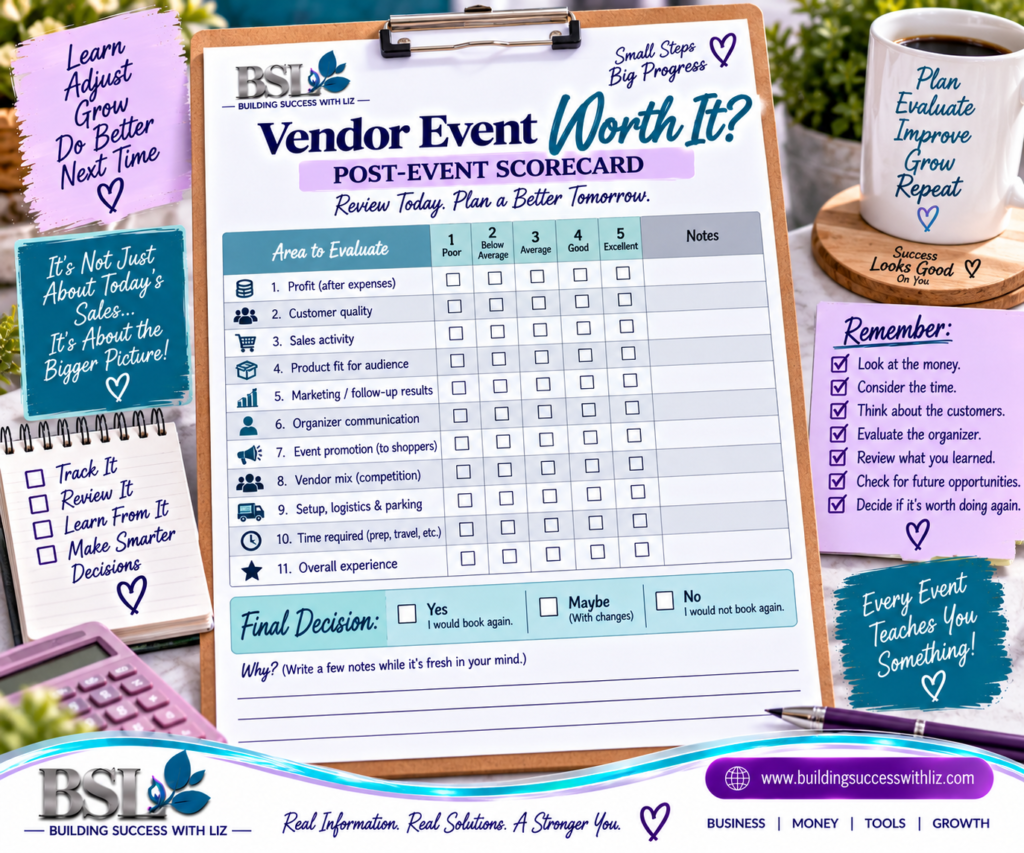
Create Your Own Post-Event Scorecard
After every event, rate these areas from 1 to 5:
- Profit
- Customer quality
- Sales activity
- Product fit
- Marketing/follow-up results
- Organizer communication
- Event promotion
- Vendor mix
- Setup and logistics
- Time required
- Overall experience
Then answer one final question:
Would I book this event again: Yes, Maybe With Changes, or No?
Most importantly, write down why.
Six months later, when registration opens again, you won’t have to depend on memory. You’ll have actual information from your business.
One Bad Event Is Information. A Pattern Is a Decision.
If your first event doesn’t go well, don’t immediately decide vendor events aren’t for you.
Maybe your prices weren’t visible. Maybe you brought too much of the wrong product. Perhaps customers kept asking for something you didn’t have. Maybe weather destroyed attendance.
Learn from it.
But if you attend the same event repeatedly, lose money repeatedly and continue returning because “maybe this year will be different,” eventually you have to respect the evidence.
Business decisions become much easier when you keep records.
The SBA’s break-even guidance makes a similar broader point: understanding costs and revenue helps business owners make decisions based on facts rather than emotion.
Liz Note
When you get home from an event, you’re probably tired. I know the last thing you want to do is sit down with receipts and start doing math.
Do it anyway.
You don’t need a complicated spreadsheet that night. Write down your sales, major expenses, what sold, what customers asked for and anything important you noticed while it is still fresh in your mind. You can organize everything properly later.
Some events will make you money. Some will teach you something. The best ones often do both.
But your goal isn’t to attend every event available.
Your goal is to learn which events deserve your business’s money, inventory and time.
Let’s Talk About It
If you’ve sold at vendor events, think about the best one you’ve attended. What made you want to return? Was it the profit, the customers, the organizer, the location or something else?
And if you’re preparing for your first event, save this article and come back to the scorecard afterward. Don’t judge your day only by the amount of money in your cash box.
FAQ
How do I know if a vendor event was worth it?
Start with actual profit after event-related costs, then evaluate the time required, quality of customers, organizer performance, follow-up business, product feedback and whether you would willingly pay to attend again.
Should I return to an event if I didn’t make a profit?
Possibly, but there should be a good reason supported by evidence. A first event may reveal fixable problems such as poor inventory selection, unclear pricing or an ineffective display. Repeated losses without measurable benefits are a stronger reason to reconsider the event.
Should I count leftover inventory as money lost?
Not automatically. Unsold evergreen inventory that can still be sold elsewhere remains useful inventory. Highly event-specific or dated merchandise has greater risk because your future opportunities to sell it may be limited.
Is a busy vendor event always a good event?
No. Large attendance does not guarantee that attendees are appropriate customers for your products or that vendors will make profitable sales.
What should I track after each vendor event?
At minimum, record sales, major expenses, products sold, leftover inventory, customer requests, leads or follow-up orders, organizer performance, total time invested and whether you would attend again.