
You sold a product for $25, and it cost you $7 in materials. It would be easy to look at those two numbers and say, “Great, I made $18.” But did you really? Once you start adding packaging, payment-processing fees, selling fees, supplies, equipment, waste, and the time it took you to make the product, that $18 can shrink pretty quickly.
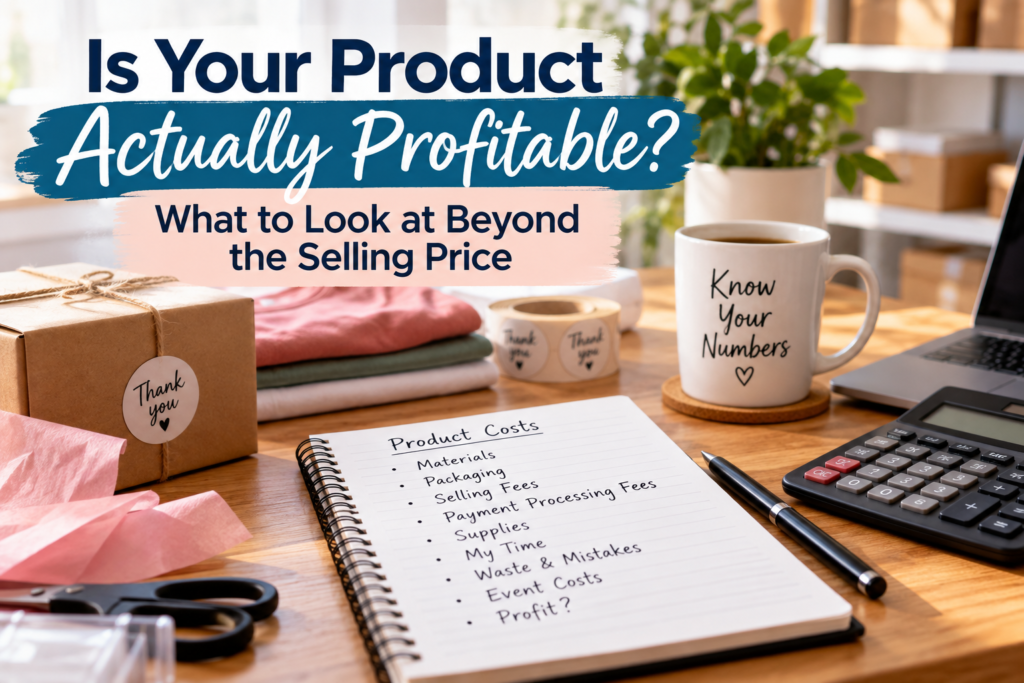
This is why I think we need to have a real conversation about product profitability. A lot of small business owners know their selling price and roughly what they paid for materials, but those two numbers alone do not tell us whether a product is actually profitable. They only give us the beginning of the story.
I understand why we focus so much on sales. When you have a good day and see $300, $500, or even $1,000 come in, it feels good because you know people are buying what you created. But after that excitement settles down, there is another question we have to ask: how much of that money did the business actually keep?
Sales and profit are not the same thing, and sometimes the product selling the most is not even the product making you the most money.
What Does Product Profitability Really Mean?
When we talk about product profitability, we are looking at what is left after the costs associated with producing and selling that product are taken into consideration. That means we have to look beyond what the customer handed us at checkout and pay attention to what it actually took to get that product into their hands.
Imagine you sell a personalized tumbler for $30 and the blank costs you $6. At first glance, you might think you made $24, but you still have to consider the vinyl or sublimation materials, packaging, payment-processing fees, and the time you spent designing, producing, checking, and packing the order. If you sell through an online marketplace, you may also have listing fees or transaction fees.
Now that $24 looks a little different.
The U.S. Small Business Administration also talks about understanding fixed costs, variable costs, selling price, and break-even points when figuring out whether a business can actually make money. Their break-even guidance is worth reviewing because understanding your true costs can help you price more accurately and catch expenses you may have overlooked.
You do not need to become an accountant to run a small business. You do, however, need to know where your money is going.
1. Start With the Actual Material Cost
Material cost is usually the first thing business owners think about when they calculate product profitability, and that makes sense because it is often the easiest cost to see. If you make a T-shirt, you probably know what you paid for the blank and the transfer. If you make candles, you may immediately think about wax, fragrance, wicks, jars, and labels.
The problem is that we sometimes stop there.
Think about all the little things that go into one finished product. Maybe you use a plastic sleeve, a piece of tissue paper, ribbon, a backing card, a sticker, a label, or a thank-you card. Each item may only cost a few cents, so it is easy to tell yourself it does not matter.
It does matter when you multiply it across dozens or hundreds of sales.
If you purchased 100 bags for $20, each bag costs about 20 cents. That 20 cents belongs in the cost of the product using that bag because the business paid for it. I would much rather see you count a small expense than pretend it does not exist and wonder later why the numbers are not adding up.
2. Packaging Can Quietly Eat Into Your Profit
Packaging deserves a closer look because it is one of those expenses that can slowly reduce product profitability without us really noticing. Boxes, mailers, protective sleeves, bubble wrap, tissue paper, labels, tape, backing cards, stickers, and thank-you inserts all cost money.
There is nothing wrong with wanting your order to look nice when the customer opens it. Good packaging can make a product feel more professional and can improve the customer’s experience. The important part is knowing how much that experience is costing you.
For example, if you sell an item for $12 and spend $2.25 on the packaging alone, that is a significant percentage of the selling price. If you then add materials, fees, and your time, you may discover that you are doing a lot of work for very little return.
This is also where I want new business owners to be careful about comparing themselves to established businesses online. You might see someone using custom boxes, specialty tissue paper, foil stickers, branded ribbon, and beautiful inserts and think you need all of it immediately. You do not.
Sometimes the pretty custom box belongs in the future plan, not today’s budget. In Save for Your Business Without Debt, we talk about separating what your business truly needs now from what would be nice to have later. Packaging is one of those areas where that distinction can save you money.
3. Do Not Ignore Selling and Payment Fees
If you sell online or accept card payments, you probably have fees somewhere in the transaction. Depending on where you sell, there may be listing fees, transaction fees, payment-processing fees, subscription charges, advertising fees, or other platform costs.
These expenses need to be part of your product profitability calculation because the amount the customer paid is not always the amount that arrives in your account.
Let’s say you sell a product for $20. After materials and packaging, you calculate that $11 remains. That still does not mean you made $11 if additional selling and processing fees are taken out before the money reaches you.
This is also why I recommend checking the current fee schedule for whatever platform you use instead of relying on an old YouTube video or social media post. Fees can change, and if you are pricing based on outdated information, your profit calculation may already be wrong before you even make the sale.
Look at what the customer paid, but also look at what actually landed in your account. Those two numbers can tell very different stories.
4. Your Time Has to Count for Something
This is where some business owners get uncomfortable because they enjoy making the product. I understand that, but enjoying the work does not mean your time has no value.
Think about everything involved from beginning to end. You may have to create or personalize the design, prepare materials, print, press, cut, assemble, check the finished product, package it, communicate with the customer, and prepare it for pickup or shipping. That time adds up quickly.
Two products can leave you with the same amount of money after materials but have completely different product profitability once you consider the time involved. If Product A leaves you $15 and takes 15 minutes to make, while Product B leaves you $15 and takes an hour and fifteen minutes, those products are not performing the same way.
This matters even more as your business grows. Something that feels manageable when you have five orders may become exhausting when you have 50. If a product takes too long to make for the amount it brings back into the business, you need to know that before you start pushing it as one of your main products.
5. Vendor Events Have More Costs Than the Booth Fee
Vendor events are another place where sales numbers can make things look better than they really are. You may finish an event and say, “I made $600 today,” but the better question is how much of that $600 was left after the event expenses.
You may have paid a booth fee, gas, tolls, parking, food, card-processing fees, and additional packaging. Maybe you bought a tablecloth, signs, display pieces, or other supplies specifically for the event. You also spent time loading the vehicle, traveling, setting up, selling, breaking down, and driving home.
Not every event expense has to be assigned directly to one product, but the costs still have to show up somewhere when you evaluate whether the event helped the business.
If you spent $150 to participate and sold $400, you did not make $400 in profit. You made $400 in sales, and now the expenses need to come out of that amount before you can determine what the business actually earned.
That is product profitability meeting real life.
If your sales have been inconsistent and you are trying to figure out whether the issue is pricing, traffic, inventory, or expenses, take a look at What to Do When Sales Are Slow: 9 Smart Moves Before You Give Up. Sometimes the answer is not to spend more money trying to fix the problem. Sometimes we need to slow down and figure out what the actual problem is first.
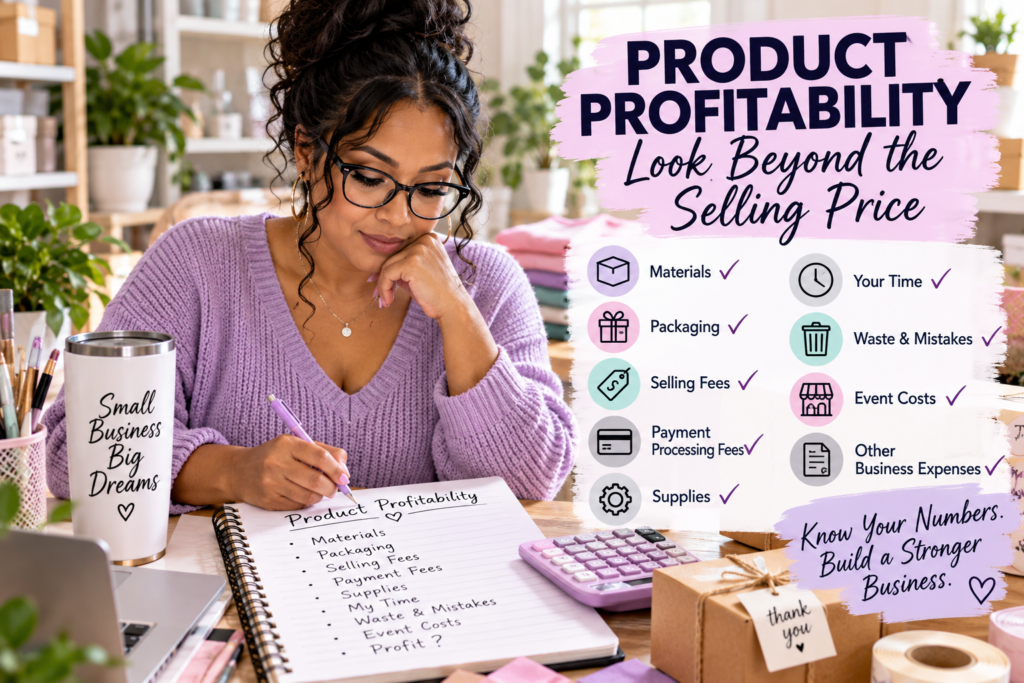
6. Mistakes, Waste, and Unsold Inventory Still Cost Money
Nobody enjoys talking about mistakes and wasted materials, but they are part of running a business. A transfer gets ruined, a label prints incorrectly, a shirt gets scorched, a piece breaks, or a personalized item has to be remade.
Then there is inventory that simply does not sell.
Maybe you made 20 seasonal products and only sold 12. The cost of those remaining eight products did not disappear just because customers did not buy them. The business still paid for those materials.
You do not necessarily need to add the full cost of every possible mistake into every product you sell, but you should watch your waste over time. If you regularly spend $500 on materials and lose $75 worth to mistakes, testing, damaged products, or unsold inventory, that information matters when evaluating product profitability.
The problem may not always be the selling price. Maybe you are producing too much before testing demand, ordering materials in quantities that are too large, or offering too many variations.
This is why testing an idea before investing heavily can save you a lot of money. In 7 Smart Ways to Research Whether Your Business Idea Will Sell, I talk about looking for real signs of demand before putting a lot of money into a product.
Making 10 and learning that customers are not interested hurts a lot less than making 100.
7. Revenue and Profit Are Not the Same Number
This may be the most important part of the entire conversation because revenue can make a business look healthier than it really is.
Revenue is the money coming into the business. Profit is what is left after the expenses are paid.
If your shop brings in $2,000 this month, it does not automatically mean you made $2,000. Maybe $800 went toward materials, another $150 went to fees, $100 went to packaging, and $200 went toward two vendor events. You still have to consider any additional operating costs on top of those expenses.
That changes the picture quickly.
This is why product profitability becomes so important when you are deciding which products deserve more attention. Your best-selling product might only leave you a small amount after expenses, while another product sells fewer units but has a stronger margin and takes less time to produce.
The best seller and the most profitable product do not always have to be the same thing.
A Simple Product Profitability Example
Let’s say you sell a handmade product for $25. Your materials cost $7, packaging costs $1.50, selling and payment fees come to $2, and you allow another $1 for small supplies and normal waste.
Your direct costs are now $11.50, which leaves $13.50 before considering your labor and the other expenses involved in operating your business.
That remaining $13.50 may be perfectly reasonable if the product takes 15 or 20 minutes to make. If it takes you two hours, however, we need to look at that product very differently.
This is why saying, “It only costs me $7 to make and I sell it for $25,” does not tell us whether a product is truly profitable. It tells us the material cost, but we still need the rest of the numbers before we know how the product is performing.
What About Equipment and Other Business Expenses?
Not every business expense can be tied neatly to one product. You may have website hosting, software subscriptions, equipment, insurance, licensing, advertising, bookkeeping, or other expenses that support the business as a whole.
Those costs still matter.
Over time, the profit generated from your products or services has to be enough to help cover those operating expenses too. That is one reason understanding your overall break-even point is useful.
If you are still working through the foundation of your business, The First 10 Steps to Starting a Business Without Feeling Overwhelmed can help you look at costs, pricing, testing, and planning before you invest too heavily. You can also visit the BSL Grow & Manage Your Business section for more articles about making stronger business decisions as you grow.
Does Low Profit Automatically Mean You Should Raise the Price?
After everything we just talked about, you may be thinking I am going to tell you to raise your prices.
Not necessarily.
Sometimes the selling price does need to change, but sometimes the real problem is on the cost side of the business. You may be buying supplies from an expensive source, using packaging that costs too much, wasting materials during production, offering too many variations, or spending too much time producing one item.
There may also be subscriptions or tools you are paying for but barely using. Maybe you are ordering inventory in quantities that tie up too much cash, or maybe your production process can be simplified without lowering the quality of the finished product.
That is why product profitability should not only be about asking, “Can I charge more?” We should also be asking, “Can I make this product more efficiently without hurting the customer’s experience?”
Both sides of the equation matter.
Liz’s Note
One thing I really want small business owners to stop doing is comparing their business to someone else’s sales screenshots. Someone can post that they made $10,000 this month, and we still know almost nothing about what happened inside that business.
We do not know if it cost them $7,000 to generate those sales. We do not know their advertising costs, payroll, refunds, inventory purchases, debt, or operating expenses. We know one number because that is the number they chose to show us.
Run your business using your own numbers.
I would rather see someone build a smaller business that understands where its money is going than chase impressive revenue numbers while having no idea whether the business is actually making money. That information may not look exciting on social media, but it is far more useful when you are trying to build something that lasts.
Review Product Profitability More Than Once
Do not calculate product profitability once and assume the answer will stay the same forever. Material prices change, shipping costs increase, suppliers adjust their rates, and selling platforms change their fees.
Your business changes too.
Maybe you find a better supplier, improve your production process, or learn how to make the product faster. Maybe your sales volume increases enough to qualify for better bulk pricing. All of those changes can affect the profitability of the product.
Every so often, go back through your main products and ask yourself what each one costs you today, how long it takes to make, whether those costs have changed, and how much you actually keep after the sale.
Pay particular attention to your best sellers. A small cost increase on a product you sell two or three times a month may not have a big impact, but that same increase on a product you sell hundreds of times can make a noticeable difference.
If you are working on getting more customers while keeping your spending under control, How to Find Your First Customers Without Spending a Fortune can also help you think about testing and promoting your products without throwing unnecessary money at advertising.
Before You Make Another Batch
Before you purchase more supplies or make another large batch of inventory, choose one product you sell regularly and run the numbers again. Start with the selling price, subtract the materials and packaging, add your selling fees, consider waste, and think about how much time the product takes you to complete.
Then look at what is left.
You may discover that the product is doing better than you thought. You may find that a small adjustment would make a big difference, or you may realize that something you considered profitable has actually been keeping you busy without giving much back to the business.
Any of those answers are useful because now you are working with information instead of guessing.
The goal is not simply to keep selling more products. The goal is to build a business where the products you are selling actually help the business make money and move forward.
That is what product profitability is really about.
Frequently Asked Questions About Product Profitability
What is product profitability?
Product profitability looks at how much money a specific product contributes after considering the expenses involved in producing and selling it. Materials are part of the calculation, but packaging, selling fees, labor, waste, and other business costs can affect the final result too.
Understanding this number helps you decide whether a product is worth continuing, whether something needs to change, or whether another product deserves more of your attention.
Is my selling price minus material cost my profit?
Usually not. Subtracting material cost from the selling price gives you useful information, but there are often additional costs involved before you arrive at actual profit.
Packaging, payment fees, marketplace charges, labor, wasted materials, and operating expenses can all reduce what the business actually keeps from the sale.
Should handmade businesses include labor in their pricing?
Your time should at least be considered when you evaluate whether a product makes financial sense. Two products may generate the same amount after materials, but if one takes 15 minutes and the other takes two hours, they are not equally valuable to the business.
You may calculate labor differently depending on your business model, but pretending your time costs nothing can give you a very misleading picture of product profitability.
What if my product sells well but the profit is too low?
Do not automatically assume the only answer is raising the price. Look at your material costs, packaging, suppliers, production process, selling fees, and the amount of time the product requires.
Sometimes a small change to the way you make, package, or purchase supplies for a product can improve profitability without changing what the customer pays.
How often should I check product profitability?
Review your numbers whenever a significant expense changes and periodically for the products that make up most of your sales. Your best sellers deserve the most attention because small increases in cost can become much larger when multiplied across many orders.
The goal is not to obsess over every penny every day. The goal is to know enough about your numbers that you can catch a problem before months go by.
Your Next Step
Do not try to calculate every product in your store today. Pick one product you sell regularly and start there.
Write down the selling price, materials, packaging, fees, waste, and the time required to make it. Then look at what the product is actually giving back to your business.
Once you understand one product, move on to the next.
You do not need complicated accounting software to begin understanding product profitability. You need accurate numbers, a little time, and a willingness to look past the selling price and see what your product is actually costing you.
That is how we stop guessing and start making stronger business decisions.