
Sometimes we make financial progress harder to recognize than it needs to be. We tell ourselves that saving $10 does not count because it is not $1,000, or that paying an extra $20 toward a credit card is not worth mentioning because the balance is still there. We may even cancel a subscription, avoid a late fee, or make it through the week without touching savings and still convince ourselves that nothing meaningful happened.
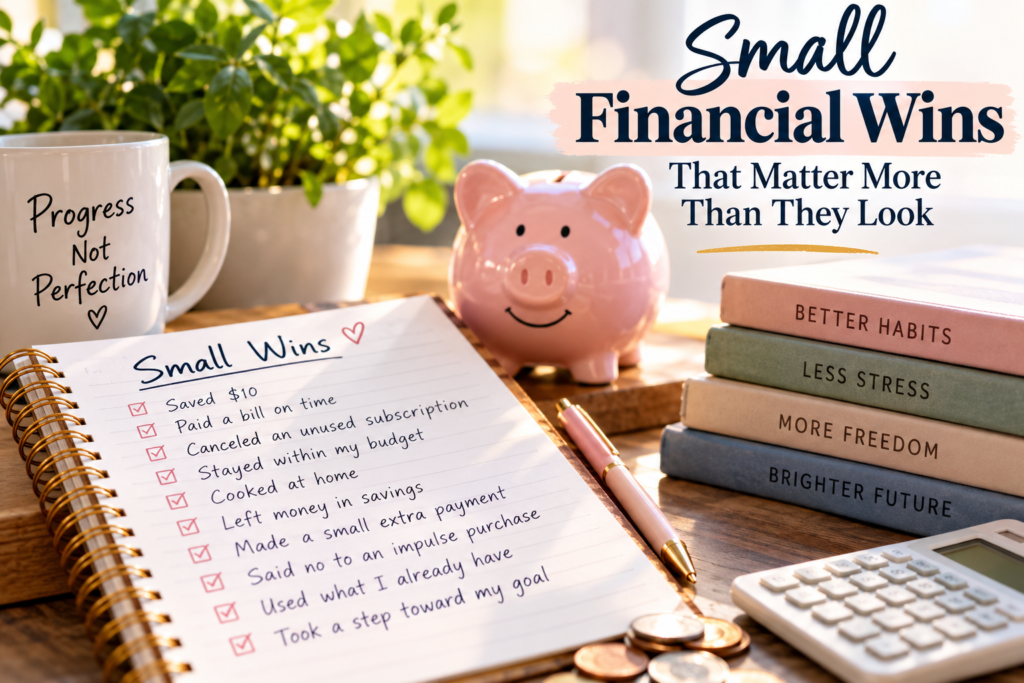
Those are small financial wins, and they matter more than they look. Financial progress is not always a huge debt payoff, a five-figure savings account, or one dramatic month where everything suddenly comes together. A lot of progress happens quietly, through slightly better choices repeated over time.
The problem is that we are surrounded by big financial goals. Save $10,000, pay off all your debt, build six months of expenses, invest more, buy a house, or start a business. Those are worthwhile goals, but when we only measure ourselves against the finish line, it can feel like we are getting nowhere even when we are actually moving forward.
That is why I want to talk about small financial wins today. They may not look impressive in the moment, but they are often the steps that eventually create the bigger result.
What Counts as a Small Financial Win?
A small financial win is any action that improves your financial position, even if the dollar amount looks modest. It can be saving $15, paying a bill before the due date, staying within your grocery budget, skipping an impulse purchase, or finally canceling something you have been paying for and not using.
Those actions count because they change what happens next. A small choice can prevent a larger expense, free up money, reduce debt, or create a habit that becomes easier to repeat.
The Consumer Financial Protection Bureau encourages people to start building a savings habit even when the amount they can save is small. Its emergency savings guide explains that even a modest amount set aside can provide some financial security and help people recover more quickly from unexpected expenses.
That matters because people often postpone saving while waiting for the perfect time to start. If you keep waiting until you can save a large amount, you may end up saving nothing at all.
1. Saving $5 or $10 Still Counts
If you can only save $5 this week, save the $5. I know that amount may not feel exciting, especially when every financial article seems to talk about saving thousands of dollars, but small financial wins become powerful when they happen repeatedly.
Five dollars saved every week is $260 over a year. Ten dollars a week becomes $520, and twenty-five dollars a week becomes $1,300. The amount grows, but just as important, you are building the habit of keeping some of your money instead of automatically spending everything that comes in.
That habit matters because consistency usually works better than setting an amount that looks impressive but does not fit your actual budget. I would rather see you consistently save $10 than set a goal of $100 a week, struggle to keep up, and give up after two weeks.
The CFPB also recommends consistent saving strategies such as recurring transfers because automation can make saving easier over time. You do not need to automate a huge amount. Start with something that fits your life and increase it when you are able.
2. Paying a Little Extra Toward Debt Is Progress
Debt can be frustrating because progress sometimes feels invisible. You make a payment and the balance is still there, then you make another payment and it is still there, which can make it feel like nothing is changing.
But it is changing. If your required payment is $75 and you are able to send $90, that extra $15 is a small financial win because you reduced the amount you owe a little faster than you would have otherwise.
The important thing is not pretending that one extra payment will magically erase a large balance. The important thing is recognizing that financial improvement is usually cumulative, which means one better decision becomes another and another.
You make the extra payment when you can, avoid adding new debt where possible, and keep moving forward. Over time, those choices begin working together even if the progress feels slow in the beginning.
If your budget has been feeling scattered and you are not sure where extra money could come from, start with the BSL Monthly Money Reset. It helps you look at your actual spending before deciding what needs to change.
3. Avoiding a Fee Is a Financial Win
We usually think of progress as money coming in or savings going up, but sometimes progress is money that never leaves. Maybe you paid a bill on time and avoided a late fee, checked your account before making a purchase, or canceled a service before it renewed for another year.
That is money you kept. If you avoid one $35 fee, your bank account may not suddenly look richer, but your financial position is still $35 better than it would have been.
This is one reason I encourage people to look at their accounts regularly instead of waiting until there is a problem. Small financial wins often come from catching something early, before it turns into a larger expense.
The numbers may not look dramatic, but preventing a loss is still progress. You do not have to wait for a big deposit to improve your finances.
4. Canceling One Unused Subscription Matters
Subscriptions are easy to ignore because they usually look harmless by themselves. Nine dollars here, twelve dollars there, and sixteen dollars for something you meant to cancel three months ago may not feel like much when you look at each charge separately.
Then you add them together. If you cancel a $15 monthly subscription you do not use, you just freed up $180 a year.
That is a real number, and it is a real small financial win. You do not have to cancel everything you enjoy or turn your life into one long list of things you are not allowed to buy.
The point is simply to pay attention. If you use the subscription and it fits your budget, keep it, but if you forgot you even had it, that money may be more useful somewhere else.
5. Leaving Money in Savings Is Also a Win
We talk a lot about putting money into savings, but we do not talk enough about the win that happens when you leave it there. Maybe you saved $300 and then had a week where you were tempted to pull $50 out for something you wanted but did not really need.
You decided not to move the money, and nothing dramatic happened on your bank statement. That was still a financial win because you protected money that already had a job.
Sometimes the best financial decision is not doing something. You did not transfer the money, place the order, or swipe the card, and you gave yourself time to think before making a decision.
Those choices matter because they help preserve progress you already made. Small financial wins are not only about adding more money. Sometimes they are about keeping what you already built.

6. Checking Your Bank Account Instead of Avoiding It
This may sound simple, but looking at your money can be a small financial win. When money is stressful, avoiding it can feel easier because opening the account means facing whatever is there.
The problem is that the numbers do not disappear while we are avoiding them. Looking at your balance gives you information, and information gives you something real to work with.
Maybe the situation is better than you feared, or maybe it is worse. Either way, now you know what is happening instead of guessing.
That is the same idea behind a Monthly Money Reset. The goal is not to judge yourself for what happened. The goal is to understand what happened so you can decide what to do next.
7. Not Buying Something Can Be Progress Too
There are times when the smartest thing you can buy is nothing. Maybe you put something in your online cart and waited overnight, then realized the next morning that you did not really want it.
Maybe you walked through a store, saw something on sale, and instead of thinking, “I am saving 40 percent,” you asked yourself whether you had planned to buy it in the first place. That pause can be one of those small financial wins that never shows up on a statement.
You will not see a line in your bank account that says, “Congratulations, you did not spend $47 yesterday.” The money is still there, though, because you made a different decision.
That matters. Avoiding an unnecessary expense can improve your finances just as much as finding a few extra dollars to save.
8. Using What You Already Own Is a Financial Win
Before buying something new, look around at what you already have. This applies to both personal finances and business finances because sometimes we keep spending while useful things are already sitting in cabinets, closets, storage bins, or inventory shelves.
Maybe you already have enough cleaning supplies for the month, or there are groceries in the freezer that can become dinner. Maybe your business already owns materials that could be used for the next product instead of placing another supply order.
Using what you already paid for can create small financial wins because it delays or eliminates another expense. That may sound basic, but it is one of the easiest places to stop money from leaving unnecessarily.
For business owners, this becomes especially important when money is tied up in inventory and supplies. In What to Do When Sales Are Slow, we talk about looking at what is already inside the business before spending more simply because sales have slowed down.
Inventory is money, and unused supplies are money. Sometimes financial progress begins by using what you already bought before ordering more.
9. Saying “Not Yet” Instead of “Never”
Financial goals become exhausting when everything feels like deprivation. You see something you want and tell yourself, “I can never have that,” and after a while budgeting starts to feel more like punishment than planning.
Try changing the language. Instead of saying, “I cannot have it,” try saying, “Not yet.”
Maybe you want new business equipment, a vacation, a new phone, or furniture for the house. Put a number on it, create a savings category, and start working toward it.
That turns the purchase from an impulse into a plan. It also gives you another way to create small financial wins because each small amount you set aside moves you closer without putting the entire cost on a credit card.
For business owners, this is one reason I like separating what the business needs now from what it can save for later. In Save for Your Business Without Debt, we discuss starting with the smallest responsible version of the business instead of trying to buy the finished version before the business has earned it.
Waiting is not failure. Sometimes waiting is one of the smartest financial decisions you can make.
10. Recovering From a Bad Money Week Counts
You overspent, ordered food more than planned, or bought something you did not need. Maybe an unexpected expense threw off the entire week and made your budget look nothing like what you had planned.
What happens next matters more than people realize. One bad decision can easily turn into a bad month if you start thinking, “I already messed up, so it does not matter now.”
It still matters. If Wednesday went badly and Thursday you make a better choice, that is a small financial win because you stopped one problem from becoming a longer pattern.
You do not have to wait until next Monday, next month, or January 1 to start again. Financial progress is not ruined because every decision was not perfect.
You adjust and continue. That ability to recover is part of financial progress too.
11. Putting Something Aside for an Upcoming Expense
Not every future expense is an emergency. Christmas comes every year, birthdays come every year, car registration renews, insurance bills arrive, and school expenses tend to return whether we are ready for them or not.
When we know an expense is coming and save a little toward it ahead of time, that is another form of small financial wins. Maybe you only put $10 aside for Christmas this week, and that amount may not feel impressive in October.
But that is $10 you will not have to find later. Do it again next week and now you have $20, and slowly the expense becomes less intimidating because you are preparing for it instead of waiting for it to become urgent.
The amount grows, but so does your sense of control. You are turning a predictable expense from a surprise into a plan.
Why Small Financial Wins Matter So Much
The biggest benefit of small financial wins is not always the dollar amount. Sometimes the bigger benefit is that they show you that progress is possible.
That matters when you have spent months feeling like your finances are stuck. Maybe you cannot pay off the credit card today, but you made the payment and avoided adding more to the balance.
Maybe you cannot build a $5,000 emergency fund this month, but you saved $25. Maybe you cannot completely overhaul your budget, but you canceled one expense and made one better decision.
Each win gives you something to build on. Financial progress often becomes easier when we stop trying to fix everything at once.
Do Not Use Small Wins to Ignore Bigger Problems
Celebrating small financial wins does not mean pretending serious financial problems are not there. If your expenses regularly exceed your income, saving $5 here and there will not solve the larger gap by itself.
If debt payments are becoming unmanageable, you may need a more complete plan. If you are repeatedly using credit cards for basic living expenses because there simply is not enough money in the budget, the issue is bigger than cutting one subscription.
Small wins help build momentum, but they do not replace looking at the full picture. Review your income, bills, debt, savings, and upcoming expenses regularly so you can see where the bigger problems are.
You can celebrate progress and still be realistic. Both things can be true at the same time.
Liz’s Note
I think we sometimes make ourselves feel worse about money because we only celebrate the finish line. You paid off one credit card, but there are still two left, so you tell yourself it is not enough.
You saved $300, but somebody online says you should have $10,000, so suddenly your $300 feels embarrassing. You stopped using one buy-now-pay-later account, but instead of recognizing that change, you focus on what you still owe somewhere else.
That kind of thinking can make progress invisible. I am not saying $300 is the same as $10,000, because it is not, but the person who has $300 saved today after having nothing six months ago has made progress.
Recognize it, then keep going. You do not have to pretend the goal is complete to admit that you are moving in the right direction.
Start Tracking Your Small Financial Wins
Here is something simple you can try this month. Create a note on your phone, a page in your planner, or a piece of paper and call it My Small Financial Wins.
Every time you do something that improves your finances, write it down. Maybe you saved $20, cooked instead of ordering food, paid an extra $10 toward debt, called and had a fee removed, avoided an impulse purchase, canceled a subscription, moved money into a sinking fund, or stayed within your grocery budget.
At the end of the month, look at the list. One decision may not look impressive by itself, but twenty better decisions can tell a very different story.
This also gives you something concrete to look back on when you feel like you are not making progress. Your list becomes proof that your habits are changing.
Frequently Asked Questions About Small Financial Wins
What are small financial wins?
Small financial wins are actions that improve your financial situation even when the dollar amount is modest. They can include saving a small amount, avoiding a fee, paying extra toward debt, canceling an unused subscription, staying within a spending category, or preparing ahead for an upcoming expense.
The important part is that the action moves your finances in a better direction. It does not have to be dramatic to be useful.
Does saving a small amount really make a difference?
Yes, especially when the habit is consistent. Small savings can create a cushion for unexpected expenses and can also help build the habit of setting money aside regularly.
The CFPB specifically notes that even small amounts of emergency savings can provide some financial security. The goal is to start with an amount you can realistically maintain and build from there.
Should I save money if I am also paying off debt?
That depends on your overall financial situation, the type and cost of the debt, and whether you have any emergency savings available. Having at least some cash set aside can help prevent a small emergency from immediately becoming new debt.
If you are unsure how to balance competing priorities, start by looking at your full monthly cash flow instead of treating savings and debt as completely separate problems. The right balance will depend on what your numbers actually look like.
How do I stay motivated when my financial progress is slow?
Track what you are doing instead of only looking at what remains. A large goal can make progress feel tiny when you constantly compare today’s number with the final target.
Recording small financial wins gives you proof that your habits are changing even before the larger numbers catch up. That proof can make it easier to keep going when progress feels slow.
What if I had a bad financial month?
Review what happened and start again from where you are. One bad month does not require another bad month.
Use a Monthly Money Reset to look at what went wrong, what was outside your control, and what you want to change next. Progress does not require perfection, but it does require paying attention.
Your Next Step
Before today is over, identify one small financial win you can make. Maybe you transfer $10 to savings, cancel a subscription you forgot about, check your bank account, make a small extra debt payment, or put $5 aside for an expense you know is coming.
Then write it down and look for another small win tomorrow. The goal is not to transform your entire financial life in one day, because that is usually where people get overwhelmed and quit.
Financial progress often happens quietly, five dollars at a time, one avoided fee at a time, and one better decision at a time. Those small financial wins may not look impressive by themselves, but together they can change a lot.