
Have you ever finally managed to save a little money, felt good seeing that balance grow, and then suddenly watched it disappear?
Christmas comes around. The car registration is due. Your child needs something for school. Then the washing machine breaks, and now the money you thought was your emergency savings is almost gone.
This is where a lot of people start thinking, “What is the point of saving if I always have to spend it?”
The problem may not be that you are bad at saving. The problem may be that one pile of money is trying to do too many jobs.
Some expenses are true emergencies. Other expenses are things we already know are coming, even if we do not know the exact date or amount yet. When all of that money is sitting together with one label that says “Savings,” it becomes very easy to use money meant for one purpose on something completely different.
That is why understanding emergency fund vs sinking fund can make such a difference.
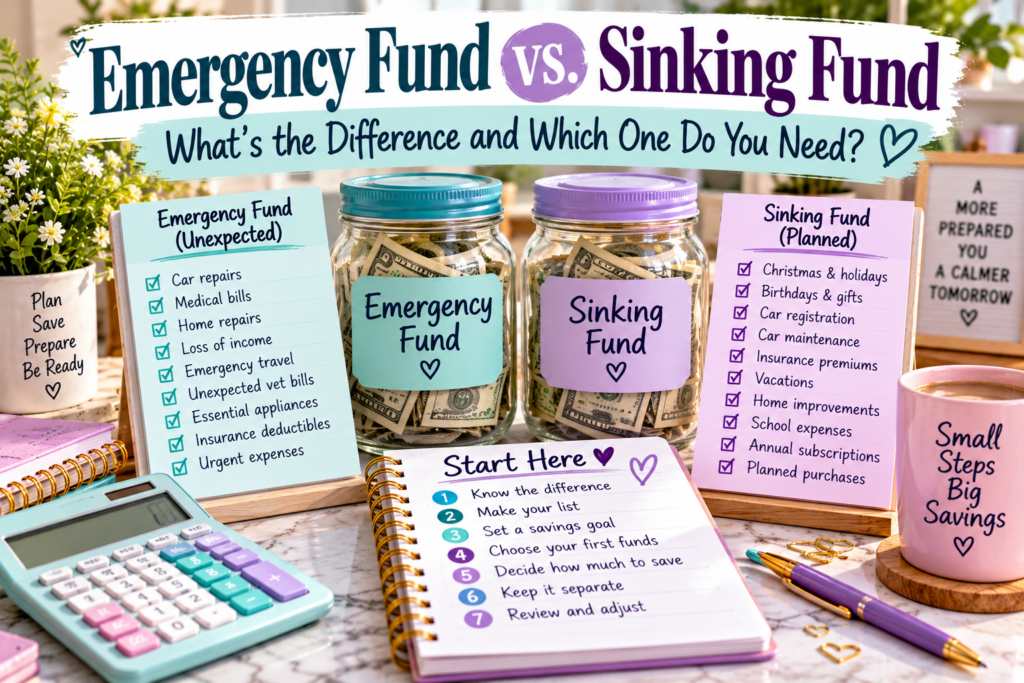
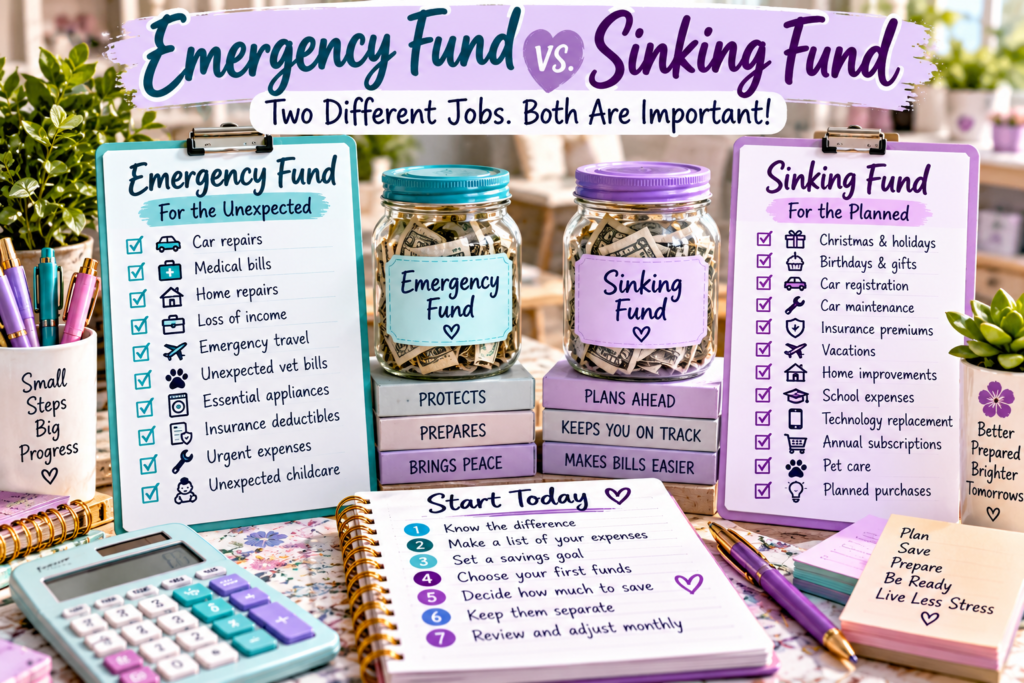
An emergency fund protects you when something unexpected happens. A sinking fund helps you prepare for expenses you already know are coming.
If you have never created either one before, do not worry. We are going to start at the beginning and set this up step by step.
Emergency Fund vs Sinking Fund: The Simple Difference
Before we start opening accounts or deciding how much money to save, let’s make the difference simple.
An emergency fund is money you keep for necessary expenses you could not reasonably predict or prepare for ahead of time. Something happened unexpectedly, and your normal monthly budget does not have enough room to cover it.
A sinking fund is money you save gradually for an expense you know is coming. You may not know the exact amount yet, but you know eventually you are going to need the money.
Think of it this way.
Your emergency fund says, “Something happened.”
Your sinking fund says, “Something is coming.”
That one distinction makes the whole emergency fund vs sinking fund conversation much easier to understand.
The Consumer Financial Protection Bureau describes an emergency fund as money set aside specifically for unplanned expenses or financial emergencies. It also explains that even a small amount of emergency savings can provide some financial security when unexpected expenses happen.
What Is Considered an Emergency Fund Expense?
One of the first things you should do when creating an emergency fund is decide what you personally consider an emergency. If you do not decide ahead of time, it becomes very easy to call almost anything an emergency when you want to use the money.
A true emergency is generally unexpected, necessary, and difficult to cover with your regular monthly budget.
Examples of expenses that may qualify for emergency-fund money include:
- An unexpected major car repair
- An emergency home repair such as a broken furnace or burst pipe
- An unexpected medical or dental expense
- A sudden loss or reduction of income
- An emergency veterinarian bill
- Necessary travel because of a family emergency
- Replacement of an essential appliance that suddenly stops working
- An insurance deductible after an unexpected event
- Emergency childcare caused by an unexpected situation
- An urgent expense required to keep you working, such as an unexpected vehicle repair
Your list may look a little different because everyone’s life is different. Someone who owns a house may have emergencies that a renter does not, while someone who depends on a vehicle for work may need to treat transportation problems differently from someone who uses public transportation.
The important part is creating your own rules before you need the money.
The Consumer Financial Protection Bureau explains that an emergency fund is money specifically set aside for unplanned expenses such as car repairs, home repairs, medical bills, or a loss of income.
What Is NOT Usually an Emergency?
This is where we sometimes get ourselves into trouble.
Christmas is not an emergency. Your car registration is not an emergency if it renews every year. A vacation is not an emergency, and neither is replacing a phone simply because a newer model was released.
Those expenses may absolutely matter to you. They simply belong somewhere else.
Examples of expenses that are usually not emergencies include:
- Christmas gifts
- Birthday gifts
- Vacations
- Routine car maintenance
- Car registration
- Annual insurance premiums
- Back-to-school shopping
- Planned home improvements
- Annual subscriptions
- New furniture you have been planning to buy
- A planned phone or computer upgrade
- Regular pet care
- Holiday meals and entertaining
- Planned business equipment
- Property taxes you know are due
This does not mean these expenses are unimportant. It means they are predictable enough that you can prepare for them using a sinking fund.
That distinction protects your emergency savings.
What Is a Sinking Fund?
A sinking fund is money you save little by little for a specific future expense.
Instead of waiting for a $600 bill and wondering where you are going to find $600, you begin saving ahead of time. If the expense is six months away, maybe you save $100 a month. If it is 12 months away, maybe you save $50 a month.
The expense becomes easier because you spread the cost over time.
This is one of the biggest advantages of understanding emergency fund vs sinking fund. Your emergency fund protects you from financial surprises, while sinking funds help prevent predictable expenses from turning into financial emergencies.
What Should You Have a Sinking Fund For?
You can create sinking funds for almost any predictable expense, but you do not need to create 30 categories on your first day.
Start with the expenses that affect your household most often.
Common personal sinking funds include:
- Christmas and holiday spending
- Birthdays and gifts
- Car registration
- Car maintenance and tires
- Home maintenance
- Annual or semiannual insurance premiums
- Medical copays and planned medical expenses
- Dental expenses
- Pet care and routine veterinary expenses
- School supplies
- Clothing
- Vacation or travel
- Technology replacement
- Furniture and home purchases
- Annual memberships
- Subscription renewals
- Property taxes
- HOA fees
- Holiday meals and entertaining
- Planned appliance replacement
Business owners can use sinking funds too. In fact, they can be extremely helpful when business expenses do not happen every month.
Possible business sinking funds include:
- Vendor-event fees
- Equipment replacement
- Inventory purchases
- Annual licenses and permits
- Business insurance
- Website renewals
- Software subscriptions
- Training and education
- Marketing expenses
- Tax preparation
- Planned business travel
- Future equipment upgrades
You do not need all of these categories. The goal is to identify the expenses that actually apply to your life.
Step 1: Start With What You Already Know Is Coming
If this is your first time setting up an emergency fund vs sinking fund system, do not start by trying to predict every expense you will have for the next five years.
Start with the next 12 months.
Take out a piece of paper, open the notes app on your phone, or use your planner. Write down the expenses you already know are coming that are not part of your normal monthly bills.
Maybe your list looks like this:
- Car registration in February
- Daughter’s birthday in March
- Annual Amazon membership in April
- New tires sometime this summer
- Christmas in December
Now you have the beginning of your sinking-fund list.
This also works well with the system we discussed in How to Prepare for Upcoming Bills Without Falling Behind. The idea is to stop letting predictable expenses surprise your budget simply because they do not happen every month.
Step 2: Decide What Your First Emergency-Fund Goal Will Be
This is where I want beginners to be realistic.
You may hear advice saying you need three months, six months, or even a year of expenses saved. Those can eventually be worthwhile goals, but if you currently have no emergency savings, hearing that you need $15,000 may make you feel defeated before you even start.
Do not begin there.
Pick a first goal you can actually see yourself reaching.
Maybe your first emergency-fund goal is:
- $100
- $250
- $500
- $1,000
Once you reach the first goal, you can decide on the next one.
If you save $100, that does not mean you now have enough for every possible emergency. It means you have $100 more protection than you had before.
That matters.
The CFPB also emphasizes that even small amounts of emergency savings can help people handle financial shocks. You do not have to wait until you can save thousands of dollars before beginning.
Step 3: Choose Your First Few Sinking Funds
Now go back to the list of upcoming expenses you made in Step 1.
Do not create a sinking fund for everything at once. Choose the two or three expenses that are closest or most important.
For example, maybe you decide to start with:
- Car registration
- Christmas
- Car maintenance
That is enough.
Later, once the system feels comfortable, you can add birthdays, home repairs, vacations, school supplies, or whatever else fits your household.
The purpose of a sinking fund is to make your money easier to manage. If you create so many categories that the system feels exhausting, you are making it harder than it needs to be.
Step 4: Figure Out How Much You Need to Save
Now we get to the math, but I promise this does not need to be complicated.
Take the total amount you expect to need and divide it by the number of months or pay periods before the expense happens.
For example, suppose your car registration will cost approximately $240 and is due in 12 months.
$240 ÷ 12 months = $20 per month
Now suppose you want $600 for Christmas and you have six months to save.
$600 ÷ 6 months = $100 per month
This gives you a target.
But here is something important: the target does not become a rule that you must follow no matter what.
If the calculation says you need to save $100 a month for Christmas and your budget only has room for $50, you now have useful information. You can lower the Christmas budget, start earlier next year, look for ways to earn extra money, or make other adjustments.
The sinking fund is helping you make the decision before December instead of after the credit-card bill arrives.
Step 5: Decide How Much You Can Actually Save
Now look at your real budget.
Not your ideal budget.
Not someone’s budget on YouTube.
Your budget.
Maybe you have $75 a month available for savings right now. You decide to divide it this way:
- $40 to your emergency fund
- $20 to car registration
- $15 to Christmas
That is perfectly fine.
Another month, you may be able to save $125. A difficult month may leave you with only $25.
Your emergency fund vs sinking fund plan needs to work with your actual income and actual expenses.
If every dollar already feels spoken for, read How to Save Money When Every Dollar Is Already Spoken For. Sometimes the first step is not finding hundreds of dollars. It is finding the first small amount you can consistently keep.
Step 6: Decide Where You Will Keep the Money
You do not necessarily need ten separate bank accounts.
Some people like separate savings accounts because it makes the money visually easier to manage. Others keep everything in one savings account and track the categories using a spreadsheet, budgeting app, planner, cash envelopes, or savings binder.
Use the system you will actually maintain.
Suppose your savings account shows $1,200.
On paper, you may have:
- Emergency fund: $600
- Car fund: $200
- Christmas fund: $250
- Medical fund: $150
The bank may show one number, but you know that money has four different jobs.
That is the important part.
Without categories, seeing $1,200 can make you feel like you have $1,200 available to spend. In reality, most of that money may already be committed.
Step 7: Fund Both, Even If the Amounts Are Uneven
One question people often ask is whether they should build the emergency fund first or start sinking funds first.
For a beginner, I do not think this always has to be an either-or decision.
If you have absolutely no emergency savings, building a small emergency cushion should probably receive some attention. At the same time, if your car registration is due next month, pretending that expense is not coming will not help you either.
You might split the money unevenly.
For example, if you have $100 available:
- $70 could go toward emergency savings
- $30 could go toward the upcoming registration
Next month, your priorities may change.
The goal is to build protection for the unexpected while also preparing for the expenses you already know are coming.
Step 8: Know Which Fund to Use
Once you have both types of savings, you need to know which one to use when an expense happens.
Ask yourself two questions:
Did I know this expense was coming?
Could I reasonably have planned for it?
If the answer is yes, it probably belongs in a sinking fund.
If the expense was necessary, unexpected, and outside what your normal budget could handle, it may belong in your emergency fund.
Let’s look at the car example.
Your oil change is routine. That belongs in your car sinking fund.
Your registration renewal happens every year. That belongs in your sinking fund.
Your mechanic tells you today that the tires will need to be replaced in six months. You now have time to start a sinking fund.
But if you hit a pothole tomorrow and suddenly need a tire replaced immediately, that may qualify as an emergency.
The expense category can be similar while the timing changes which fund makes sense.
Step 9: Use the Money Without Feeling Like You Failed
This is one of the biggest mental adjustments people need to make with savings.
If you saved $500 for Christmas and spend the $500 on Christmas, you did not lose your savings.
You used the money for exactly what you saved it for.
That is success.
If you saved $1,000 in an emergency fund and an actual emergency requires $600, using the $600 does not mean you are back at square one.
The emergency fund did its job.
Savings is not meant to sit untouched forever just so the account balance looks impressive. Money should have a purpose.
Step 10: Rebuild After You Use a Fund
Once a sinking fund is used, you begin again for the next time that expense will happen.
Christmas ends and you start saving for next Christmas.
The car registration gets paid and you start preparing for next year’s renewal.
If you use your emergency savings, rebuild when your budget allows.
You do not have to replace the entire amount immediately.
Start again with whatever you can manage.
This cycle is normal. Savings gets built, used for its intended purpose, and rebuilt.
Your Emergency Fund List: Start Here
If you are unsure what your emergency fund should cover, use this starter list as a guide.
Your emergency savings may be used for:
- Unexpected loss of income
- Urgent medical or dental bills
- Major unexpected car repairs
- Emergency home repairs
- Emergency veterinarian expenses
- Replacement of a necessary appliance that suddenly breaks
- Essential emergency travel
- Unexpected insurance deductibles
- Urgent childcare needs
- Other necessary expenses that could not reasonably have been planned
Before using the money, ask whether the expense is necessary, unexpected, and difficult to cover through your regular monthly budget.
If it meets those three conditions, it may be an emergency.
Your Sinking Fund List: Start Here
Now create a list of expenses you know you will eventually have to pay.
Your sinking funds might include:
- Christmas and holidays
- Birthdays and gifts
- Car registration
- Car maintenance
- Tires
- Home maintenance
- Insurance premiums
- Medical copays
- Dental care
- Pet care
- School expenses
- Clothing
- Vacations
- Annual subscriptions
- Technology replacement
- Furniture
- Property taxes
- Annual memberships
- Planned appliance replacement
- Planned business purchases
- Vendor-event fees
- Business licenses
- Equipment upgrades
You do not need to fund all of these at once.
Circle your top three.
Start there.
What If You Only Have $20 to Start?
Then start with $20.
Do not dismiss a small beginning because it does not look impressive.
Maybe you put $15 into your emergency fund and $5 toward your closest sinking-fund expense. The next time you have another $20, you do it again.
That is how savings grows.
In our Realistic Savings Challenge: A Smarter Way to Save $1,000 to $5,000, we talk about why saving at your own pace is often more sustainable than forcing yourself into a challenge that does not match your income.
The purpose of saving money is to improve your financial situation.
It should not create another financial emergency.
Why Sinking Funds Can Protect Your Emergency Fund
Once sinking funds are working, you may notice something important.
You stop reaching for emergency savings as often.
Car registration comes due, but you already have the money.
Christmas arrives, but you are already prepared.
You need new tires, and your vehicle fund has been slowly building.
Those expenses no longer have to compete with your true emergency savings.
That is why understanding emergency fund vs sinking fund is so useful. They are not competing savings strategies.
They work together.
Your sinking funds absorb predictable expenses, while your emergency fund stays available for life’s surprises.
Review Your Funds During Your Monthly Money Reset
Your sinking-fund priorities will change throughout the year.
A holiday that was eight months away is suddenly two months away. Your mechanic tells you that a repair will probably be needed sooner than expected. Maybe you use part of your emergency fund and need to begin rebuilding it.
That is why savings should be reviewed regularly.
During your Monthly Money Reset, check your emergency-fund balance and each active sinking fund. Look at what is coming up next and decide whether any contributions need to change.
You are not setting the plan once and being stuck with it forever.
Your money plan should change when your life changes.
Liz’s Note
I think a lot of people believe they are bad at saving because they keep having to use the money they saved.
Sometimes that is not the real problem.
Maybe every dollar in savings was sitting in one account with no specific job.
Then Christmas took some.
The car took some.
An annual bill took some.
By the time a real emergency happened, there was not much left.
That would make almost anyone feel like they could never get ahead.
Separating an emergency fund vs sinking fund gives your money direction.
Your emergency fund says, “I am here for something you could not see coming.”
Your sinking fund says, “We already know this is coming, so let’s get ready.”
You do not need thousands of dollars to begin doing this.
You need a starting point.
Frequently Asked Questions About Emergency Fund vs Sinking Fund
What is the main difference between an emergency fund and a sinking fund?
The biggest difference between an emergency fund vs sinking fund is whether the expense could reasonably have been planned. Emergency savings are generally reserved for necessary and unexpected expenses, while sinking funds are created for expenses you know are coming.
Both are savings, but they serve different purposes. Keeping them separate makes it easier to know what money is actually available when something unexpected happens.
Do I need both an emergency fund and sinking funds?
Having both can be useful because they solve different problems. Your emergency fund protects you from unexpected financial shocks, while sinking funds prepare you for predictable expenses.
You do not need to fully fund both at the same time. Start small and build each one gradually based on your priorities.
What should I save for first?
If you have no emergency savings at all, consider starting a small emergency cushion. At the same time, look at any important expense you already know is coming soon.
You can split what you are able to save rather than waiting until one fund is completely finished before starting the other.
Is car maintenance an emergency or sinking fund expense?
Routine maintenance and expenses you know are coming generally belong in a sinking fund. Oil changes, registration, planned tire replacement, and maintenance recommended for the future are good examples.
A sudden urgent repair you could not reasonably anticipate may qualify as an emergency.
How many sinking funds should a beginner start with?
Start with two or three. Choose expenses that are coming soon or expenses that tend to put the most pressure on your budget.
Once you are comfortable with the system, add additional categories if they are useful.
What happens if I use my emergency fund?
If a genuine emergency happens, use the money. That is why you saved it.
Once the situation is under control, begin rebuilding the fund at a pace your budget can handle. Using emergency savings for an actual emergency means the plan worked.
Your First Emergency Fund vs Sinking Fund Plan
If you are starting today, keep this simple.
First, choose a small emergency-fund goal. Maybe it is $100, $250, or $500.
Next, write down the predictable expenses coming during the next 12 months. Circle the two or three that are most important.
Estimate how much each one will cost and when you will need the money. Divide the amount by the time you have left, then compare that number with what your budget can realistically handle.
Finally, decide how much you can save this month and divide it between your emergency fund and your most important sinking funds.
You do not need the perfect system.
You need the first deposit.
Once your money has different jobs, something changes. The next annual bill does not feel quite as surprising, and your emergency savings has a better chance of still being there when a real emergency arrives.
That is the real purpose of understanding emergency fund vs sinking fund.
You are not just saving money.
You are preparing your money for what comes next.