
You finish a vendor event with $600 in sales, pack up your booth, get in the car, and think, “That was a pretty good day.”
Maybe it was.
But before you decide the event was profitable, we need to look at what it cost you to make that $600. The booth fee, products you sold, packaging, card-processing fees, gas, tolls, parking, food, and other expenses all came out of that money somewhere.
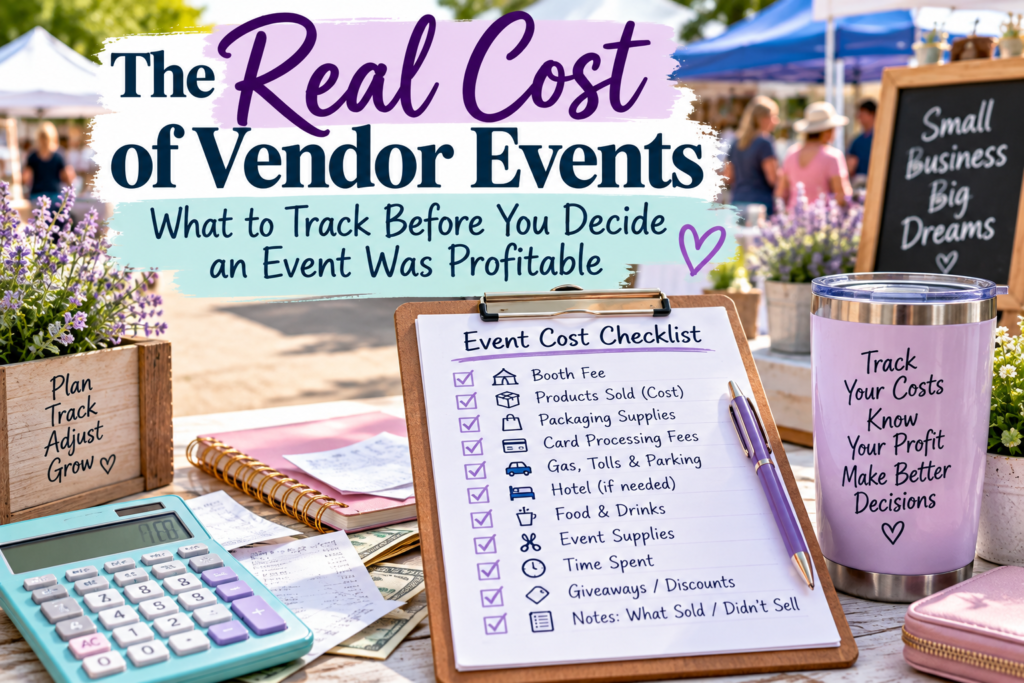
That is why vendor event profitability cannot be measured by sales alone.
I understand why we focus on the sales number. That is the number we see coming through the payment app, adding up on our sales sheet, or sitting in the cash box at the end of the day. It feels like the easiest way to decide whether an event was worth attending.
The problem is that revenue tells us what came in. It does not tell us what we kept.
If you want to know whether an event deserves another booth fee next year, vendor event profitability is the number you really need to understand.
What Does Vendor Event Profitability Actually Mean?
When I talk about vendor event profitability, I am talking about what is left after you subtract the costs connected to participating in and selling at that event.
That sounds simple until you start listing those costs.
Most vendors remember the booth fee because they paid it directly to the organizer. Some will also remember gas or hotel expenses. What tends to get forgotten are the smaller expenses scattered throughout the day, along with the cost of the actual products that were sold.
A vendor who reports $800 in sales did not necessarily make $800, and a vendor who reports $400 in sales did not necessarily have a bad event. You need more information before either number tells you very much.
The U.S. Small Business Administration explains that understanding fixed and variable costs is important when determining when revenue actually begins producing profit. Its break-even guidance also reinforces why businesses need to understand expenses before deciding whether sales produced a financial gain.
That same thinking applies to vendor events.
1. Start With the Vendor Fee
The first expense is usually obvious: what did you pay for the space?
Maybe the booth fee was $40. Maybe it was $150. Maybe you paid several hundred dollars for a larger festival or multi-day event.
Write down the full amount.
If there were separate charges for electricity, corner placement, additional tables, insurance, early setup, or anything else required by the organizer, include those too. They are part of what it cost you to participate.
This matters for vendor event profitability because your sales first have to recover those costs before the event can begin generating profit.
If you paid $150 just to be there and made $175 in sales, you did not make $175. Before even considering products, fees, transportation, or your time, most of that revenue has already been used to recover the booth fee.
That does not automatically mean the event was worthless, but financially, we need to call the numbers what they are.
2. Count the Cost of the Products You Actually Sold
This is one of the biggest expenses vendors forget when they talk about event sales.
Suppose you made $600.
How much did the products that generated that $600 cost you?
If you sold T-shirts, there were shirt blanks and transfers. If you sold soap, there were oils, fragrances, packaging, labels, and other ingredients. If you sold jewelry, there were beads, findings, charms, backing cards, and packaging.
Those costs do not disappear because the products were already sitting in your inventory before the event.
They are still part of vendor event profitability.
Let’s say you made $600 in sales and the products sold cost you $210 to produce. Your $600 has already become $390 before you subtract anything else.
That is why gross sales can be misleading.
This connects directly with our conversation about product profitability. If you do not know what each product actually costs you, it becomes difficult to know what your vendor event really earned.
3. Do Not Forget Card Processing Fees
A lot of vendors accept card payments, and that is usually a good thing because customers may spend more when they are not limited to the cash in their wallet.
But those transactions have a cost.
Payment-processing companies generally take a percentage or fee from transactions. The exact amount depends on the service and payment method you use, so check your own current fee schedule instead of guessing.
At the end of the event, look at the processing fees actually charged.
If customers purchased $500 through card payments, the full $500 may not be what reached your account. Those fees belong in your vendor event profitability calculation because they were required to process those sales.
They may look small one transaction at a time, but after a busy event, those small amounts add up.
4. Track Gas, Tolls, Parking, and Transportation
Transportation is another expense that can make two events with similar sales results completely different financially.
Imagine Event A generates $500 in sales and is 15 minutes from your house. Event B also generates $500 but is two hours away, requires tolls, and charges $20 for vendor parking.
Those events did not cost you the same amount to attend.
Track the gas you used, tolls you paid, parking fees, public transportation, trailer costs, or other transportation expenses connected to the event.
If you travel regularly for events, this category becomes even more important.
A long-distance event may still be profitable, but you need the numbers to prove it. Vendor event profitability should help you compare opportunities instead of relying on the sales total alone.
5. Include Hotels and Overnight Expenses
Multi-day events can look attractive because you have more time to sell, but they can also become expensive very quickly.
If the event requires a hotel, add that cost.
Then include parking at the hotel, meals you would not normally have purchased, pet care if needed, or other expenses caused specifically by being away from home.
Suppose you make $1,000 at a two-day festival. That sounds excellent until you subtract a $300 vendor fee, a $200 hotel, product costs, food, gas, tolls, and card-processing fees.
Maybe it is still profitable.
Maybe it is not.
The point is that vendor event profitability tells you the answer instead of the sales number deciding for you.
6. Food and Drinks Belong Somewhere in the Numbers
This expense can be easy to ignore because everyone has to eat.
But there is a difference between the food you would normally eat at home and spending $18 at an event because you were there for nine hours without bringing anything.
If the event caused the additional expense, track it.
You do not have to make this complicated. Write down what you spent on food and drinks specifically because you were attending the event.
This is also one of those expenses you can sometimes reduce at the next event. Bringing water, snacks, or lunch from home may improve vendor event profitability without changing a single thing about your booth or products.
That is why tracking expenses is not only about deciding whether an event was good or bad. It can show you where next year’s event could cost less.
7. Separate Reusable Equipment From Event-Specific Expenses
This part needs a little common sense.
Suppose you purchased a $120 canopy before your first vendor event. Should the entire $120 be charged against that one event?
Probably not if you plan to use the canopy at 20 more events.
The same can apply to tables, tablecloths, signs, display racks, carts, tent weights, card readers, and other reusable equipment.
However, you should still track those purchases as business expenses.
For vendor event profitability, I would separate reusable equipment from direct event expenses so you can see both numbers. You might have an “event operating cost” number and a separate “equipment investment” number.
This gives you a clearer picture.
If you are a newer vendor and still deciding where your money should go, our Vendor Event Budget: Where Should a New Vendor Spend Their Money First? goes deeper into deciding what you actually need before spending hundreds of dollars trying to build the perfect booth.
Your setup needs to be safe, functional, and presentable. It does not need to look like somebody else’s $5,000 booth on your first weekend.
8. Packaging Used at the Event Is an Expense Too
Bags, tissue paper, stickers, boxes, protective sleeves, receipt paper, and other packaging may cost only a few cents or a dollar at a time.
But again, multiply those costs across dozens of sales.
If you sold 50 items and each sale used approximately 75 cents in packaging, that is another $37.50 connected to the event.
That amount belongs in your vendor event profitability calculation.
I am not saying you need to stand at the booth calculating the cost of every piece of tissue paper while customers are waiting. You can calculate an average packaging cost beforehand and use that number when reviewing the event later.
The goal is not to make event tracking exhausting.
The goal is to stop pretending costs do not exist because they are small.
9. What About Your Time?
This is the part that gets complicated.
You may spend two hours preparing inventory, another hour loading the vehicle, an hour driving, two hours setting up, eight hours selling, another hour breaking down, and an hour driving home.
Suddenly that “eight-hour event” used 16 hours of your time.
Whether you assign an exact hourly wage to every event is up to you and depends on how you run your business. But I think you should at least track the hours.
Your time gives you another way to compare events.
Suppose Event A leaves you with $300 after direct expenses and requires six total hours. Event B also leaves you with $300 but requires 16 hours.
Financially, those events may produce the same amount of profit, but they absolutely do not require the same amount of work.
Tracking time helps you decide whether vendor event profitability is strong enough for the effort involved.
10. Do Not Confuse Inventory You Brought With Inventory You Sold
This one is especially important for newer vendors.
You may bring $3,000 worth of products to an event, but that does not mean the event cost you $3,000 in inventory.
If you bring those products home and can sell them somewhere else, that inventory still has value.
For the event profitability calculation, focus primarily on the cost of the products actually sold, damaged, spoiled, lost, given away, or made specifically for an event and unlikely to sell elsewhere.
This becomes especially important with seasonal products.
If you made $500 worth of products specifically for a Christmas event and most of them are still sitting in bins in February, that information matters differently than everyday inventory you can continue selling all year.
Good vendor event profitability tracking helps you see those differences.
11. Track Discounts and Giveaways
Did you offer a special event discount?
Did you give away samples?
Did you donate an item for the event raffle?
Did you give someone a free product?
Those decisions may make sense as marketing, but they still have costs.
You do not necessarily need to call every giveaway a financial mistake. A sample might bring in a customer. A raffle donation might introduce your business to people who had never seen it before.
Just track it.
When you measure vendor event profitability, the goal is not to judge every expense negatively. The goal is to know what happened.
12. Measure What Sold, Not Just How Much You Sold
An event can teach you something even beyond the total profit.
Which products sold?
Which products received attention but did not convert into sales?
Which price points moved quickly?
What did customers repeatedly ask for?
Did people purchase one item at a time or several?
Did a product sell out?
This information helps you prepare better inventory for the next event.
Maybe you brought 40 of one item and sold two, while another product sold out before noon. That tells you something worth knowing.
This is also why your event notes should include more than “Made $475.”
Your vendor event profitability improves when you use previous events to make better decisions about what to bring, how much inventory to make, and where to spend your money.
13. Track Traffic and Shopper Behavior Too
Money matters, but there are other things worth recording.
Was the event actually busy?
Did shoppers stop at booths?
Were people carrying bags and buying from other vendors?
Was most of the crowd looking rather than shopping?
Did traffic disappear after the first two hours?
This becomes useful when deciding whether weak sales were mostly an issue with your booth or whether the entire event had limited buying activity.
In Successful Vendor Event: 9 Critical Signs Beyond Sold-Out Booths, we talk about why a sold-out vendor roster does not automatically mean strong shopper traffic or strong sales. A good event needs actual customers, not simply a full room of vendors.
One vendor having a bad day does not prove an event was bad, and one vendor having an excellent day does not prove everyone did well.
Look at the bigger picture.
14. Promotion Matters When Evaluating the Event
Before deciding whether you want to return, think about how the event was promoted.
Did the organizer advertise consistently?
Was the event information easy for customers to find?
Were there signs?
Did local people seem to know the event was happening?
Was the organizer depending mainly on vendors to bring their own followers?
Those questions matter because you are paying for access to an event and its audience.
In Who Is Responsible for Bringing Customers to a Vendor Event?, we discuss the difference between an organizer’s responsibility to market the event and a vendor’s responsibility to promote their individual participation and convert event traffic into customers.
You should promote your business.
But you should not have to single-handedly create the event’s entire customer base.
That information belongs in your post-event notes because vendor event profitability is affected by the quality of the opportunity you paid to participate in.
A Simple Vendor Event Profitability Example
Let’s put everything together.
Suppose your event sales were $700.
Your expenses were:
- Vendor fee: $100
- Product cost for items sold: $220
- Card-processing fees: $18
- Gas and tolls: $35
- Parking: $10
- Food and drinks: $22
- Packaging used: $25
- Event-specific supplies: $15
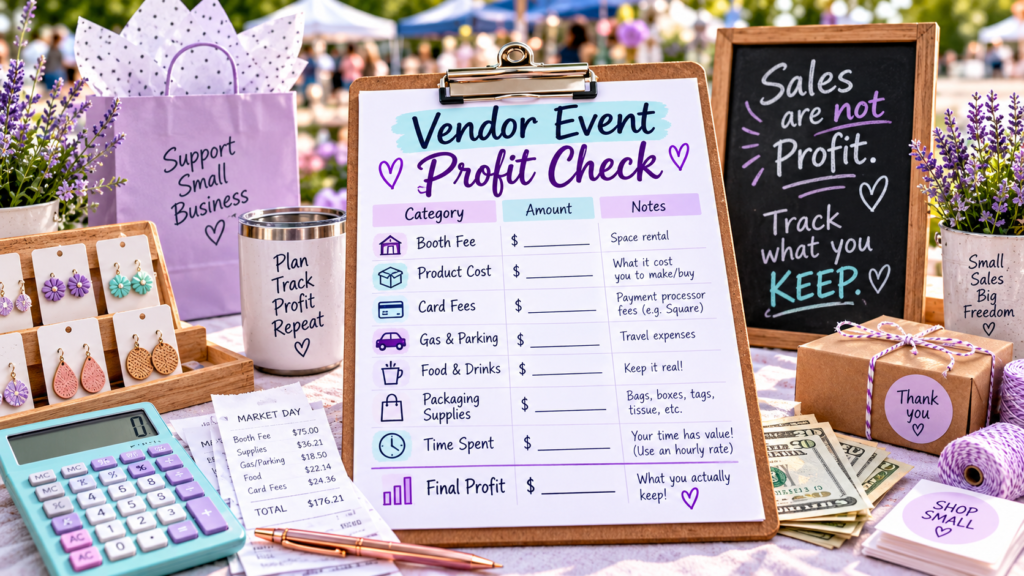
Your direct event expenses total $445.
That leaves $255 before considering general business overhead and the value of your time.
Now we have a much more useful number than simply saying, “I made $700.”
You had $700 in revenue.
Based on this example, you had approximately $255 remaining after those direct event expenses.
That does not mean the event was automatically good or bad. Maybe $255 was worthwhile for you. Maybe the event took 14 hours from loading the vehicle to getting home and you decide the return was too small.
That decision belongs to you.
The purpose of calculating vendor event profitability is to give you enough information to make that decision intelligently.
Was Breaking Even a Bad Event?
Not necessarily.
This is where I do not want us to become so focused on profit that we ignore context.
A new vendor’s first event may involve equipment purchases that will be used repeatedly. You might be learning which products people respond to, practicing your setup, testing prices, or figuring out how much inventory you actually need.
Breaking even at your first event may still give you useful information.
The problem is when every event continues to break even and we keep telling ourselves that eventually something will change without changing anything.
After several events, you should have data.
Which organizers brought customers?
Which locations worked?
Which products performed?
Which booth fees were reasonable?
Which events barely covered expenses?
That is where vendor event profitability becomes part of your business strategy instead of simply an after-event calculation.
Do Not Let a Busy Booth Fool You
A busy booth can feel successful.
People stop.
They compliment your products.
They ask questions.
They take business cards.
They tell you they will come back.
That attention is encouraging, but compliments do not pay the vendor fee.
You still need sales.
At the same time, do not assume a quiet-looking booth automatically failed. A vendor selling $100 products may need only a few customers to have an excellent day, while someone selling $3 products may need constant traffic.
This is why comparing your booth to the vendor beside you usually does not tell you much.
Measure your own vendor event profitability using your own costs, products, prices, and goals.
Should You Count Future Orders From the Event?
Yes, but track them separately.
Suppose someone meets you at an event, takes your card, and places a $150 custom order three days later.
That event contributed to the sale.
Record it.
I would simply separate event-day sales from event-generated follow-up sales so you can see both.
The same goes for wholesale inquiries, custom-order requests, newsletter signups, social followers, or website visits.
Those results can have value.
Just do not use them to pretend an event was profitable when the financial numbers say otherwise.
A slow event can create future opportunities, and that is worth recording. It is still different from making a profit that day.
Create a Vendor Event Scorecard
After each event, record the same information.
Track the event name, date, location, booth fee, total sales, product costs, payment fees, gas, tolls, parking, food, packaging, event-specific expenses, total hours, products sold, best sellers, slow sellers, traffic, weather if relevant, organizer communication, marketing, and whether you would attend again.
Then calculate your direct profit.
Over time, this becomes extremely useful.
You may discover that small community events consistently produce better vendor event profitability than expensive festivals. You may learn that certain locations work better for your products or that a particular organizer consistently attracts shoppers who actually buy.
Now you are no longer choosing events based on a pretty flyer.
You are choosing them based on your own history.
Liz’s Note
One of the things I want vendors to stop doing is automatically saying an event was great because they had a certain amount in sales.
Tell me what you kept.
If you made $800, I am happy that you made sales, but I still want to know whether it cost you $200 or $700 to make that happen.
I also do not think we should label every slow event a failure without looking at what happened. Sometimes the audience was wrong. Sometimes the organizer did not promote. Sometimes the weather changed everything. Sometimes our booth, inventory, pricing, or products need work.
We need the whole story.
That is why I like numbers.
Numbers do not tell us everything, but they give us something more useful than guessing.
Frequently Asked Questions About Vendor Event Profitability
What expenses should I include when calculating vendor event profitability?
Include the vendor fee, cost of products sold, payment-processing fees, transportation, tolls, parking, food purchased because of the event, packaging, hotel expenses when applicable, and event-specific supplies. You should also track your time and any reusable equipment purchases separately so you understand the full investment involved.
The exact list will look different for every business. The important thing is to use the same basic categories from event to event so you can make fair comparisons.
Is my total event sales number my profit?
No. Total sales are your event revenue, not your profit.
To understand vendor event profitability, subtract the expenses connected to generating those sales. Only then can you see how much money remained from the event.
Should I include the cost of all inventory I brought?
Usually, you would focus on the cost of products actually sold, damaged, lost, given away, spoiled, or created specifically for an event with limited future use. Inventory you bring home and can continue selling still has value.
Keep good inventory records so you know what left the event with customers and what came back home.
How do I know if a vendor event is worth doing again?
Look at profit, hours worked, traffic quality, products sold, organizer communication, promotion, location, customer fit, and any follow-up sales or opportunities generated by the event.
One number should not make the entire decision. Vendor event profitability is extremely important, but combining the financial results with your event notes gives you a much better picture.
What if I only broke even?
Breaking even does not automatically mean the event was a failure, especially if you are new and gained useful information or purchased reusable equipment. However, repeatedly attending events that only recover your costs deserves a closer look.
Use what you learned to decide whether changing inventory, reducing expenses, improving your booth, choosing different events, or stopping a particular event would make more sense.
Your Next Step
If you attended an event recently, pull out your sales total and do not stop there.
Write down what the booth cost, what the products sold cost you, your processing fees, transportation, food, packaging, and any other direct expenses.
Then calculate what remained.
After that, write down what sold, what did not sell, what the traffic looked like, how the organizer handled the event, and whether you would pay to participate again.
That is the information you need before deciding whether an event was truly profitable.
Because a $700 sales day might be an excellent event.
It might also be an expensive way to make $100.
Vendor event profitability helps you know the difference.