
When money gets tight, people usually do not stop spending completely. They start becoming more selective about what feels necessary, useful, affordable, or worth the price.
That difference matters.
If sales slow down, it is easy to assume the answer is to lower prices, add more products, run a sale, or copy whatever another business says is selling. But selling in a slow economy is less about chasing one magical product and more about understanding what customers are willing to spend money on when they are watching their budget more carefully.
Recent Federal Reserve research found that households reduced spending more heavily in non-essential categories when prices rose, while essential spending held up better. That does not mean every useful product will sell or every decorative product will fail, but it does reinforce something small businesses need to understand: when shoppers feel pressure, they become more selective about where their money goes.
So instead of asking, “What product is guaranteed to sell right now?” I think the better question is:
How can I make what I sell easier for the customer to justify?
That is what we are going to work through.
Selling in a Slow Economy Starts With Understanding the Buyer
When people feel financially comfortable, they may make purchases simply because something is cute, interesting, new, or fun. When money feels tighter, that same shopper may pause longer before buying.
They begin asking themselves different questions.
Do I need this?
Will I actually use it?
Is it worth the price?
Can I find something similar for less?
Would this make a good gift?
Can I wait?
That change in thinking affects selling in a slow economy because your customer may still like your product while deciding not to purchase it today.
That is an important distinction.
A shopper can think your product is beautiful and still walk away. They can love your booth and still decide the price does not fit their budget. They can pick something up three times and still put it back.
That does not automatically mean the product is bad.
It means you need to understand what is stopping the sale.
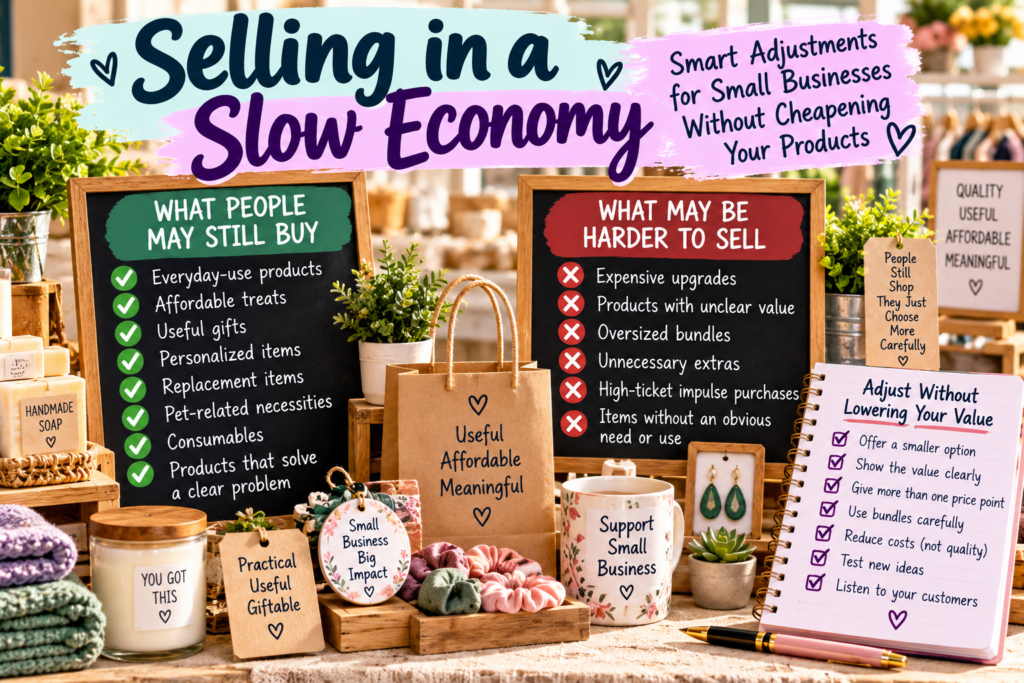
What Shoppers May Still Be Willing to Buy
There is no universal list of products that will always sell during a slower economy. Your customers, location, price point, product quality, competition, and presentation all matter.
But there are certain characteristics that can make a purchase easier to justify.
Everyday-Use Products
Products that solve an everyday need can be easier for shoppers to justify because they know how they will use them.
That might include soap, practical accessories, household items, food products, organizational products, refillable items, or anything that clearly serves a purpose.
The key word is clearly.
If the shopper has to stare at the product for five minutes trying to figure out what it is for, you are already making the purchase harder.
When selling in a slow economy, usefulness should be obvious.
Affordable Treats
People may cut back on large purchases without eliminating every little pleasure.
That is why smaller affordable treats can still have a place.
A candle, small baked good, inexpensive accessory, bookmark, sticker, small self-care item, or another modestly priced product may feel easier to justify than a much larger purchase.
The idea is not to make everything cheap.
It is to have an entry point.
A customer who cannot spend $45 today may still be comfortable spending $8 or $12.
That smaller product can also introduce someone to your business without requiring a large commitment.
Useful Gifts
Gift buying does not disappear because money is tight.
Birthdays still happen.
Holidays still happen.
Graduations still happen.
People still want to thank someone, celebrate someone, or show appreciation.
The difference is that shoppers may become more conscious of the gift budget.
A product becomes easier to sell when the customer can immediately picture the recipient.
Instead of simply labeling something “handmade mug,” you might show the customer who it could be for.
Teacher gift.
New homeowner gift.
Dog lover gift.
Coworker gift.
Grandmother gift.
When you connect the product with a use or recipient, you reduce the amount of thinking the shopper has to do.
That can help when selling in a slow economy.
Personalized Products
Personalization can increase perceived value because the item feels less generic.
A simple keychain may compete with hundreds of inexpensive keychains online. A personalized keychain with someone’s name, school colors, team colors, profession, or meaningful phrase becomes a different type of purchase.
The customer is no longer only buying the object.
They are buying the personal connection.
That does not mean personalization automatically makes something profitable or desirable. You still need to know your costs and whether your customer values the option enough to pay for it.
But when done well, personalization can help the buyer understand why the product costs more than a mass-produced alternative.
Replacement and Maintenance Purchases
Some spending happens because something wears out or needs to be replaced.
A customer may postpone buying a decorative sign, but they cannot always postpone replacing something they use every day.
That could include practical household items, work accessories, routine pet products, consumables, or replacement products.
Again, your job is not to force every product into the “necessary” category.
Your job is to understand where your product fits honestly.
If the product is mostly decorative or optional, market it that way and focus on why it brings value rather than pretending it is essential.
Products That Solve a Clear Problem
Products become easier to justify when the benefit is easy to understand.
A storage item that saves space.
A planner that helps someone organize bills.
A reusable product that replaces something purchased repeatedly.
A gift bundle that saves the customer time.
A travel item that makes packing easier.
A personalized label that helps identify belongings.
The problem does not have to be life-changing.
It simply needs to be clear.
The U.S. Small Business Administration recommends understanding customer demand, market conditions, pricing, and the value your business brings to the customer. That becomes especially important when shoppers are being more selective.
What May Become Harder to Sell
Now we need to talk about the other side of this.
Some products may become harder to move when people feel financially cautious.
That does not mean you immediately discontinue them. It means you pay closer attention.
Expensive Impulse Purchases
Higher-priced products that do not solve an urgent need may take longer to sell.
Someone may still want the item but decide to wait until payday, a birthday, a holiday, or another time when the purchase feels easier.
That changes how you should evaluate demand.
If customers repeatedly show interest but hesitate at checkout, the product may not be unwanted.
The timing or price may simply require more consideration.
Oversized Bundles
Bundles can work well when they provide obvious value.
They can also become expensive very quickly.
If you combine six items and the final bundle costs $75, a customer who would have happily purchased one $15 item may walk away because the only option feels too large.
This is why selling in a slow economy may require more flexibility.
Offer the bundle if it makes sense, but consider allowing shoppers to buy individual pieces too.
The bundle should create convenience or value.
It should not trap the customer into spending more than they intended.
Products With Unclear Value
This is a big one.
If the shopper cannot understand why something costs $30, they may compare it to a cheaper product that looks similar.
You know your materials.
You know how long it took.
You know the quality difference.
The customer may not.
This is where presentation and explanation matter.
If something is handmade, explain what makes it different.
If the material is better, say so.
If it lasts longer, demonstrate that.
If it is customizable, show examples.
If the packaging makes it gift-ready, explain that benefit.
Do not assume customers can see the value just because you can.
Premium Extras That Increase the Price Without Increasing the Value
This is where small businesses sometimes hurt themselves.
We add the specialty box.
Then tissue paper.
Then custom ribbon.
Then shredded paper.
Then a thank-you card.
Then another insert.
Then a sticker.
The package looks beautiful, but suddenly $3 or $4 has been added to the cost of a $12 product.
If the customer values that presentation, wonderful.
But if the packaging is mostly there because you saw someone else doing it online, look at the numbers.
Your customer may prefer a $12 product in simple clean packaging over a $17 version wrapped like a luxury gift.
Before adding extras, revisit Product Profitability: 7 Costs to Check Beyond the Selling Price so you know whether those additions are supporting the business or quietly reducing your margin.
Step 1: Look at What Is Actually Selling
Before changing the business, look at your recent sales.
Not what you think people like.
Not what receives the most compliments.
What are people actually buying?
Write down your products and look at the last 30, 60, or 90 days.
Which products sold repeatedly?
Which sold once?
Which did not sell at all?
Which price points moved the most?
Did customers buy individual items or bundles?
Did certain products sell better online than at events?
This is the first step in selling in a slow economy because your own customers give you better information than a generic trend list.
If sales have already slowed down, use the process in What to Do When Sales Are Slow: 9 Smart Moves Before You Give Up before changing everything at once. That article walks through sales, traffic, expenses, customers, and inventory so you can identify the actual problem first.
Step 2: Watch What Customers Pick Up but Do Not Buy
This is one of the most useful things you can observe at an event.
Someone picks up a product.
Reads the sign.
Checks the price.
Turns it over.
Asks a question.
Then puts it back.
Do not immediately take that personally.
Pay attention.
If it happens repeatedly with the same product, something is creating hesitation.
It could be the price.
It could be that the customer does not understand the product.
It could be the size.
It could be the packaging.
It could be that they like it but do not need it.
If ten people do the same thing, you have information worth investigating.
That is real market research.
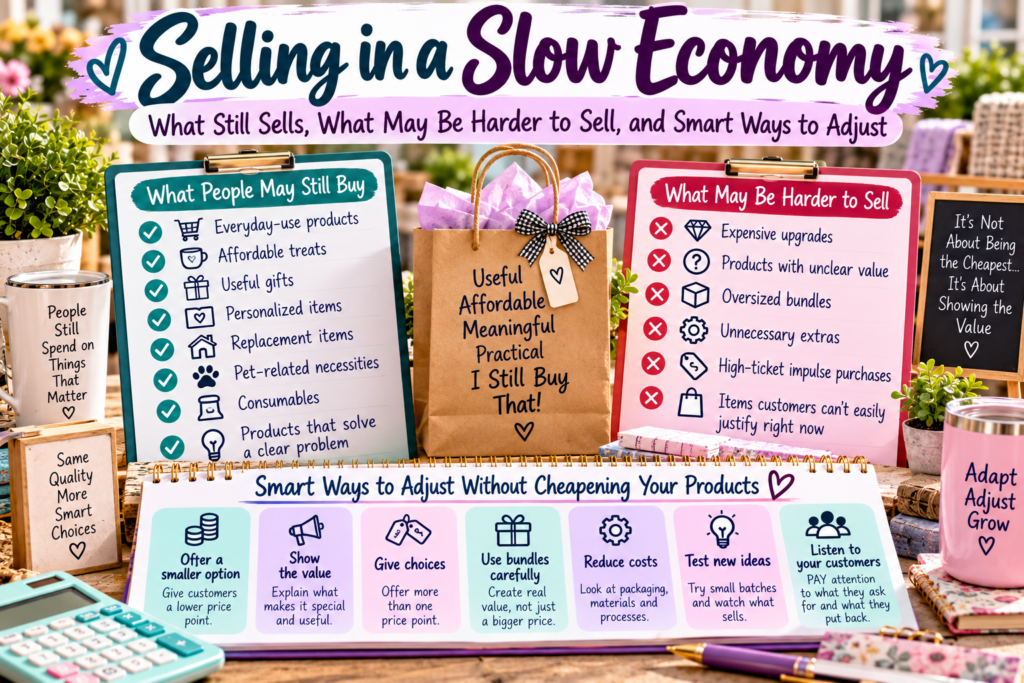
Step 3: Add a Smaller Option Before Cutting the Price
Imagine you sell a $30 gift set.
Instead of immediately discounting it to $22, ask whether you could create a smaller $12 or $15 version.
The larger product can stay.
The smaller one gives budget-conscious shoppers another way to buy from you.
This is much different from permanently lowering the value of the original product.
For example, a soap business might offer a full gift set and an individual bar.
A stationery business might offer a complete journal kit and a smaller bookmark or card set.
A jewelry maker might have a statement piece and a smaller everyday option.
A food vendor might offer a full-size package and a sample-size option.
The customer gets a choice.
Your business protects the original product.
That is a much stronger approach to selling in a slow economy than panicking and discounting everything.
Step 4: Show the Customer What Makes the Product Worth It
This is where you have to stop assuming the product speaks for itself.
Sometimes it does not.
If something is washable, tell them.
If it is reusable, tell them.
If it can be personalized, tell them.
If it is handmade in small batches, explain what that means for the customer.
If the material is higher quality, explain why it matters.
If the product is ready to give as a gift, point that out.
You are not begging someone to buy.
You are giving them enough information to decide whether the product is worth the price.
The SBA’s guidance on business planning emphasizes having a clear value proposition and understanding what makes your offer useful to the customer.
That becomes even more important when shoppers are thinking carefully before spending.
Step 5: Give Customers More Than One Price Point
You do not need 50 products.
You do need enough variety that every shopper is not forced into the same spending level.
You might have:
- A small entry-level product
- A middle-priced main product
- A higher-priced premium option
For example:
$5 small item
$15 everyday item
$30 gift option
$50 premium bundle
Those numbers are only examples.
Your actual pricing needs to come from your costs and profit requirements.
The important point is giving customers choices without filling your booth with hundreds of products.
A smaller assortment with clear price levels can sometimes work better than a huge collection that overwhelms shoppers.
Step 6: Do Not Discount Before You Know Your Minimum Price
This part matters.
A discount can increase sales while still making your business worse financially.
Suppose a product costs you $8 to make and sell.
You normally charge $15.
Then sales slow down, so you discount it to $10.
You may sell more units.
But after your expenses, there may be almost nothing left.
The goal is not simply to move inventory.
The goal is to make sales that still make sense for the business.
Before running discounts, calculate your actual costs.
Know the lowest price you can comfortably accept.
The SBA has also emphasized pricing based on costs, margins, competitive considerations, and long-term sustainability rather than simply guessing or discounting without understanding the numbers.
Step 7: Use Bundles Carefully
Bundles work when they make buying easier.
Maybe three products purchased separately total $30, and you offer the bundle for $27.
The customer sees a small savings.
You increase the sale.
The numbers still work.
That is useful.
But do not create a giant bundle just because bundles are popular.
If your customer came looking for a $10 item and the only bundle costs $65, you did not create value for that shopper.
You created a bigger purchase.
Those are not the same thing.
Step 8: Reduce Costs Before Reducing Quality
If your margin is getting tight, look at the cost structure before assuming your product needs to become cheaper or lower quality.
Can you order packaging differently?
Can you eliminate something the customer does not value?
Can you buy a frequently used material in a better quantity?
Can you reduce waste?
Can you simplify production?
Can you stop carrying a variation that barely sells?
Can you use inventory you already own?
These changes can improve profit without changing the customer experience.
That is a much healthier strategy for selling in a slow economy than racing competitors to the lowest possible price.
Step 9: Ask Customers Better Questions
Do not ask:
“Why didn’t you buy?”
That puts people on the spot.
Instead, gather information naturally.
At an event you might ask:
“Are you shopping for yourself or a gift?”
“What kinds of products are you looking for today?”
“Would you prefer the single item or the set?”
“Which size would be most useful?”
You can also watch what questions customers repeatedly ask.
If five people ask whether something comes in a smaller size, that matters.
If shoppers repeatedly ask whether they can purchase items separately, that matters.
If people ask why the product costs what it does, your value may not be clear enough.
Your customers will often tell you what needs adjustment if you listen.
Step 10: Track the Economy, but Do Not Use It as an Excuse for Everything
Economic conditions matter.
As of mid-2026, consumer prices remained higher than a year earlier, and Federal Reserve reports described consumers as price-conscious and, in some areas, more selective about major purchases.
That context is useful.
But do not let “the economy” become the automatic answer every time something does not sell.
Maybe the issue is price.
Maybe it is visibility.
Maybe the product is seasonal.
Maybe the wrong customers are seeing it.
Maybe the event was poorly attended.
Maybe the product needs improvement.
Maybe people simply do not want it.
Your job is to separate what the broader economy is doing from what your own business is doing.
Step 11: Test Before You Make a Big Change
If you think customers need lower-priced options, test a few.
Do not make 100.
If you want to try a bundle, create a small batch.
If you think packaging is too expensive, test a simpler version.
If you think customers need clearer signs, change the signs at one event.
Then watch what happens.
Small tests give you information without tying up too much money.
This is especially important for new businesses because you are still learning what your customers actually want.
Selling in a Slow Economy at Vendor Events
Vendor events give you something online selling cannot always give you.
You can watch people make decisions in real time.
Pay attention to:
- What makes them stop
- What they pick up first
- Which prices they check
- What they ask about
- What they put back
- What they purchase together
- What they request that you do not carry
- Whether they shop the entire event or simply browse
Do not leave the event with only one number.
“I made $400” is not enough.
Track what actually sold and what it cost you to participate.
That is where The Real Cost of Vendor Events: What to Track Before You Decide an Event Was Profitable becomes important. A busy event can still lose money, while a smaller event with lower expenses can sometimes produce a better result.
What If Your Higher-Priced Products Stop Selling?
Do not automatically remove them.
Look for patterns first.
Are people still asking about them?
Do they sell during holidays?
Do they work better online?
Are customers buying them as gifts rather than personal purchases?
Would a payment option make sense for your type of product?
Can you offer a smaller version without changing the original?
Some products simply need a longer buying decision.
You should still watch inventory carefully because expensive products can tie up a lot of cash.
But slower does not always mean dead.
What If Customers Keep Saying “That’s Too Expensive”?
Listen, but do not automatically lower the price.
You need context.
Is everyone saying it?
One person?
Are people saying it but others are still buying?
Does the product actually cost a lot to make?
Does the customer understand the value?
Is your price significantly different from comparable products?
Is your target customer actually the person standing in front of you?
Not everyone is your customer.
The goal is not to make every person think your product is cheap.
The goal is to make sure the right customer understands why the price makes sense.
Liz’s Note
I think one of the fastest ways to hurt a small business during a slow period is to panic.
Sales drop, so we make more products.
Then we cut prices.
Then we order new packaging.
Then we pay for an event.
Then we run ads.
Now sales are still slow, but we have spent even more money.
That is not adapting.
That is reacting.
If shoppers are being more careful, we need to become more careful too.
Look at what people are buying.
Look at what they are leaving behind.
Look at the prices that move.
Look at what your products cost.
Then adjust one thing at a time.
Maybe you need a smaller product.
Maybe the value needs to be clearer.
Maybe the bundle needs work.
Maybe the price is fine.
Maybe the product is not the problem at all.
The numbers and your customers will tell you much more than panic will.
Frequently Asked Questions About Selling in a Slow Economy
What products sell best in a slow economy?
There is no guaranteed product category. However, items that are useful, affordable, giftable, personalized, consumable, or solve a clear problem may be easier for customers to justify when budgets are tight.
The better approach is to look at what your own customers continue buying rather than copying a generic list.
Should I lower my prices when the economy is slow?
Not automatically. Lowering prices without knowing your costs can increase sales while reducing or eliminating profit.
Before discounting, calculate your minimum profitable price and look for other options such as smaller sizes, entry-level products, simpler packaging, or better value communication.
Should I stop selling premium products?
Not necessarily. Premium items may sell less frequently but can still be profitable and important to your product line.
Track whether shoppers continue showing interest, what seasons they sell best in, and whether a lower-priced companion product could give customers another choice.
Are bundles good when customers are spending less?
They can be, but only when the customer sees clear value and has the option to spend less if needed. A bundle should make purchasing easier, not force a shopper into a larger purchase.
Always check that the bundle still protects your profit.
How do I know if slow sales are caused by the economy?
You usually cannot know from the sales number alone. Look at traffic, customer behavior, conversion, seasonal patterns, pricing, competition, product demand, and your own historical sales.
Broader economic conditions can influence spending, but your specific business may also have issues that need separate attention.
What should I change first when sales slow down?
Start by reviewing what is selling, what is not, what customers are asking for, and where they hesitate. Then test one small change.
Avoid changing pricing, products, marketing, inventory, and packaging all at the same time because you will not know which change actually helped.
Your Next Step
Take your five best-selling products and your five slowest-selling products.
Write down the selling price, product cost, how often each one sells, and what customers usually say or ask about it.
Then ask:
Is the value obvious?
Is there a lower-priced way to enter this product category?
Is the customer being asked to spend more than necessary?
Is the packaging adding value or simply adding cost?
Does this product solve a problem, serve a purpose, make a useful gift, or create a meaningful experience?
What have customers actually shown me?
Do not change everything after answering those questions.
Pick one thing to test.
That is how selling in a slow economy becomes a business strategy instead of a panic response.
You do not need to become the cheapest business in the room.
You need to understand what your customer values, protect your profit, and make it easier for the right customer to say yes.