
Have you ever looked at two products that were almost identical and immediately felt like one was worth more? Maybe both were handmade, both used similar materials, and both were priced within a few dollars of each other, but one looked more complete, more trustworthy, and easier to understand. That difference is often not the product itself. It is the way the business presents it, and that is where small business branding starts to matter.
A lot of people hear the word branding and think about a logo, but branding is much bigger than that. Your logo is one piece, but your small business branding also includes your colors, labels, packaging, product names, signage, photos, social media, website, and the way you communicate with customers. All of those pieces work together to tell the customer what kind of business you are before they ever buy anything from you.
The goal is not to make a simple product look expensive just for the sake of charging more. The goal is to make your business easy to understand, easy to remember, and easy to trust. When those things happen, customers are more likely to recognize your products, understand your value, and remember where they bought from you later.
Small Business Branding Starts With the Customer
Before choosing colors, fonts, stickers, or packaging, start with the person you are trying to reach. Too many business owners create branding around what they personally like and only later stop to ask whether it makes sense for the customer they want to attract. That can lead to a business that looks nice but feels disconnected from the products or the audience.
Think about who normally buys from you and why they are shopping. Are they buying something practical, something personalized, a gift, a small treat, or something sentimental? Are they looking for affordable products, premium products, or something in between? Once you know that, your small business branding can support the buying experience instead of simply decorating it.
The U.S. Small Business Administration talks about the importance of understanding your target market, your value, and the customer experience when building a marketing strategy. That matters here because good branding should support those same goals, not exist separately from them. You can review the SBA’s guidance on marketing and customer strategy here: U.S. Small Business Administration marketing guidance.
Make It Obvious What the Product Is
One of the easiest branding mistakes to make is creating a product name that sounds cute but does not actually tell the customer what they are buying. Imagine seeing a jar labeled only “Sunday Morning.” That name may sound nice, but if you cannot tell whether it is a candle, body scrub, coffee blend, or room spray, the customer has to stop and figure it out.
Good small business branding should reduce confusion. You can still use creative names, but you should pair them with enough information that the customer understands the product quickly. For example, “Sunday Morning” could be followed by “Vanilla, Coffee & Warm Cinnamon Soy Candle.” Now the product still has personality, but the customer immediately understands what it is.
That kind of clarity is especially important at vendor events because shoppers are often moving quickly. They may only glance at your display for a few seconds before deciding whether to stop. If your product makes sense immediately, you have removed one barrier from the buying decision.
Build a Look Customers Can Recognize
Recognition usually comes from repetition. If your logo is lavender and teal but your packaging is black and gold, your website is red and white, and your social media graphics change every week, the customer may not connect those pieces back to the same business. Each individual item might look fine, but the business as a whole can feel scattered.
Strong small business branding does not require every item to look identical. It simply needs enough consistency that customers begin to recognize your style. That might mean using the same logo, repeating a small group of colors, sticking with two or three fonts, and using similar label layouts across your products.
Over time, this becomes more important. A customer may see you at a spring market, scroll past one of your Facebook posts two months later, and then find you again online during the holidays. If the branding feels consistent, those separate moments begin to connect, and that is how recognition starts to build.
Make Sure Customers Can Find You Again
One of the most practical parts of small business branding is making sure customers know who made the product. This sounds simple, but it is easy to forget when the focus is on making the packaging look nice. A customer may love what they bought and still have no idea how to find you again if your business name is missing.
Your business information should appear somewhere appropriate on the product or packaging. That could be a label, tag, backing card, small insert, or sticker. You do not need to cover everything with your logo, but you should give the customer an easy path back to you.
This matters because a repeat customer is much easier to lose than most people realize. If someone is sitting at home three months later saying, “I loved this, but I cannot remember who I bought it from,” that is a missed opportunity. Good small business branding helps prevent that.
Packaging Can Change the Way a Product Feels
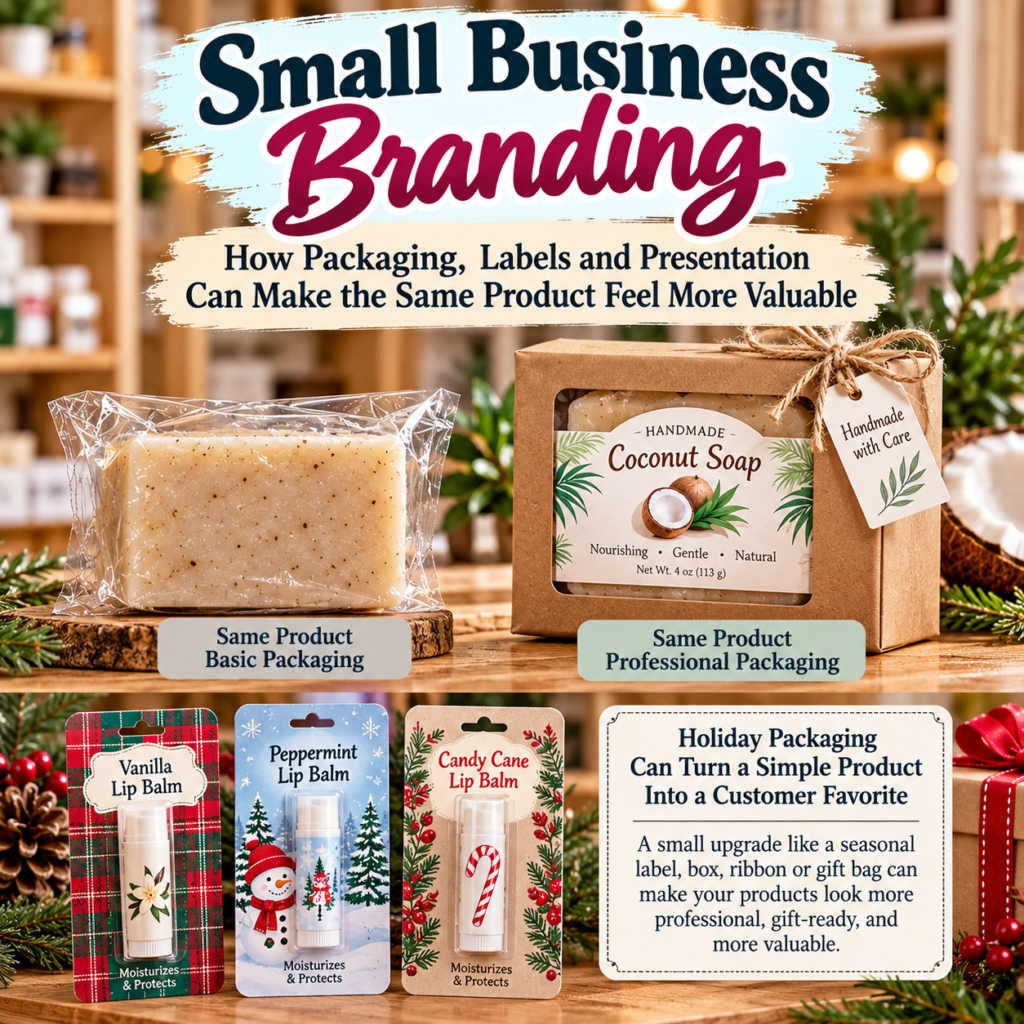
Packaging can absolutely influence how a customer sees a product. Take two similar handmade items and place one in plain packaging while the other has a clear label, coordinated design, product information, and a professional finish. The product itself may be similar, but the customer experience feels different.
That does not mean the more expensive package is automatically better. Branding and profitability have to work together, because beautiful packaging is not helping the business if it destroys the margin. A $5 product does not need $4 worth of packaging just to look more impressive.
This is why I always recommend checking the real numbers before upgrading packaging. In Product Profitability: 7 Costs to Check Beyond the Selling Price, we talk about how packaging, fees, time, and small extras can quietly reduce what the business actually keeps. Your small business branding should add value without creating a financial problem.
Holiday Packaging Can Make a Simple Product Feel Gift-Ready
Holiday shopping is one of the clearest examples of why packaging matters. During the holiday rush, people are not only buying products for themselves. They are looking for gifts, stocking stuffers, teacher gifts, coworker gifts, small thank-you gifts, and inexpensive items that still feel special when they hand them to someone.
That is where small business branding can make a simple product much easier to sell.
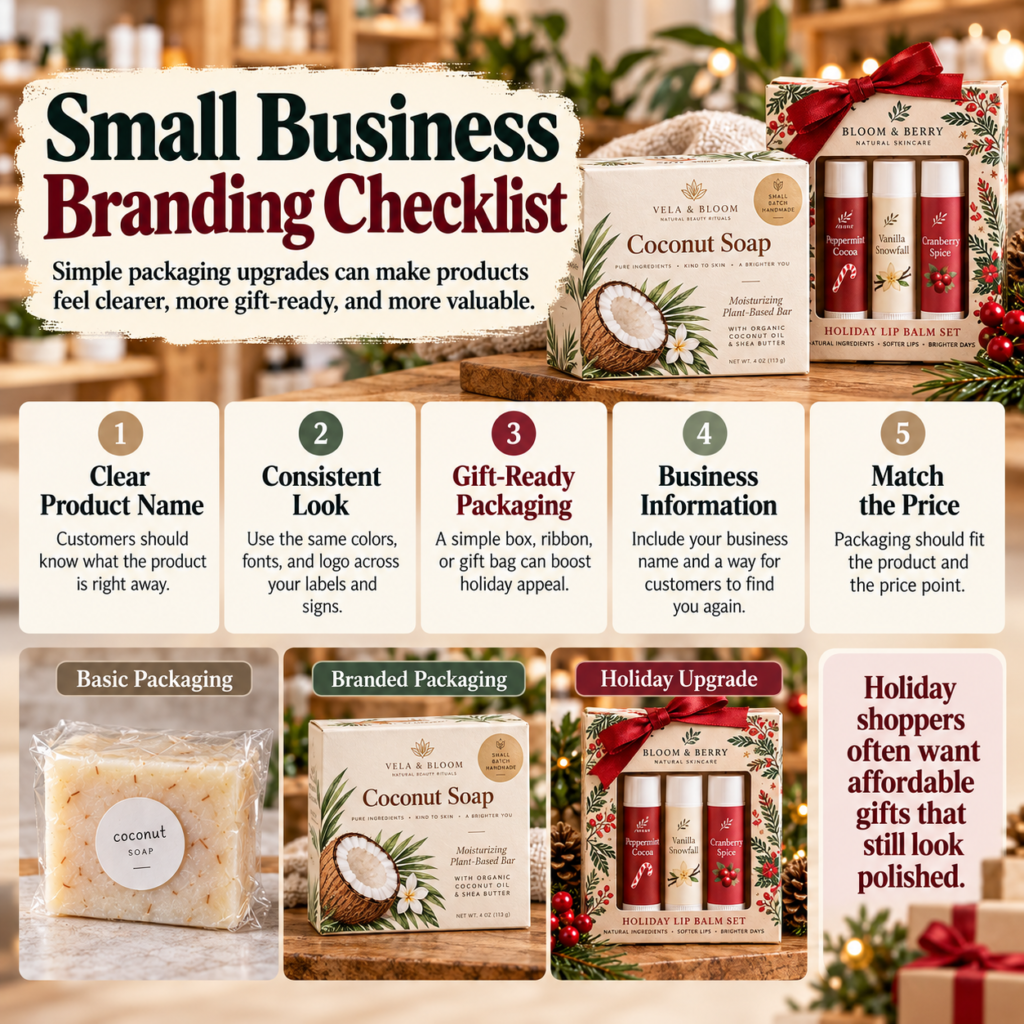
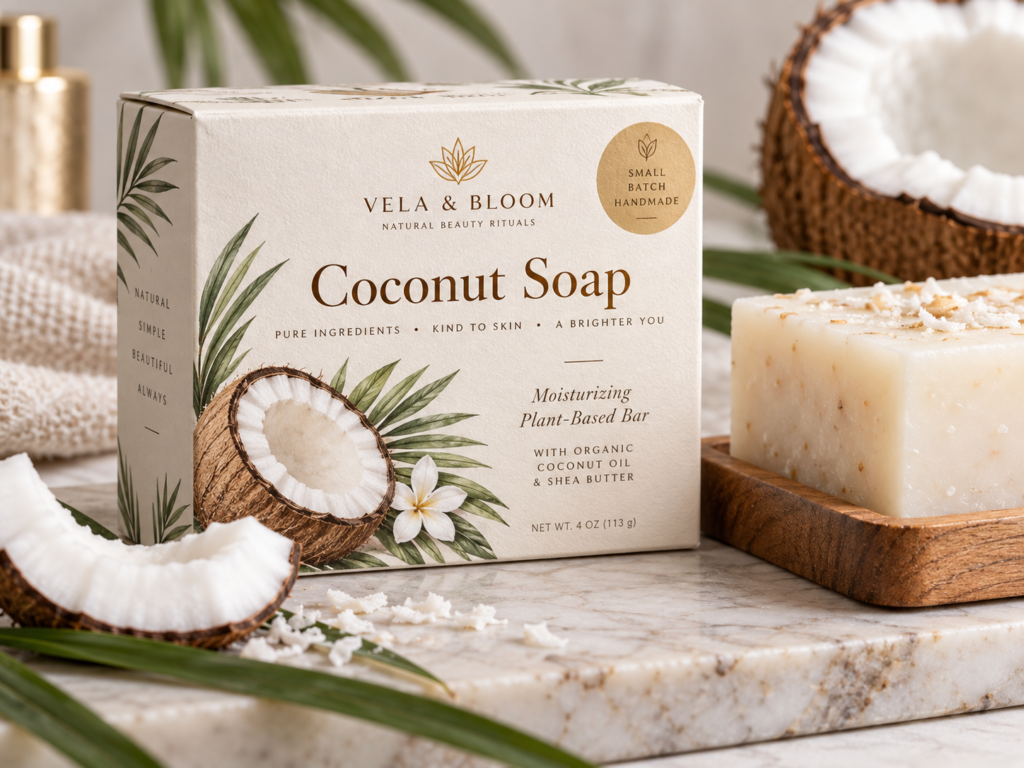
Think about a handmade bar of coconut soap. If the soap is sitting in plain plastic wrap inside a bin with a sign that says “Coconut Soap,” the customer may see it as exactly that: one bar of soap. Now take that same bar, wrap it neatly, add a label with your business name and coconut imagery, include the product information, and place it in a small box or gift bag. You did not necessarily change the soap itself, but you changed the way the customer sees the product.
Now it looks like a gift.
That difference can matter a lot during the holidays because shoppers often want something that feels ready to give. They may be working with a small budget, but they still do not want the gift to look cheap. A product can be affordable and still look polished, thoughtful, and professional.
You also do not need expensive custom packaging to create that effect. A small box, clear bag with a branded topper, ribbon, bow, holiday label, tissue paper, or simple gift tag can change the entire presentation. The important thing is that the upgrade fits the product and still leaves enough profit for the business.
This is where presentation and product profitability have to work together. You want the customer to see more value, but you do not want to spend $3 packaging a $5 item unless the numbers still make sense. Sometimes a 25-cent or 50-cent packaging upgrade can make a much bigger difference in how the product feels than adding several dollars of unnecessary extras.
The Same Product Can Serve a Different Purpose During the Holidays
This is another reason I think business owners should look at seasonal packaging differently.
A product that is normally an everyday item can become a holiday gift simply because of how it is presented.
Lip balm is a good example. During most of the year, someone may see a tube of lip balm as a basic personal-care item. During the holidays, put that same lip balm in packaging with a holiday background, a clean branded label, and a presentation that makes it feel ready for gifting, and suddenly it can become a stocking stuffer, teacher gift, coworker gift, or small add-on present.
That changes how the customer thinks about the product.
I have done this with lip balm myself. During holiday events, I use holiday-themed packaging that I create, and depending on the event, I can price the lip balm around $3 to $5. People buy them because they are inexpensive enough to be an easy purchase but still look like something they can actually give to someone.
That is the part I want newer sellers to understand.
Sometimes you do not need a completely different holiday product.
You may need a better holiday presentation for a product you already sell.
Make It Easy for the Customer to Picture Giving It Away
Holiday shoppers are often moving quickly. They may have ten people left on their list and very little interest in going home to wrap every small purchase themselves.
If your product already looks gift-ready, you have solved part of their problem.
You can help even more by making the purpose obvious. A small sign might say “Perfect Stocking Stuffer,” “Teacher Gift Under $10,” “Easy Coworker Gift,” or “Ready to Give.” That does not change the product, but it helps the customer immediately understand what they can do with it.
This is another place where small business branding becomes part of the sales process. Your packaging is not only protecting the product. It is helping the shopper imagine the product as a finished gift.
And during the holidays, that can absolutely help make the sale.
Keep the Holiday Upgrade Simple
I would still be careful about turning holiday packaging into a major expense.
You do not need a custom printed box for every $4 item.
Look for small upgrades that create a bigger visual difference:
- Holiday-themed backing cards
- Seasonal labels
- Small kraft or white boxes
- Ribbon or twine
- Simple bows
- Gift-ready clear bags
- Holiday tissue paper
- Branded gift tags
- Small gift bags
- A sticker with your business name and product information
The goal is to make the product look intentional and giftable, not overloaded.
The best holiday packaging should make the customer think, “I can give this exactly as it is.”
That is a very different feeling from, “I guess I can find something to put this in when I get home.”

Liz’s Holiday Packaging Tip
If you already sell small products, do not automatically assume you need to create an entirely new holiday line.
Look at what you already have and ask whether the presentation can change.
Can the lip balm become a stocking stuffer?
Can the soap become a teacher gift?
Can the bookmark become a small gift for a reader?
Can the keychain become a personalized stocking filler?
Can two inexpensive products become a small ready-to-give set?
That is where small business branding can help you get more out of products you are already making.
The product does not always need to change.
Sometimes the packaging does the heavy lifting.
Good Branding Does Not Have to Be Expensive
A lot of new business owners feel like they need custom boxes, specialty tissue paper, foil labels, branded bags, and a full display system before they are ready to sell. You do not. A clean, consistent presentation can look professional without being expensive.
Simple packaging can work beautifully when it is done well. A kraft box with a consistent sticker, a clear bag with a professional label, or a backing card with your logo and business information can all build recognition. What matters most is that the product looks intentional and connected to the rest of the business.
This is the same principle we use when talking about vendor setup. In Vendor Event Budget: Where Should a New Vendor Spend Their Money First?, we talk about putting money toward what helps the business function and sell before trying to copy expensive setups from established businesses. The same rule applies to small business branding.
Build Branding That Matches the Product and Price
The way a product is presented should make sense for what it is and what it costs. A small impulse item can have simple, clean packaging, while a higher-priced gift set may need a little more presentation to feel complete. The goal is not to make everything look luxurious. The goal is to make the presentation feel appropriate.
When the product, price, and presentation match, the customer does not have to work as hard to understand the value. A $6 product in simple packaging can still look polished, while a $60 product may need stronger presentation to support the higher price point. That balance is part of small business branding.
What you want to avoid is either extreme. You do not want cheap-looking packaging on a premium product, but you also do not want to overspend on packaging for a low-cost product that cannot support it financially.
Help the Customer Understand the Value
Customers do not automatically know what makes your product different. You know how long it took to make, what materials you used, why you chose that process, and what makes the product special. The customer only knows what they can see and what you tell them.
This is where small business branding becomes part of the sales process. If the product is washable, reusable, personalized, handmade in small batches, or designed for a specific type of customer, make that clear. If your materials are stronger, safer, or longer lasting, explain the benefit in plain language.
This matters even more when handmade sellers are compared with mass-produced products. If the difference is not obvious, the customer may only compare prices. Branding helps you give the customer more information to work with than just the number on the tag.
Do Not Copy Every Trend You See
It is normal to get inspiration from other businesses, but constantly changing direction can make your brand harder to remember. You see one business using soft neutral colors, another using bright pastel packaging, and someone else using black and gold, and suddenly you want to change everything again.
The problem is that the customer does not see your brand as often as you do. You may be tired of your logo after six months, but the customer may only be seeing it for the second or third time. Recognition takes repetition, and repetition takes time.
Your small business branding should evolve when there is a real reason to change it, not simply because a new design trend appeared. A consistent brand that customers recognize is usually more valuable than a brand that is constantly being redesigned.
Give Your Products a Family Resemblance
If you sell several product types, they do not all need to use the exact same package or layout. Greeting cards may look different from candles, and gift sets may look different from bookmarks. What matters is that customers can still tell they came from the same business.
You might repeat the same colors, logo, fonts, label style, or photography approach across different products. Those repeated elements create a family resemblance that strengthens small business branding without forcing every product into the same design.
This also makes your job easier as the business grows. When you introduce a new product, you are not starting from zero because you already have a visual system to work from.
Branding Can Make Products More Giftable
Gift shoppers often want something that already feels finished. If a product looks incomplete or needs extra work before it can be given to someone, the customer may keep walking. A clear label, simple gift-ready package, or coordinated presentation can make the buying decision easier.
You can also use branding to help the shopper understand who the product might be for. A small sign that says “Teacher Gift,” “Dog Lover Gift,” “Thinking of You,” or “New Home Gift” can help customers picture the recipient immediately. That is another way small business branding supports the sale without lowering the price.
The point is not to put every product into a fancy gift box. It is to help the customer understand how the product fits into their life.
Branding Builds Trust Before the Customer Buys
A new customer does not know you yet, so they look for small signals before deciding whether to buy. They notice whether the product is clearly labeled, whether the price is easy to find, whether the packaging looks clean, and whether the business appears organized.
None of those things guarantees quality, but together they reduce uncertainty. That matters because buying from a new business always involves a little bit of trust.
Strong small business branding helps the business feel intentional instead of temporary. The customer sees that there is a real name, a consistent look, and a clear way to find you again if they need to.
Small Business Branding Continues After the Sale
Branding does not stop when the customer hands you money. The way you package the order, answer questions, handle mistakes, and communicate after the sale all become part of the brand experience.
A beautiful label cannot make up for poor customer service. If your branding says thoughtful, professional, and dependable, the actual experience should feel the same way.
That is why small business branding is not just visual. The way customers feel after buying from you affects whether they return, leave a positive review, or recommend you to someone else.
Do Not Rebrand Every Time You Get Bored
There is nothing wrong with updating your branding when the business changes, but constant redesigns can work against you. If your colors, logo, labels, and packaging change every few months, customers never get enough repetition to recognize you.
Sometimes the best thing you can do is leave a good system alone and let it work. You can improve small pieces without tearing everything apart.
Give your small business branding time to build recognition. A customer may need to see your business several times before the look becomes familiar.
Look at Your Branding From the Customer’s Side
Before your next event or product launch, put one product in front of you and pretend you have never seen it before. Ask yourself whether you can immediately tell what it is, what it costs, who made it, and why someone would want it.
Then look at the packaging and ask whether it fits the price and whether the customer could find the business again later. If something feels confusing, write it down.
You may discover that the problem is not your logo at all. Maybe the product description needs work, the business name is too small, the price is hard to find, or the packaging is costing more than it needs to.
A Simple Small Business Branding Checklist
If you are building small business branding for the first time, keep it manageable. You do not need a full branding department, and you do not need to solve everything in one day.
Start with the basics:
- A clear business name
- A simple logo
- Two or three main colors
- Two or three readable fonts
- Clear product names
- Easy-to-understand descriptions
- Consistent labels or tags
- Visible pricing
- Your business name on the packaging
- An easy way for customers to find you again
- Packaging that fits the product and price
- A consistent look across your website and social media
Once those pieces are working together, your brand will already feel stronger.
When Should You Spend More on Branding?
There may come a time when investing more in branding makes sense. Maybe your products are selling consistently, customers recognize your business, and you know which product lines are staying long term.
At that point, custom packaging, professionally printed materials, or upgraded displays may be worthwhile. The important thing is knowing why you are making the investment.
Ask what problem the upgrade is solving. If it improves recognition, protects the product, makes reordering easier, or improves the customer experience, it may be worth considering. If the only reason is that it looks prettier, pause and look at the numbers first.
Liz’s Note
I think one of the easiest mistakes small business owners make is looking at an established brand and assuming they need to start where that business finished. We see the custom boxes, polished displays, professional photos, and coordinated packaging, but we do not see the years of testing that came before it.
You do not need the finished version of your business on day one. You need clear labels, consistent colors, a business name people can see, and packaging that makes sense for what you sell.
Your small business branding can grow with you. Start with the parts that help customers understand and remember the business, then improve the rest as the business earns the money to support it.
Frequently Asked Questions About Small Business Branding
What is small business branding?
Small business branding is the combination of visual and customer-experience elements that help people recognize and remember your business. It includes things like your logo, colors, fonts, packaging, labels, photography, messaging, and the way customers are treated.
The goal is to create enough consistency that customers can connect those pieces back to your business. Good branding helps people understand who you are and what they can expect from you.
Do I need expensive packaging?
No. Clean, simple, and consistent packaging can build a strong brand without costing a lot of money.
The packaging should fit the product, the price, and the customer. Spending more only makes sense if the customer experience or the business actually benefits from it.
Can branding help me charge more?
Branding can help customers understand value, but it does not automatically justify any price. Your costs, market, customer expectations, and profitability still matter.
The strongest small business branding supports the value that is already there instead of trying to manufacture value through presentation alone.
Should every product look exactly the same?
No. Different products can have different packaging while still looking connected to the same business.
Repeating your logo, colors, fonts, photography style, and overall presentation can create consistency without making every product identical.
How often should I change my branding?
Only when there is a real reason. That might be a major change in your audience, product line, business direction, or an existing brand that creates confusion.
If your current branding works, give it time. Recognition does not happen overnight.
Let’s Talk About Your Brand
Take one product you currently sell and look at it from the customer’s point of view. Ask yourself whether the product is easy to understand, whether your business name is visible, whether the packaging fits the price, and whether someone could easily find you again later.
Now think about the one thing you would change first. Maybe it is the label, the product description, the colors, the packaging, or the way your business name appears.
What is the one part of your branding you feel needs the most work right now?
Share it in the comments. Someone else may be working through the exact same problem.
Your Next Step
Do not redesign your entire business today. Choose one product and review the customer experience from beginning to end.
Look at the name, label, packaging, price, business information, and how the customer would find you again. Then choose one improvement that makes the product clearer, more consistent, or easier to remember.
That is what effective small business branding should do. It should help your business feel organized, recognizable, trustworthy, and easy to come back to.