
One of the first things small-business owners hear about marketing is that they need to “get on social media.” That advice sounds simple until you actually try to follow it. Suddenly you are trying to post on Facebook, create Reels for Instagram, record Tik Toks, answer comments, take product photos, run your business, fill orders, and somehow still have time left in the day.
The truth is that your business does not need to be everywhere just because other businesses are. Choosing the right social media platform for business starts with understanding who you are trying to reach, what kind of content you can realistically create, and what you actually want social media to do for your business.
Facebook, Instagram, and TikTok can all be useful. They simply do different things well. One platform may be better for building a local community, another may be better for showing off beautiful products, and another may help new people discover you through short-form video. The goal is not to decide which platform is universally “best.” The goal is to figure out which one makes the most sense for your particular business.
That decision matters even more when your time and marketing budget are limited. If you are already working on products, customers, inventory, vendor events, bookkeeping, and everything else that comes with running a small business, your social media strategy needs to support the business rather than become another full-time job.
Start With Your Customer Before You Choose a Social Media Platform for Business
Before comparing Facebook, Instagram, and TikTok, start with the person you are trying to reach. This is where many businesses get the order backward. They choose a platform because it is popular, then try to figure out what to post there.
A better approach is to ask where your customer already spends time.
Current U.S. research shows why that matters. Pew Research Center reported in 2026 that about 70% of U.S. adults use Facebook, 51% use Instagram, and 37% use TikTok. Those numbers tell us that all three platforms have large audiences, but they do not tell us that every audience is the same. Pew Research Center
Age makes a noticeable difference as well. Pew’s 2025 U.S. research found that Instagram and TikTok usage was particularly strong among adults ages 18 to 29, while Facebook continued to reach substantial percentages across all age groups. Among adults ages 30 to 49, for example, 80% reported using Facebook, 62% Instagram, and 44% TikTok. Pew Research Center
That is why choosing a social media platform for business should never start with, “Everybody says I need TikTok,” or, “Facebook is old.” Start with your actual customer. If the people most likely to buy from you are spending time somewhere, that deserves more attention than whatever platform happens to be getting the most hype this month.
Facebook: Strong for Community, Local Reach, and Conversation
Facebook still makes sense for many small businesses, especially businesses that depend on local customers, repeat buyers, referrals, community groups, and events. It can be particularly useful for businesses that need space to explain something rather than relying completely on fast video.
Facebook also gives businesses several ways to interact with customers. A business page can share updates, photos, events, links, videos, and customer information. Groups can create stronger community conversations, while local groups can help businesses learn what people in their area are asking for or talking about.
This does not mean every business should spend all day posting on Facebook. It means that Facebook may be the right social media platform for business when your customers are active there and your business benefits from relationships, conversations, local visibility, or repeat interaction.
For example, imagine someone selling handmade products at craft fairs. Facebook may give that seller a practical place to announce upcoming events, show new products, share customer photos, answer questions, and remind followers where they will be next weekend. That kind of marketing is different from hoping one short video goes viral. It is about staying visible to people who may already know the business.
This is also why I would connect this topic to our article on how to find your first customers without spending a fortune. Social media can help, but it works better when it is part of a broader plan for reaching actual customers instead of simply collecting followers.
Instagram: Strong When Your Business Is Visual
Instagram can make a lot of sense when customers need to see the product, transformation, process, style, or experience before they become interested. That includes businesses selling handmade products, clothing, food, beauty services, home décor, artwork, photography, travel experiences, and many other visually driven products and services.
A strong Instagram account can work almost like a visual introduction to your business. Someone may discover a Reel, visit your profile, look through your photos, read a few captions, and form an opinion about the business before they ever click your website.
That is why consistency matters. You do not need every post to look identical, but customers should be able to understand what you sell and what kind of business they have landed on.
Instagram can also work well when you are comfortable showing products in use rather than only posting finished product photos. A candle maker might show pouring, labeling, packaging, or gift preparation. A baker might show decorating. A crafter could show part of the production process. These small behind-the-scenes moments can help customers connect with the work that goes into a product.
Choosing Instagram as your primary social media platform for business makes the most sense when visuals are important to the buying decision and you can consistently produce photographs or short videos without making content creation take over your entire workday.
This connects naturally with our discussion about small business branding and making products feel more valuable. On a visual platform, presentation, photography, packaging, and brand consistency can influence how quickly someone understands your business.
TikTok: Strong for Discovery and Short-Form Education or Entertainment
TikTok works differently because discovery plays such a large role in the experience. People do not necessarily need to already follow a business before seeing one of its videos. That creates opportunities for smaller businesses to get in front of people who may never have searched for them directly.
TikTok’s own small-business guidance emphasizes understanding your target audience before promoting your business and describes the platform as one where people discover brands and products as part of the path from discovery to consideration and purchase. TikTok For Business
That makes TikTok interesting for businesses that can teach, demonstrate, entertain, tell stories, answer questions, or show something happening quickly.
A soap maker could show the cutting process. A financial coach could explain one money mistake in thirty seconds. A vendor could show how they pack for an event. A baker could show the difference between a plain cake and the finished decorated cake. A business owner could answer one common customer question instead of trying to squeeze five ideas into the same video.
TikTok may be the right social media platform for business if you enjoy short-form video and your product or expertise gives you plenty of things to demonstrate, explain, or show. It becomes much harder when the owner dislikes video so much that every post feels like a major production.
That is an important point. A theoretically perfect platform is not very useful if you hate creating for it and eventually stop posting altogether.
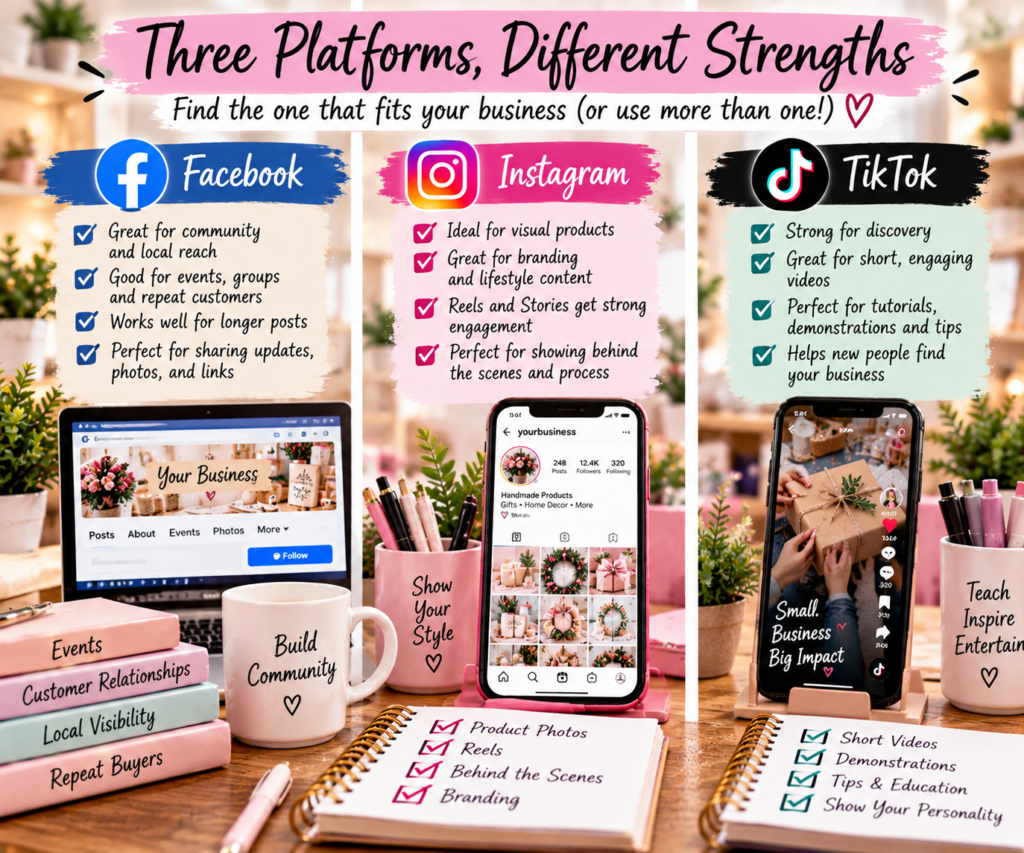
Facebook vs. Instagram vs. TikTok: What Is the Actual Difference?
Here is the simplest way I would explain it to a new business owner:
| Platform | Often useful for | Content that fits naturally |
| Community, local businesses, repeat customers, events, discussions | Photos, updates, links, videos, events, community posts | |
| Visual products, branding, lifestyle, portfolios | Photos, Reels, Stories, carousels, behind-the-scenes content | |
| TikTok | Discovery, demonstrations, education, personality-driven content | Short video, tutorials, product demonstrations, storytelling |
This does not mean Facebook cannot use video or that TikTok cannot help a local business. There is plenty of overlap. The table is simply a way to think about the natural strengths of each social media platform for business.
The bigger question is which strength matches what your business needs right now.
Do Not Choose a Platform Based Only on Follower Count
This is something I think small-business owners need to hear more often. A large number of followers does not automatically mean a profitable audience.
You could have 20,000 people watching entertaining videos who never buy anything, while another business has 1,500 followers and regularly gets orders, referrals, event attendance, and repeat customers from that smaller audience.
That is why follower count should not be the only measurement you watch.
Pay attention to whether people visit your website, ask questions, join your email list, save posts, send messages, request quotes, visit your booth, book appointments, or purchase products. Those actions tell you more about whether the social media platform for business you selected is helping your business.
This is similar to what we discussed in The Real Cost of Vendor Events. A crowded event does not automatically mean a profitable event. In the same way, a large social media audience does not automatically mean a profitable marketing channel. You have to look at what actually happens after the attention.
You Do Not Have to Be Equally Active on All Three Platforms
This is where I think many small-business owners can give themselves some breathing room.
There is nothing wrong with having accounts on Facebook, Instagram, and TikTok. The problem starts when you convince yourself that you must create completely different content for all three platforms every single day.
That can turn marketing into a production line.
Instead, consider choosing one primary social media platform for business, one secondary platform, and then repurpose content where it makes sense. If you make a useful 30-second video for TikTok, perhaps that same basic video can become an Instagram Reel and a Facebook Reel. You may change the caption, opening text, or call to action so it fits each audience, but you do not necessarily need to start over every time.
Repurposing content is not being lazy. It is using your time intelligently.
The important thing is not to copy everything blindly. A Facebook audience may respond differently than a TikTok audience. The same core idea can be reused while the presentation is adjusted.
Think About What You Are Actually Trying to Accomplish
One business may want online sales. Another wants people to visit a physical location. Another needs appointments. Another wants potential clients to trust its expertise. Another sells primarily at vendor events and simply needs customers to remember the business between shows.
Those businesses should not automatically have the same social media strategy.
If you sell handmade products at markets, your goal might be showing new inventory and telling people where you will be. If you provide bookkeeping services, your goal may be educating potential clients until they trust your knowledge. If you own a salon, your content may be designed to show results and encourage appointments.
Your goal helps determine the right social media platform for business because it tells you what you need the platform to accomplish.
A platform should have a job.
If you cannot explain what you want Facebook, Instagram, or TikTok to do for your business, it becomes very easy to spend hours creating content simply because you feel like you are supposed to.
Match the Platform to the Content You Can Actually Create
I also want business owners to be realistic about personality, time, skills, and resources.
Suppose TikTok looks promising for your target audience, but you absolutely hate being on camera. That does not automatically mean TikTok is impossible. You could use product demonstrations, hands-only videos, voiceovers, screen recordings, text-based videos, before-and-after clips, or behind-the-scenes footage.
But if even that feels miserable and prevents you from posting consistently, another platform may be a better place to put your energy.
The same goes for Instagram. If your product depends heavily on visuals but your photos are dark, unclear, or inconsistent, improving product photography may make a bigger difference than increasing how often you post.
Choosing a social media platform for business should take your customer into account, but it also has to take you into account. A marketing plan has to be sustainable enough that you can actually follow it.
When Should You Use More Than One Platform?
Using multiple platforms makes sense when each one serves a purpose and you can manage them without neglecting the rest of your business.
For example, Facebook might help you maintain relationships with existing customers and promote local events. Instagram might act as your visual portfolio. TikTok might help new people discover the business through educational or entertaining short videos.
Now you have three platforms with three jobs.
That is very different from posting randomly on all three because you are afraid you will miss something if you do not.
As the business grows, you can always expand. You do not have to build the entire social media system during your first month.
Give a Platform Enough Time Before You Decide It Does Not Work
One mistake I see is businesses posting five times, getting little response, and immediately deciding the platform does not work.
Social media usually requires testing.
You need enough content to notice patterns. Which topics get comments? Which videos hold attention? Which posts generate profile visits? What questions do customers keep asking? What makes someone click through to learn more?
That information becomes useful only when you pay attention to it.
At the same time, do not keep pouring hours into a social media platform for business simply because someone told you that you must be there. If you have tested it consistently and it produces little meaningful business activity, it is reasonable to reconsider how much time you are giving it.
Marketing should involve testing, measuring, and adjusting.
Liz’s Note
I think one of the biggest mistakes small-business owners make is turning social media into another thing they believe they are failing at.
They see someone posting three TikToks a day, somebody else creating beautiful Instagram Reels, and another business running an active Facebook group. Before long, they feel like they need to do all of it.
You don’t.
You need to know who you are trying to reach, choose a social media platform for business that gives you a reasonable chance of reaching those people, and learn how to use that platform well. Once you have a system that works, you can build from there.
Your goal is not to become a full-time content creator unless that is actually your business. Your goal is to use social media to support the business you are trying to build.
Frequently Asked Questions About Choosing a Social Media Platform for Business
Which social media platform is best for a small business?
There is no single social media platform for business that is best for every company. The right choice depends on your target customer, type of business, marketing goal, and the type of content you can consistently create.
A local service business may get strong results from Facebook. A highly visual product business may benefit from Instagram. A business that teaches or demonstrates well through short video may find TikTok useful.
Should a new business start with Facebook, Instagram, or TikTok?
Start with customer research rather than the platform name. Find out where the people most likely to buy from you spend their time and what kind of content they respond to.
Then choose one platform to learn well before trying to manage everything at once.
Do I need to post on social media every day?
Not necessarily. Consistency matters, but consistency does not automatically mean daily posting.
Three useful posts a week can be more valuable than seven rushed posts that say very little. Choose a schedule you can maintain and pay attention to the response you receive.
Can I use the same content on Facebook, Instagram, and TikTok?
Yes, you can repurpose a core idea across platforms. You may need to adjust the length, caption, format, opening, or call to action because people use each platform differently.
Repurposing saves time and can help a small business maintain a presence without constantly creating something new.
How do I know if my social media is actually helping my business?
Look beyond likes and followers. Pay attention to website visits, messages, leads, bookings, sales, event attendance, email signups, inquiries, saves, and repeat customers.
Those measurements help you determine whether your chosen social media platform for business is producing useful business activity rather than simply attention.
Let’s Talk About Your Social Media Strategy
Take a look at the platforms you are using right now. Are you using them because your customers are there, or because you feel like every business is supposed to have an account?
That distinction matters.
Think about which platform brings you the most meaningful interaction, which one feels easiest for you to maintain, and which one seems to connect you with the people who could realistically become customers.
Which platform currently works best for your business: Facebook, Instagram, or TikTok, and what have you noticed about the people who interact with you there?
Your Next Step
Do not open three apps and start posting more today.
Instead, choose the social media platform for business that appears to fit your customer and business goal best. Spend the next few weeks paying closer attention to what happens there. Track the content people respond to, the questions they ask, the traffic you receive, and whether any of that attention turns into meaningful business activity.
Once you understand what is working, you can decide whether another platform deserves more of your time.
You do not need to win on every social network. You need a marketing system that helps the right people find your business, understand what you offer, and eventually become customers.