
Improving your finances does not always require a dramatic lifestyle change, a huge raise, or a perfect budget. Sometimes the best place to start is with one month of focused attention.

A 30-day financial improvement plan gives you enough time to look at where your money is going, make a few meaningful changes, and begin building better habits without trying to fix everything at once. The goal is not to completely transform your financial life in thirty days. The goal is to finish the month knowing more, wasting less, and feeling more in control of what happens next.
That matters because financial improvement is usually built through smaller decisions repeated over time. Paying off thousands of dollars of debt may take months or years. Building a full emergency fund can take time too. But reviewing subscriptions, finding money leaks, organizing bills, starting a savings transfer, or changing one spending habit can begin this week.
This 30-day financial improvement plan is designed to be realistic. You do not have to give up everything you enjoy, follow an extreme no-spend challenge, or pretend that unexpected expenses will never happen. We are going to use the next thirty days to understand your money better and make decisions that can continue after the month is over.
Start Your 30-Day Financial Improvement Plan With the Truth
Before you can improve your finances, you need to know what is actually happening with your money.
That sounds simple, but a lot of people manage money based on what they think they spend rather than what they really spend. You may believe groceries cost one amount, eating out costs another, and small purchases barely matter. Once you look at the transactions together, the picture can be very different.
For the first few days of your 30-day financial improvement plan, do not rush into cutting everything. Start by reviewing the last thirty to sixty days of bank and credit-card activity. Look at income, bills, subscriptions, food, transportation, shopping, debt payments, savings, and anything else that regularly takes money from the account.
The purpose is not to judge yourself. You are gathering information. If you discover that a category is much higher than expected, that information gives you something useful to work with.
This is also where our Monthly Money Reset can help. A regular money review makes it easier to catch problems before several months go by.
Days 1–4: Write Down What Is Coming In and Going Out
The first part of your 30-day financial improvement plan is about getting the numbers in one place.
Write down your expected income for the month. If your income changes from week to week, use a realistic estimate based on what you normally receive rather than your best possible month.
Next, list your regular expenses. Include housing, utilities, insurance, transportation, groceries, minimum debt payments, phone service, subscriptions, childcare, medical costs, and anything else you know will need to be paid.
Then look at the expenses that are less predictable. Dining out, convenience purchases, hobbies, entertainment, online shopping, and small everyday spending often fall into this group.
Once you have everything in front of you, compare the money coming in with the money going out. You are not looking for perfection. You are looking for where you have room to make a better decision.
Days 5–7: Find Three Money Leaks
A money leak is not necessarily a large expense. It is money leaving your account without giving you enough value in return.
Maybe you are paying for two streaming services you barely use. Maybe delivery fees have quietly become part of the weekly routine. Maybe you are paying monthly for an app you forgot you subscribed to. Perhaps convenience-store purchases are adding up more than expected.
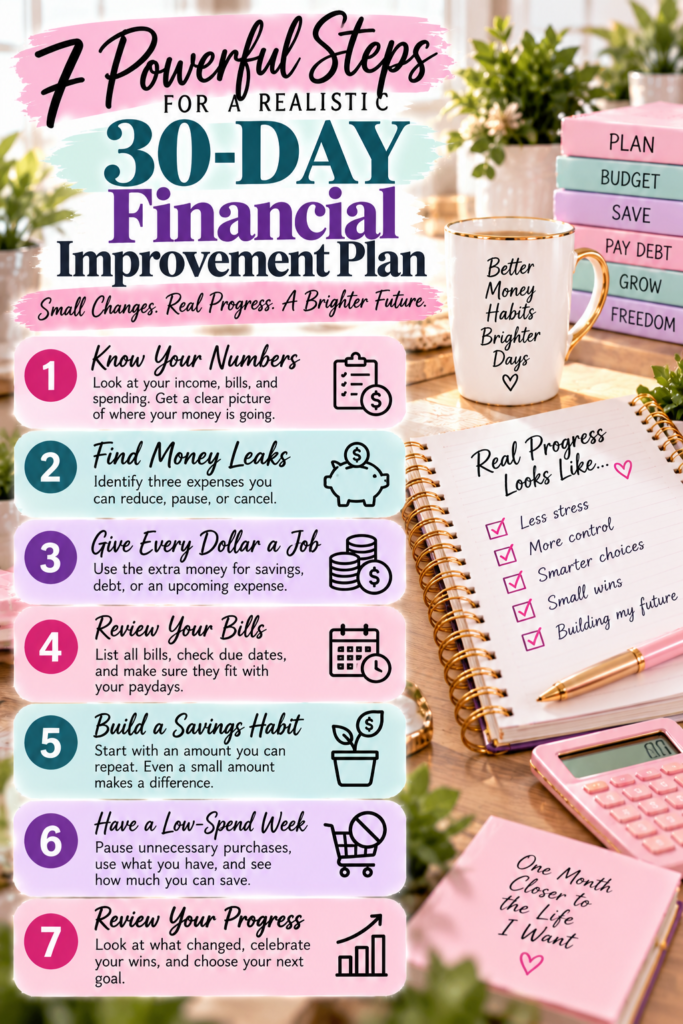
During this part of your 30-day financial improvement plan, look for three expenses you could reduce, pause, cancel, or replace.
Do not try to eliminate twenty things at once. That usually turns financial improvement into punishment. Three changes are enough to create movement and give you a better chance of sticking with them.
If one subscription costs $15 a month, that may not look impressive by itself. But $15 every month is $180 over a year. Looking at recurring expenses annually can make it easier to decide whether something is still worth keeping.
Week 2: Give Every Extra Dollar a Job
Once you free up some money, decide where it should go.
This is an important part of a 30-day financial improvement plan because saving $40 by canceling something does not help much if that same $40 disappears somewhere else the following week.
You might send extra money toward an emergency fund, a credit-card balance, a sinking fund, or an upcoming expense. The right choice depends on what your finances need most.
If you have no financial cushion at all, beginning a small emergency fund may be a useful first step. The Consumer Financial Protection Bureau explains that even a small emergency savings balance can help people recover more quickly from unexpected expenses and reduce the need to rely on credit. You can read the CFPB’s emergency-savings guidance here: Consumer Financial Protection Bureau emergency fund guide.
This also connects with our article on Emergency Fund vs. Sinking Fund. They serve different purposes, and knowing the difference can help you decide where the extra money from your 30-day financial improvement plan should go.
Choose One Financial Priority for the Month
One of the easiest ways to become discouraged with money is trying to solve every financial problem at the same time.
You may want to pay off credit cards, build emergency savings, save for Christmas, repair your car, increase retirement savings, and stop overspending. All of those goals may matter, but trying to attack them equally can make your progress difficult to see.
Choose one main priority for this 30-day financial improvement plan.
For example, your goal might be to save your first $200 emergency cushion. It could be paying an extra $100 toward one credit card. Maybe you need to get one overdue bill current. Perhaps your biggest win would simply be making it through the month without adding anything new to your credit cards.
A realistic goal gives the month direction.
It also gives you something specific to measure on Day 30.
Week 2: Review Your Bills Before They Are Due
Bills are easier to manage when they are not surprises.
Use several days during your 30-day financial improvement plan to list every bill, the amount, and the due date. If an amount changes from month to month, use an estimate and update it once the statement arrives.
Then compare the bill dates with your paydays.
Sometimes the problem is not that someone lacks enough monthly income to cover everything. The problem is timing. Too many payments may fall during the same week, creating a cash-flow squeeze even though the month looks manageable overall.
Depending on the company, you may be able to request a different due date. It will not work for every bill, but it is worth checking if payment timing is creating unnecessary stress.
This is also a good time to turn on payment reminders. Autopay can be useful when you know the money will be available, but reminders may be safer for bills when your account balance changes frequently.
Week 2: Check Your Credit-Card Balances
Do not avoid looking at your balances because the number makes you uncomfortable.
Knowing the balance gives you information.
Write down each card’s balance, minimum payment, due date, and interest rate if you know it. You do not need an elaborate debt payoff plan yet. During a 30-day financial improvement plan, the first goal can simply be understanding what you owe.
Then make sure at least the minimum payment is included in your monthly plan.
If you have extra money available for debt, choose a strategy you can maintain. Some people prefer paying additional money toward the smallest balance because seeing one account disappear keeps them motivated. Others prefer targeting the highest interest rate first because it can reduce the amount of interest paid over time.
The best plan is not the one that looks smartest on paper if you abandon it after two weeks. It is the one you can realistically continue.
Week 3: Create One Small Savings Habit
You do not have to begin by saving hundreds of dollars.
Start with an amount you can repeat.
Maybe that is $5 from every paycheck. Maybe it is $20 a week. Perhaps you transfer whatever you did not spend from one budget category at the end of the week.
During your 30-day financial improvement plan, the habit matters almost as much as the amount because you are teaching yourself that saving is something you do regularly rather than something you attempt only when money is left over.
If possible, keep the savings separate from everyday spending money. Even a separate savings account can create enough distance to reduce the temptation to spend it casually.
This connects with Small Financial Wins That Matter More Than They Look. A small amount may not completely change your finances today, but repeating the behavior changes what your finances can look like later.
Week 3: Plan for One Expense You Know Is Coming
Not every unexpected bill is truly unexpected.
Christmas comes every year. Car registrations renew. Birthdays happen. School expenses return. Cars eventually need maintenance. Insurance premiums may be due every six or twelve months.
If you know something is coming, use your 30-day financial improvement plan to begin preparing for it.
Choose one future expense and determine approximately how much you will need. Then divide that amount by the number of weeks or months you have left before you need the money.
Even if you cannot save the full amount right now, starting early reduces how much pressure the expense creates later.
This is exactly where sinking funds can be useful. Instead of treating predictable expenses like emergencies, you gradually save for them ahead of time.
Week 3: Have One Low-Spend Week
Notice that I said low-spend, not necessarily no-spend.
Extreme challenges can work for some people, but they can also create an all-or-nothing mindset. Someone goes five days without spending anything, buys something on Day 6, feels like the challenge is ruined, and gives up completely.
A low-spend week is more flexible.
During this part of your 30-day financial improvement plan, pay the normal bills and buy the things you actually need, but pause unnecessary purchases for seven days. Use what you already have. Eat food already in the house before buying more. Delay online shopping. Skip impulse purchases.
This exercise is useful because it shows you how much spending is automatic.
At the end of the week, calculate how much you did not spend compared with a normal week. Then give some of that money a job.
Week 4: Review What Changed
By the fourth week, you should have enough information to see patterns.
Go back to where you started your 30-day financial improvement plan and compare it with where you are now.
Did you cancel anything?
Did you reduce the spending category?
Did you save something?
Did the debt balance go down?
Did you avoid using a credit card for something you normally would have charged?
Did you finally organize your bills?
Financial progress does not have to mean that your bank account suddenly has thousands of extra dollars. Better awareness and better habits count too.
This is similar to the idea behind our article Small Financial Wins That Matter More Than They Look. A small financial improvement can become important when it continues month after month.

Do Not Ignore the Progress That Does Not Show Up in Your Bank Balance
Some financial improvements are difficult to see immediately.
Learning exactly how much you spend on groceries matters.
Knowing every bill’s due date matters.
Understanding your credit-card balances matters.
Stopping one unnecessary subscription matters.
Creating a savings routine matters.
Those things may not create a dramatic before-and-after picture in thirty days, but they give you information and systems that make future progress easier.
That is one reason I prefer a realistic 30-day financial improvement plan over promises to completely change your financial life in a month.
Thirty days can start the change.
It does not have to be finished.
What If There Is Nothing Left to Cut?
This is important because not everyone has a budget filled with easy expenses to eliminate.
Sometimes the problem is not overspending.
Sometimes housing, food, transportation, insurance, medical expenses, childcare, or debt payments are already consuming most of the income.
If you review your spending during your 30-day financial improvement plan and genuinely cannot find meaningful cuts, do not keep squeezing essential expenses until your life becomes unmanageable.
At that point, the financial conversation changes from reducing expenses to increasing income, restructuring debt, negotiating bills, accessing available assistance, or making longer-term changes.
That distinction matters because budgeting advice can become frustrating when every financial problem is treated as though it came from buying coffee or streaming services.
Sometimes the math simply does not work.
Recognizing that is useful information too.
Use Extra Income Intentionally
If extra money comes in during your thirty days, decide what to do with it before it disappears.
That could be overtime, a side-hustle payment, a refund, money from selling something, or unexpected business income.
You do not necessarily have to send every dollar toward debt or savings. You can divide it.
For example, part might go toward your financial priority, part toward an upcoming expense, and a small portion toward something enjoyable.
The important part is making the decision intentionally.
A 30-day financial improvement plan is not supposed to teach you that spending money is bad. It is supposed to help you decide where your money goes rather than wondering where it went.
Do Not Build a Budget You Cannot Live With
A budget that requires perfect behavior will probably fail.
If you normally spend money eating out, budgeting zero dollars forever may not be realistic. If you enjoy hobbies, entertainment, or occasional purchases, pretending those things will disappear completely may create a plan you resent.
Build some flexibility into your 30-day financial improvement plan.
The amount may need to be smaller than what you currently spend, but allowing yourself reasonable spending makes the plan easier to maintain.
You are trying to build financial habits for real life.
Real life includes birthdays, tired evenings, unexpected errands, small treats, and mistakes.
A useful financial plan has room for being human.
Your 30-Day Financial Improvement Plan Does Not End on Day 30
Day 30 is not graduation from managing money.
It is your review point.
Look at the changes that worked and keep them.
If the weekly savings transfer was easy, continue it. If the low-spend week taught you something useful, repeat one every month. If checking your account once a week kept you more aware, make that part of your routine.
Then decide what the next financial goal should be.
Maybe Month 2 focuses on debt.
Maybe you increase the emergency fund.
Maybe you begin a Christmas sinking fund.
Maybe you work on income.
The purpose of this 30-day financial improvement plan is to create enough momentum that you have a clearer starting point for whatever comes next.
Liz’s Note
I think people sometimes avoid working on their finances because the goal feels too big.
They hear things like “save six months of expenses,” “pay off all your debt,” or “max out your retirement account,” and they are thinking, “I am trying to make it to Friday.”
That is exactly why I like starting with thirty days.
You do not have to fix everything this month. You need to learn something about your money and improve something.
If your 30-day financial improvement plan helps you save your first $50, stop one unnecessary charge, organize your bills, reduce one credit-card balance, or finally understand where the money is going, that is progress.
Then you build on it.
Financial improvement is not always one enormous decision. A lot of the time, it is several smaller decisions that finally start working together.
Frequently Asked Questions About a 30-Day Financial Improvement Plan
Can I really improve my finances in 30 days?
Yes, but the goal should be realistic. A 30-day financial improvement plan can help you understand your spending, organize bills, reduce waste, begin saving, and make progress toward debt.
It is unlikely to solve every financial problem in one month, and it does not need to.
How much money should I save during the 30 days?
There is no universal amount.
Choose an amount that fits your current finances. Saving $25 that you can continue every month can be more useful than forcing yourself to save $300 once and then immediately needing to withdraw it.
Should I pay debt or build savings first?
That depends on your situation.
If you have no emergency savings at all, building a small cushion can help prevent every unexpected expense from going back onto a credit card. At the same time, high-interest debt can be expensive to carry.
You may decide to do both on a small scale until you have enough of an emergency cushion to focus more aggressively on debt.
Do I need a strict budget for this plan?
No.
Your 30-day financial improvement plan needs structure, but it also needs to be realistic. Start with your income and required expenses, then set reasonable limits for flexible categories.
A plan you can follow is more useful than a perfect budget you abandon.
What if I miss a day or overspend?
Continue.
You do not have to restart the entire month because one day did not go as planned. Look at what happened, adjust if necessary, and keep going.
One mistake does not erase the progress you have already made.
What should I do after the 30 days?
Review what worked and choose your next financial priority.
You may continue the same habits while focusing on debt, emergency savings, sinking funds, holiday expenses, or another goal.
The first thirty days should help you make the next thirty days more intentional.
Let’s Talk About Your Money Goal
If you could improve just one thing about your finances over the next thirty days, what would make the biggest difference?
Would you like to stop relying on a credit card between paychecks? Build your first small emergency fund? Get caught up on a bill? Spend less on something that keeps getting out of control? Finally figure out exactly where your money goes?
Choose one.
You do not need ten financial goals at the same time.
What is the one financial improvement you would most like to make over the next 30 days?
Your Next Step
Today, do not try to complete the entire 30-day financial improvement plan.
Start with Day 1.
Pull up your bank account, credit-card statements, or spending tracker and review what happened during the last month. Write down your income, regular bills, debt payments, savings, and the spending categories that surprised you.
Then choose one financial priority for the next thirty days.
That is enough for today.
Tomorrow you can take the next step.
Thirty days from now, the goal is not to have perfect finances. The goal is to understand your money better than you do today, have at least one improved habit in place, and know exactly what you want to work on next.