
A business plan can look perfect when you first write it, but running the actual business is where you find out which parts of that plan were realistic. Customers may respond differently than you expected, expenses may increase, a product may not sell, an event may disappoint, or a marketing strategy may take much longer to produce results than you thought it would.

None of those things automatically mean the business is failing. Sometimes they simply mean you have new information that you did not have when the original plan was created. A good business owner learns how to use that information instead of treating the original plan as something that can never be changed.
Learning how to adjust your business plan is one of the most important skills you can develop because very few businesses follow the exact path they imagined at the beginning. Your plan should give you direction, but it should also leave room for reality. The goal is not to keep changing everything whenever you have a bad week. The goal is to recognize when the evidence is telling you that part of the plan needs to change.
The U.S. Small Business Administration describes a business plan as a roadmap for how you structure, run, and grow your business. I think “roadmap” is a useful way to look at it because a roadmap gives you a destination and a direction, but it does not guarantee that you will never run into construction, traffic, or a detour along the way.
Before You Adjust Your Business Plan, Figure Out What Actually Went Wrong
When something in the business is not working, the natural reaction can be to start changing everything. Sales are slow, so you change prices. An event goes badly, so you stop doing events. A product sits on the table, so you decide the whole product line was a mistake.
That kind of reaction can create more problems because you may be changing the wrong thing. Before you adjust your business plan, slow down long enough to identify the actual problem. Ask what you expected to happen, what actually happened, and where the difference appeared.
Suppose a product did not sell at an event. That does not automatically mean customers do not want the product. Maybe the event had poor attendance, your booth location was bad, the product was difficult to see, the price was not displayed clearly, or the people attending the event were simply not your target customer.
Those situations require very different responses. If you do not identify the real problem first, you may eliminate a good product when the real issue was the event, presentation, or audience.
1. Separate the Goal From the Original Strategy
One of the easiest ways to feel like a business plan has failed is to confuse the goal with the method you originally chose to reach that goal. Those are two separate things.
Imagine that your goal is to earn an additional $20,000 in revenue this year. Your original business plan says you will reach that number by attending twenty vendor events. After several events, however, you discover that the fees, travel, weather, inconsistent attendance, and time away from production are making that strategy less profitable than you expected.
That does not necessarily mean the $20,000 goal has to disappear. It may simply mean you need to adjust your business plan and find a different route to the same destination. You might attend fewer, better-researched events while putting more effort into online sales, repeat customers, wholesale opportunities, digital products, or seasonal promotions.
This is why I like separating the destination from the route. A change in strategy does not automatically mean you have abandoned the goal. Sometimes changing the route is exactly what helps you reach it.
2. Let the Numbers Tell You What Needs Attention
Business decisions become much more difficult when they are based only on feelings. You may love making a particular product even though it barely sells, or you may dislike doing something that consistently produces your strongest profit. You may also leave an event feeling successful because the booth was busy, only to realize later that your expenses consumed most of the money you brought in.
That is why your numbers need to be part of the conversation when you adjust your business plan. Look at revenue, profit, product sales, average order value, event fees, inventory costs, advertising costs, shipping, refunds, and any other numbers that help you understand what is really happening.
This connects directly to our discussion about Product Profitability. A product can sell well and still produce very little profit if the materials, packaging, fees, and labor are too high. The same thing happens with events. A crowded event can still be a poor business decision if the booth fee, travel, meals, lodging, and lost production time leave very little money at the end.
Numbers will not make every decision for you, but they can show you where to look. If sales are growing but profit is shrinking, that tells you something different from sales and profit both falling. When the numbers disagree with what you thought was happening, pay attention to the numbers.
3. Decide Whether the Problem Is the Strategy or the Execution
Sometimes the business plan is wrong. Other times the plan is perfectly reasonable, but the way it was carried out needs improvement. Knowing the difference can prevent you from abandoning an idea before you have actually tested it.
Suppose your plan says social media will help bring people to your website. You post several times during one week, receive little traffic, and decide social media does not work. That may not be enough information to make that decision because the problem could be inconsistent posting, unclear calls to action, weak content, the wrong platform, or simply not giving the strategy enough time.
On the other hand, if you have been consistent, tested several types of content, tracked website traffic, and still see very little meaningful activity, then it may be time to adjust your business plan. The important thing is knowing whether you tested the strategy fairly before declaring it a failure.
This is also where our article on choosing the right social media platform for business becomes relevant. Sometimes the strategy itself is not bad. You may simply be trying to reach the right customer in the wrong place.
4. Change One Major Thing at a Time When You Can
When business owners become frustrated, it is tempting to redesign everything at once. Prices change, products change, branding changes, the website changes, the social media strategy changes, and suddenly the business looks completely different.
The problem is that when everything changes at the same time, you have no idea what actually helped.
When you adjust your business plan, try testing one major change at a time whenever that is practical. If a product is not selling, perhaps you first improve the photos and description. If that does not help, you might test the presentation or audience. If you still see no improvement, then you have more evidence that the product itself may need to change.
This approach takes more patience, but it gives you better information. Instead of reacting emotionally, you are testing ideas and learning from what happens.
That is especially important for newer businesses because so much of the first year involves testing assumptions. You may think customers want one thing and discover that they consistently ask for something else. That is not necessarily bad news. It is valuable information about where the business might need to go next.
5. Keep the Parts of the Business That Are Working
When one area is struggling, it is very easy to start believing the entire business is broken. Before you make major changes, identify what is already working.
Maybe one product consistently sells while another sits. Maybe one event organizer repeatedly brings strong traffic while several other events disappoint. Perhaps Facebook brings you actual customers while another platform gives you lots of views but no sales. You may also notice that repeat customers are increasing even though new customer growth has slowed.
Those patterns matter because they can help you adjust your business plan without tearing apart the entire business. If one product category is clearly stronger, you may decide to expand it. If one type of event produces better results, you can use that information when choosing future events.
Successful adjustments often involve doing more of what works and less of what does not. That sounds simple, but business owners sometimes overlook the strongest parts of the business because they are so focused on fixing the weakest ones.
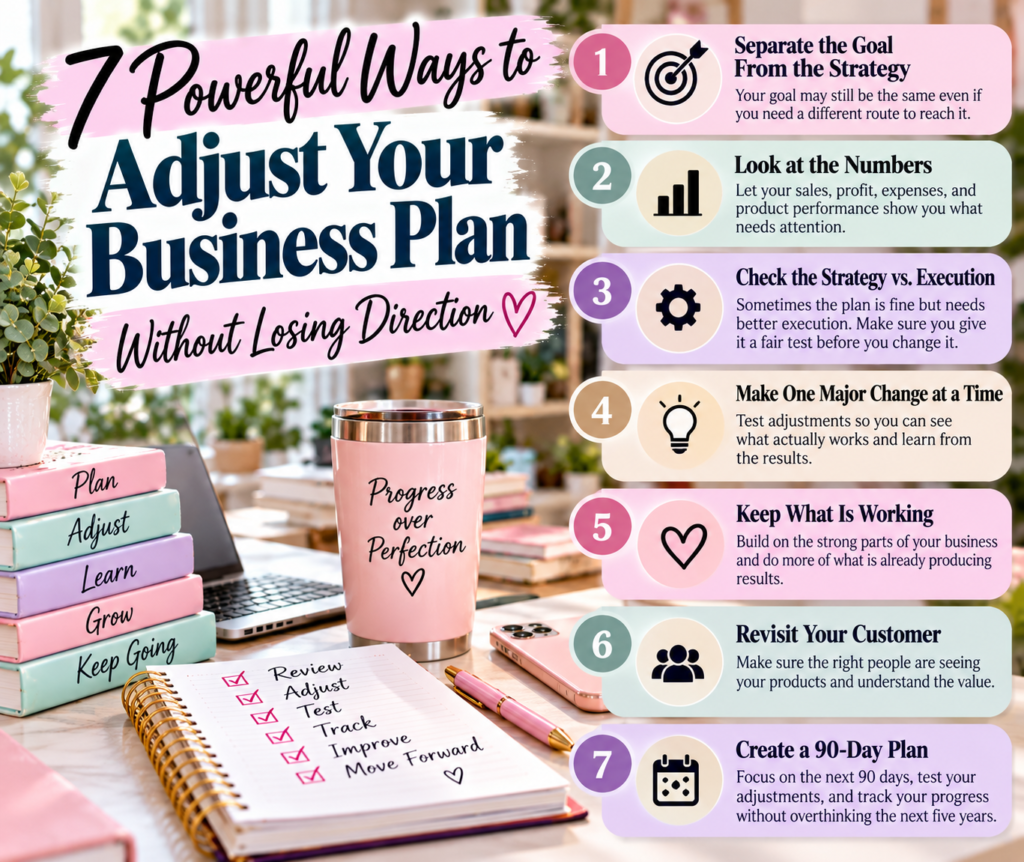
6. Revisit the Customer Before You Change the Product
Sometimes a business owner decides a product is too expensive or unwanted when the real problem is that the wrong customers are seeing it. A handmade item can feel expensive to someone comparing it with a mass-produced product, while the same price may make complete sense to a shopper specifically looking for something handmade, customized, or locally produced.
Before you adjust your business plan by cutting prices or completely changing your products, take another look at your customer. Ask who you originally thought would buy, who is actually purchasing, who comes back, who asks questions, and which customers seem to understand the value most quickly.
This is also where marketing becomes important. A strong product shown to the wrong audience can look like a weak product. If customers never understand what makes the item different, the problem may be messaging and positioning rather than the product itself.
Our discussion about selling in a slow economy fits here too. Customer priorities can change when money becomes tighter. Sometimes the business needs to adjust how the product is positioned, packaged, bundled, or explained rather than immediately lowering the price.
7. Rewrite the Next 90 Days Instead of the Next Five Years
When something changes, you do not always need to rewrite your entire long-term business plan. Sometimes the most useful thing you can do is create a new plan for the next ninety days.
A ninety-day period gives you enough time to test an adjustment while still keeping the experiment manageable. For example, you might decide that during the next three months you will attend fewer vendor events, improve your top five online listings, increase follow-up with previous customers, and track which marketing channel generates the most actual sales.
That gives you specific things to measure. At the end of the ninety days, you can review the results and decide whether to continue, expand, modify, or stop the strategy.
This is a much more realistic way to adjust your business plan than trying to predict every detail of the next five years. Your long-term direction still matters, but the next ninety days are usually where the actual work happens.
Not Every Slow Period Means Your Business Plan Is Broken
A slow week does not automatically mean you need a new strategy. Businesses have seasons, customers change their spending patterns, certain products sell better at different times of year, and marketing efforts often take time to produce results.
Before you make a large change, compare the current period with previous months and look at the larger pattern. Ask whether something changed in your pricing, inventory, marketing, event schedule, website traffic, customer behavior, or the broader market.
If you constantly adjust your business plan every time sales drop for a few days, you may never give any strategy enough time to work. You end up reacting instead of learning.
The goal is not constant change. The goal is informed change based on enough evidence to make a reasonable decision.
The U.S. Small Business Administration describes a business plan as a roadmap for how you structure, run, and grow your business, which is why it should be reviewed and adjusted as the business changes.
Sometimes the Original Assumption Was Simply Wrong
Every business plan contains assumptions. You assume customers will pay a particular price, an event will attract enough shoppers, a marketing strategy will bring in leads, or you will be able to produce a certain number of products every week.
Some of those assumptions will turn out to be wrong.
That is not always a crisis. It is often part of running a business.
Imagine that you planned to make 100 products every week but discover that you can realistically produce only 45 without exhausting yourself. The answer is not to force yourself to make 100 because that number appeared in the original plan. The better response is to adjust your business plan using the information you now have.
You may raise prices, reduce the number of products offered, improve production efficiency, batch tasks differently, or eventually hire help. What matters is that the new plan reflects reality rather than an assumption you made before you had experience.
Include Capacity in Your Business Plan, Not Just Revenue Goals
Many business plans concentrate heavily on money goals. You want to make $10,000, sell 500 products, book 100 clients, or attend twenty events.
Those goals can be useful, but there is another question that needs to be answered: Can the business actually handle that level of activity?
If you receive 100 orders, can you make them on time? Can you package and ship them? Can you answer customer messages, order supplies, keep records, and replace inventory without working every waking hour?
When you adjust your business plan, look at capacity along with revenue. Growth is only helpful when the business can support it.
Sometimes the next step is not getting more orders. It may be improving systems so you can handle the orders you already have.
Do Not Keep Investing in Something Just Because You Already Spent Money on It
This is one of the harder decisions in business.
You purchased supplies, created packaging, took photographs, paid listing fees, and spent hours developing a product. After all of that, customers still show very little interest.
The money you already spent can make you feel like you have to keep going because stopping would mean admitting the investment did not work. But continuing to spend money does not recover what you already spent. It can simply create a larger loss.
Before you abandon the product, give it a fair test. Improve the presentation, confirm that the right customer has seen it, and gather enough information to make a reasonable decision. If the evidence continues to show that the product is not working, learning to adjust your business plan may mean letting it go.
That is not giving up on the business. It is deciding not to keep feeding resources into one part of the business that is not producing enough value.
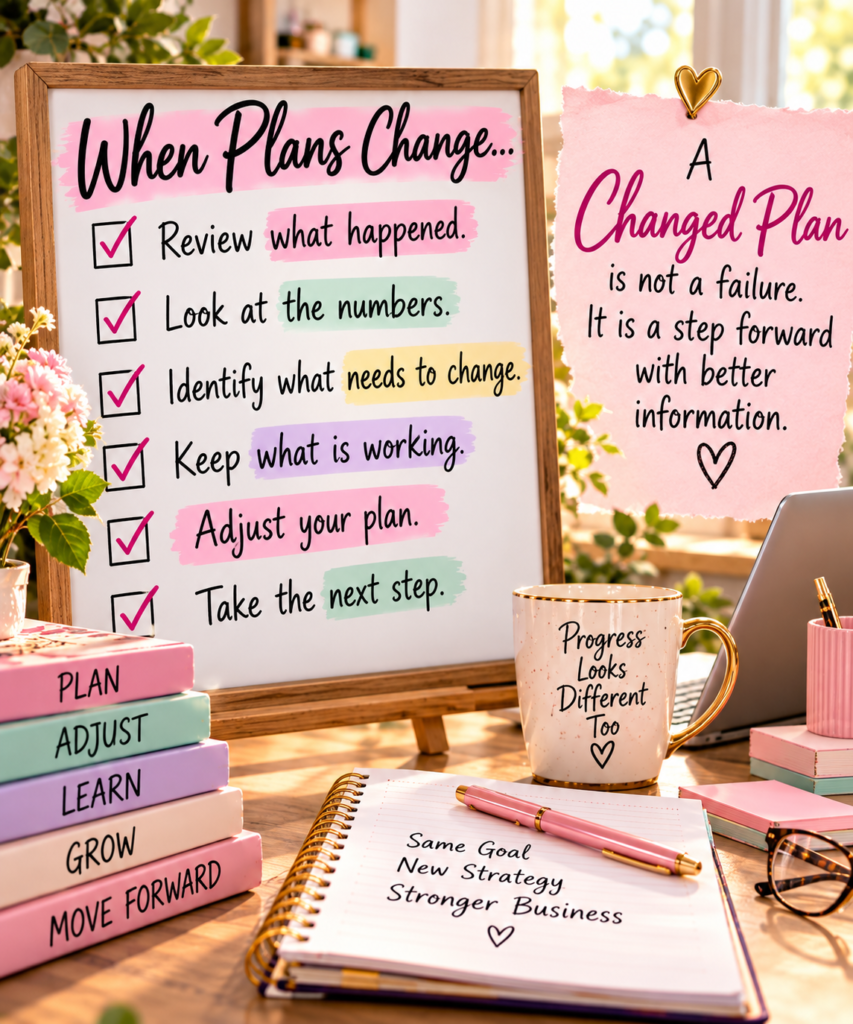
Changing the Plan Does Not Mean You Failed
This is probably the most important lesson in this entire article.
You created your original business plan using the information you had at the time. Six months later, you may have actual sales data, customer feedback, expense history, event experience, supplier information, and a much better understanding of how long things really take.
You should make better decisions when you have better information.
Changing the plan because you learned something is not failure. In many cases, refusing to change despite clear evidence would be the bigger mistake.
When you adjust your business plan, you are not saying the original idea was foolish. You are saying that the business has taught you something and you are willing to use that information.
That is part of becoming a stronger business owner.
Do Not Confuse Adjusting With Chasing Every New Idea
There is another side to being flexible. You do not want to become so willing to change that the business starts chasing every new trend.
Someone says a certain product is selling, so you immediately buy supplies. Someone tells you TikTok is the only platform that matters, so you abandon everything else. Another vendor tells you about an amazing event, so you register before researching it.
That is not necessarily adjusting. Sometimes it is simply reacting.
Before you adjust your business plan, ask whether the new opportunity fits your customer, financial goals, time, capacity, and overall direction. A new idea can be exciting and still be the wrong idea for your business.
Knowing what not to pursue can save just as much money and time as knowing what to pursue.
Create a Simple Business Plan Review Routine
You do not need to pull out a fifty-page business plan every week. A simple monthly or quarterly review can give you enough information to stay connected to what is happening.
Look at what you planned to accomplish, what actually happened, what sold, what did not sell, which expenses increased, which marketing produced results, and what customers kept asking for. Then decide whether anything needs attention during the next month or quarter.
Over time, these reviews begin to show patterns. You may notice certain products perform better during specific seasons, one event type consistently gives you better results, or one marketing channel produces more customers than another.
Those patterns make it much easier to adjust your business plan based on evidence instead of guessing.
Liz’s Note
I think people sometimes imagine that successful business owners make a plan once and then follow it perfectly. That sounds nice, but I do not think that is how real businesses work.
You can research, prepare, calculate, and make the best plan possible. Then customers, suppliers, events, expenses, time, weather, competition, and real life get involved. Something is going to change.
That does not mean you throw away the entire plan.
When I think about how to adjust your business plan, I think the important part is keeping your larger goal in sight while being willing to change the method. If an event does not work, learn from it. If customers keep asking for something different, pay attention. If a product is costing more than it earns, look at the numbers.
Your business is constantly giving you information. Use that information to make the next decision better than the last one.
Frequently Asked Questions About How to Adjust Your Business Plan
Is it normal to change a business plan?
Yes. A business plan is built from the information, assumptions, and goals you have at a particular point in time. Once the business begins operating, you gain real-world information that can make parts of the original plan outdated or unrealistic.
The important thing is not whether the plan changes. The important thing is why it changes and whether the new direction is supported by evidence.
How often should I review my business plan?
For many small businesses, a monthly quick review and a more detailed quarterly review can work well. If your business is changing quickly, you may need to look at it more often.
The goal is to review the plan often enough that you notice problems and opportunities before too much time passes.
How do I know whether to change the plan or give it more time?
Look at whether you have actually tested the strategy long enough and consistently enough to judge it. One disappointing result may not tell you much, while a repeated pattern across several months may tell you a lot.
Ask whether the original assumptions still make sense, whether the strategy was executed properly, and whether you have enough information to make a decision.
Does changing my business plan mean the first plan was bad?
No. The original plan may have been perfectly reasonable based on what you knew at the time.
As you gain experience, your information improves. Your plan should improve with it.
What should I change first when something is not working?
Start with the part directly connected to the problem. If profit is weak, review costs and pricing. If sales are weak, review the customer, product, marketing, and presentation. If you are overwhelmed, review capacity and operations.
Do not rebuild unrelated parts of the business just because one area needs attention.
Can I adjust my business plan without changing my main goal?
Absolutely. In many cases, this is exactly what you should do.
The destination may still make sense while the route needs to change. Learning how to adjust your business plan without losing direction means knowing the difference between the two.
Let’s Talk About Your Business Plan
Think about one thing in your business that has not gone the way you expected. It could be a product, a vendor event, a marketing strategy, pricing, production time, or even the type of customer who is actually buying from you.
Now compare what you expected with what really happened.
Then ask yourself: Does the goal need to change, or does the way I am trying to reach the goal need to change?
That one question can prevent a lot of unnecessary decisions.
Your Next Step
Choose one part of your business that is not performing the way you expected and write down what the original plan said should happen. Next to it, write down what actually happened and what evidence you have.
Look for the gap between the two.
Then decide whether the problem came from the strategy, execution, customer, cost, timing, capacity, or one of the assumptions you made at the beginning. Choose one reasonable adjustment to test over the next thirty to ninety days and track what happens.
You do not have to rebuild your entire business because one part of the plan stopped working. Learning to adjust your business plan means responding to what the business is teaching you while keeping your overall direction clear.
A business plan should help you move forward. When the road changes, sometimes the smartest thing you can do is change the route without forgetting where you are trying to go.