If you sell POD shirts, sublimation tumblers, laser-cut signs, 3-D printed products, embroidery, stickers, mugs, decals, greeting cards, or other handmade products, there is a good chance you have purchased digital files at some point. Maybe it was an SVG from Etsy, an illustration from Creative Fabrica, an STL file for 3-D printing, or a design from another marketplace that said commercial use included.
That phrase can create a false sense of security.
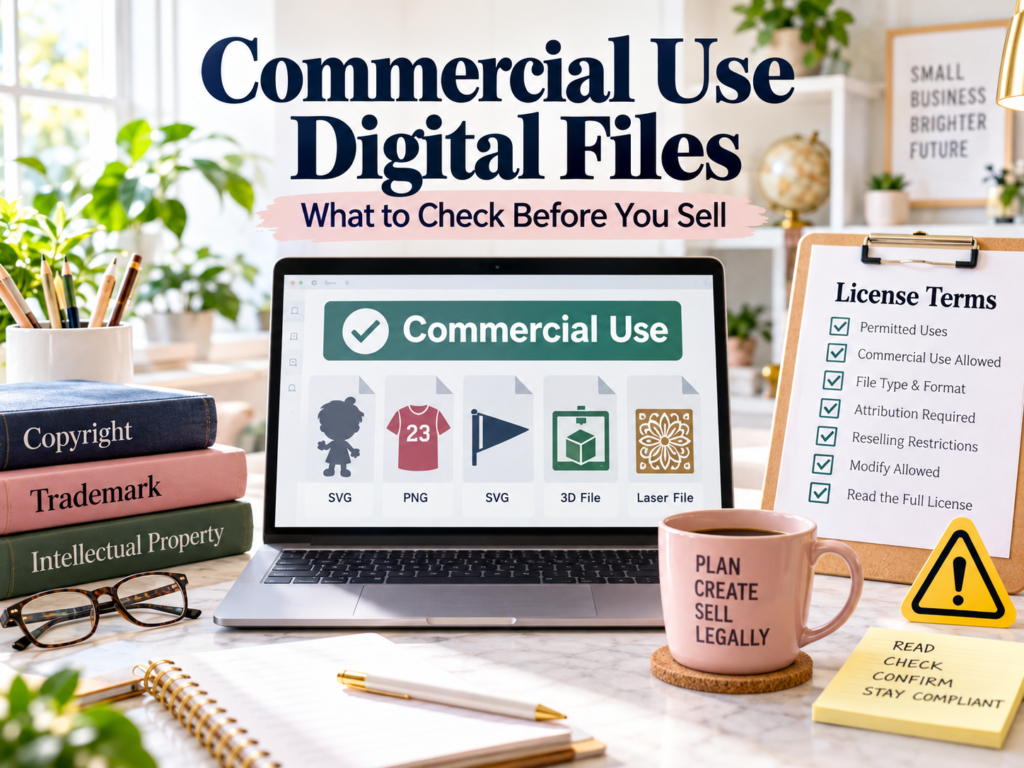
A seller can only give you the rights they actually own or are authorized to license. If the file contains someone else’s protected character, logo, brand name, mascot, artwork, or trademark, the commercial-use statement from the marketplace seller does not automatically give you permission from the actual rights holder.
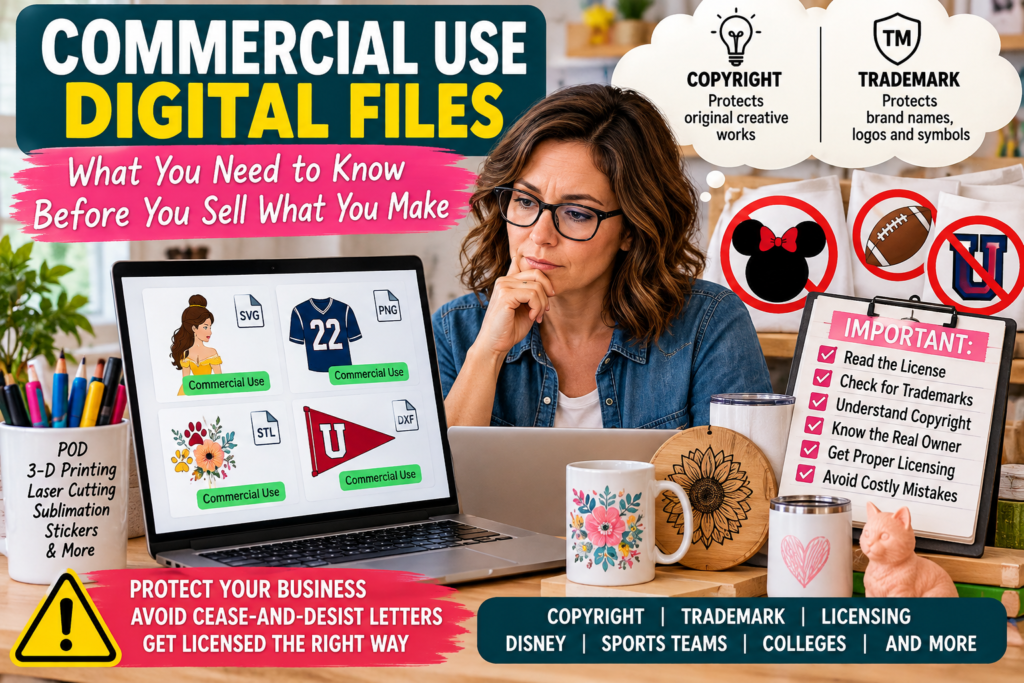
That is especially important when the file contains Disney characters, professional sports logos, college logos, recognizable brands, celebrity images, movie characters, or other well-known intellectual property. Buying the file does not automatically mean you bought the right to sell merchandise using the intellectual property inside it.
Before we go further, this article is for general educational purposes only and is not legal advice. Copyright and trademark questions can depend on the specific design, the way it is used, the product being sold, the license involved, and other facts. When you are unsure, speak with an intellectual-property attorney or contact the rights holder or its authorized licensing representative.
First, Understand the Difference Between Copyright and Trademark
Copyright and trademark are often mentioned together, but they are not the same thing. Understanding the difference can help you identify what kind of problem may exist before you buy or commercial use digital files.
The U.S. Copyright Office explains that copyright protects original works of authorship that are fixed in a tangible form. That includes things such as illustrations, photographs, paintings, music, books, movies, computer programs, and other original creative works. Copyright generally exists automatically when an eligible original work is created and fixed. U.S. Copyright Office
Trademark law protects something different. The USPTO explains that a trademark can be a word, phrase, symbol, design, or combination of those things that identifies the source of goods or services. That is why business names, logos, slogans, and other brand identifiers are commonly associated with trademark protection. USPTO
A single product can involve both types of intellectual property. A Disney character illustration may involve copyright because it is a creative work, while Disney names, logos, and other brand identifiers can also involve trademark rights. A college mascot may involve copyrighted artwork while the university’s name, logo, or athletic marks may also function as trademarks.
That is why asking only, “Is this copyrighted?” is not enough. You may need to ask whether copyright, trademark, or both are involved.
1. “Commercial Use” Does Not Mean You Can Use Anything Commercially
This is the first misunderstanding we need to clear up.
When a digital-file seller writes commercial use allowed, that usually means they are giving you permission to use whatever rights they legally control under the terms of their license. If they created an original floral design and own the copyright, they may be able to let you use that design on products you sell.
But imagine that same seller uploads a file containing Mickey Mouse, a Nike logo, an NFL team logo, or a university mascot. The seller does not automatically gain ownership of those intellectual-property rights simply because they recreated the image as an SVG, PNG, embroidery file, or STL.
That is why buying commercial use digital files requires one more question:
Does the seller actually own or control the rights they are giving me permission to use?
Creative Fabrica itself warns users not to use recognizable characters, celebrity likenesses, or brand elements without proper authorization. Its commercial-use guidance also recommends checking trademark databases and seeking legal guidance when necessary. Creative Fabrica
That is an important reminder because even a marketplace that offers legitimate commercial licenses recognizes that outside intellectual-property rights still matter.
2. Disney Deserves Extra Attention
Disney is one of the clearest examples of why this subject matters.
You may find Disney SVGs, clipart, embroidery files, printable designs, laser files, or other downloads on marketplaces. Some listings may even say commercial use, small-business license, or sell up to 500 items.
None of those phrases automatically means Disney gave permission.
Disney’s own help site directs people who want permission to use Disney property to Disney’s licensing resources. Disney also maintains product-integrity systems for authorized licensees and vendors producing Disney-branded products. Disney Help
Disney’s legal notices also identify numerous Disney names and properties as protected copyrights or trademarks, including Disney, Pixar, Marvel, and other properties. Disney Help
So if an Etsy seller creates a Mickey Mouse SVG and gives you a PDF titled Commercial License, that PDF is not automatically a Disney license.
It may show that you purchased a file from that seller. It may describe what the seller says you may do with the file. What it does not automatically prove is that Disney authorized that seller to license Disney intellectual property.
For a new business, this is exactly the kind of risk I would avoid. Starting a business by building inventory around famous protected characters may feel like an easy way to attract customers, but it can also lead to listings being removed, inventory becoming unusable, cease-and-desist demands, or potentially litigation. The USPTO explains that trademark owners can pursue infringement claims, and possible remedies can include injunctions stopping use, destruction or forfeiture of infringing products, monetary relief, and in some circumstances attorneys’ fees. USPTO
That is not where you want your new business money going.
3. A Cease-and-Desist Letter Is Not Something to Ignore
This is important enough that we should eventually make it a separate BSL article.
A cease-and-desist letter is not the same thing as automatically being sued. However, the USPTO explains that such a letter generally tells you that another party believes you may be infringing its trademark and demands that you stop or consider stopping the accused use. The USPTO specifically advises recipients to take these communications seriously because the response can have legal consequences. USPTO
For a small seller, receiving one can mean suddenly having to stop selling a product, remove online listings, change designs, discard inventory, or pay for legal advice. If the situation escalates into litigation, the expense and time involved can become much larger. The USPTO notes that trademark litigation can be expensive and time-consuming. USPTO
That is why this is not a good “I will worry about it later” area of business.
It is much easier to research the rights before creating fifty shirts than to discover later that the shirts cannot legally be sold.
And yes, I would absolutely make a separate companion article later on what to do if your small business receives a cease-and-desist letter.
4. Buying From Etsy Does Not Mean Etsy Approved the Intellectual Property
Etsy is a legitimate, major marketplace, but that does not mean Etsy personally verifies every seller’s ownership of every design before the listing appears.
Etsy’s intellectual-property policy states that Etsy is a marketplace of independent third-party sellers. Etsy says sellers are responsible for ensuring they have the necessary rights to the content they post and are not violating another party’s intellectual-property rights. Etsy can also remove or disable material when it receives qualifying infringement reports. Etsy
That distinction is important.
If you purchase commercial digital files from Etsy, your receipt shows that you bought something from an Etsy seller. It does not automatically establish that Disney, the NFL, Nike, a university, or another rights holder authorized the design.
The same principle applies to other marketplaces. A recognizable website can provide a place for people to sell digital products without personally becoming the owner of every intellectual-property right contained in those files.
That is why you still need to read the license and investigate the underlying design.
This also connects with our BSL article on Product Profitability: 7 Costs to Check Beyond the Selling Price. A product is not truly profitable if you invest in materials, packaging, inventory, and marketing only to discover later that you cannot legally continue selling it.
5. Professional Sports Teams Are Protected Too
Sports designs are another area where new businesses can get into trouble because team logos are easy to find online.
You may see NFL, NBA, MLB, NHL, or other team designs being sold as SVGs, embroidery files, decals, or sublimation graphics. The fact that someone else is selling the digital file does not mean you have received a merchandise license from the league or team.
The NFL’s terms, for example, state that the NFL and its member clubs own rights in their team and league names, logos, designs, and other trademarks and prohibit unauthorized commercial use unless permission has been granted. NFL.com
That means seeing hundreds of similar football shirts on marketplaces should not be your legal test.
“Everybody else is doing it” is not licensing.
Before using a professional sports logo on products for sale, find the official licensing information from the league, team, or authorized licensing organization.
6. College Logos Have a Real Licensing Process
College merchandise is another excellent example because the legitimate licensing process is very different from purchasing a $4 SVG.
Many colleges use CLC, the Collegiate Licensing Company, to manage merchandise licensing. CLC explains that a retail license allows an approved company to produce products bearing participating collegiate trademarks for retail sale. It also lays out a formal process involving an application, institutional review, fees, insurance, supply-chain disclosures, a licensing agreement, product samples, official labels, and artwork approval. CLC
That process tells you something important.
If you buy a University of Alabama, Penn State, Ohio State, Maryland, or another college logo from a digital seller, you have not automatically completed the university’s licensing process.
The university owns its marks.
An authorized licensing company such as CLC may administer permissions for participating institutions.
The person who uploaded the SVG does not become the university simply because they created a digital file.
If you want to sell legitimate college merchandise, begin with the university’s trademark/licensing office or check whether its program is handled through CLC.
7. A Seller Cannot Give Away Rights They Do Not Have
This is the central lesson of the article.
Suppose I create an original flower illustration. I own the rights to that original artwork, so I may be able to give you permission to use it commercially.
Now suppose I trace a famous professional sports logo and sell you the SVG. I may have created the digital file itself, but that does not automatically mean I obtained the rights to the underlying sports trademark.
The same concept applies to Disney.
The same applies to college logos.
The same applies to major brands.
The same applies to copyrighted artwork.
A license from the file seller only goes as far as the rights that seller is legally entitled to grant.
That is why people buying commercial use digital files should separate two questions:
Did I legally buy this file?
and
Do I have the legal rights needed to use everything inside this file on merchandise I sell?
Those are not always the same question.
8. Changing the Design Does Not Automatically Make It Safe
Another misunderstanding is that changing a few things solves the intellectual-property problem.
Someone may change Mickey Mouse’s shirt color, redraw a sports logo, add flowers around a college mascot, or change one part of a protected illustration and assume it is now original enough to sell.
Copyright law is not that simple.
The U.S. Copyright Office explains that only the copyright owner has the right to prepare or authorize new versions of a copyrighted work, subject to exceptions such as fair use. Simply changing someone else’s work does not automatically give you ownership or permission to commercially exploit it. U.S. Copyright Office
Trademark problems can also remain if the design still uses protected brand identifiers or creates confusion about whether a product is authorized, sponsored, or connected to the trademark owner. The USPTO describes trademark infringement as unauthorized use likely to cause confusion, deception, or mistake regarding the source of goods or services. USPTO
So “I changed it a little” is not a licensing strategy.
9. Read the Actual Commercial License
Not every commercial license is bad. Many legitimate artists and digital marketplaces sell original assets with useful commercial rights.
The problem is assuming that every commercial license means the same thing.
One license may allow unlimited physical products. Another may allow only 500 sales. Some licenses permit print-on-demand. Others restrict it. A license might allow a graphic to be used as part of a larger design but prohibit selling the original graphic by itself.
When buying commercial use digital files, read the actual terms rather than relying on the words commercial use in the thumbnail.
Look for things such as whether physical products are allowed, whether POD is allowed, whether there are quantity limits, whether digital resale is prohibited, whether you have to modify the artwork, and whether third-party trademarks or protected characters are excluded.
Creative Fabrica, for example, specifically warns against using protected characters, celebrity likenesses, or brand elements without proper authorization even within its broader commercial-use ecosystem. Creative Fabrica
The license matters.
The ownership behind the license matters even more.
How to Research a File Before You Buy It
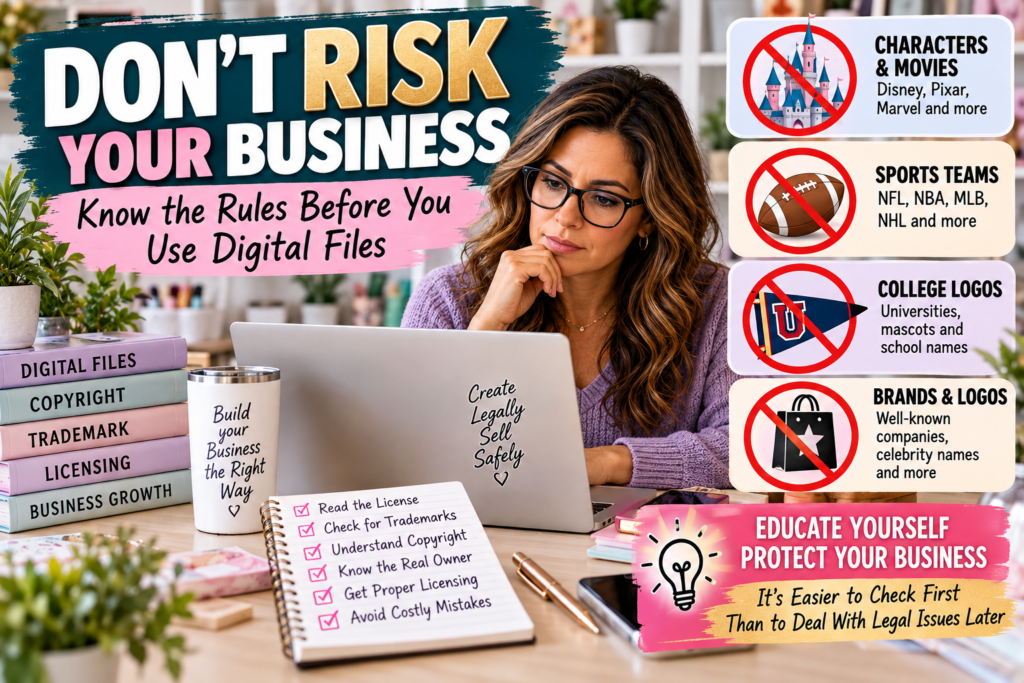
You do not have to turn every $3 SVG purchase into a legal investigation, but certain designs should immediately make you slow down.
If you see a famous character, sports team, college, company logo, movie property, celebrity, or recognizable brand, assume there may be intellectual-property rights involved and investigate before using it commercially.
For trademarks, use the USPTO’s official resources to learn about trademarks and search federal records. The USPTO explains that names, logos, slogans, and other identifiers can function as trademarks and provides tools for searching existing marks. USPTO
For copyright information, use the U.S. Copyright Office.
U.S. Copyright Office: What Is Copyright?
If the design belongs to a particular company, go to that company.
That last part is the most important.
How Do You Get Legitimate Licensing?
The licensing process depends on the rights holder.
For Disney property, start with Disney’s official licensing resources. Disney’s own help page directs permission requests to its licensing website. Disney Help
Disney Permission and Licensing Information
For participating colleges, check the institution’s licensing department or CLC’s application process. CLC says each institution makes its own licensing decisions, and approval may involve product reviews, fees, insurance, supply-chain information, agreements, official labels, and artwork approval. CLC
For professional sports teams, start with the league or team’s licensing department.
For another company, look for sections on its website called Licensing, Permissions, Brand Licensing, Trademark Licensing, Consumer Products, or Rights and Permissions.
The legitimate permission comes from the owner or someone the owner has authorized to license those rights.
Not from whoever happened to sell you the file.
What About “Disney-Inspired” or “NFL-Inspired”?
Adding the words inspired by does not automatically solve the problem.
Neither does writing:
“Not affiliated with Disney.”
“Fan art.”
“For handmade sellers only.”
“Small-business use.”
“Commercial license included.”
Those phrases do not create rights that you otherwise do not have.
Whether a particular design infringes copyright or trademark is a legal question based on the actual facts. A disclaimer in your Etsy description is not a substitute for permission from the rights holder.
For a small business, the smarter approach is to create or purchase original designs where the ownership is clear. That gives you a much stronger foundation than building a business around products that could disappear the moment a rights holder objects.
This also connects with our article on Small Business Branding: How to Make the Same Product Feel More Valuable. Building your own recognizable style and product identity gives customers a reason to remember your business instead of depending on someone else’s famous brand to make the sale.
Buying a File Is Not the Same as Buying the Intellectual Property
This sentence is worth remembering:
You can legally purchase a file and still not have permission to commercially use all of the intellectual property inside that file.
Your receipt proves a transaction happened.
It does not automatically prove the seller owned every right involved.
A seller-created commercial license may tell you what that seller permits. It does not automatically establish permission from Disney, an NFL team, a university, or another third-party rights owner.
That is why recordkeeping still matters. Save your receipts, the exact license terms, screenshots of the license when appropriate, and information about where the file came from. Those records can help document what you purchased, but do not confuse documentation of the purchase with ownership of underlying third-party rights.
Why This Matters Before You Start a Business
This is the part I especially want new sellers to understand.
You are trying to build something.
You may already be paying for equipment, blanks, ink, printers, 3-D filament, laser materials, booth fees, packaging, websites, advertising, and inventory. The last thing you need is to invest more money into a product line that you may later have to stop selling.
A cease-and-desist letter can arrive before a lawsuit, and the USPTO advises recipients to take those letters seriously. Trademark owners also have the option of pursuing lawsuits, and remedies can potentially include stopping the use, destroying or forfeiting infringing merchandise, monetary relief, and in some situations attorneys’ fees. USPTO
That does not mean every mistaken use leads to a lawsuit.
It means “I am only a small business” is not a business strategy for intellectual property.
Research first.
Spend second.
Sell third.
That order can protect a lot of money and stress.
Liz’s Note
I think this is an area where many small-business owners make mistakes without realizing what they are doing.
They are not necessarily sitting down saying, “I am going to steal somebody’s brand today.” They go to a website they already know, see a digital file they like, read commercial use, pay for it, and believe they are doing everything correctly.
I understand how that happens.
But when you are running a business, we have to go one step further.
If you buy a Disney file from an Etsy seller, your transaction is with that Etsy seller. You did not automatically become a Disney licensee because the seller typed “commercial use” in the description.
The same applies to an NFL logo or a college mascot.
That is why I would rather see somebody spend ten minutes checking a file before buying it than spend hundreds of dollars making inventory they later cannot safely sell.
Starting a business already has enough challenges.
Receiving a cease-and-desist letter or facing an intellectual-property dispute because you trusted the wrong digital-file listing does not need to be one of them.
Frequently Asked Questions About Commercial Use Digital Files
What is the difference between copyright and trademark?
Copyright generally protects original creative expression such as artwork, photographs, music, books, movies, and illustrations. Trademark generally protects identifiers such as business names, logos, slogans, and symbols that distinguish the source of goods or services. U.S. Copyright Office
A single product can involve both types of protection.
If a digital file says commercial use, can I sell products with it?
Maybe.
You need to read the license and determine whether the seller actually owns or controls the rights involved. If the file is completely original artwork owned by that seller, the commercial license may give you the rights you need.
If the file contains third-party intellectual property, you may need permission from the actual rights holder.
Can I sell Disney products if I bought a Disney SVG from Etsy?
The purchase itself does not automatically give you a license from Disney.
Disney has its own licensing and permission process. If you want to use Disney intellectual property commercially, check Disney’s official licensing resources rather than relying solely on a marketplace seller’s statement. Disney Help
Can small businesses be sued for trademark infringement?
A trademark owner may pursue an infringement action when it believes unauthorized use violates its rights. The USPTO explains that trademark litigation can potentially result in injunctions, monetary relief, destruction or forfeiture of infringing products, and other remedies if infringement is proven. USPTO
Your business being small does not automatically create an exemption from intellectual-property law.
What should I do if I receive a cease-and-desist letter?
Take it seriously and consider speaking with an attorney experienced in trademark or intellectual-property disputes. The USPTO explains that responding, ignoring the letter, negotiating, and other options can all carry legal consequences depending on the situation. USPTO
We should make a separate BSL article on this because it deserves a complete step-by-step explanation.
Can I sell college merchandise if I buy the logo online?
Buying the logo file is not the same as receiving permission from the university.
Many colleges use formal licensing systems, including CLC, and legitimate retail licensing can involve an application, institutional approval, fees, insurance, official labels, and artwork approval. CLC
Does Etsy guarantee that digital files are legally licensed?
Etsy says sellers are responsible for ensuring they have the rights needed for what they list, and Etsy has procedures for intellectual-property owners to report alleged infringement. Etsy
A listing being available for purchase should not be treated as proof that every third-party right has been cleared.
Let’s Talk About Your Digital Files
Think about the digital files you have purchased for your business.
Do any contain Disney characters, professional sports teams, college logos, movie characters, celebrities, major brands, or other recognizable intellectual property?
If they do, pull up the license.
Look at who issued it.
Then ask yourself:
Did I receive permission from the actual rights owner or an authorized licensing agent, or did I only receive permission from the person who sold me the file?
That is an important difference.
Your Next Step
Before you make another batch of products from a digital design, review the file and its license.
Identify whether the design is completely original or contains someone else’s brand, artwork, logo, character, or other intellectual property. If another rights holder is involved, go directly to that company, university, league, or authorized licensing agent and find out what permission is actually required.
For Disney, start with Disney.
For collegiate marks, start with the university or CLC where applicable.
For professional sports, start with the league or team.
For trademarks generally, use the USPTO.
For copyright questions, use the U.S. Copyright Office.
And if the situation is unclear enough that you are risking significant inventory or money, talk to a qualified attorney before you proceed.
Buying commercial digital files can be a great resource for a small business.
Just remember that buying the digital file and buying permission to commercially use every piece of intellectual property inside it are not always the same thing.