
When the holidays get closer, a lot of customers stop shopping the way they do the rest of the year. They are not just looking for something cute, interesting, or useful for themselves. They are trying to solve a problem. They need teacher gifts, coworker gifts, stocking stuffers, hostess gifts, secret-santa gifts, neighbor gifts, and something thoughtful for people they care about without spending all day trying to figure it out.
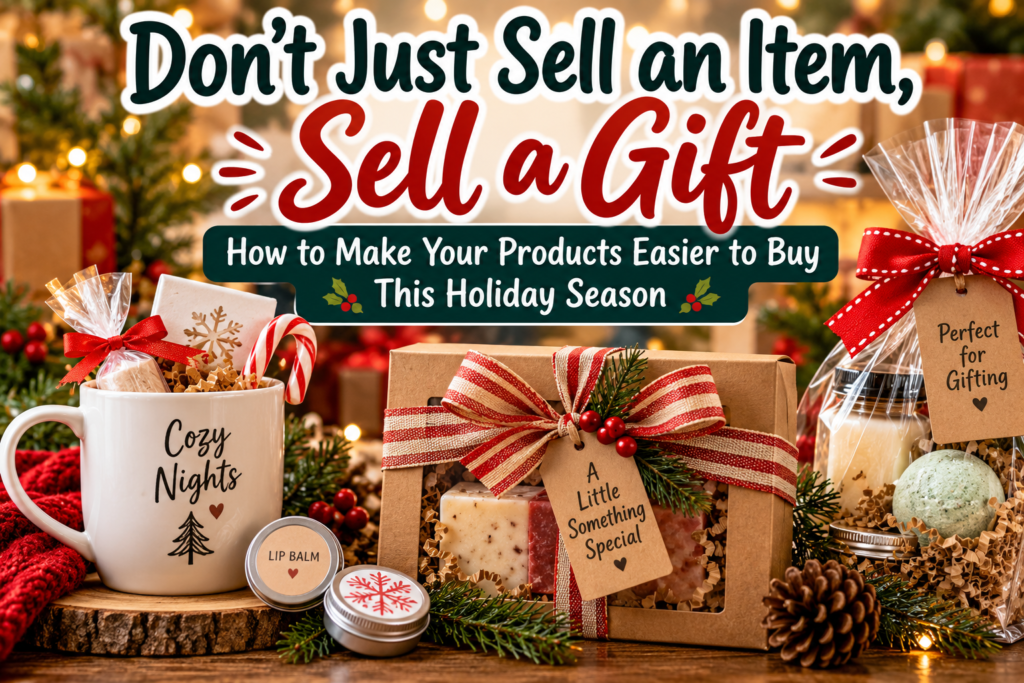
That shift matters more than a lot of small business owners realize. During the holiday season, people are often not just buying a product. They are buying something they can hand to someone else and feel good about giving. That is why holiday gift bundles and gift-ready presentations can make such a difference.
If your product is sitting there as a single item with no story, no suggested use, and no easy presentation, the customer may still like it and keep walking. Not always because the product is bad, but because they are shopping with a gift-giving mindset. If you help them see the item as a finished gift instead of just another product on a table, you make the buying decision easier.
That is what this post is really about. I do not want you to think the answer is to throw random items together with a bow and call it a bundle. I want you to think strategically. If you are selling during the holidays, the goal is not just to sell more products. The goal is to make those products easier for holiday shoppers to say yes to.
Holiday Shoppers Are Looking for Solutions, Not Just Products
One of the biggest mistakes small business owners make during the holidays is assuming customers shop the same way they do in spring or summer. They do not. Holiday shoppers are often under pressure. They are thinking about budgets, gift lists, school events, office exchanges, family gatherings, and shipping deadlines all at the same time.
That is why a single handmade item may not feel complete enough unless the customer immediately understands how it fits into their holiday shopping. A lip balm is nice, but a lip balm presented as a stocking stuffer feels easier to buy. A bar of soap is nice, but a soap tucked into a small gift box with a label and ribbon feels more gift-ready. A mug is nice, but a mug paired with cocoa, a spoon, and a tag that says “Cozy Night Gift” becomes a solution.
The U.S. Small Business Administration emphasizes the importance of understanding what your customer values and how your product solves a need or fits into a buying decision. That applies here too. When customers are shopping during the holidays, one of the needs they are trying to solve is finding a gift that feels thoughtful, complete, and easy to give. You can review SBA marketing guidance here: U.S. Small Business Administration marketing and sales guidance.
When you understand that, holiday gift bundles start making a lot more sense. They are not just about raising the price. They are about helping the customer finish a gift decision faster.
Don’t Just Put Items Together. Build a Gift Around a Purpose
A real gift bundle should feel like it belongs together. It should make sense to the customer without them having to study it too long. One of the easiest ways to make a bundle feel stronger is to build it around a clear purpose, theme, or recipient.
For example, instead of placing three unrelated things together and hoping someone buys them, you might create a bundle around “Teacher Appreciation,” “Stocking Stuffer Set,” “Cozy Night In,” “Self-Care Gift,” “Book Lover Gift,” or “Coffee Break Gift.” The theme helps the customer understand why those products are together and who they are for.
That is a big difference. A random group of products looks like inventory you were trying to move. A thoughtful set looks like a gift someone can confidently buy. This is where holiday gift bundles become more than packaging. They become a selling tool.
The good news is that you do not need complicated bundles to do this well. In fact, simpler is often better. A strong holiday bundle usually works because the customer can understand it quickly. The more thinking they have to do, the more likely they are to put it down and keep shopping.
Think Like a Gift Buyer, Not Just a Seller
When you create bundles or gift-ready products, try to step out of the maker mindset for a minute and into the shopper mindset. A business owner often thinks about inventory, cost, materials, and what products are available. A holiday shopper is often thinking something much more basic: “Who can I give this to, and will it look like enough?”
That question should guide your decisions.
If the product is too plain, the customer may feel like they still have more work to do. If the product looks incomplete, they may worry it does not feel special enough. If the bundle is too expensive, they may immediately rule it out. If it looks cluttered or random, they may not understand what they are supposed to do with it.
Strong holiday gift bundles work because they remove those questions. The customer can picture the recipient. They can see the value. They understand the purpose. Most importantly, they feel like the product is already part of the solution.
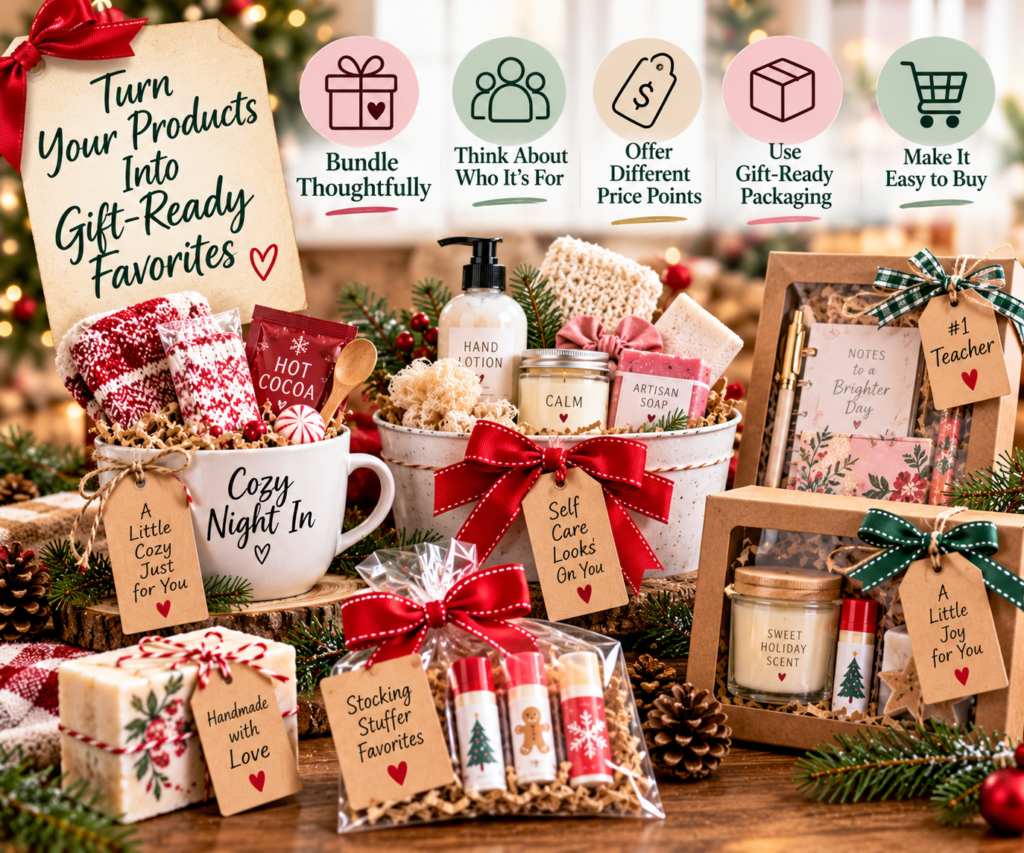
Packaging Can Turn an Everyday Product Into a Holiday Gift
This is one of the biggest things I want sellers to understand going into the holiday season. A product does not always need to change completely to become more appealing during the holidays. Sometimes the packaging does most of the work.
A plain lip balm may feel like an ordinary everyday item. That same lip balm in holiday-themed packaging can suddenly become a stocking stuffer. A simple bar of soap sitting in a clear wrap may feel basic, but place that same soap inside a small box with a label, scent name, business branding, and neat presentation, and it feels much more polished. Add a ribbon, a small tag, or a gift bag, and it can feel ready to hand to a teacher, coworker, or neighbor.
That does not mean you should overspend on packaging or create something so decorated that it no longer makes financial sense. It means presentation affects perceived value. During the holidays, customers often want something affordable that still looks nice enough to give. That is exactly why holiday gift bundles and gift-ready upgrades can help.
This connects directly to Small Business Branding: How to Make the Same Product Feel More Valuable. Sometimes the product itself is not the issue. Sometimes the difference between “just an item” and “a gift” comes down to the way it is presented. It also connects to Product Profitability: 7 Costs to Check Beyond the Selling Price, because packaging should help the sale without quietly eating up all of your profit.
Create Different Gift Levels for Different Buyers
Not every shopper is coming to your table or website with the same budget. Some need a quick $5 or $10 stocking stuffer. Others want a $20 teacher gift. Someone else may be shopping for a more substantial present in the $35 to $50 range.
That is why I like offering multiple price points during the holiday season. It gives customers options without forcing everyone into the same spending level. You might have a small item, a mid-range gift set, and a larger premium bundle. This gives people a way to buy from you even if they cannot afford the biggest set.
For example, you could have a $5 gift-ready single item, a $15 mini bundle, a $25 themed set, and a larger premium option if your products support it. The numbers will depend on your costs and product type, but the principle stays the same. Holiday gift bundles become more effective when they meet customers where they are financially.
This also helps during vendor events because not everyone walks in planning to spend the same amount. If you only offer high-ticket bundles, you may lose people who wanted something small but thoughtful. If you only offer inexpensive singles, you may miss the chance to increase the sale for someone who would happily buy a more finished gift.
Bundles Should Increase Value, Not Just Increase the Price
A bundle should feel useful, thoughtful, or convenient. It should not feel like a business owner grabbed extra items and stacked them together to force a larger purchase. Customers can usually sense the difference.
Let’s say you sell body care. A bundle with soap, lip balm, and a lotion sample might make sense as a small self-care gift. If you throw in a random keychain just to raise the price, the whole set may feel less intentional. If you sell stationery, a notepad, pen, and bookmark may work well together. If you add something unrelated that does not improve the gift, the bundle can start feeling forced.
This is where being honest about the customer experience matters. Good holiday gift bundles help the shopper. Weak bundles mainly help the seller try to move extra inventory. Those two things are not the same, and shoppers usually know it.
When in doubt, ask yourself whether the bundle makes life easier for the person buying it. If the answer is yes, you are probably on the right track.
Help the Customer See Who the Gift Is For
One of the easiest ways to increase gift sales is to make the recipient obvious. Customers do not always need help liking a product. Sometimes they need help picturing who they would buy it for.
That is why small signs, product titles, and packaging language can help so much during the holidays. “Teacher Gift,” “Coworker Gift,” “Secret Santa Pick,” “Stocking Stuffer,” “Hostess Gift,” or “Book Lover Set” gives the shopper something specific to connect to.
This is especially helpful for shoppers who are overwhelmed or buying for several people at once. They do not want to stand there and invent ideas. They want something that helps them check a name off the list. Holiday gift bundles work well because they reduce the amount of thinking the customer has to do.
This idea also ties into Selling in a Slow Economy. When people are being more careful with spending, they are often still willing to buy when the product feels useful, meaningful, affordable, or giftable. A good holiday bundle can check several of those boxes at once.
Stocking Stuffers Are Small, but They Matter
Do not overlook smaller gift items during the holidays. A lot of customers are not looking only for the “main” gift. They are also looking for smaller add-ons. Stocking stuffers, teacher gifts, office-exchange gifts, and little thank-you gifts can be strong sellers because they fill a very specific need.
This is where thoughtful presentation can make a huge difference. A lip balm in regular packaging may feel like an everyday item. A lip balm in seasonal packaging suddenly feels more like a holiday purchase. A single item becomes easier to justify when it looks intentional and gift-ready.
You gave a perfect example of this with your lip balm. During the holidays, you use your own custom holiday packaging, and depending on the event, you can price it around $3 to $5. People buy it because it is affordable, festive, and easy to use as a stocking stuffer. That is a strong lesson for small business owners. Sometimes you do not need a completely different product. You need a different presentation for the season.
That is a very practical holiday strategy, and it is one reason holiday gift bundles and gift-ready packaging can be so effective even at lower price points.
Do Not Make the Bundle So Fancy That You Lose the Profit
I want to say this clearly because holiday excitement makes a lot of sellers start adding extras to everything. You can very quickly talk yourself into tissue paper, special boxes, ribbon, crinkle paper, tags, bows, ornaments, stickers, and multiple inserts. Then you look down and realize the packaging has become far too expensive for the product.
That is not a branding win if the numbers stop making sense.
A bundle or holiday presentation should improve the sale, not quietly wipe out the profit. Sometimes a simple box, a clear label, a holiday topper, or a neat bow is enough. Customers often just want the product to look finished and nice enough to give. They do not necessarily need the product packaged like a luxury department-store item.
This is why I would always test small upgrades before committing to a big holiday packaging plan. See what creates the biggest difference in presentation without creating unnecessary cost. Strong holiday gift bundles should still be good business decisions, not just cute ones.
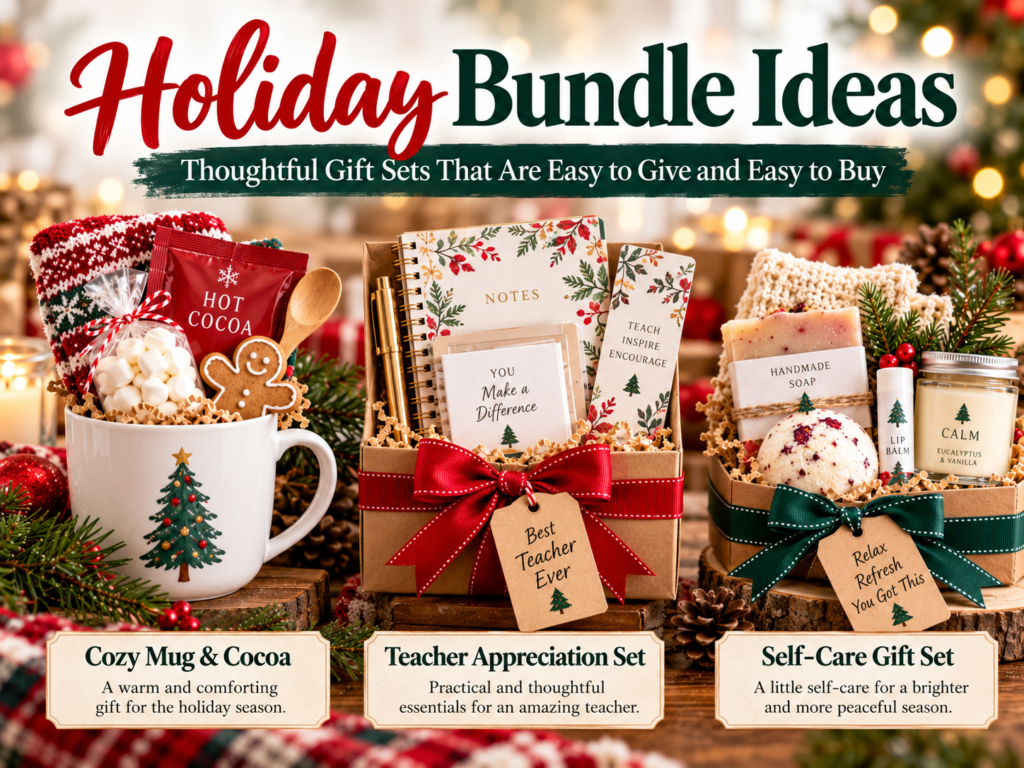
Use the Bundle to Tell a Story
One thing that makes a bundle stronger is when it feels like it tells a small story. That does not mean it has to be dramatic. It just means the shopper can understand the purpose and mood of the set.
A “Cozy Night In” gift tells a story. A “Teacher Thank-You” set tells a story. A “Holiday Self-Care” bundle tells a story. Even a simple “Stocking Stuffer Trio” tells the customer what the set is for.
That story matters because it helps move the bundle out of the “random group of products” category and into the “finished gift” category. This is another reason holiday gift bundles work well during the last quarter of the year. Holiday shoppers are often not just buying things. They are buying moments, feelings, convenience, and ways to show thoughtfulness without making life harder on themselves.
Test Before You Build a Table Full of Bundles
It can be tempting to go all in and make twenty versions of every idea. I would not do that right away. Start by testing.
Create a few bundles and see what customers respond to. Watch which ones they pick up, ask about, and purchase. Notice whether people seem more interested in individual products or in pre-made sets. Pay attention to the price points that move most easily.
If you are selling at events, this becomes even easier because you can watch the response in real time. If you are selling online, track which photos and products get the most clicks, saves, or purchases. The point is to let the customer help you decide what is worth expanding.
That is one reason I like using vendor events as research opportunities too. The Real Cost of Vendor Events: What to Track Before You Decide an Event Was Profitable is about more than money. It is also about paying attention to what actually sells and how customers behave. The same idea applies here.
Make Buying Easier, Not More Confusing
Sometimes sellers accidentally make holiday shopping harder by offering too many versions, too many add-ons, and too many custom choices all at once. A few choices are good. Too many choices can overwhelm people.
If you have holiday bundles, make them easy to understand. Use clear names. Show the price. Make it obvious what is included. If the item is gift-ready, say so. If it is a stocking stuffer, say so. If it is a teacher’s gift, say so.
Good holiday gift bundles help customers move toward a decision. Confusing bundles slow the customer down. And during the holidays, people often do not want to be slower. They want it easier.
Liz’s Note
I think this is one of the biggest mindset shifts holiday sellers need to make. You are not only selling a product in Q4. You are often selling a gift, a stocking stuffer, a small thank-you, a hostess gift, or an easy solution for someone who still has five names left on their list.
That changes how your product needs to show up.
A basic product can sell very differently once it looks gift-ready. I have seen it with smaller products like lip balm. During the holidays, holiday-themed packaging can turn a simple product into something people happily pick up because it already feels like it belongs in a stocking or gift bag.
That is what I want sellers to understand. Sometimes the product does not need to change nearly as much as the presentation, the positioning, and the way you help the shopper imagine giving it away.
Frequently Asked Questions About Holiday Gift Bundles
What are holiday gift bundles?
Holiday gift bundles are groups of products packaged or presented together in a way that makes them feel like a ready-to-give gift. They usually work best when the products fit a clear theme, purpose, or recipient.
A strong bundle should make sense to the customer without a lot of explanation. It should feel intentional, not random.
Do holiday gift bundles help increase sales?
They can, especially during the holiday season when customers are shopping for gifts instead of only shopping for themselves. Bundles can increase convenience, make products feel more complete, and give the customer an easier buying decision.
They can also increase average order value when the bundle still feels useful and reasonably priced.
Should I bundle products just to raise the price?
No. A bundle should improve the shopping experience, not just create a bigger total. If the products do not belong together or the customer does not understand the value, the bundle will feel forced.
The best holiday gift bundles feel thoughtful, helpful, and gift-ready.
What kinds of products work well in holiday gift bundles?
Products that are useful, giftable, themed, or easy to pair tend to work well. That could include body care, stationery, candles, food items, small accessories, bookmarks, personalized products, or stocking-stuffer items.
The key is not the category alone. The key is whether the products work together in a way that makes sense to the shopper.
Do I need expensive packaging to make a product feel like a gift?
No. You need packaging that makes the product feel neat, intentional, and ready to give. Sometimes a small box, clear bag, holiday topper, ribbon, branded label, or gift tag is enough to make a simple product feel more polished.
The goal is to improve the presentation without making the product unprofitable.
Let’s Talk Holiday Selling
Now I want you to think about your own products from the customer’s point of view.
Which of your products could become a better holiday seller if the presentation changed? Which item could become a stocking stuffer, teacher gift, coworker gift, or small ready-to-give bundle? Do you already have products that would work well together if you packaged them more intentionally?
I’d love to know: what product do you sell that could become a better gift with the right packaging or bundle idea?
That question alone can help you start seeing your products differently.
Your Next Step
Look at your current products and choose three that could be turned into a gift-ready offer this season. Then ask yourself who each one is for, what problem it solves for the holiday shopper, what price point makes sense, and how you can present it in a way that feels thoughtful without overspending.
Do not start by making ten bundles at once. Start smaller. Test a few strong ideas. Watch what customers respond to. Pay attention to which gifts feel easiest for shoppers to understand and buy.
That is how holiday gift bundles become more than a cute holiday idea. They become a practical way to help customers shop faster, help your products feel more valuable, and help your business sell more intentionally during the holiday season.