
Starting a business can feel overwhelming when you have an idea but no experience. You may know what you want to sell, or at least have a general direction, but then the questions start piling up. How much will it cost? Who is the customer? What licenses do you need? How should you price it? What should you buy first? How do you find customers if nobody knows you yet?
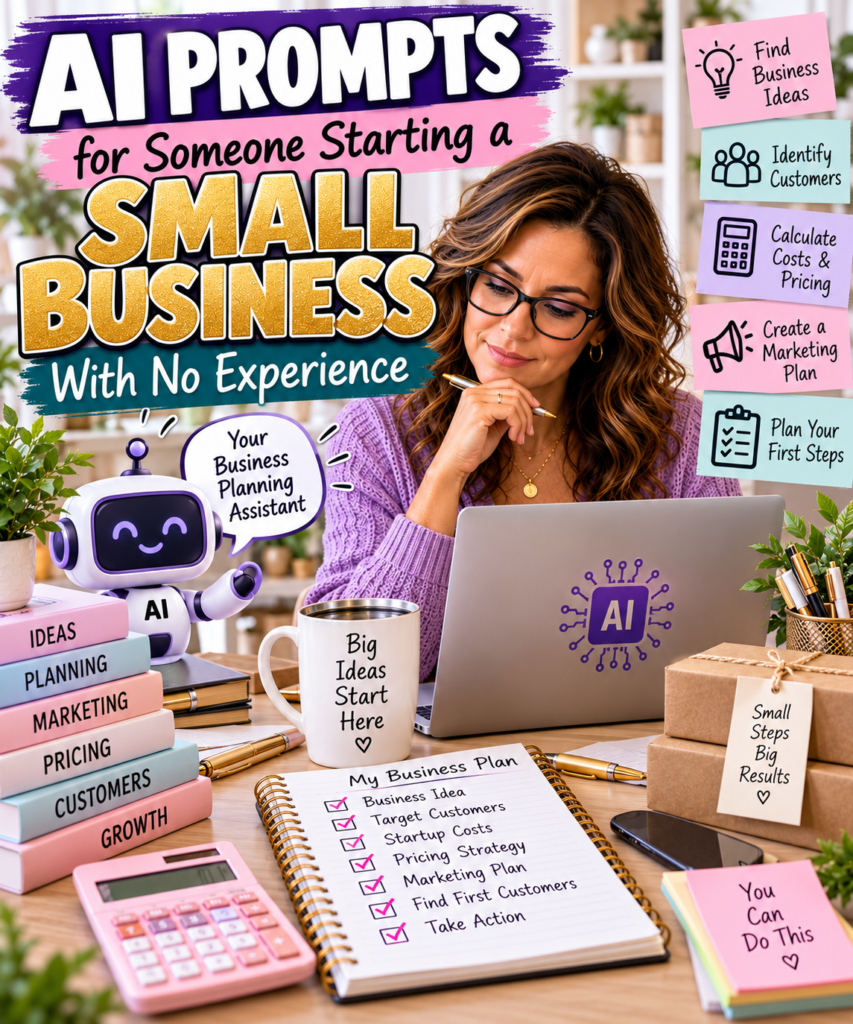
That is where AI prompts for starting a small business can be useful. AI can help you organize your thoughts, compare ideas, identify missing information, build checklists, estimate what needs more research, and break a large goal into smaller steps. For someone starting from scratch, that can make the process feel far less intimidating.
The key is knowing how to ask the right questions. A vague prompt such as “Help me start a business” may give you a vague answer. A stronger prompt explains the business idea, the budget, the experience level, the location, the goal, and what kind of answer would actually help. OpenAI’s current prompting guidance recommends being clear and specific, providing enough context, and refining the prompt after reviewing the first answer. OpenAI Help Center
Before we go further, remember that AI should support your thinking, not replace professional advice or official research. If you are dealing with taxes, business structure, permits, insurance, legal questions, food regulations, licensing, or other requirements, verify the information with official government sources or a qualified professional before acting.
How to Get Better Results From AI Prompts for Starting a Small Business
The quality of the answer depends heavily on the quality of the prompt. If you give AI very little information, it has to make more assumptions. If you provide useful context, ask for a specific output, and tell it what not to assume, the answer is usually much more useful.
OpenAI’s small-business training materials recommend thinking about four basic parts: the goal, the context, the output, and the boundary. In simple terms, tell AI what you want help with, what it needs to know, what kind of answer you want back, and what it should not invent or decide for you. OpenAI Academy
For example, instead of typing:
Help me start a business.
Try something more useful:
I want to start a small handmade candle business from home. I have no previous business experience and a startup budget of $500. Help me identify the first 10 things I need to research before spending money. Separate required tasks from optional tasks, and flag anything that depends on local laws or permits instead of guessing.
That is one of the simplest ways to make AI prompts for starting a small business work better for you.
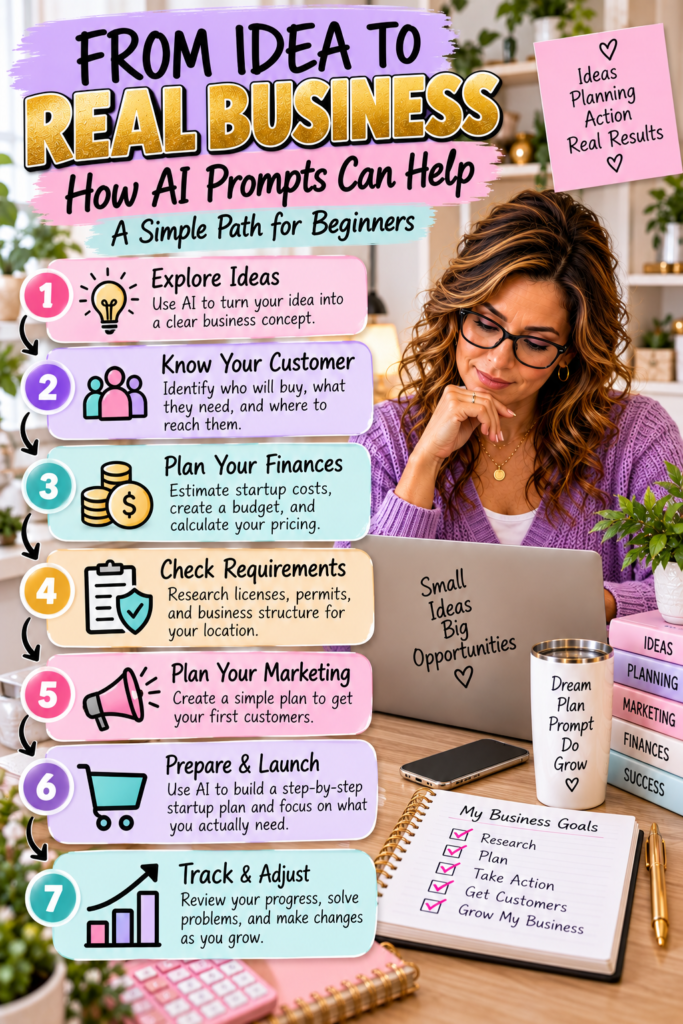
1. Use AI to Turn a Rough Idea Into a Business Concept
A lot of people have an idea before they have a business plan. Maybe you enjoy making soap, baking, 3-D printing, doing hair, cleaning homes, designing digital files, or creating handmade products. The problem is figuring out whether that idea can become something customers will actually pay for.
Use this prompt:
I want to start a small business selling or providing
. I have no previous business experience. Help me turn this idea into a simple business concept. Explain what I could sell, who the likely customer may be, what problem it solves, how the business could make money, and what I should research before spending money. Do not assume information you do not know. Tell me what questions I still need to answer.This is one of the most useful AI prompts for starting a small business because it helps turn a general thought into something more concrete. You are not asking AI to tell you whether the business will succeed. You are asking it to help you identify what you still need to understand.
2. Use AI to Compare Several Business Ideas
Sometimes the problem is not having too few ideas. It is having too many.
You may be trying to decide between candles, lip balm, resin products, digital printables, vending, cleaning services, or 3-D printed products. AI can help organize those options so you can compare them based on startup cost, difficulty, demand, and potential profit.
Try:
Compare these small-business ideas for a beginner: [list your ideas]. Evaluate each one based on startup cost, learning curve, competition, equipment needed, repeat-customer potential, profit potential, legal or licensing considerations, and how quickly a beginner could realistically start selling. Do not choose based only on popularity. Show me the strengths, risks, and what I should research before deciding.
This kind of comparison can stop you from choosing a business simply because it looks popular on social media. A business idea that works well for somebody with years of experience and thousands of dollars in equipment may not be the best first choice for someone with a $300 budget and ten hours a week.
3. Use AI to Identify Your Target Customer
One of the most common beginner mistakes is saying, “My product is for everyone.”
Very few products are truly for everyone, and marketing gets much harder when you do not know who you are trying to reach. One of the best AI prompts for starting a small business is a prompt that helps you think about who may actually want what you are selling.
Try:
My business idea is [describe the business]. Help me identify 2 or 3 realistic customer groups that may be most interested in this product or service. For each group, explain what they may care about, why they might buy, what concerns or objections they may have, and where I might reach them. Separate facts from assumptions and tell me what I would need to validate with real customers.
The final sentence matters. AI can suggest likely customer groups, but those suggestions are still hypotheses until real people show you what they actually want.
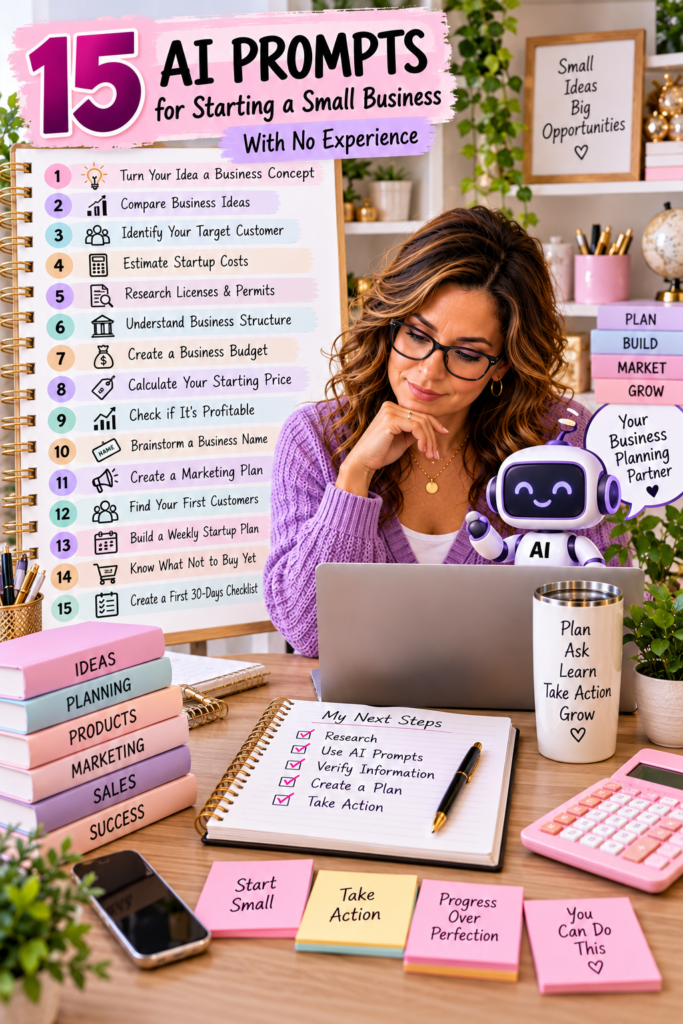
4. Use AI to Estimate Startup Costs
Starting a business usually costs money, but beginners often spend in the wrong order. They buy logos, signs, furniture, expensive equipment, or large amounts of inventory before they know what is actually necessary to make the first sale.
Use this prompt:
I want to start a [business type] with a startup budget of approximately $amount. Create a beginner startup-cost checklist. Separate expenses into required before launch, useful but optional, and expenses that can wait. Include equipment, supplies, packaging, licenses, permits, insurance, website or marketplace fees, marketing, and emergency cash where relevant. Flag costs that depend on my state or local rules instead of guessing.
The U.S. Small Business Administration advises new business owners to think about location, business structure, registration, tax IDs, licenses, permits, banking, and insurance before launch because requirements can vary based on the business and where it operates. Small Business Administration
That is why AI prompts for starting a small business should help you build a research list, not convince you that every estimated number is guaranteed to be correct.
5. Use AI to Research Licenses and Permits
This is one area where AI needs clear boundaries.
You can use AI to help identify what you may need to research, but you should not rely on it as the final authority for permits, inspections, zoning, registrations, or licenses. The SBA notes that requirements and fees vary based on business activity, location, and government rules, with some requirements handled at the federal level and others at the state, county, or city level. Small Business Administration
Try this prompt:
I am planning to start a [business type] in [city and state]. Give me a checklist of the licenses, permits, registrations, taxes, inspections, or zoning issues I may need to research. Do not tell me that I definitely need something unless you can identify an official source. Tell me which federal, state, county, or city government websites I should verify before I open.
This is a much safer way to use AI prompts for starting a small business because the AI helps you ask the right questions while still sending you back to the proper authorities for confirmation.
You can also use the SBA’s Launch Your Business resources as a starting point for researching registration, tax IDs, permits, insurance, banking, and business structure.
6. Use AI to Understand Business Structure Options
Beginners hear words such as sole proprietorship, LLC, corporation, and partnership long before they understand what those terms mean.
AI can help explain the differences in plain language, but it should not automatically choose the structure for you. Business structure can affect taxes, liability, paperwork, and registration requirements, and the SBA specifically recommends choosing carefully and consulting business counselors, attorneys, or accountants where appropriate. Small Business Administration
Try:
Explain the common differences between operating as a sole proprietor and forming an LLC for a small [type of business]. I am a beginner. Compare setup, liability, paperwork, ongoing responsibilities, and questions I should ask an accountant or attorney. Do not tell me which structure I must choose.
This is one of those AI prompts for starting a small business that can make an unfamiliar subject easier to understand before you talk with a professional.
7. Use AI to Build a Simple Business Budget
Many people focus on the money required to open the business but forget the money required to keep it running.
A monthly business budget should help you see recurring expenses, variable costs, supplies, selling fees, software, marketing, taxes, and other costs that continue after launch.
Try:
Help me create a simple monthly budget for a new [business type]. Include fixed expenses, variable expenses, cost of goods or materials, marketing, software, selling fees, taxes I may need to plan for, and a small emergency reserve. Ask me for missing numbers instead of inventing amounts.
Notice the phrase ask me for missing numbers instead of inventing amounts. That boundary is important because financial planning becomes useless if the AI quietly fills in numbers that have nothing to do with your actual business.
8. Use AI to Help Calculate Your Starting Price
Pricing is another area where beginners commonly guess.
Some people look at competitors and copy their price. Others total the material cost and add a few dollars. Neither approach tells you whether the price covers labor, packaging, selling fees, overhead, waste, and profit.
Use this prompt:
Help me calculate a starting selling price for . My material cost is $, packaging cost is $, platform or selling fees are approximately __%, labor time is __ minutes, and I want to account for overhead and profit. Show the calculation step by step and tell me which numbers I still need to confirm. Do not invent missing costs.
Then compare the answer with your real numbers.
Our Product Profitability: 7 Costs to Check Beyond the Selling Price article goes deeper into the costs that often get missed when pricing a product. That is a useful next step after using AI prompts for starting a small business to organize the initial calculation.
9. Use AI to Check Whether a Product Is Actually Profitable
A product can sell well and still be a poor business decision.
If it takes too much time, requires expensive materials, has high platform fees, or needs constant discounting, the business may generate sales without generating enough profit.
Try:
Review this product idea as a beginner small-business owner. Selling price: $. Materials: $. Packaging: $. Selling fees: $. Labor time: ___. Other known costs: ___. Calculate the estimated gross profit before taxes and identify any costs I may have forgotten. Then explain what might need to change if the margin is too low.
This is where AI prompts for starting a small business become useful for decision-making instead of simply generating ideas. You are giving AI actual numbers and asking it to help you evaluate them.
10. Use AI to Brainstorm a Business Name
AI can generate dozens of names quickly, but that does not mean every name is available or safe to use.
Use this prompt:
Give me 20 original business-name ideas for a [business type] that feels [style or personality]. Avoid names that obviously copy well-known companies or brands. Then give me a checklist for checking domain availability, social media availability, state business-name records, and trademarks before I choose one.
Do not skip the research after the name is generated.
A creative suggestion from AI does not prove that a business name is legally available. This is also where our article on commercial use digital files, copyright, and trademark becomes relevant because branding decisions should be researched before you invest in signs, packaging, websites, or merchandise.
11. Use AI to Create a Simple 30-Day Marketing Plan
Beginners frequently think they need Facebook, Instagram, TikTok, YouTube, Pinterest, email marketing, paid ads, and a website all at once.
That usually creates more work than results.
Try:
I am starting a [business type] and currently have little or no audience. Create a simple 30-day beginner marketing plan using only [choose one or two channels]. I can spend approximately [hours] per week and $budget. Focus on realistic actions that could help me reach my first customers. Do not suggest using every social media platform at once.
The best AI prompts for starting a small business should respect your actual time and resources. A marketing plan that assumes you have forty hours a week available is not useful if you are starting the business around a full-time job.
12. Use AI to Find Your First Customers
This is one of the biggest fears for new business owners.
You can make the product. You can build the website. You can create the social media page. But eventually somebody has to buy.
Try:
I am starting a [business type] and do not have customers yet. Give me 10 realistic ways to find my first customers without depending entirely on paid advertising. Separate the ideas into online, local, referral, and partnership strategies. Explain which ones are most realistic for a beginner with a small budget.
Then look at the ideas and choose a few that make sense for your particular business.
Our How to Find Your First Customers Without Spending a Fortune article can help you go further once you are ready to start finding real buyers.
13. Use AI to Build a Weekly Startup Plan
Starting a business can become overwhelming because every task feels important at the same time. One of the most practical AI prompts for starting a small business is simply asking AI to organize the work into a realistic order.
Try:
I have [number] hours per week available to work on starting my business. My current tasks are [list the tasks]. Organize them into a realistic four-week startup plan. Put legal, financial, customer-validation, and required setup tasks before optional branding or shopping. Leave buffer time and tell me what can wait until after launch.
This prevents a common mistake: spending three weeks designing logos and buying decorations while the important registration, pricing, product testing, and customer research remain unfinished.
14. Use AI to Identify What Not to Buy Yet
This may be one of the most valuable prompts in the article because new business owners can spend money very quickly.
Try:
I am a beginner starting a [business type] with a budget of $amount. Here is the list of things I am considering buying: [list]. Tell me which purchases appear necessary before I can make my first sale, which could wait, and which may be unnecessary at the beginning. Explain your reasoning and do not assume expensive equipment is automatically better.
A business does not need to look perfect before it makes the first sale. In many cases, proving that customers actually want the product matters more than having the most expensive setup.
This is where good AI prompts for starting a small business can help separate what feels exciting from what is actually necessary.
15. Use AI to Build a First 30-Days Checklist
After you have researched the major pieces, ask AI to bring everything together.
Try:
Create a realistic first-30-days checklist for someone starting a [business type] with no previous business experience. Prioritize customer validation, legal requirements, basic finances, product or service setup, pricing, and first sales. Keep branding and optional purchases secondary unless they are truly required. Mark anything that needs verification from an official government, tax, legal, insurance, or licensing source.
That final prompt gives you a working roadmap without pretending every business follows the exact same path.
Do Not Let AI Make Every Business Decision for You
AI can help you organize information, compare options, run calculations, write questions, generate drafts, and identify areas you may have overlooked. It can save a tremendous amount of time when you are starting from scratch.
But a polished answer is still something you need to evaluate.
OpenAI’s small-business guidance recommends tracing important claims back to sources, separating facts from assumptions, recalculating important numbers, checking names, dates, prices, policies, and keeping a person responsible for the final decision. OpenAI Academy
That is exactly how I would use AI prompts for starting a small business. Let AI help you think faster, but do not let it become the person making every important decision.
- If AI tells you that you need a certain permit, verify it.
- If it gives you a price calculation, check the math.
- If it generates a business name, research the name.
- If it recommends a supplier, compare suppliers.
- If it suggests that a certain market is profitable, find real evidence.
AI can help point you toward the question. You still need to verify the answer.
Be Careful With Private Business Information
Beginners sometimes assume that if AI can help analyze information, they should paste everything into the conversation.
You do not need to do that.
OpenAI’s current small-business training recommends sharing only what the task requires and keeping passwords, payment information, confidential records, and other secrets out of prompts. OpenAI Academy
For example, AI does not need your bank account number to help create a budget. It does not need customer credit-card information to help write a refund policy. It does not need employee Social Security numbers to help you create an onboarding checklist.
Give AI enough context to help with the task, but do not provide sensitive information simply because you can.
Our ChatGPT Business Privacy article goes deeper into what small businesses should think about before sharing information with AI.
Start Small and Improve the Prompt
You do not have to write a perfect prompt on the first try.
OpenAI recommends an iterative approach, which simply means asking the question, reviewing the answer, and then improving the request based on what is missing. OpenAI Help Center
If the first answer is too general, say so.
You might respond:
This is too broad. Give me only the first five steps I should complete before spending more than $500.
Or:
This assumes I already have customers. Rewrite it for someone with no audience.
Or:
You gave me estimates. Show me which numbers I need to verify before I use this plan.
That back-and-forth is one of the reasons AI prompts for starting a small business can be so useful. You do not have to know the perfect question at the beginning. You can improve the conversation as you learn.
Liz’s Note
Starting a business can feel overwhelming because you do not know what you do not know. You may have a great product idea and still have no clue what business structure means, whether you need a license, how to calculate a price, where customers will come from, or which expenses are actually necessary.
That is one of the reasons I think AI can be so useful for beginners. It can help you organize the questions, break down complicated subjects, compare ideas, and create a starting point when you are staring at a blank page.
But I would never let AI make every decision for me.
If AI tells me I need a certain license, I am checking the official government website. If it calculates a product price, I am checking the numbers. If it gives me a business name, I am researching the name before I buy a domain or print anything.
Use AI to help you think faster.
Do not use it as permission to stop thinking.
Frequently Asked Questions About AI Prompts for Starting a Small Business
Can AI really help me start a business if I have no experience?
Yes. AI prompts for starting a small business can help beginners organize ideas, understand unfamiliar concepts, compare options, create checklists, build simple plans, and identify questions they need to research.
AI should not replace attorneys, accountants, licensing agencies, insurance professionals, or official government information when those sources are necessary.
What is the best AI prompt for starting a small business?
There is no single best prompt because the right question depends on what you need help with. A beginner choosing between several business ideas needs a different prompt from someone trying to price a product or identify local permit requirements.
The strongest AI prompts for starting a small business usually include the goal, relevant context, the type of output you want, and any important boundaries.
Can AI tell me which business I should start?
AI can help you compare business ideas, but it should not make the final decision for you. Your skills, budget, time, experience, customer demand, competition, location, and personal goals all matter.
Use AI to help you analyze the options rather than asking it to choose your future for you.
Can AI write my business plan?
AI can help create a first draft of a business plan, organize sections, identify missing information, and help you think through the details. You still need to replace generic assumptions with real market research, actual costs, financial information, and evidence.
A business plan becomes useful when it reflects the real business, not when it simply sounds professional.
Can AI tell me exactly how much it will cost to start my business?
It can help identify expense categories and provide rough estimates when reliable information is available, but actual costs can vary significantly by location, supplier, industry, equipment, insurance, taxes, licensing, and business structure.
Use AI to build the checklist, then verify the real numbers.
Can AI tell me which licenses I need?
It can help identify possible requirements and point you toward the agencies you should research, but licensing rules can vary by state, county, city, and business activity. The SBA specifically notes that licensing and permit requirements vary by activity and location. Small Business Administration
Always verify the requirements with the appropriate government agency.
Try One Prompt Before You Leave
You do not have to use all 15 AI prompts for starting a small business today.
Choose the prompt that matches the problem you are facing right now.
- If you are still deciding what to sell, compare ideas.
- If you already know the business, research startup costs.
- If you know the costs, work on pricing.
- If the product is ready, think about customers.
- If you have too many tasks, build the weekly plan.
The point is not to ask AI to build the entire business for you. The point is to use it to solve the next problem in front of you.
Let’s Talk About Your Business Idea
If you were starting a business today, which part would you want AI to help you with first?
Would it be choosing the business idea, figuring out startup costs, setting prices, finding customers, creating a marketing plan, or figuring out what you actually need to buy?
Tell me in the comments.
I am especially interested in seeing where beginners feel the most stuck because those answers can help shape the next BSL step-by-step guide.
Your Next Step
Pick one of the AI prompts for starting a small business from this article and use it with your real business idea.
- Add your budget.
- Add your available time.
- Add your location if the question depends on local rules.
- Add your experience level.
- Then review the answer carefully and ask follow-up questions until the plan becomes useful.
- Do not try to solve the entire business in one conversation.
Use AI to help you take the next smart step, verify the important information, and keep moving forward.
Starting a business without experience does not mean you have to know everything on day one.
It means you need to keep learning what to ask next.