
Did your June bill already look higher than expected?
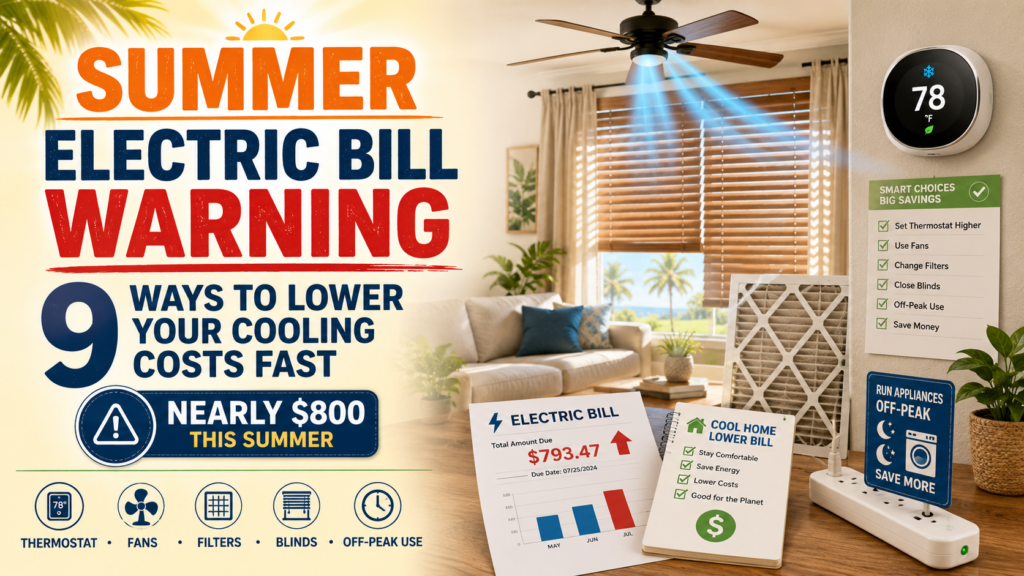
Your summer electric bill may be headed toward nearly $800 this year, and many households have not even reached the hottest part of the season yet.
According to the latest 2026 summer cooling update from the National Energy Assistance Directors Association, average residential electricity expenses are projected to rise 10.5% this summer, reaching about $792 for June through September.
That is exactly why lowering your summer electric bill cannot wait until August. A few changes actually make a difference, while other popular tips barely move the needle.
So here’s the real question: what actually works to bring that number down — and what’s just advice that sounds good but barely moves the needle?
I dug into this deeply, and the answer might surprise you. Some of the most repeated tips save you almost nothing. A few specific changes save real money. Let’s talk about which is which.
FREE DOWNLOAD: The Summer Energy Savings Checklist
A printable list ranking every strategy in this post by actual dollar impact — so you know exactly where to spend your effort first.
Why Your Summer Electric Bill Is Higher This Year
I would also change “heating and cooling account for roughly 42%” to “nearly half of the energy used in your home goes to heating and cooling”, because that wording matches ENERGY STAR better. Two things are colliding this year to push that number higher than usual.
First, summer 2026 is bringing record-breaking heat to large parts of the country, meaning your AC runs longer and harder just to maintain the same indoor temperature.
Second — and this is the part most people don’t know — residential electricity prices are rising in part because of the explosive growth of AI data centers, which consume enormous amounts of electricity and are increasingly competing with households for the same regional power supply. This is a structural shift in the energy market, not a temporary blip.
Your summer electric bill is affected by three things: how often your AC runs, how much heat enters your home, and what rate you pay when you use electricity.
The result: your bill is being squeezed from both directions. Higher usage, higher rates.
The Summer Electric Bill Fixes That Actually Work
1. Set Your Thermostat to 78°F When Home, Higher When Away
This is the single highest-impact change available to most households. The Department of Energy found that setting your thermostat to 78°F when you’re home and awake — and raising it further when you’re out — can save up to 10% on your cooling costs annually.
The trick that makes this bearable: raise your normal setting by just 1 degree per day instead of jumping all at once. Your body adjusts gradually, and most people don’t even notice the change after about a week.
Real dollar impact: $30–$70 over the summer season.
2. Use Ceiling Fans to Raise Your Thermostat Setting Without Losing Comfort
This is the tip almost nobody combines correctly. A ceiling fan doesn’t actually cool a room — it cools you, through the wind-chill effect on your skin. That means you can raise your thermostat by 4 additional degrees while running a fan and feel exactly as comfortable as you did before.
Combine this with tip #1: thermostat at 78°F, fan running, and you’re getting AC-level comfort while your unit works dramatically less.
Real dollar impact: $40–$80 over the summer, when combined with thermostat adjustment. Affordable ceiling fans on Amazon
3. Change Your Air Filter Right Now
A clogged, dirty air filter slows airflow by 5–15%, forcing your AC system to work significantly harder to cool the same space. This is one of the cheapest fixes on this entire list and one of the most overlooked.
The Department of Energy recommends checking your filter monthly during peak summer use and replacing it every 1–3 months. If you can’t remember the last time you changed yours — that’s your answer.
Real dollar impact: $20–$50 over the summer from improved system efficiency, plus it extends the life of your AC unit. AC Unit Filters bulk on Amazon
4. Close Blinds and Curtains on Sun-Facing Windows During the Day
About 76% of sunlight that hits your windows enters and generates heat inside your home — and most blinds stay in the exact same position every single day, doing nothing to stop it.
This is a zero-cost change. Close blinds and curtains on south- and west-facing windows during peak daylight hours. Light-colored window coverings reflect more heat than dark ones.
Real dollar impact: $15–$35 over the summer, completely free to implement.
5. Shift High-Energy Tasks to Off-Peak Hours
Many utility companies charge more for electricity during peak demand hours — typically 4-9pm when everyone gets home and cranks the AC simultaneously. Running your dishwasher, washing machine, and dryer before 4pm or after 9pm can meaningfully reduce what you pay per kilowatt-hour, especially if you’re on a time-of-use billing plan.
Check your utility bill or account online to see if you’re on a time-of-use rate. If you are, this single habit shift is one of the most impactful things on this list.
Real dollar impact: $25–$60 over the summer for households on time-of-use plans.
6. Unplug “Energy Vampire” Devices
Many electronics — computers, printers, TVs, coffee makers, phone chargers — continue drawing power even when turned off. Berkeley Lab says standby power is typically 5% to 10% of residential electricity use, so the safer wording is “standby devices can quietly account for 5% to 10% of home electricity use.
The easiest way to do this without unplugging everything manually: use a smart power strip that cuts power to an entire group of devices with one switch.
Real dollar impact: $15–$40 over the summer. [Smart power strips on Amazon →](YOUR AMAZON AFFILIATE LINK)
7. Cook Outside or Use Smaller Appliances
Using your oven or stovetop can raise your kitchen’s temperature by up to 10 degrees — temperature your AC then has to work to remove. Cooking on an outdoor grill, or using a microwave, air fryer, or slow cooker instead of the oven, keeps that heat outside where it belongs.
Real dollar impact: $10–$25 over the summer, plus genuinely more comfortable cooking.
What’s Mostly Hype (Lower Priority)
A few commonly repeated tips sound good but produce minimal real-world savings for most households:
Switching every light bulb to LED — genuinely useful long-term, but the summer-specific savings are small ($5–$15) unless you’re replacing many incandescent bulbs at once. Worth doing, just don’t expect it to move your bill dramatically on its own.
Smart thermostats — Energy Star-certified smart thermostats save about 8% on average, which is meaningful, but the upfront cost ($120–$250) means the payback period is often 2–3 summers. Worth it if you’re already planning to replace your thermostat — not an urgent stand-alone purchase if money is tight right now.
If Your AC Bill Is Genuinely Unaffordable
If even after implementing these changes your bill is still more than your household can manage, you have real options:
LIHEAP (Low Income Home Energy Assistance Program) — a federal program that helps eligible households pay heating and cooling bills. Search “your state LIHEAP application” to find your state’s specific program.
Utility company budget billing plans — many utilities offer a “budget plan” or “equal payment plan” that averages your annual usage into equal monthly payments, smoothing out the summer spike.
Call your utility directly and ask about payment arrangements before a bill becomes overdue — this is the same principle as negotiating any other bill. They would rather work with you than have a missed payment go to collections.
Summary
- Summer electric bills are projected to average $778 this year — an 8.5% increase
- The highest-impact changes: thermostat at 78°F, ceiling fans, fresh air filters, blocking sun through windows
- Shift high-energy tasks to off-peak hours if you’re on a time-of-use plan
- LED bulbs and smart thermostats help but are lower priority if your budget is tight
- LIHEAP and utility payment plans exist for households that need direct assistance
- Download the [free Summer Energy Savings Checklist](YOUR FREEBIE LINK)
Your Turn
What’s your electric bill looked like so far this summer compared to last year? Drop a comment — seeing real numbers from real households helps everyone reading this get a sense of what to expect.
And if this post helped you find even one change to make today — please share it. Someone in your life just opened a higher-than-expected bill this week too.
Share this post | Download the checklist | Subscribe for weekly money tips
FAQ
Is 78°F actually comfortable, or will I be miserable? Most people adjust within a week if they raise the temperature gradually — 1 degree per day rather than all at once. Combined with a ceiling fan, 78°F feels significantly cooler than the number suggests because of the wind-chill effect on your skin.
Does closing vents in unused rooms save money? This is actually debated among HVAC professionals — closing vents can sometimes create pressure imbalances that make your system work harder rather than less. The safer, well-supported strategy is closing doors to unused rooms rather than closing vents.
How do I know if I’m on a time-of-use electricity plan? Check your utility bill for language like “peak” and “off-peak” rates, or call your utility provider directly and ask. If you are on one, shifting laundry and dishwasher use to off-peak hours is one of the easiest wins available.
Final Thoughts
A $778 average summer electric bill is a real number that’s going to land in real households this year — but it doesn’t have to land at full force in yours. The strategies that actually work are mostly free or low-cost, and the highest-impact ones take less than an hour to implement today.
If rising costs across your whole household budget are weighing on you this summer, read our post on How to save $100 this month without cutting what you actually enjoy— many of the same principles apply across your full budget, not just your energy bill.
Stay cool out there.