
Preparing for a vendor event can make $500 disappear surprisingly fast. You need inventory, a booth fee, packaging, displays, signs, payment supplies, a tent for some events and maybe a few products created specifically for the occasion. Before long, a beginner who planned to spend a few hundred dollars can have a shopping cart worth twice that amount.
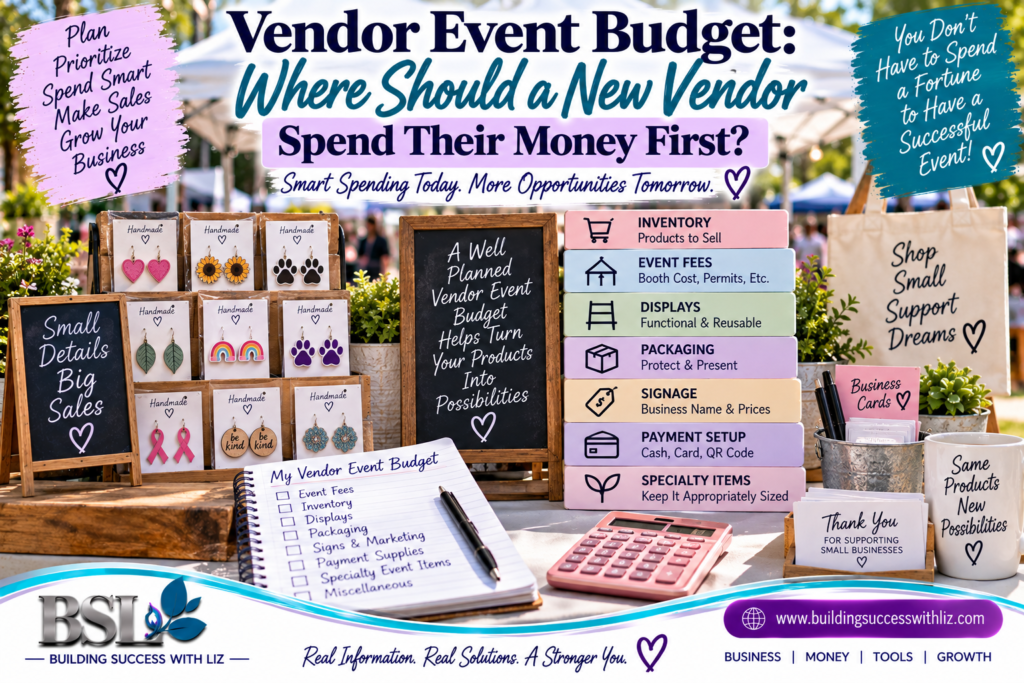
This is why having a vendor event budget matters before you start buying. The goal isn’t to create the prettiest booth at the event or bring the largest amount of inventory. The goal is to spend your available money where it gives your business the best opportunity to make sales while avoiding hundreds of dollars sitting in displays or products you may not use again.
Yesterday, we talked about why your vendor booth doesn’t have to be perfect before you start selling. Today we’re taking the next step: If your money is limited, what deserves it first?
A Vendor Event Budget Should Start With the Event Itself
Before deciding how much inventory to make, look at the event you’re actually attending. A weekly farmers market, two-day craft festival, breast cancer awareness event, pet-rescue fundraiser and Christmas market should not automatically receive the same inventory plan.
Ask how long the event lasts, what kind of customers are expected, whether you’ve attended before, how much the booth costs and whether the products you’re considering can be sold somewhere else if they don’t sell that day.
This is basic market research applied to vendor events. The U.S. Small Business Administration recommends examining demand, market size, customer characteristics, location, competition and pricing when evaluating a market. Those same questions can help you decide how aggressively to invest in inventory for an event.
SBA Market Research and Business Planning Resources
If this is your first time attending an event, you’re working with more uncertainty. That doesn’t mean don’t go. It means don’t spend as though you already know exactly what will sell.
Don’t Treat a One-Day Specialty Event Like Your Entire Business
This becomes especially important with themed events.
Imagine you’re attending a breast cancer awareness event. You know shoppers may be interested in products connected to the cause, so creating an appropriate themed collection makes sense.
What doesn’t automatically make sense is spending most of your vendor event budget creating a huge quantity of breast-cancer-specific inventory for one day.
The same applies to pet events, school events, sports events, holiday markets and other specialty markets. You want enough relevant merchandise for customers to recognize that you prepared for the audience, but you don’t necessarily want your entire investment tied to one theme.
A specialty event should influence your inventory.
It shouldn’t automatically become your entire inventory.
Build Your Inventory in Three Layers
One practical way to prepare for a specialty event is to think about inventory in three layers rather than creating one enormous themed collection.
Your first layer is your proven evergreen inventory. These are products that fit your business and can travel with you to many different events. If they don’t sell Saturday, you can bring them somewhere else next weekend or list them online.
Your second layer is a curated event collection. These products speak specifically to the audience you’re expecting. A pet event might justify dog- and cat-related merchandise. An awareness event might justify a carefully selected collection using the appropriate colors, symbols and messages.
Your third layer is experimental inventory. These are the new products or designs you aren’t sure about yet. Bring enough to test customer response without turning the experiment into a huge financial commitment.
This approach gives you variety without forcing you to bet your entire budget on one day.
Event-Specific Doesn’t Always Have to Mean Event-Limited
Here’s where planning can save you money.
Suppose you’re preparing for a dog-rescue event. A product printed with the event’s exact name and date has a very limited selling window. A well-designed dog-lover product, however, might sell at the rescue event, another pet event, a regular craft fair, online or as a gift.
That doesn’t mean you should never create truly event-specific merchandise. Sometimes it makes sense. But the more specific a product becomes, the more carefully I would think about quantity.
When possible, create some themed merchandise that still has selling opportunities after the event ends.
That’s evergreen inventory working inside a specialty collection.
Don’t Be Afraid of Selling Out of a Test Product
Beginners sometimes overproduce because they’re afraid of the sentence:
“What if I sell out?”
Selling out isn’t automatically a bad outcome.
Suppose you make 20 pieces of a new specialty product and sell all 20. Yes, perhaps you could have sold 25. But you’ve also learned that customers want the product, and now you have actual information to use when deciding how many to make next time.
Compare that with making 100 because you were afraid of running out, selling 20 and bringing 80 home.
Inventory is money you’ve already spent. Our BSL article What to Do When Sales Are Slow discusses this same problem from another direction: before spending another $500, look at what the money already sitting in inventory is telling you.
Your goal isn’t to sell out of everything within the first hour. Your goal is to make reasonable inventory decisions based on the information you actually have.
Leftover Specialty Inventory Isn’t Automatically a Loss
If a specialty product doesn’t sell, first ask whether it can be sold somewhere else.
An undated product created for an annual awareness event may potentially be stored appropriately and brought back the following year. An evergreen pet product can go to another pet market. Holiday products may have another selling opportunity later in the season or the following year if they aren’t dated or trend-dependent.
You still need to track leftover inventory because money remains tied up in those products until they’re sold. But leftover merchandise isn’t automatically worthless simply because one event ended.
This is why I prefer products with multiple selling opportunities whenever practical.
Pretty Booth, No Inventory Is the Wrong Balance
Now let’s go back to the original problem.
Imagine a beginner has $500 available. They spend $250 on displays and decorations, $100 on the booth fee and another $75 on packaging and miscellaneous supplies.
They have $75 left for merchandise.
They may have created a beautiful place for customers to stand, but what are the customers going to buy?
This doesn’t mean spend $475 on inventory and throw it onto a bare table. Presentation matters. Safety matters. Signs matter. The customer needs a functional shopping experience.
The better question is:
What is the minimum amount I need to create a safe, organized and shoppable booth, and how much can I preserve for products that actually generate revenue?
That’s a much healthier way to build a vendor event budget.
Spend First on Things That Can Make Money More Than Once
When money is limited, I like purchases that can work repeatedly.
A neutral table covering can travel to many events. A sturdy reusable display can hold different collections. Your business banner identifies you everywhere. Business cards can leave with customers at multiple events. Packaging that works across several products doesn’t become useless because one market ended.
Evergreen inventory also has multiple opportunities to produce revenue.
Compare those purchases with a highly specific decoration that works for one event, one day and one theme. It may be beautiful, but beautiful doesn’t automatically make it the better business purchase.
The SBA recommends evaluating business decisions by comparing costs with potential benefits rather than looking at the purchase in isolation. That’s exactly the mindset we’re applying here.
SBA Manage Your Business and Cost-Benefit Guidance
Spend first on what can make money more than once.
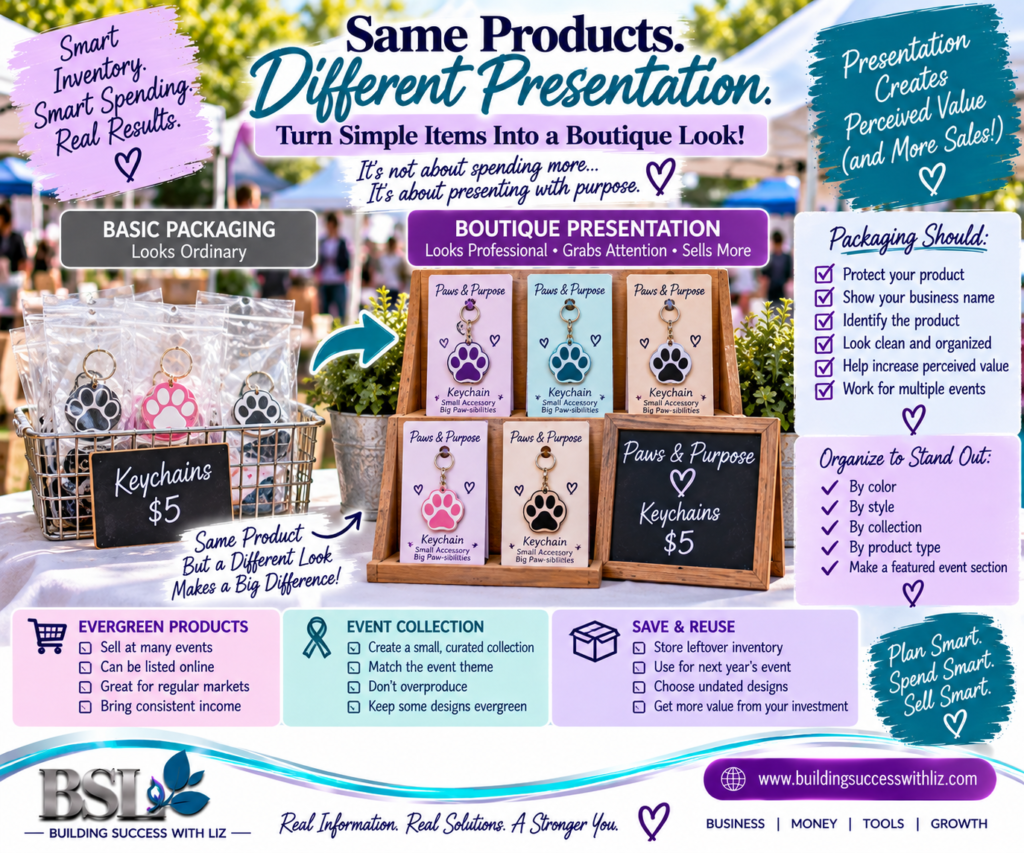
Boutique Presentation Does Not Require Boutique Prices
Here’s another place where beginners can work smarter.
You can have an inexpensive product and still present it beautifully.
Suppose you have a small handmade item and simply put it inside a clear plastic bag and hang it from the display. The product may be perfectly good, but the presentation can make it look unfinished or inexpensive.
Now take that same product and add a clean backing card with your business logo, product name and appropriate information. Arrange the products neatly by color, collection or style. Suddenly the customer experiences the item differently.
You haven’t pretended it’s something it isn’t.
You’ve simply presented it intentionally.
Same product. Different perceived value.
Packaging Should Do More Than Hold the Product
Good packaging doesn’t have to mean expensive packaging.
For many small handmade products, a simple backing card, label, sleeve, belly band or appropriately sized package may be enough to create a more finished presentation. Your exact packaging will depend on what you sell and any labeling or safety requirements that apply to that product.
Think about what the packaging needs to accomplish. It may need to protect the product, identify what it is, display your business name, provide necessary information and make the item easier to merchandise.
Your packaging can also continue marketing after the event. Our article How to Promote Your Business Without Feeling Pushy explains that packaging, business cards, websites, vendor displays and customer service are all ways a business communicates its value.
That doesn’t mean a $5 product needs $4 worth of packaging.
Please don’t give the poor thing tissue paper, three ribbons, a wax seal, a charm and its own birth certificate.
Make it look finished without packaging away your profit.
Organization Can Make a Booth Look More Expensive for Free
Before buying another display, reorganize what you already have.
Products arranged by color can create visual impact. Grouping by style can help customers compare choices. Keeping similar products together makes shopping easier. Creating a small featured collection can draw attention to the theme of the event without requiring you to redesign the entire booth.
At a breast cancer event, for example, you could create one intentional awareness section while the rest of the booth contains your normal products. At a pet event, a featured pet collection can immediately tell shoppers that you prepared something relevant for them while your evergreen products remain available throughout the rest of the booth.
You haven’t purchased an entirely new setup.
You’ve merchandised the existing setup differently.
That’s an important distinction.
Don’t Buy a New Booth for Every Theme
The same principle applies to displays and decorations.
Attending a breast cancer event doesn’t mean you suddenly need pink shelves, a pink table covering, pink baskets and an entirely different booth. A pet event doesn’t require you to rebuild the setup with paw prints covering every available surface.
Use the core equipment you already own whenever possible and add a few removable, appropriate elements that acknowledge the event.
Your tables, displays, tent, weights, payment setup, signs and other foundational pieces should ideally serve you across many events.
Yesterday’s article about creating an affordable vendor booth display goes deeper into exactly how to do that. Once that September 28 article is live, we should link it right here rather than inventing the URL before WordPress publishes it.
Don’t Forget Your Website When Planning the Booth
If you have a website, display it.
Put the address on your business card. Consider including it on appropriate packaging or backing cards. Display a QR code that takes customers somewhere useful, and test that code before the event.
The purpose isn’t to cover every product with advertising. It’s to give customers a way to find you after they leave.
A shopper might love something but decide not to purchase that day. They may want a different color, need to wait until payday, want to show the product to someone else or simply run out of time before returning to your booth.
Your website gives that customer another door into the business.
The SBA’s website guidance emphasizes making it clear what a business sells and giving visitors a way to continue interacting with the business.
SBA Small Business Website Guidance
Your Event Doesn’t End When You Pack the Car
This is another reason I don’t want beginners judging every event solely by the amount of cash collected that day.
Of course, event sales matter. You paid money and invested time to be there.
But an event can also introduce people to the business. Someone may take a card, scan your QR code, follow you, visit the website later, ask about a custom order or tell another person about something they saw.
That doesn’t mean we pretend a terrible event was profitable because three people followed us on Facebook. We still need to measure the money honestly.
It simply means your booth should give interested people a way to reconnect with you after the event.
A Sample $500 Vendor Event Budget
I don’t want to give beginners a fake formula and tell them every $500 budget should be divided exactly the same way. A jewelry vendor, T-shirt seller, baker and digital-product business can have completely different costs.
Instead, use a $500 example to practice making decisions.
Suppose the booth fee is $75. You already own an acceptable table and tent, but you need proper tent weights, a basic table covering and a few inexpensive display solutions. You also need packaging, business cards and enough inventory for the event.
Before spending anything decorative, protect the money required for the non-negotiables. Then determine how much inventory you can reasonably produce based on your product costs and expected audience. Only after the functional booth and appropriate inventory are covered should optional decorative upgrades start competing for the remaining money.
That’s very different from walking into a store with $500 and buying whatever makes the booth look pretty.
Your vendor event budget should be a plan before it becomes a shopping trip.
Don’t Forget the Costs That Aren’t Sitting on the Table
Your event cost isn’t just the booth fee and inventory.
Depending on the event, you may also have fuel, parking, tolls, food, payment-processing costs, bags, packaging, lodging, additional insurance requirements or other expenses. Some of those costs won’t be obvious when you’re staring at the finished booth.
That’s why gross sales alone don’t tell you whether an event was profitable.
We’re going to deal with that directly in our September 30 article about determining whether a vendor event was actually profitable. For today’s decision, just remember that every dollar you spend unnecessarily on one part of the event leaves one less dollar available somewhere else.
What Should Get the Money First?
Instead of giving you a universal percentage, I would prioritize the vendor event budget in this order of thinking: first cover required event costs and safety needs, then protect enough money for appropriate inventory, then make the booth functional and easy to shop, then cover packaging and checkout needs, then make sure customers can identify and find the business again.
After those things are handled, look at optional upgrades.
Maybe that beautiful new shelf makes sense.
Maybe it doesn’t yet.
The order can change depending on what you already own, but the principle stays the same: necessities and revenue opportunities should compete for your money before decoration does.
Liz’s Note
When I prepare for a specialty event, I don’t think every product in my booth needs to become event-specific. I want merchandise that fits the audience, but I also want to think about what happens if that product comes home with me.
Can I sell it at another event? Can I list it online? Is it undated so I can use it again next year? Can I create a smaller themed collection while still bringing the regular products my business already sells?
I also don’t believe a boutique presentation has to mean an expensive presentation. Sometimes a simple backing card with your logo and the product name can completely change how a small product looks. Organizing products by color or style can change the presentation without buying anything at all.
The goal isn’t to make inexpensive products pretend they’re luxury products. The goal is to make sure poor presentation doesn’t make a good product look cheaper than it really is.
Use your money where it works hardest.
Frequently Asked Questions
How much inventory should I buy for a one-day vendor event?
There isn’t one number that works for every business. Consider your product cost, event length, expected audience, previous sales history, event theme and whether leftover inventory can be sold elsewhere. If you’re testing a new event or product, a smaller controlled quantity may give you useful information without tying up too much cash.
Should my vendor event budget include event-specific products?
It can, especially when the event has a clear theme or audience. However, be careful about investing heavily in merchandise that has only one realistic selling opportunity. Consider combining evergreen inventory with a smaller event-specific collection.
What should I spend money on first for a vendor event?
Start with required event expenses and safety, appropriate inventory, a functional display, pricing and checkout needs, packaging and a way for customers to identify and find your business again. Optional decorations and upgrades can come after the essentials are covered.
How can inexpensive packaging look more professional?
Use packaging that fits the product and presents it cleanly. A simple backing card, label or sleeve with consistent branding can make a product look more finished without adding excessive cost. The presentation should support the product rather than becoming more expensive than the product itself.
Should I display my website at vendor events?
Yes, if you have one. Make the website or an appropriate QR code easy to find on your signage, cards or other suitable marketing materials. Customers who don’t purchase at the event may want to find the business later.
Your Vendor Event Budget Should Work Harder Than Your Decorations
A beautiful booth is wonderful when you can afford it. A large inventory is wonderful when customers actually want it. Specialty products can be excellent when the right audience is standing in front of you.
The mistake is assuming more is automatically better.
Your vendor event budget should help you create enough inventory to sell, present those products professionally, operate safely, make purchasing easy and give customers a way to find you again. It should also leave you with products and equipment that can continue working for the business after one Saturday afternoon is over.
Start with what earns its place in the budget. Test specialty products before producing huge quantities. Use inexpensive presentations strategically. Organize what you already own. Keep your website visible, and let real customer behavior tell you where the next investment belongs.
Spend first on what can make money more than once.
Let’s Talk About It
If you had $500 to prepare for your next vendor event, where would most of your money go right now: inventory, displays, packaging, signage or something else? Think about whether that purchase will still be useful after the event ends.
And if you’ve attended specialty events before, what happened to the themed inventory that didn’t sell? Your experience may help another vendor decide whether to make 20 pieces instead of 100.