
The fourth quarter can bring some of the biggest sales opportunities of the year, especially for small businesses that sell gifts, handmade products, seasonal items, services, or products people purchase for the holidays. But entering October with a general goal of “making as much as possible” is not really a sales strategy. A strong Q4 revenue goal gives you a specific number to work toward and, more importantly, gives you something you can break down into smaller, measurable steps.

Setting the number is only the beginning. The real work starts when you calculate how many orders you need, determine what customers need to spend, decide which products will carry the quarter, and check whether your business can realistically produce and fulfill that amount of business. That is what turns a Q4 revenue goal from an exciting number written in a planner into an actual business plan.
The U.S. Small Business Administration makes a similar point when discussing business planning and break-even analysis. Once you understand how much you need to sell, you can set revenue targets and make decisions based on numbers instead of emotion. Small Business Administration
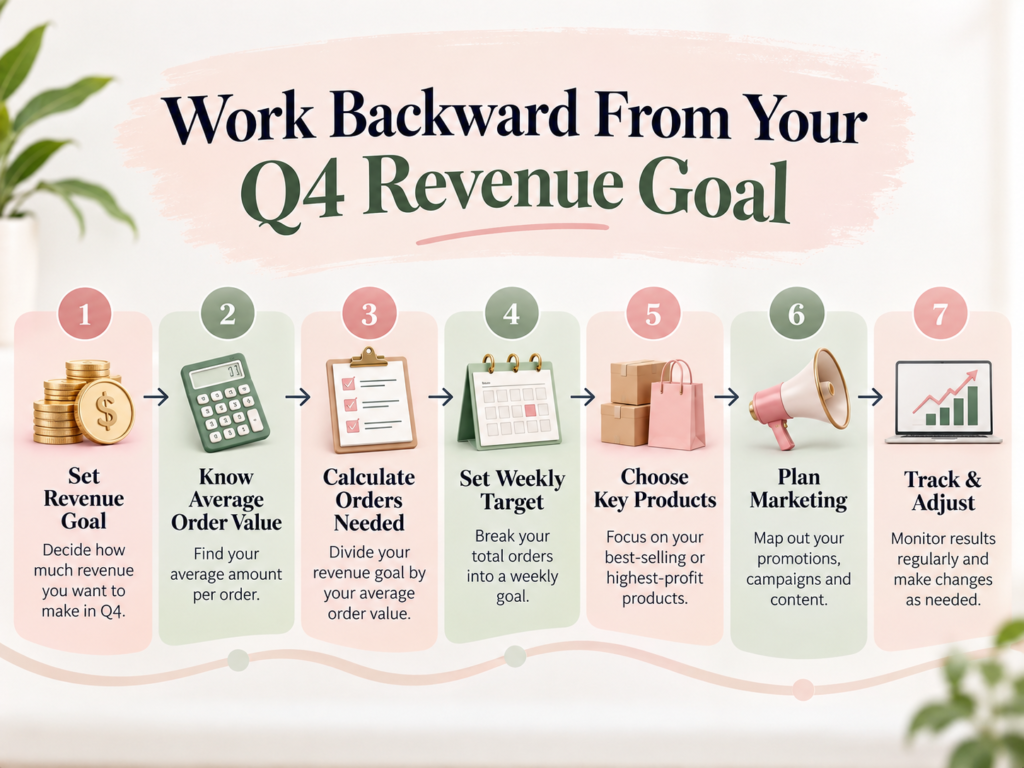
This article will show you how to work backward from your Q4 revenue goal so you know what needs to happen between now and the end of December.
1. Start With a Q4 Revenue Goal That Has a Reason Behind It
The first step is choosing your number, but do not choose it simply because it sounds impressive. A realistic Q4 revenue goal should have some connection to what your business has already demonstrated that it can do, along with the growth you reasonably expect during the holiday season.
Start by looking at your average monthly revenue, previous fourth-quarter sales if you have them, current customer traffic, upcoming vendor events, seasonal demand, average order value, inventory, and production capacity. If your business normally generates $2,000 per month, for example, a $7,500 or $8,000 quarter may represent meaningful growth. A $30,000 target would require a much bigger change in traffic, pricing, sales volume, or capacity, and you should be able to explain where that growth is expected to come from.
This does not mean you cannot set an ambitious Q4 revenue goal. It means the number needs a reason behind it. If you expect sales to increase because you added a new sales channel, booked several strong holiday events, expanded your customer base, introduced higher-value products, or increased your average order value, those are specific reasons the goal might be higher than your normal quarterly revenue.
The SBA recommends using financial information, revenue and expense tracking, and sales planning to make better business decisions rather than relying entirely on assumptions. Small Business Administration That is exactly the approach we want here.
Before You Go Further, Understand Revenue Versus Profit
Your Q4 revenue goal is not the same thing as your profit goal. Revenue is the total amount of money the business brings in from sales before expenses are deducted, while profit is what remains after you account for the costs required to generate those sales.
Imagine your business generates $12,000 in Q4. If materials, packaging, shipping, marketplace fees, vendor fees, advertising, labor, and other costs total $8,000, you did not make $12,000 in profit. That distinction matters because a business can have impressive sales numbers while keeping very little of the money it generates.
This is why I would review your product costs while setting the revenue target. Our Product Profitability: 7 Costs to Check Beyond the Selling Price article walks through the expenses that can easily be missed when deciding whether a product is actually profitable. Your Q4 revenue goal should help strengthen the business, not encourage you to chase sales that cost almost as much to generate as they bring in.
2. Break Your Q4 Revenue Goal Into Monthly Targets
A large quarterly number can feel overwhelming because it does not tell you what needs to happen today, this week, or even this month. Breaking the Q4 revenue goal into smaller monthly targets makes it easier to understand what the business actually needs to accomplish.
Suppose your total Q4 target is $12,000. You might set an October target of $3,000, a November target of $4,000, and a December target of $5,000. Those numbers do not have to be equal because your customers may not shop equally throughout the quarter. A gift-based business may experience much stronger demand in November and early December, while a business with major October vendor events could see the opposite pattern.
Once the monthly numbers are established, the $12,000 Q4 revenue goal becomes much easier to manage. Instead of constantly wondering how you will make $12,000, you can focus on what products, promotions, events, and sales activity need to produce $3,000 in October.
That smaller question is easier to answer, measure, and adjust.
3. Work Backward From Your Average Order Value
This is where the Q4 revenue goal starts becoming a practical sales plan. Once you know how much revenue you want, determine approximately how much your average customer spends per order.
Suppose your Q4 revenue goal is $12,000 and your average order value is $40. You would need approximately 300 orders to reach the target. Spread over a twelve-week period, that works out to roughly 25 orders per week.
Now you have something much more useful than a $12,000 number. You can ask whether your business can realistically attract and fulfill about 25 orders every week.
Average order value also explains why two businesses can have the same Q4 revenue goal but need completely different strategies. A business with a $20 average order value would need about 600 orders to generate $12,000, while a business averaging $60 per order would need only about 200. The revenue target is identical, but the workload is dramatically different.
This is also where pricing matters. If you have consistently underpriced your products, you may be creating far more work than necessary just to reach the same revenue target. Our Know Your Worth in Business article goes deeper into understanding pricing, costs, and the value of your work.
4. Decide Which Products Will Help Reach the Q4 Revenue Goal
One mistake small businesses make during the holiday season is trying to sell everything at once. If you have thirty products, that does not mean all thirty need the same amount of marketing attention.
Review your sales and identify the products most likely to help you reach your Q4 revenue goal. Your strongest candidates may include existing best sellers, high-margin products, seasonal items, easy-to-produce items, giftable products, repeat-purchase products, and bundles that increase the amount customers spend.
This is also a good time to look at production time. A product that sells for $75 may look better than one selling for $25, but not if the $75 product takes five hours to create and the lower-priced product can be produced quickly in batches. Revenue alone does not tell the full story.
You want the products supporting your Q4 revenue goal to make sense financially and operationally. Instead of asking only, “What can I sell?” ask, “What can I sell profitably, repeatedly, and efficiently during one of the busiest parts of the year?”
That small shift in thinking can keep you from building your holiday strategy around products that create more work than money.

5. Turn Your Q4 Revenue Goal Into Weekly Numbers
Once you have monthly targets, divide them again. Weekly revenue targets give you an early warning when something is not working instead of forcing you to wait until the end of the month to discover that you are behind.
If your November target is $4,000, for example, your business needs to generate roughly $1,000 per week. If your average order value is $40, that means you need about 25 orders per week.
Now your Q4 revenue goal connects directly to what you are doing every day. By the middle of the week, you can see whether sales are tracking toward the weekly target and whether your marketing is producing the traffic and orders you expected.
This does not mean you need to panic every time Tuesday is slow. Weekly numbers are there to provide information. If one week ends at $800 instead of $1,000, you know there is a $200 gap to understand rather than simply hoping December somehow makes everything work out.
That is also where tracking becomes valuable. Look at which products sold, where customers came from, what promotions produced orders, and whether average order value changed. Over several weeks, you may begin seeing patterns that tell you where to put more of your time.
6. Make Sure Your Capacity Matches Your Q4 Revenue Goal
You can create a mathematically perfect plan that is physically impossible to execute.
If the numbers say you need 300 orders to reach your Q4 revenue goal, you need to determine whether you can actually produce, package, ship, and support 300 orders without sacrificing quality or exhausting yourself.
Think through production time, available supplies, packaging inventory, shipping deadlines, equipment limitations, customer service, and how quickly you can restock materials. If you sell at vendor events, remember that event preparation and travel also consume time that is not available for production.
Capacity becomes especially important if you make products by hand. There is a big difference between selling 25 digital downloads each week and hand-making 25 complicated physical products. Your Q4 revenue goal must reflect the type of business you actually operate.
If the required number of orders is higher than your current capacity, you still have options. You might simplify the product line, increase average order value, offer bundles, improve your production process, bring in temporary help, raise prices where appropriate, or adjust the revenue target.
The numbers are not there to tell you that you failed. They are there to show you where the plan needs work.
7. Build Your Marketing Around the Q4 Revenue Goal
This is where the revenue plan becomes a marketing plan.
Instead of posting randomly throughout November and hoping customers buy something, decide what your marketing needs to accomplish in order to support the Q4 revenue goal. If your weekly revenue target is $1,000, your promotional activity should be designed to help generate enough traffic and orders to reach that number.
That could include holiday launches, email campaigns, social media content, vendor events, gift guides, product bundles, Black Friday promotions, Cyber Monday offers, customer follow-ups, shipping-deadline reminders, upsells, or repeat-customer promotions. You do not need to use every marketing method available. You need to use the methods that make sense for your products and customers.
This is also where you should watch for activity that looks productive but produces very little. Spending four hours creating content that does not generate traffic, engagement, inquiries, or sales may not be the best use of your limited Q4 time. Your Q4 revenue goal gives you a way to ask whether the activity is contributing to the result you are trying to create.
If sales are slower than expected, our Selling in a Slow Economy article can also help you think through what customers may still be willing to buy and how to adjust your selling strategy without immediately assuming the answer is constant discounting.
What Happens If You Fall Behind Your Q4 Revenue Goal?
Missing a weekly or monthly target does not automatically mean the entire quarter is lost. It means you have new information and need to decide what to do with it.
Suppose your October target was $3,000 and the business finished October at $2,500. Instead of panicking, investigate the $500 gap. Was traffic lower than expected? Did customers spend less per order? Did a product launch underperform? Did you have fewer selling days than planned? Did production limitations prevent you from stocking enough of your strongest products?
Once you understand the problem, you can decide how to respond. You may increase promotion around proven products, introduce a bundle that raises average order value, remove weak products from the marketing calendar, add another sales opportunity, or adjust your November and December targets.
You may even decide that the original Q4 revenue goal needs to change. That does not automatically mean the business failed. A responsible business owner adjusts a plan when the assumptions behind that plan are no longer accurate.
That is exactly what we discussed in When Business Plans Fall Apart: How to Adjust Your Business Plan Without Losing Direction. The goal is not to defend the original plan at all costs. The goal is to make better decisions with the information you have now.
Do Not Hit the Revenue Goal by Destroying Your Profit
One of the easiest ways to create impressive Q4 revenue is to discount everything heavily. That does not necessarily mean the business is performing well.
If your Q4 revenue goal requires constant 30%, 40%, or 50% discounts, calculate what those promotions are actually doing to your profit margin. You may generate more orders while keeping less money from each one, creating significantly more work without significantly improving the business.
Sometimes increasing perceived value can be more effective than simply lowering the price. A bundle, gift-ready packaging, complementary add-on, free-shipping threshold, or limited seasonal set may encourage customers to spend more while preserving more of your margin.
The objective is not to reach the Q4 revenue goal at any cost. The objective is to generate healthy revenue that contributes to the long-term strength of the business.
Use Your Q4 Revenue Goal to Make Better Business Decisions
Once you understand your target, the Q4 revenue goal becomes a decision-making tool rather than just a financial wish.
If you are considering another vendor event, compare the fee, travel, inventory, and time against the amount of revenue you realistically expect the event to produce. If you want to launch another product, ask whether it supports the quarter’s sales strategy or distracts from something already performing well.
The same thinking applies to inventory. Instead of making fifty units because fifty sounds like a good number, use your sales target, previous sales, and current demand to estimate how much inventory you actually need.
The SBA encourages business owners to track revenue and expenses, evaluate costs and benefits, and connect marketing and sales activity to defined goals. Small Business Administration Your Q4 revenue goal can help you do exactly that.
A Real Q4 Revenue Goal Example
Imagine a handmade business decides on a Q4 revenue goal of $15,000. Its average order value is $50, which means the business would need approximately 300 orders during the quarter.
If the quarter contains roughly twelve selling weeks, that means about 25 orders per week. The business would need to average approximately $1,250 in weekly revenue to stay on pace.
Now imagine the owner looks at production capacity and realizes she can comfortably fulfill only 15 orders per week. That is valuable information because it reveals a problem before the busiest part of the season arrives.
The business now has choices. It can try to raise its average order value, create higher-value bundles, simplify production, increase capacity, obtain help, adjust pricing, or lower the Q4 revenue goal to something the business can realistically fulfill.
That is the entire reason we work backward. The process exposes the gap between the number we want and what the business currently needs to do to reach it.
Liz’s Note
I think one of the easiest things in business is writing down a big revenue number. The harder part is being able to explain exactly how the business is supposed to reach it.
If I say I want a Q4 revenue goal of $10,000, I should be able to tell you approximately how many orders that requires, what products I expect to sell, how much the average customer needs to spend, where those customers are likely to come from, and whether I can physically handle the workload.
That does not mean everything will happen exactly according to plan. Business rarely works that way. What it does mean is that I have something more useful than hope.
I would rather see a small-business owner set an $8,000 Q4 revenue goal with a clear path toward reaching it than write down $25,000 because it sounds impressive and have no idea what has to happen next.
Frequently Asked Questions About a Q4 Revenue Goal
What is a good Q4 revenue goal for a small business?
There is no single Q4 revenue goal that works for every business because businesses have different prices, customers, profit margins, capacity, and sales histories. Start with your own numbers and consider previous revenue, expected seasonal demand, average order value, available inventory, and how much business you can realistically fulfill. A useful goal should challenge the business while still being supported by a reasonable plan.
Should my Q4 revenue goal be higher than the rest of the year?
It can be, particularly if your business benefits from holiday shopping, gift buying, seasonal events, or year-end demand. However, you should not automatically increase your Q4 revenue goal simply because it is the fourth quarter. Look at your own sales history and upcoming opportunities before deciding how much growth is realistic.
How do I calculate how many orders I need?
Divide your Q4 revenue goal by your average order value. If your target is $12,000 and the average customer spends $40, you would need approximately 300 orders. From there, divide the number across the remaining weeks to estimate your weekly sales requirement.
What if my average order value is too low?
Before deciding that you simply need more customers, look at whether customers have reasons to purchase more during each transaction. Bundles, add-ons, complementary products, gift sets, and appropriate free-shipping thresholds may increase average order value. The important part is making sure those offers are still profitable.
What should I do if I miss my weekly Q4 revenue target?
Review what happened before making major changes. Look at traffic, conversion, average order value, product availability, marketing activity, and customer response. One slow week does not automatically mean the entire Q4 revenue goal is impossible, but repeated misses may show that part of the strategy needs to change.
Should I focus on revenue or profit during Q4?
You need to pay attention to both. Revenue shows how much money the business generates, while profit tells you how much remains after expenses. Reaching an impressive Q4 revenue goal does not help very much if the cost of generating those sales consumes nearly all of the revenue.
Try This Before You Set Your Q4 Goal
Before you decide on your final Q4 revenue goal, write down your total Q4 target, October target, November target, December target, average order value, estimated number of orders needed, weekly revenue requirement, weekly order requirement, strongest products, main sales channels, and maximum weekly production capacity.
Then compare those numbers with one another. If your goal requires 40 orders every week but your business can only produce 20, you have discovered something important before spending money on inventory or advertising.
That is exactly what planning is supposed to do.
Let’s Talk About Your Q4 Revenue Goal
The number itself is usually not the hardest part. The difficult part is figuring out what needs to happen inside the business to make that number possible.
Some business owners struggle to choose a realistic Q4 revenue goal. Others know the number but do not know how many orders they need. Some understand both but are not sure how to attract enough customers to reach the target.
Which part is hardest for you: choosing the revenue goal, calculating the sales you need, or figuring out how to bring in enough customers to reach it?
Tell me in the comments. I am especially interested in seeing where small-business owners are getting stuck because those answers can help shape the next BSL breakdown.
Your Next Step
Choose your Q4 revenue goal, but do not stop after writing down the number. Break it into monthly targets, calculate the orders required, determine your average order value, identify the products most likely to generate the sales, and compare the required workload with what your business can realistically produce.
Then turn those numbers into weekly targets and build your marketing around them. Check your progress throughout the quarter so you still have time to adjust if customers behave differently than expected.
A Q4 revenue goal becomes useful when it helps you make better decisions before the quarter is over. You do not have to predict Q4 perfectly, but you should understand what your number requires and be willing to change the strategy when the numbers tell you something is not working.
That is the difference between hoping for a strong quarter and actually planning one.