
Having $500 available to start a business gives you more options than having $50 or $100, but it can also create a new problem: feeling as though you need to spend all of it. Some of the smartest business ideas under $500 begin by using only part of that budget, testing whether customers are interested, and keeping the rest of the money available until you know what the business actually needs.
Five hundred dollars is enough to take certain ideas beyond the planning stage. You may be able to purchase a small amount of inventory, basic equipment, professional supplies, packaging, or marketing materials. What it is not is permission to go shopping for everything that looks useful.
Your first goal is still the same.
Find something people will pay for.
Then let actual customer demand help determine where the rest of your money goes.
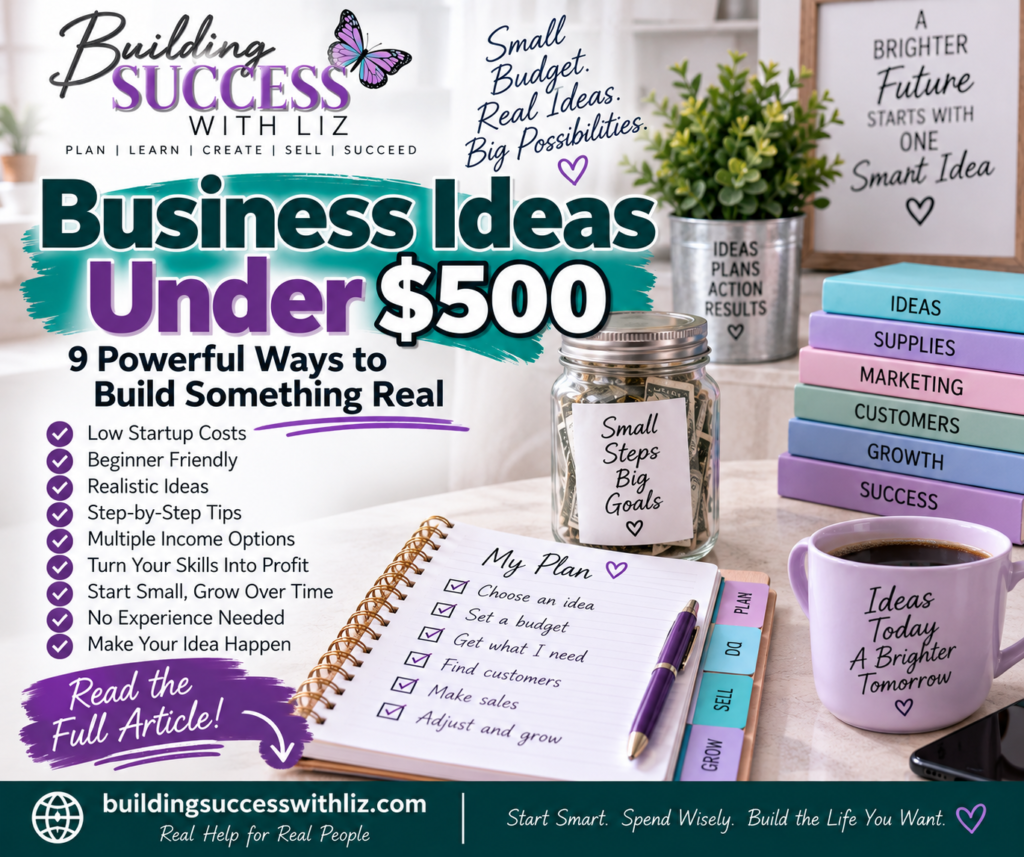
What Changes When You Have a $500 Startup Budget?
With a $100 budget, you may primarily be testing a service, making a few samples, or using tools you already own. A $500 budget can give you more room to create a small product collection, purchase better supplies, attend a carefully researched local event, or buy basic equipment that directly helps you produce what you plan to sell.
But before looking at business ideas under $500, write down the expenses you believe your business will have.
The U.S. Small Business Administration recommends calculating startup costs before launching. Startup expenses can include equipment, supplies, licenses, permits, insurance, inventory, advertising, market research, printed marketing materials, and a website. Review the SBA’s startup-cost guidance.
BSL also has a complete guide on this exact issue. Before spending your money, read How Much Money Do You Really Need to Start a Business?.
Now let’s look at what a $500-or-less test could actually look like.
1. Start a Small Handmade Product Collection
If you enjoy crafting, $500 can give you room to create a focused collection without trying to stock an entire store.
You might create greeting cards, bookmarks, ornaments, keychains, stationery, simple home décor, accessories, personalized items, or another product that fits your skills and available equipment.
The key word is focused.
You do not need twenty types of products in ten colors each. Start with a few products that work together and make sense for the same customer.
For example, instead of spending $500 creating fifteen unrelated items, you might spend a portion of the budget creating three coordinated products, packaging them properly, photographing them well, and testing them with customers.
BSL’s Create Products to Sell guide can help you compare handmade products, digital products, printables, services, and other ways of turning a skill into something sellable.
2. Build a Small Personalized-Gift Business
Personalized products can include items such as shirts, bags, mugs, ornaments, keepsakes, stationery, or gift items.
This is one of the business ideas under $500 where beginners need to be especially careful about equipment.
Do not immediately purchase every machine you see another creator using.
First decide what you want to sell. Then determine the minimum equipment necessary to create that product safely and consistently. Compare prices, supplies, replacement costs, maintenance, and how many products you would need to sell before the equipment pays for itself.
You may discover that outsourcing part of the production at the beginning makes more financial sense than purchasing another machine.
Your business does not become more legitimate because your workroom has more equipment.
It becomes stronger when customers buy what you make.
3. Start a Cleaning or Home-Organizing Service
A $500 budget can provide a solid starting point for a service business because most of your income comes from your labor rather than inventory.
Depending on the service, you could use part of the budget for quality cleaning or organizing supplies, protective equipment, printed materials, scheduling tools, transportation expenses, and any business requirements that apply in your area.
You could specialize instead of trying to clean or organize everything.
For example:
- Pantry organization
- Closet resets
- Home-office organization
- Move-in or move-out assistance
- Small-space organization
- Basic residential cleaning
A clear service is easier for customers to understand than simply saying, “I do cleaning and organizing.”
Start with one or two services. Learn how long the work actually takes. Then price accordingly.
4. Create a Small Stationery or Planner Business
This is another area where a $500 budget can provide enough room to test physical products without creating a warehouse of inventory.
You could create notepads, planners, journals, savings trackers, bookmarks, greeting cards, checklists, or organizational products.
You may use the budget for paper, printing, binding supplies, packaging, samples, mockups, or a small amount of finished inventory.
But do not decide what people need based only on what you personally like.
Research first.
Look at customer reviews on products already being sold. Pay attention to what people praise and what they complain about. Search for questions buyers are asking. Look for something useful you can improve or simplify.
That is exactly why I created 7 Smart Ways to Research Whether Your Business Idea Will Sell. Researching before spending can save far more than the time it takes to do it.
5. Offer Mobile Car-Care or Basic Detailing Services
If this is work you know how to perform properly, basic mobile car-care services can sometimes be tested without a commercial location.
A beginner might start with interior cleaning, vacuuming, windows, basic surface cleaning, and other services that match their skills and equipment.
Your budget may go toward cleaning products, microfiber towels, brushes, storage containers, protective supplies, a portable vacuum or other necessary tools, and simple marketing.
Before starting, research any local business, environmental, insurance, water-use, or other requirements that may apply.
And again, resist the temptation to buy professional equipment designed for a business doing dozens of vehicles each week when you have not served your first five customers.
Start with the service you can deliver well now.
Upgrade when the business proves it needs the upgrade.
6. Start a Small Event-Decorating Service
Birthdays, baby showers, graduations, retirement celebrations, business events, and other gatherings create opportunities for people who enjoy decorating.
A beginning $500 budget might support a small collection of reusable décor, basic setup tools, backdrop materials, table accents, signage supplies, or materials for one specialized service.
But this is another one of those business ideas under $500 where trying to offer everything can destroy the budget quickly.
Instead of becoming a full-service event company immediately, specialize.
Maybe you begin with simple balloon arrangements.
Maybe you create welcome signs.
Maybe you provide small dessert-table setups.
Maybe you specialize in table décor.
Build one service well enough that customers can understand what they are hiring you to do.
Then expand based on actual requests.
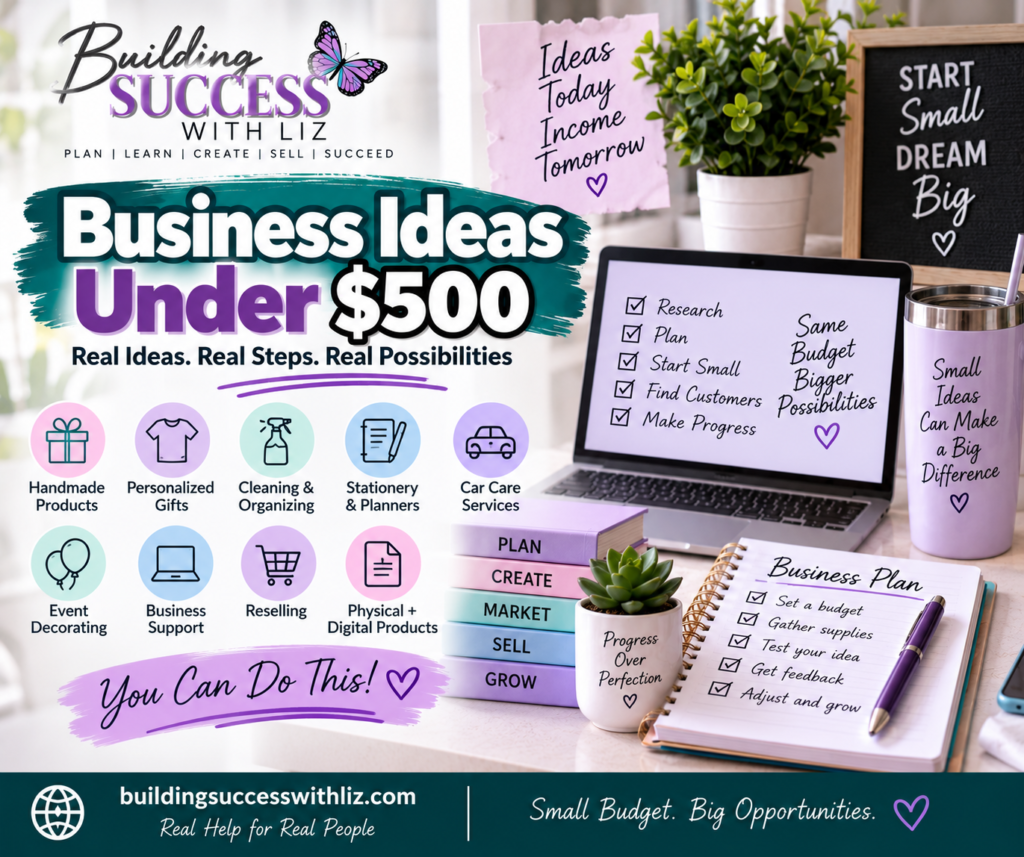
7. Build a Small Local Business Support Service
There are small-business owners who need help but are not ready for a full-time employee.
You may be able to help with tasks such as organizing customer information, photographing simple products, preparing basic social-media graphics, organizing files, creating spreadsheets, updating menus or price lists, scheduling content, or helping prepare materials for vendor events.
If you already own a computer, smartphone, and basic software, your $500 may barely need to be touched.
You could use a portion for a tripod, basic lighting, printed materials, a simple portfolio, software you genuinely need, or transportation to clients.
The biggest mistake would be buying a large collection of software subscriptions before you have paying customers.
Start with the tools you have.
When a paying client creates a real need for something better, then consider upgrading.
8. Start a Small Resale Business Carefully
Reselling can be another option, but this one deserves caution because inventory can consume $500 very quickly.
Do not spend your entire budget buying merchandise simply because the retail price looks much higher than what you are paying.
You need to know whether customers actually buy the item at the price you expect to charge.
Research sold prices, not only asking prices.
Consider selling fees, packaging, shipping, storage, returns, transportation, and how long your money could remain tied up in unsold merchandise.
Start with a small test.
If $100 or $150 worth of carefully selected inventory sells consistently, you have information you can use before purchasing more.
If it does not sell, you still have most of your startup budget.
That is much better than having $500 sitting on shelves.
9. Combine a Physical Product With a Digital Product
One of my favorite business ideas under $500 is building around one customer instead of one product.
Suppose your customer is someone trying to save money.
You might sell a physical savings binder and also offer printable savings trackers.
If your customer is a small-business owner, you might sell a physical planner while also creating downloadable inventory or expense sheets.
If your customer is planning a celebration, you might sell physical invitations and matching printable planning pages.
The point is not to make more products just for the sake of having more listings.
The point is to ask:
What else does this same customer genuinely need?
When products work together, you can build a collection more intentionally instead of constantly chasing unrelated trends.
Do Not Spend $500 Just Because Your Budget Is $500
This may be the most important lesson in this entire article.
If you can test your idea for $175, spend $175.
Keep the remaining $325.
You may discover after your first ten customers that they want a different color, size, service, package, or product than you expected.
That remaining money gives you options.
A beginner with $500 does not have to look like a business with a $50,000 operating budget.
You need enough supplies and equipment to deliver what you promised professionally and safely.
The rest can wait.
Give Every Dollar a Job
Before spending your startup money, divide the budget into categories.
A hypothetical $500 plan might look something like this:
- $175 for essential equipment or supplies
- $100 for starting inventory or materials
- $50 for packaging
- $50 for marketing or printed materials
- $25 for software or tools
- $100 held in reserve
Your numbers will be different because your business will be different.
What matters is having a plan before you start clicking “add to cart.”
And remember that permits, licenses, insurance, registration, taxes, and other requirements vary by business and location. Those costs need to come before decorative upgrades that do not help you legally or safely operate.
Track the Money From Day One
Once you begin spending business money, keep records.
The IRS says good business records help owners monitor progress, identify income sources, track expenses, prepare financial statements and tax returns, and support the information reported on those returns. The IRS allows businesses to choose a recordkeeping system suited to them as long as it clearly shows income and expenses. Read the IRS recordkeeping guidance.
You can start with a simple spreadsheet if that works for your situation.
Record the $14 supply purchase.
Record the $50 sale.
Record the vendor fee.
Record packaging.
Record shipping supplies.
Small expenses have a habit of becoming big expenses when nobody is tracking them.
Your First Customers Matter More Than Your First Upgrade
You may have $500 available, but your first priority is still finding out whether customers want what you are selling.
You do not need expensive advertising to begin doing that.
Your first customers may come from local events, referrals, community connections, conversations, small-business networking, printed materials, or people who have already seen what you do.
If you are ready to start looking for buyers, read How to Find Your First Customers Without Spending a Fortune.
A customer who pays you $25 teaches you more about your business than fifty people telling you an idea sounds wonderful.
Liz’s Note
Having a larger startup budget can make you feel as though you are supposed to create a larger business.
You are not.
If I had $500 to test a new business today, I would not ask, “How can I spend this $500?”
I would ask, “What is the least I need to spend to find out whether someone will buy this?”
That question changes everything.
You stop buying for the business you imagine having someday and start spending for the business you are actually building today.
There will always be another machine, another supply, another course, another subscription, another booth display, and another upgrade someone says you need.
Customers should help prove when those investments make sense.
Start smaller than your budget allows.
Keep some money available.
Learn from real sales.
Then grow.
Frequently Asked Questions
Can I really start a business with $500?
Some businesses can be started or tested for $500 or less, particularly services, digital products, and small product collections. Others require significantly more because of equipment, licensing, insurance, inventory, facilities, or regulatory requirements. Research the specific business before spending money.
What are the best business ideas under $500 for beginners?
The best idea depends on your existing skills, equipment, available time, local requirements, and customer demand. Service businesses often require less inventory, while a $500 budget may also allow you to test a focused handmade or physical product collection.
Should I spend the whole $500 immediately?
Usually there is no reason to spend the entire budget before you have information from customers. Purchase what you need to test and operate appropriately, then keep part of the money available for adjustments and opportunities.
Should I buy equipment or inventory first?
That depends on the business. Buy only the equipment required to deliver your product or service properly. If inventory is involved, test a manageable amount before purchasing large quantities.
How do I know whether my business idea is worth investing more money in?
Look for real evidence: paying customers, repeat purchases, inquiries, profitable pricing, and consistent interest. Do not rely only on compliments from friends or views on social media.
What Would You Do With $500?
There are plenty of business ideas under $500, but having a list of ideas is not the same as starting.
Pick one idea.
Research the customer.
Calculate the true cost.
Determine what you legally need.
Buy only what is necessary for the first test.
Then put the offer in front of real people.
If you had exactly $500 available to start or improve a small business, what would you spend the first $100 on?
Share your answer in the comments. I would especially love to hear from people who already started small. What purchase actually helped your business, and what do you wish you had waited to buy?
And if you are still figuring out your first steps, continue with 10 Steps to Starting a Business Without Feeling Overwhelmed.