
You started selling your products, and things are finally moving. Maybe you opened an Etsy shop because it gave you a relatively easy way to get online. Maybe most of your sales happen at vendor events, through social media, or by word of mouth. Then someone tells you, “You need your own website.” Suddenly, you’re wondering whether the way you’ve been selling is holding your business back.
This is one of those small-business questions that gets turned into an argument when it really should be a business decision. Some sellers will tell you to leave Etsy because of the fees. Others swear by Etsy because customers are already shopping there. Then there are people who insist that every serious business needs its own website.
The truth is that Etsy vs your own website doesn’t have one correct answer. These are different selling tools that can serve different purposes. For some businesses, Etsy makes sense. For others, an independent website is the better choice. And for some businesses, using both may actually be the smartest strategy.
Before you open another platform or close one that’s already working, let’s figure out what you’re actually trying to accomplish.
1. Start With the Biggest Difference: Marketplace vs. Your Own Store
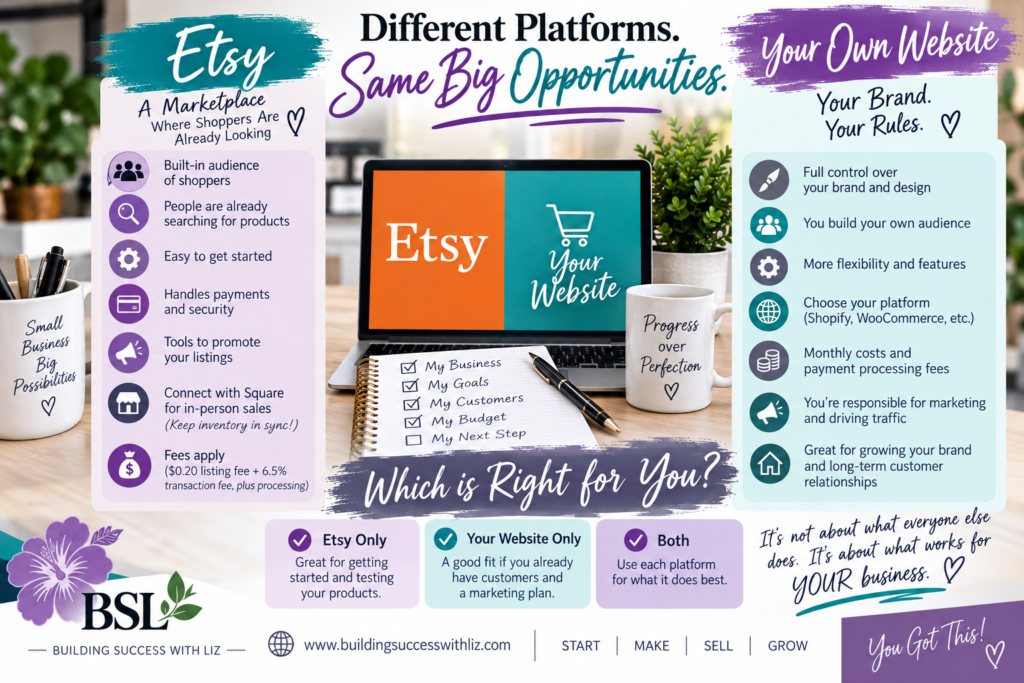
Etsy is a marketplace. Your shop operates inside a much larger shopping platform where customers are already searching for products. That doesn’t mean Etsy hands you customers simply because you open a shop. You still have to compete for attention through your products, photographs, titles, descriptions, pricing, reviews and customer service.
Your own ecommerce website works differently. Whether you use Shopify, WooCommerce or another platform, you’re creating an online store centered around your individual business. You have greater control over the presentation, customer experience, branding and other aspects of the store, but you’re also responsible for giving people a reason to visit it.
That distinction matters because you’re not simply deciding between two websites. You’re deciding between selling inside someone else’s established marketplace and building a store where you need a plan for attracting the shoppers yourself.
Our BSL Sell Online and In Person section makes this point from a broader perspective: you don’t have to sell everywhere. The goal is to choose selling channels that fit your customers, products and current stage of business.
2. Ask Where Your Customers Are Supposed to Come From
Imagine spending several days building a beautiful online store. Your photographs look great, the products are organized, your policies are finished, and the checkout works perfectly.
Then you wait.
And wait.
Nothing is technically wrong with the website. The problem is that nobody knows it’s there.
One of Etsy’s advantages is access to an established marketplace. People already visit Etsy looking for products, although individual sellers still have to compete to be discovered. With your own website, traffic may need to come from Google searches, social media, email marketing, referrals, advertising, vendor events, repeat customers or other marketing efforts.
That’s why I don’t automatically tell a brand-new business owner, “Go build a website.” First I want to know how customers are going to find it.
If you already have people asking where they can order, repeat customers, an engaged social audience, an email list or customers from vendor events who want to purchase again later, your own website may have a stronger starting point. If you’re still working on attracting those first buyers, our guide on How to Find Your First Customers Without Spending a Fortune can help you work on the customer side before adding another selling expense.
3. Understand What You’re Actually Paying Etsy For
This is where I think the Etsy conversation sometimes becomes too simple.
People see fees coming out of a sale and understandably think, “That’s my money.” It is reasonable to look closely at every fee your business pays. But before deciding a fee is too expensive, you should understand what you’re receiving in exchange for it.
Etsy currently charges a $0.20 listing fee and a 6.5% transaction fee, along with payment-processing and certain other fees that may apply depending on the transaction and services used. You should always check Etsy’s current terms because platform pricing can change.
But Etsy isn’t charging simply for a blank webpage with your products sitting on it. You’re participating in an established marketplace with existing shopper traffic, search tools, payment infrastructure and seller features. Whether those things are worth the cost depends on whether they’re actually helping your business make profitable sales.
That’s a very different question from simply asking, “Does Etsy charge fees?”
4. If You Sell at Markets, Don’t Overlook Etsy’s Square Connection
This is something many handmade sellers and vendor-event businesses may not realize.
Etsy officially integrates with Square for in-person selling. When eligible Etsy listings are connected with Square, sellers can process in-person transactions through Square while keeping Etsy inventory connected. According to Etsy’s current guidance, Etsy doesn’t charge its standard 6.5% transaction fee or Etsy Payments processing fee on those in-person Square transactions. Square’s own payment-processing fees apply instead, while Etsy’s applicable $0.20 listing or renewal fees can still apply.
That can be useful for someone who sells both online and at vendor events. Instead of thinking of Etsy as something that only exists for online orders, a seller may be able to connect parts of the online and in-person operation while keeping inventory more organized.
There’s one claim I wouldn’t make without stronger evidence: that using Square at events automatically improves your Etsy search ranking. You may hear sellers say that their Etsy shop seemed to grow after connecting in-person sales, and their experience may be completely genuine. But I haven’t found enough current official documentation from Etsy to tell you that Square sales automatically cause Etsy to rank your shop higher.
That’s an important distinction. We can talk about what Etsy officially confirms without turning one seller’s experience into a promise for everybody else.
5. Don’t Compare Etsy Fees With a Website That You Pretend Is Free
This is another mistake I see in platform comparisons.
A seller calculates what Etsy took from an order and compares that amount with the imaginary cost of selling through their own website at $0.
But your own ecommerce store isn’t necessarily free.
Depending on the platform and setup, you may have subscription costs, payment-processing fees, a domain, paid applications, email services, themes, advertising or other expenses. Shopify, for example, publishes several subscription levels for its ecommerce platform in addition to applicable payment-related costs.
Then there’s the expense that’s harder to see on a monthly statement: customer acquisition.
If Etsy helps a new customer discover your product through its marketplace, that has potential value. If your independent website requires you to spend money on advertising or significant time creating content to generate the same sale, that also has a cost.
This doesn’t mean Etsy is cheaper. It doesn’t mean your own website is cheaper either.
It means you need to compare the total cost of making the sale.
Tomorrow’s BSL article is going to dig much deeper into exactly this question: Are Etsy Fees Really Too High? How to Know If the Problem Is Fees, Pricing, or Profit.
6. Know Your Profit Before Blaming Your Platform
Suppose you’re selling a handmade product for $25 and you’re frustrated every time you see selling fees deducted.
Before changing platforms, calculate what that $25 product actually earns.
What did the materials cost? What about packaging? How long did it take to make? What selling fees apply? Are you paying for advertising? Did you include overhead? Is shipping affecting the margin? What does payment processing cost?
If you can’t answer those questions, you don’t yet know whether Etsy is the problem.
Moving a poorly priced product from Etsy to your own website doesn’t magically make the product profitable. You may save one type of fee while discovering other expenses that you weren’t calculating before.
That’s why platform decisions and pricing decisions have to work together.
7. Decide How Much Control You Actually Need
An independent website gives you something Etsy can’t fully provide: a store built around your own brand.
You can determine how products are organized, what information customers see, what pages exist, how your brand is presented and how customers move through the shopping experience. You can also build other parts of your online presence around that store, such as educational content or an email list.
That’s valuable, especially as a business grows.
But greater control also means greater responsibility. You have to maintain the store, learn the platform, troubleshoot problems and create a strategy for bringing customers there.
A beginner with six products and very few customers may not need every possible ecommerce feature today. Having more control only creates value when you have a reason to use that control.
8. Ask Whether You’re Ready to Market Your Own Website
I love seeing a business owner get excited when their website goes live. There’s something special about typing your business name into the address bar and seeing your own store appear.
But after the excitement comes the business question:
Who’s coming to visit?
A website needs traffic just like a physical store needs people walking through the door. Creating the website doesn’t automatically create the audience.
Before paying for another selling channel, decide how you’ll bring customers there. Maybe you’ll use social media consistently. Perhaps your vendor-event customers will receive information showing them where they can reorder. Maybe you’re building an email list, working on Google visibility, creating useful content or developing a base of repeat customers.
You don’t need to master every marketing method. You do need to understand that building the store and attracting shoppers are two different jobs.
9. Etsy and Your Own Website Don’t Have to Be Enemies
This may be the most important thing to understand about the entire Etsy-versus-website debate.
You may not have to choose.
A business can potentially use Etsy for marketplace discovery and an independent website for its broader brand presence and other sales opportunities. Shopify itself discusses Etsy and Shopify as platforms sellers can use together rather than treating them as an automatic either-or decision.
The question is whether both platforms have a purpose.
Perhaps Etsy is bringing new customers who are searching the marketplace while your website serves returning customers and people who already know your brand. Maybe your website eventually becomes your primary store while Etsy remains another discovery channel.
But don’t add a second platform just so you can say you have one. Two selling channels also mean more products to maintain, inventory to track, messages to answer, orders to manage and expenses to monitor.
If you’re going to operate both, give each one a job.
10. Look at the Stage Your Business Is Actually In
This is where I want beginners to stop comparing themselves with businesses that are five years ahead of them.
A brand-new seller with ten products, limited cash and no established audience doesn’t have the same needs as someone with hundreds of orders, repeat customers, strong social traffic and an email list.
If you’re starting out and Etsy fits what you sell, the marketplace may give you a practical place to learn online selling while you work on attracting customers. If you’re already generating consistent sales and customers are actively looking for your business outside Etsy, an independent store may become a logical next step.
And if Etsy is working while your independent audience is growing, there may be no reason to immediately shut down one in favor of the other.
The goal isn’t to graduate from Etsy.
The goal is to build a selling system that makes sense for your business.
So Which One Should You Choose?
Instead of asking which platform is better, ask what problem you’re trying to solve.
If you need access to an existing marketplace where people are already shopping for products like yours, Etsy may deserve serious consideration. If you already have ways to bring customers directly to your business and want greater control over your brand and shopping experience, your own website may make more sense.
If both platforms can serve different purposes and you have the time and systems to manage them, using both may be perfectly reasonable.
What I don’t want you to do is spend money simply because another business owner told you what a “real business” is supposed to have.
Liz’s Note: Use Other People’s Experiences as Information, Not Instructions
One business owner may tell you Etsy is terrible because the fees destroyed their profit. Another may tell you Etsy built their entire business. Someone else may say moving to their own website was the best decision they ever made.
All three people could be telling the truth.
They’re telling you what happened in their business.
Their products may have different margins. Their customers may shop differently. Their advertising costs may be different. One may have 50,000 social media followers while another is trying to find their first 50 customers. One may sell exclusively online while another sells at markets every weekend and uses Square.
Listen to other business owners. Learn from what worked and what didn’t.
Then go back to your numbers.
That’s where your answer lives.
Frequently Asked Questions
Is Etsy better than having your own website?
Neither option is automatically better. Etsy gives sellers access to an established marketplace, while an independent website generally gives businesses more control over branding and the customer experience. Your product, customers, marketing ability, expenses and stage of business should help determine which option makes sense.
Can Etsy sellers use Square for vendor events?
Yes. Etsy officially supports an integration with Square for in-person selling. Eligible Etsy listings can be connected so inventory stays synchronized when those items sell through Square. Square’s payment-processing fees apply to the transaction, while applicable Etsy listing or renewal fees may still apply.
Will Square sales improve my Etsy search ranking?
I wouldn’t promise that. Etsy provides official information about connecting Square, inventory syncing and applicable fees, but I haven’t found current official documentation saying that processing an in-person Square sale automatically increases an Etsy shop’s search ranking.
Do I need a website if I already sell on Etsy?
Not necessarily. If Etsy is meeting your needs, you don’t have to add another selling platform just because other businesses have one. Consider adding a website when you can identify what you need it to accomplish.
Should I close Etsy when I start my own website?
Not automatically. Some businesses use Etsy and an independent ecommerce store at the same time. If both channels produce value and you can manage them effectively, there may be a reason to keep both.
Is selling through your own website cheaper than Etsy?
It depends. Compare marketplace fees with the total costs associated with your independent store, including subscriptions, payment processing, apps, marketing and customer acquisition. The cheapest-looking option isn’t necessarily the one that produces the highest profit.
Don’t Add Another Platform Without Giving It a Job
The real decision isn’t simply Etsy vs your own website. It’s deciding what you need each selling channel to accomplish.
Etsy may give you access to shoppers already searching inside a marketplace and can even connect with Square for businesses selling in person. Your own website can give you greater control over your brand and create an independent home for your business. Using both can offer additional opportunities, but it also creates more work.
You don’t have to build everything at once. Start with what makes sense for where your business is today, track what happens and understand the numbers before you expand.
Then, when you add another selling channel, you’ll know exactly why you’re adding it.
That’s a much better reason than, “Someone told me I was supposed to.”
Let’s Talk About It
If you’re already selling, where are your customers buying from you right now? Etsy? Your own website? Social media? Vendor events? Or are you using a combination?
If you sell at events, I’d especially like to know whether you’ve tried connecting Etsy with Square and what your experience has been. Did it make managing your online and in-person inventory easier, or do you prefer keeping the two completely separate?
Share your experience in the comments. Your answer may help another beginner who’s trying to figure out which selling setup makes sense.