
Starting a business comes with a surprisingly clear checklist. You choose what you want to sell, research the idea, figure out your costs, handle the necessary registrations, create your products or services, decide where you’ll sell, and eventually announce that you’re open. Even when the process feels overwhelming, there is usually another task waiting to be checked off the list.
Then the business opens, the excitement of launch settles down, and a completely different question appears: Now what?

Knowing what to do after starting a business can actually feel more confusing than getting the business open. Suddenly you’re hearing that you need more products, a better website, more followers, paid advertising, vendor events, an email list, another selling platform and perhaps new equipment. If you try to do all of it at once, you can spend a lot of money and create a lot of work without knowing whether any of it is actually helping your business grow.
If you followed my guide on The First 10 Steps to Starting a Business Without Feeling Overwhelmed, you already worked through much of the foundation and launch stage. This article begins where that one ends. Your job now isn’t simply to do more. It’s to start learning what your business is telling you and use that information to decide what deserves your attention next.
1. Start With What Actually Happened After You Opened
Before your business opened, many of your decisions were based on research and reasonable assumptions. Once real customers enter the picture, you finally have information that belongs specifically to your business. That information is valuable, even if your first few weeks don’t produce the sales numbers you hoped for.
Look at what customers are actually doing. Which products are they buying? Which products receive questions but no purchases? Are people picking something up at events and putting it back down after seeing the price? Are customers visiting your website but not completing an order? Are certain social media posts bringing inquiries while others receive likes but never lead to sales?
Don’t rush to change everything because of one slow week or one customer’s opinion. Start recording what happens and look for patterns. A new business doesn’t need an expensive analytics system to begin learning from its customers. A spreadsheet, notebook or simple sales report can give you enough information to start making better decisions.
2. Figure Out Where Your Paying Customers Are Coming From
It’s easy to focus on follower counts because social media puts those numbers right in front of us. But 5,000 followers and five paying customers tell you something very different from 500 followers and 50 paying customers. After opening, you need to begin understanding where the people who actually spend money with your business are finding you.
Customers may discover you through Etsy, Google, Facebook, Instagram, a vendor event, your website, a referral, a business card or simply because someone told them about you. Start asking new customers how they found you whenever it makes sense. Over time, you may discover that one source is producing significantly more business than another.
That doesn’t mean you immediately abandon every marketing channel that isn’t producing sales. Some channels take time to develop. It does mean you should be careful about pouring more money and hours into something simply because another business owner says you need to be there. If you’re still working on those early customers, my guide on How to Find Your First Customers Without Spending a Fortune is a good place to start.
3. Know Whether You’re Making Sales or Actually Making Money
One of the biggest changes after starting a business is that estimated numbers begin turning into real numbers. You aren’t only calculating what something should cost anymore. You can start seeing what it actually costs to operate your business.
Suppose you bring in $1,000 in sales this month. It feels wonderful to say, “My business made $1,000,” but sales aren’t the same as profit. You may have spent money on materials, packaging, shipping supplies, marketplace fees, payment processing, advertising, vendor fees, website expenses, subscriptions and other operating costs. If those expenses totaled $850, there is only $150 remaining before considering taxes and any other costs you haven’t accounted for.
This is why bookkeeping matters from the beginning. You don’t need to become an accountant, but you do need to understand what is coming in and what is going out. The U.S. Small Business Administration’s guide to managing business finances is a useful free resource for learning the basics.
A busy business isn’t automatically a profitable business. The earlier you understand that distinction, the better decisions you can make about pricing, products, marketing and expansion.
4. Learn What’s Selling Before You Keep Adding Products
New business owners are often excited about creating. One product becomes five, five become fifteen, and suddenly the business has a huge product line before the owner has figured out what customers actually want. This is especially easy for handmade and creative businesses because making something new can feel productive.
But your business may not need another product yet. It may need more customers for the products you already have.
Before adding something new, study what’s already happening. Which product sells most frequently? Which one produces the best profit? Which product takes the most time to make? Are customers buying certain products together? Is something getting plenty of attention but very few purchases? Those answers can tell you whether you should expand, improve an existing product, create a bundle, change how something is marketed or stop making something altogether.
We’ll go deeper into this later in the September series when we talk about how to test a new product before investing too much money in it. For now, remember that a larger product catalog doesn’t automatically create a stronger business.
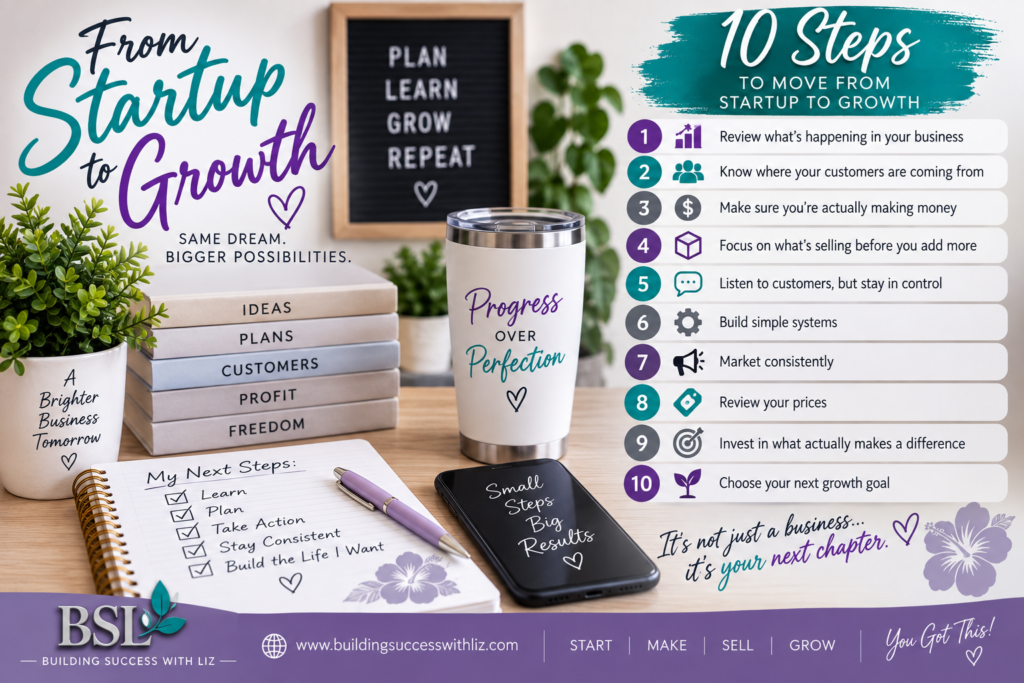
5. Listen to Your Customers Without Letting Them Run the Business
Customer feedback can uncover opportunities you never considered. Someone may ask for another size, color, flavor, service option or package. When the same request keeps appearing, that’s worth paying attention to because your customers may be showing you an unmet demand.
The key word is keeps.
One customer asking, “Can you make this in blue?” doesn’t necessarily mean you should order $300 worth of blue materials. Twelve customers asking the same question deserves a closer look. Keep track of recurring requests before deciding whether an idea deserves your money.
You still have to evaluate whether the request fits your brand, skills, costs, production capacity and overall business. Listening to customers should make you a better decision-maker. It shouldn’t turn your business into a place where every suggestion becomes another product.
6. Create Simple Systems Before the Business Gets Busier
When you’re filling only a few orders, it’s tempting to keep everything in your head. You remember who ordered what, where the supplies are, which customer needs a response and what needs to be shipped tomorrow. That may work for a while, but it becomes much harder as orders and responsibilities increase.
Start creating simple systems before you desperately need them. You may need a process for receiving orders, tracking inventory, answering customer messages, saving receipts, bookkeeping, production, shipping, appointments, vendor-event preparation or weekly marketing. A system doesn’t have to mean expensive software or complicated automation.
Sometimes a checklist is a system. Sometimes it’s a spreadsheet, labeled storage bins or a standard way of processing every order from purchase through delivery. The goal is to stop making yourself remember every step every time you perform a task.
Good systems also make future growth easier. If you eventually hire someone or ask another person to help, you can show them the process instead of trying to explain something that has always existed only in your head.
7. Market Consistently Instead of Only When You Need Sales
A common small-business cycle looks like this: sales are good, so marketing slows down. Sales become quiet, so the business suddenly posts everywhere. Sales improve again, and the marketing disappears.
That creates a constant cycle of trying to restart attention.
Consistent marketing doesn’t mean you have to post six times a day or join every social media platform. It means choosing a realistic way to remain visible to the people most likely to buy from you. Show what you sell, explain why it matters, answer common questions, share useful information, show parts of your process when appropriate and make it easy for customers to understand where they can purchase.
Your existing customers are part of this process too. Follow up when appropriate, provide good service, ask satisfied customers for reviews and give people a reason to remember your business. Marketing isn’t an emergency button you press only when you need money. It’s an ongoing part of operating the business.
8. Review Your Prices Using Real Information
The price you chose before opening was probably based partly on estimates. Once you’re operating, you have better information. You may discover that a product takes twice as long to make as expected, packaging costs more than you calculated, marketplace fees are affecting the margin, or supplies have increased in price.
Now you can review your prices using reality instead of guesses.
Don’t automatically lower your prices because customers compare you with Walmart, Temu or another seller. Don’t automatically raise them because someone on social media tells you that you’re charging too little, either. Look at your materials, labor, fees, overhead, selling expenses and desired profit, then decide whether the price makes sense for your business.
Sometimes the problem isn’t the selling price at all. The supplier may be too expensive, the production process may be inefficient, the product may take too long to make, or the business may be spending money somewhere it doesn’t need to.
Later this month, we’re going to tackle this from several angles, including why handmade products cost more than mass-produced products and how to price handmade items when customers compare them to Temu.
9. Decide What Actually Deserves More Money
Once the business is operating, there will always be something else you could buy. Better equipment, more inventory, advertising, a website, another marketplace, new displays, upgraded packaging, additional subscriptions and new products can all look like the next step.
The better question is: What problem would this purchase solve?
If your strongest product keeps selling out, investing in additional inventory may make sense. If production can’t keep up with demand, better equipment might save enough time to justify its cost. If customers repeatedly ask whether they can order online, improving your online purchasing process may deserve attention.
But don’t spend simply because you feel that a “real business” should have something. The SBA’s business management resources cover several areas that become increasingly important as a company operates and grows, including finances, employees, taxes and marketing.
Your business should earn the right to receive more of your money by showing you where that investment can make a difference.
10. Pick One Meaningful Growth Goal
Once you understand what’s happening in the business, you can choose what you want to improve. The mistake is trying to improve everything at once.
“Grow my business” sounds like a goal, but it’s difficult to act on because it doesn’t tell you what growth actually means. A more useful goal might be reaching $1,000 in monthly sales consistently, increasing repeat customers, improving your profit margin, building an email list, reducing production time, attending two carefully researched markets each month or establishing a reliable weekly marketing routine.
Choose a goal that can be measured, then work backward from the result. If you want $1,000 in monthly sales and your average order is $50, that’s approximately 20 orders. Now you have a better question to answer: What realistically needs to happen for this business to generate about 20 orders per month?
That question can lead you toward practical action. “I need to grow” usually just creates pressure.
Growth Doesn’t Always Mean Getting Bigger
We often picture business growth as more products, more employees, more locations and more revenue. Those things can represent growth, but they’re not the only measures that matter.
A business can grow by becoming more profitable without dramatically increasing sales. It can grow by developing repeat customers, improving production time, eliminating an unprofitable product, negotiating better supplier costs or creating systems that give the owner back several hours each week. A business can even become stronger by deciding not to expand into something that doesn’t make financial sense.
This is why comparing your business with someone else’s can become dangerous. Their goal may be ten employees and a warehouse. Your goal may be a profitable business you can operate yourself without working seven days a week. Neither is automatically better.
Your business doesn’t have to look impressive from the outside. It needs to work for the goals you are trying to achieve.
What Should You Focus on During Your First 90 Days?
Your first 90 days aren’t a deadline for proving whether you’re a “real entrepreneur.” They’re an opportunity to learn. Pay attention to sales, expenses, customer behavior, marketing results, recurring questions and the amount of time it takes to actually operate the business.
Try not to make huge decisions based on one good weekend or one terrible week. A successful vendor event doesn’t necessarily mean you should book ten more immediately, just as a slow event doesn’t automatically mean your products are the problem. Give yourself enough information to separate patterns from isolated experiences.
Most importantly, protect your cash while you’re learning. The beginning is often when business owners feel the most pressure to buy everything they think the business will eventually need. Your early money is valuable because it gives you room to adjust when reality turns out differently from your original plan.
Liz’s Note: The Questions Change After You Open
Before starting a business, most questions begin with “How do I?” How do I register? How do I price this? How do I find customers? How do I build a website? Those questions are about getting the business ready to operate.
After opening, the questions begin to change. You start asking why one product sells while another doesn’t, where customers are coming from, whether you’re actually making money, whether an event was worth the cost, whether another platform makes sense and where you should invest next.
That’s progress.
You’re moving away from making every decision based on what you think might happen and beginning to make decisions based on what the business is actually showing you. You won’t always have a perfect answer, but you’ll have something better than a guess: information from your own business.
Frequently Asked Questions
What should I focus on after starting my business?
Focus on learning how the business actually performs. Track sales, expenses, profit, customer behavior, marketing sources and recurring customer questions. You don’t need to add products, platforms or expenses simply because the business has opened.
How long should I wait before deciding whether my business is working?
There isn’t one timeline that works for every business because products, services and industries have different sales cycles and startup costs. Instead of choosing an arbitrary deadline, establish measurable indicators such as inquiries, sales, repeat purchases, expenses and profit, then look for patterns over time.
Should I add new products immediately after opening?
Usually, it’s worth learning how your initial products perform before making a large investment in additional inventory. If customers repeatedly request something new or your sales reveal an obvious opportunity, test the idea on a smaller scale before committing significant money.
Do I need my own website after starting a business?
Not necessarily. The answer depends on what you sell, where your customers currently shop, how they prefer to purchase and what you need a website to accomplish. Our next article in this series will look specifically at Etsy, your own website, or both, because this decision deserves more than a yes-or-no answer.
How do I know when my business is ready to grow?
Look for evidence that the current operation is working reasonably well. Consistent demand, workable margins, repeat customers, reliable processes and enough capacity to handle additional business are stronger signs than simply feeling like it’s time to get bigger.
Your Grand Opening Was the Beginning
Opening your business was a milestone, but it wasn’t the finish line. The next stage is about learning how to operate something that can last. That means tracking what happens, understanding your numbers, listening to customers, improving what works, correcting what doesn’t and being careful about where you invest your money.
If you’re wondering what to do after starting a business, you don’t need to solve the next five years today. Pick the next problem that actually matters, work on it, measure what happens and use what you learn to choose the next step.
That’s how a startup begins becoming a business.
Let’s Talk About It
If your business is already open, what has been harder than you expected after the launch? Maybe it’s finding consistent customers, keeping up with marketing, managing inventory, understanding profit, deciding what to sell next or simply figuring out what deserves your attention every day.
Share your experience in the comments. There’s a good chance another new business owner is struggling with the same question. And if you know someone who recently opened a business and is already wondering, “Okay, now what?”, save or share this article with them.