
You started your business with one idea. Then you learned how to make something else. A customer asked whether you could offer another product. You watched a video showing a new machine, tool, or technique. Suddenly, your shopping cart is full of supplies for a product your business was not selling yesterday.
That excitement is normal, especially in a handmade or creative business. Once you realize what you can make, it becomes very easy to see possibilities everywhere. But should you add another product simply because you know how to make it?
Not necessarily.
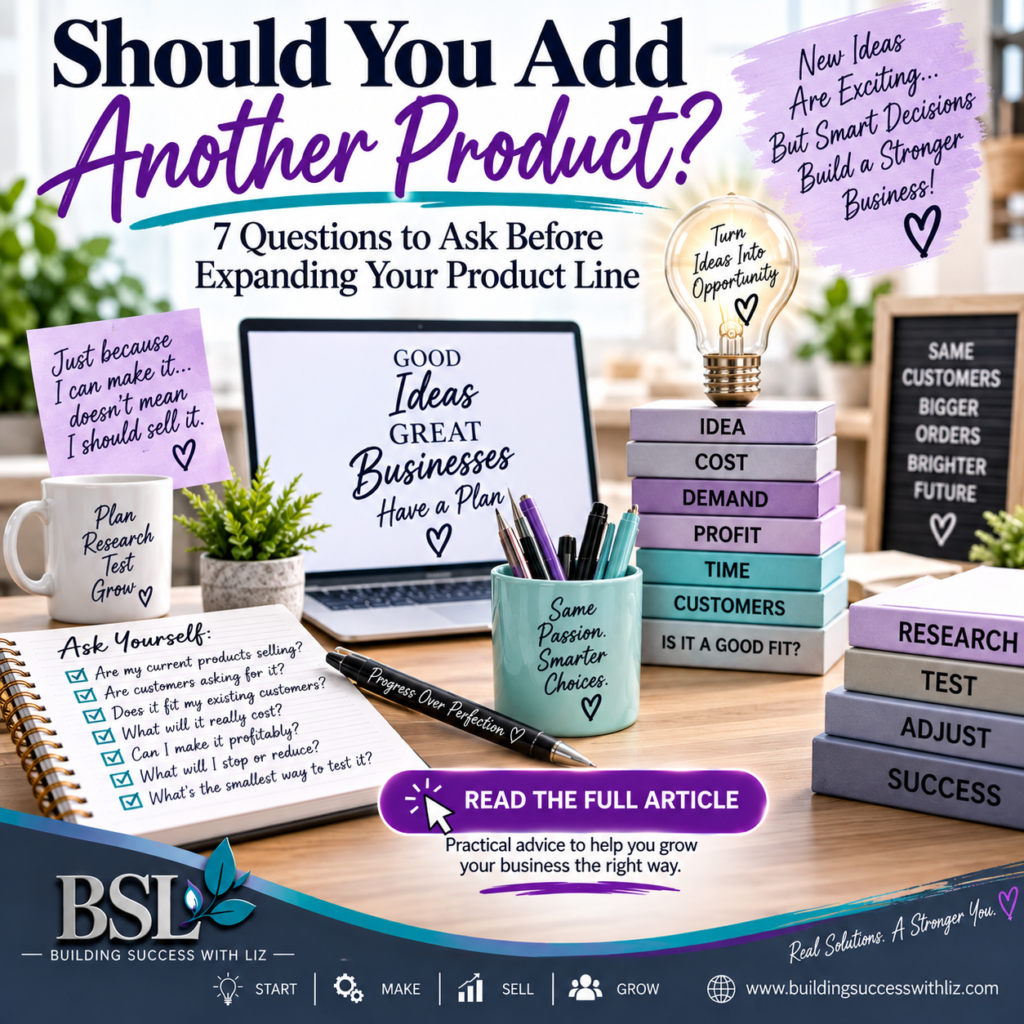
A new product can help your business grow, attract repeat customers, and increase the amount customers spend with you. It can also tie up money in equipment and supplies, take attention away from products that are already selling, and leave you with another stack of inventory that needs somewhere to live.
Before you expand your product line, give the idea a job. Ask what it is supposed to do for the business and whether there is enough evidence to justify spending money on it.
1. Are Your Current Products Actually Selling?
Before asking should you add another product, look at what is happening with the products you already have.
Which products sell consistently? Which ones sell occasionally? Which products get compliments but very few purchases? Which ones have been sitting in inventory for months?
This is where sales records become more valuable than your memory. You may feel like a certain product is doing well because customers talk about it, while another quieter product is actually producing more sales and better profit.
If your current products are struggling, adding more products may not solve the problem. You could end up spreading the same customers across a larger collection instead of increasing total sales.
Sometimes your business doesn’t need another product. It needs more customers for the products it already has.
Before investing in something new, take a serious look at your existing sales and ask whether you are expanding from strength or trying to escape a problem you have not solved yet.
2. Are Customers Actually Asking for It?
Customer requests can be useful clues.
If several customers keep asking, “Do you make matching keychains?” or “Do you have this in a smaller size?” that deserves your attention. Repeat customers asking for something that naturally fits what they already buy from you can be particularly valuable information.
But be careful with one request.
One person saying, “You should make these!” is not the same as ten customers trying to buy them.
And we have to talk about one of my favorite small-business sentences:
“Oh, that’s cute! I would definitely buy one.”
Maybe they will.
Maybe they won’t.
Interest is useful, but purchases provide stronger evidence.
The U.S. Small Business Administration’s market research guidance recommends looking at factors such as demand, market size, market saturation and pricing when evaluating an opportunity. It also recommends direct research methods such as surveys, questionnaires, focus groups and interviews.
Your existing customers give you another valuable source of information: their actual behavior.
Pay attention to repeated requests, purchases, special orders, questions and products customers frequently buy together.
3. Does the New Product Fit the Customer You Already Serve?
This question can save you a lot of money.
Imagine you sell handmade soaps and your customers regularly ask for soap dishes, travel containers or gift sets. Those products could complement what you already sell.
Now imagine you decide to start selling 3D-printed dragons because you saw somebody selling a table full of them at a vendor event.
Could the dragons sell?
Absolutely.
But that’s a different question from whether they belong in your business.
A new product does not have to be identical to your existing products, but there should be a reason it belongs there. It might serve the same customer, solve a related problem, create an add-on purchase, provide a seasonal option or give existing customers a reason to return.
This is where I want you to separate opportunity from distraction.
A profitable product exists somewhere in almost every direction you look. You cannot build all of those businesses at the same time.
4. What Will It Really Cost to Add the Product?
This is where the exciting idea needs a calculator.
Do not calculate only the price of the main material.
Write down everything required to get the product ready for an actual customer. Depending on the product, that could include equipment, materials, tools, packaging, labels, shipping supplies, software, replacement parts, storage, samples, listing fees and your time.
Suppose you discover a product that costs only $3 in materials.
Sounds fantastic.
Except you need a $400 machine to make it, $100 in additional supplies, $75 in packaging and several weeks of practice before you can produce something you are comfortable selling.
That does not automatically make the idea bad. It changes the decision.
The question is no longer, “Can I sell this $3 product for $15?”
Now you need to ask how many profitable sales it would take to recover the additional investment and whether your expected demand supports that investment.
If you need help investigating demand before committing money, use our BSL guide on how to research whether your business idea will actually sell before you spend money. It walks through researching customers, competition and demand and testing an idea on a smaller scale before making a large commitment.
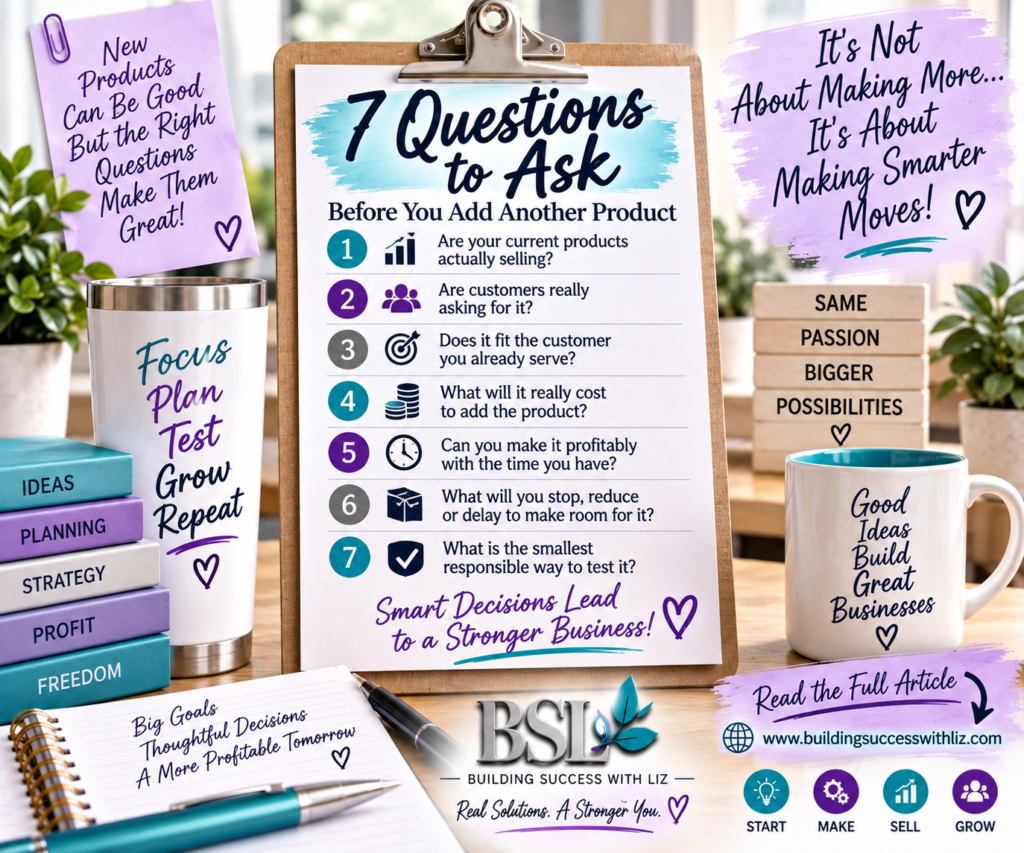
5. Can You Make It Profitably With the Time You Have?
There is a cost that creative business owners forget constantly:
time.
You may discover a product with excellent material margins that takes 45 minutes to produce. Another product may make slightly less money per item but take five minutes.
Those are very different products when you have 20 orders waiting.
Ask yourself how long the new product takes from beginning to end, not just how long the machine runs or how long the final assembly takes.
Include preparation, designing, cutting, printing, pressing, sewing, curing, finishing, cleaning, packaging, personalization and customer communication when those steps apply.
Then ask another important question:
If this product becomes successful, can I actually keep up with it?
You don’t want to discover that your wonderful new bestseller has created a business you hate operating.
6. What Will You Stop, Reduce or Delay to Make Room for It?
This is the question we don’t ask enough.
Every new product requires something.
Money.
Shelf space.
Storage.
Photographs.
Listings.
Marketing.
Production time.
Learning time.
Mental attention.
If you already have 25 products and add five more, you now have 30 products to manage. If you add another machine, you need somewhere to put it, supplies for it, maintenance for it and time to learn it.
The SBA’s product-planning guidance recommends organizing products into meaningful categories and connecting product plans with sales projections rather than creating an unnecessarily overwhelming catalog. It also encourages businesses to plan future product improvements and development intentionally.
That’s a much healthier way to think about expansion.
Instead of continually asking, “What else can I add?”, occasionally ask:
“What has earned the right to stay?”
Your business does not need to become a craft-store aisle containing everything you have ever learned how to make.
7. What Is the Smallest Responsible Way to Test It?
You have gone through the first six questions and the new product still looks promising.
Good.
You still don’t need 100 of them.
Create the smallest test that will give you useful information.
That might mean making three instead of thirty, adding one color before offering twelve, testing one design at an upcoming event, accepting a limited number of custom orders, creating one sample for photographs or offering the product to existing customers before buying large quantities of materials.
Our earlier BSL guide on researching whether a business idea will sell goes deeper into small product tests. One of the principles we use there is simple: scale based on evidence, not excitement.
That principle still applies after your business is established.
The difference is that now you have something new that beginners do not have yet: your own business data.
Use it.
You know what customers have purchased. You know what they ask for. You know which events produce sales. You know which products sit on the table. You know what your audience clicks on. You know which items people reorder.
Your next product decision should be smarter because your business has already taught you something.
The “I Can Make It” Trap
Creative entrepreneurs are especially vulnerable to this.
You start with a Cricut.
Then you discover sublimation.
Then you see laser engraving.
Then embroidery looks interesting.
Then you walk past a vendor selling 3D-printed products.
Three YouTube videos later, you’ve mentally purchased a new machine and opened another division of the company.
Learning new skills is wonderful. I am absolutely in favor of experimenting and learning.
But there is an important distinction:
Being able to make something does not automatically mean your business should sell it.
A hobby asks, “Would I enjoy making this?”
A business has to ask additional questions: Who is buying it? What will it cost? What can I charge? What profit remains? Does my existing customer want it? Can I produce it efficiently? What else could I be doing with the same money and time?
You can learn something without turning it into another product line.
That is allowed.
Give Every New Product a Job
Before adding something to your business, finish this sentence:
“I am adding this product because I expect it to __________.”
Maybe the answer is:
- increase the average amount each customer spends;
- give existing customers something complementary to buy;
- solve a repeated customer request;
- replace a poorly performing product;
- provide a higher-profit option;
- fill a seasonal demand;
- reach a specific customer you have already identified.
If you cannot finish that sentence without saying, “because everybody seems to be selling them,” you probably need more research.
Your product line should be a business strategy, not a collection of things that looked interesting on Tuesday.
Liz’s Note: I Understand the Temptation
I understand how easy it is to see another product or another machine and immediately start thinking about what you could make with it. When you’re creative, you’re naturally going to see possibilities.
But I’ve also learned that seeing potential in something and needing it in your business are two different things.
I would rather test one new product with a small investment, learn what customers actually do, and then expand than spend hundreds or thousands of dollars trying to prepare for sales that haven’t happened yet.
You do not have to chase every opportunity.
Sometimes the smartest business decision is “not yet.”
And if the test works?
Great. Now you have evidence telling you where to put more money.
Frequently Asked Questions
Should you add another product if customers ask for it?
A customer request is worth paying attention to, especially when the same request comes from several customers. However, a request alone does not guarantee enough demand to justify a major investment. Calculate the costs and consider testing a small quantity before expanding.
How many products should a small business sell?
There is no ideal number that works for every business. A small, profitable collection can outperform a large collection that is expensive and difficult to manage. Focus on whether each product serves your customer, produces acceptable profit and earns its place in the business.
Should I buy new equipment to add another product?
Not until you understand the complete investment and realistic sales opportunity. Calculate the equipment, supplies, training, maintenance and production costs, then estimate how many profitable sales you would need to recover the investment.
What if my new product doesn’t sell?
A small test limits the damage. Review whether the issue was demand, customer fit, pricing, presentation, timing or where you offered the product. Then decide whether to adjust it, test again, pause it or stop.
Is it bad for a business to sell many different types of products?
Not automatically. A broad product line can work when it has a clear customer and business strategy. The problem begins when products are added without considering demand, profitability, production capacity, inventory and how they fit the overall business.
Before You Buy the Supplies
The next time you see a product and think, “I could make that,” don’t immediately tell yourself no.
Tell yourself:
“Let’s see if it deserves my money.”
Look at your current sales. Listen to your customers. Calculate the complete investment. Value your time. Decide how the product fits your business. Then test the smallest responsible version before making a large commitment.
That is how you expand a product line without turning every exciting idea into another expense.
Let’s Talk About It
This one should be fun because I know I’m not the only person who has seen something new and immediately started calculating where another machine could fit.
What product have you been thinking about adding to your business, and what is making you hesitate?
Share it in the comments. If you’ve already expanded your product line, tell us what happened. Did the new product become a bestseller, perform about as expected, or teach you an expensive lesson?
Save this article before your next supply-shopping session, and share it with another business owner who has ten product ideas and only two shelves left.