
When you are still paying off debt, it can be difficult to feel as though anything is changing. You may make payments month after month, open your statement, see that there is still a balance, and immediately focus on how far you still have to go instead of how far you have already come.
That is why learning how to measure financial progress is so important. Becoming debt free may be one of your long-term goals, but debt payoff is not the only sign that your financial situation is improving. You may also be borrowing less, saving more, paying bills on time, reducing interest charges, preparing for predictable expenses, and creating more breathing room in your monthly budget.
Those changes matter because they reduce the chances that you will have to depend on debt again. When you measure financial progress using several different signs instead of one remaining balance, you get a much clearer picture of whether your financial life is actually becoming stronger.
If you are just beginning to organize your finances, our A Realistic 30-Day Financial Improvement Plan can help you build a manageable starting routine instead of trying to change everything at once.
Why You Should Measure Financial Progress Beyond Your Debt Balance
Debt balances matter. If your balance is decreasing, that is good. But the amount you still owe does not tell the entire story.
Imagine two people who each owe $10,000 on credit cards. The first person has no emergency savings, continues adding $600 of new purchases every month, frequently pays late, and has no idea how much interest is being charged. The second person has $1,000 in emergency savings, has stopped using the cards for new purchases, pays every bill on time, and is steadily reducing the balance.
They owe the same amount, but their financial situations are very different.
The second person has built financial stability that the first person has not yet developed. That is why you should measure financial progress by looking at several parts of your finances together instead of judging yourself by one number.
1. Your Total Debt Balance Is Going Down
The most obvious way to measure financial progress is to compare your total debt today with what you owed several months ago.
Suppose you started the year owing $28,000 and now owe $23,500. You may look at $23,500 and think, “That is still a lot of debt.” It is, but you have also reduced what you owe by $4,500.
Both facts can be true at the same time.
It can help to record your balances once a month rather than checking them constantly. Monthly tracking lets you see the larger trend without becoming discouraged by small day-to-day fluctuations.
Our Monthly Money Reset is a good place to build that habit. Instead of thinking about debt every day, you can choose one regular time each month to review balances, savings, bills, spending, and upcoming expenses.
2. You Are Adding Less New Debt
Paying debt down is important, but reducing new borrowing can be an equally important sign of improvement.
Imagine paying $500 toward a credit card while adding another $450 of purchases during the same month. You made a payment, but the balance probably did not change very much.
Now imagine that several months later you still pay $500, but you only add $50 in new charges. The debt can now begin falling much faster because most of your payment is no longer being replaced by new spending.
When you measure financial progress, track both sides of that equation. Look at how much you paid toward debt and how much new debt you added.
If new borrowing is steadily decreasing, your financial habits are changing even before the final balance reaches zero.
3. Your Emergency Savings Is Growing
One of the most frustrating cycles in debt repayment happens when you pay down a credit card and then have to use it again because an unexpected expense appears.
The car needs a repair. A medical bill arrives. An appliance stops working. Without any savings available, the credit card can become an emergency fund.
That is why emergency savings can be an important part of how you measure financial progress. If you had $50 saved six months ago and now have $600, your financial position has improved because you have created some distance between an unexpected problem and new debt.
You do not necessarily need thousands of dollars immediately for that improvement to matter. Even a small cushion can prevent some expenses from becoming new balances.
Our Emergency Fund vs. Sinking Fund guide explains the difference between money reserved for true emergencies and money saved for expenses you know are coming.
4. Fewer Unexpected Expenses Are Turning Into Debt
Sometimes the expense does not change. What changes is how you handle it.
Suppose a $350 car repair once meant adding $350 to a credit card. A year later, another $350 repair happens, but this time you pay for it from savings.
You still had the repair. You still spent the money. But your financial response was completely different.
That is a powerful way to measure financial progress because it shows that you are becoming less dependent on borrowed money when life does not go according to plan.
This is also why small improvements deserve more credit than we sometimes give them. Our Small Financial Wins article focuses on exactly that idea: small changes may not look dramatic, but they can gradually create a much more stable financial situation.
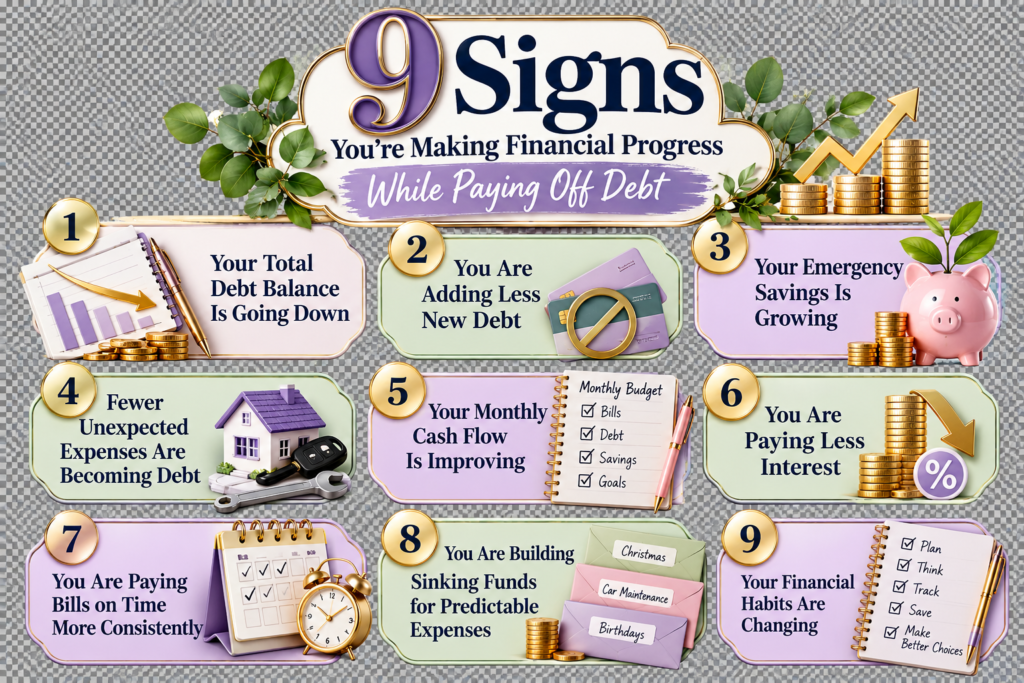
5. Your Monthly Cash Flow Is Improving
Another way to measure financial progress is to look at how much room exists in your monthly budget after essential expenses and required payments are covered.
Perhaps you paid off a small personal loan with a $90 monthly payment. Ninety dollars may not sound life-changing, but that creates $1,080 of additional cash flow over twelve months.
That money can now go toward another debt, emergency savings, a sinking fund, retirement, or another important financial goal. More importantly, it reduces the feeling that every dollar has already been committed before the month begins.
Cash flow may also improve because you canceled unused subscriptions, reduced insurance costs, paid off a credit card, negotiated a bill, or simply became more intentional about where money goes.
When you measure financial progress, ask whether managing each month feels slightly easier than it did before.
6. You Are Paying Less Interest
Interest is one of the reasons debt can feel as though it moves so slowly. Part of every payment may go toward the cost of borrowing rather than reducing the balance itself.
As balances decrease, the amount of interest you pay may also decrease, depending on the type of debt and how the interest is calculated. That means looking at interest charges over time can give you another way to measure financial progress.
The Consumer Financial Protection Bureau explains how credit-card interest is commonly calculated and why carrying larger balances can increase the amount of interest paid. You can review its explanation through the CFPB guide to credit-card interest.
Compare several months of statements. If the balance is falling and the interest charged is also decreasing, more of your future payments may be able to go toward reducing what you actually owe.
Do not ignore that improvement simply because there is still a balance.
7. You Are Paying Bills on Time More Consistently
Financial progress is also about creating reliable systems.
Perhaps there was a time when you regularly forgot due dates, paid late fees, overdrew your account, or moved money around at the last minute trying to cover bills. If that happens much less often now, your financial situation has improved.
When you measure financial progress, pay attention to consistency. Are bills being paid on time? Are you checking due dates before they become emergencies? Do you know what needs to come out of each paycheck?
Those changes may not produce a dramatic number you can post on social media, but they can save money and reduce stress.
A household that has moved from regular late fees and missed payments to predictable monthly bill management has made meaningful financial progress even if debt remains.
8. You Are Building Sinking Funds for Predictable Expenses
Not every large expense is an emergency.
Christmas happens every year. Car maintenance eventually happens. Birthdays happen. Insurance renewals happen. School expenses come around again. Annual subscriptions renew.
When these expenses surprise you every year, they can easily end up on a credit card.
A sinking fund changes that.
If you know you generally spend $600 during the holidays, for example, setting aside $50 each month means the money can already be available when December arrives. Instead of creating another $600 balance, you use money you planned ahead to save.
That is another important way to measure financial progress because you are preventing future debt while paying off existing debt.
Your Emergency Fund vs. Sinking Fund can help you decide which expenses belong in each category and start building both gradually.
9. Your Financial Habits Are Changing
Some of the most important financial improvements happen before the numbers show the full result.
Maybe you now check your accounts regularly instead of avoiding them. Perhaps you know exactly how much you owe, what your interest rates are, and when your payments are due.
Maybe you think before making purchases, compare prices, plan larger expenses, or wait before buying something simply because you want it.
Those habits matter when you measure financial progress because long-term financial improvement depends on more than one successful month. The goal is to develop behaviors that make it easier to keep the progress you are creating.
If your habits today are different from the habits that contributed to your financial problems, that is meaningful progress.
Stop Measuring Your Progress Against Someone Else’s Debt-Free Story
One of the quickest ways to become discouraged is to compare your financial situation with someone else’s highlight reel.
You may see someone announce that they paid off $40,000 in twelve months. That is a wonderful accomplishment, but you probably do not know their entire financial situation.
You may not know their household income, housing costs, childcare expenses, health expenses, whether they received a bonus, whether they sold something valuable, or whether two incomes were contributing to the goal.
Their accomplishment does not become less impressive because their circumstances were different. It simply means their timeline should not automatically become yours.
The better way to measure financial progress is to compare yourself with your own starting point. Are you borrowing less than you used to? Saving more? Paying fewer fees? Understanding your finances better? Reducing balances?
Those are much more useful comparisons.
What Financial Progress Can Look Like in Real Life
Consider someone who begins January with $12,000 in credit-card debt, $100 in emergency savings, $475 in required monthly payments, $70 in recent late fees, and about $600 per month in new credit-card purchases.
Six months later, the credit-card balance is $10,400. Emergency savings has grown to $750. Required monthly payments have dropped to $430, there have been no late fees, and new credit-card spending has fallen to about $150 per month.
That person is not debt free.
But their financial situation has improved substantially.
Debt decreased by $1,600. Savings increased by $650. New borrowing fell sharply. Late fees disappeared, and monthly obligations became a little easier to manage.
If this person looked only at the remaining $10,400 balance, they might believe they were barely moving. Looking at the full picture shows why it is important to measure financial progress in several ways.
What If Your Debt Is Not Falling Very Fast?
There may be times when balances barely move, and that deserves attention rather than shame.
Maybe your income temporarily decreased. Perhaps interest rates are high, essential expenses increased, or an emergency interrupted the debt-payoff plan. You may also be paying minimums while building a small emergency reserve so that you do not immediately create new debt the next time something goes wrong.
The important thing is understanding why the numbers are moving slowly.
If you are struggling to make required payments, do not wait until the account becomes seriously delinquent before looking for help. The Consumer Financial Protection Bureau recommends contacting your credit-card company as soon as you believe you may have trouble paying because some issuers may have hardship or payment-assistance options. You can read more in the CFPB guidance for people struggling with credit-card payments.
The goal is to respond to the situation early instead of pretending there is no problem.
Use a Monthly Money Reset to Measure Financial Progress
One of the easiest ways to track improvement without obsessing over money every day is to choose one regular date each month for a financial review.
During that review, record your total debt, emergency savings, sinking funds, interest charges, new debt added, bills paid, and any balances that were completely eliminated. Then compare those numbers with the previous month.
Our Monthly Money Reset can help you create that routine, while the 30-Day Financial Improvement Plan can give you practical steps if you want a more structured reset.
The purpose is not to create another complicated financial system. It is simply to measure financial progress often enough that you can recognize improvements and catch problems before they become larger.
Do Not Ignore Progress Because It Looks Small
Small progress can be easy to dismiss.
Saving $25 may not feel impressive. Paying an extra $50 toward debt may not feel important. Avoiding one late fee might not seem worth celebrating.
But those changes build on each other.
The person who saves the first $100 begins developing the habit required to save $1,000. The person who stops adding new credit-card debt makes paying off the existing balance much more achievable. The person who consistently pays bills on time creates a financial routine that can eventually make everything else easier.
When you measure financial progress, do not require every improvement to be dramatic before you acknowledge it.
Small progress is still progress.
Liz’s Note
When you still have debt, it can feel as though nothing is changing because the balance is still sitting there every time you look at the account. Sometimes we become so focused on getting that number to zero that we overlook everything else that has already improved.
That is why I think it is important to measure financial progress in more than one way. If you once put every unexpected expense on a credit card and now have $500 saved, that matters. If you stopped adding new balances, that matters. If you paid off one small account and freed up $60 every month, that matters too.
None of those things mean we should ignore the remaining debt. They mean you are creating the habits, savings, and breathing room that can make getting out of debt more realistic.
Debt freedom may be the destination, but there are a lot of financial victories between where you started and where you are trying to go.
Frequently Asked Questions About How to Measure Financial Progress
How do I know whether I am making financial progress if I still have debt?
Look at more than the remaining balance. You can measure financial progress by checking whether debt is decreasing, new borrowing is slowing, savings are growing, bills are being paid on time, interest charges are declining, and monthly cash flow is becoming easier to manage.
The important question is whether your overall financial position is stronger than it was several months ago.
Should I save money while I am paying off debt?
There is no single approach that fits every household, but having no savings at all can leave you vulnerable to creating new debt when an unexpected expense occurs. Even a modest emergency cushion may give you some protection while you continue making debt payments.
Your interest rates, income stability, required payments, essential expenses, and personal circumstances should all be considered when deciding how aggressively to divide extra money between debt repayment and savings.
Does making only the minimum payment count as financial progress?
Paying at least the required payment on time is important because it keeps the account current. However, if you are able to pay more than the minimum without neglecting essential expenses, additional payments can generally help reduce the balance faster and decrease total interest costs.
If the minimum is currently all you can afford, focus first on staying current and improving your overall financial situation so that larger payments may become possible later.
How often should I measure financial progress?
For many people, once a month is enough. A monthly review allows you to see changes in debt, savings, spending, and cash flow without becoming consumed by every small daily fluctuation.
Consistency matters more than checking constantly.
What if my debt increases during one month?
Look at why it increased before deciding that all your previous progress disappeared. A necessary medical expense or emergency repair is different from repeatedly spending beyond your budget without understanding why.
Use the increase as information. Then decide whether something needs to change in your spending, savings, income, or financial plan.
Does building savings count as financial progress while I still owe money?
Yes. Savings can reduce the chances that your next unexpected expense will become additional debt.
When you measure financial progress, look at both sides of the picture. Paying down old debt while building some protection against future debt can both contribute to a stronger financial position.
Let’s Talk About Your Financial Progress
Debt payoff can take time, and the middle of the process is often the hardest part because the finish line still feels far away. That is exactly when recognizing smaller improvements becomes important.
Maybe you saved your first $500. Perhaps you paid off one account, stopped using Buy Now, Pay Later, went several months without a late payment, or finally wrote down every debt you owe.
Those accomplishments count.
What is one sign of financial progress you have made that does not involve being completely debt free?
Share it in the comments. Someone else who feels discouraged may need to see that financial improvement can begin long before the final debt balance reaches zero.
Your Next Step
Choose several numbers you will use to measure financial progress each month instead of relying on one debt balance. Track your total debt, emergency savings, new debt added, interest charged, monthly payments, and one or two financial habits that are important to you.
Then compare those numbers with where you started.
If you are borrowing less, saving more, paying bills more consistently, preparing for predictable expenses, and gaining greater control over your monthly money, your financial situation is changing even if there is still debt left to pay.
Keep working toward the larger goal, but do not ignore the evidence that you are already moving forward.