
Getting a podcast invitation can feel exciting, especially when you have been putting in the work to build your business and get noticed. Someone wants to hear your story, your experience, or your perspective, and that can open the door to a completely new audience that may not have found you any other way.

But before you immediately say yes, there are a few things you should check first. A podcast invitation can be a valuable opportunity, but only if the show is a good fit, the invitation is legitimate, and you understand what the host expects from you. The goal is not simply to appear on a podcast. The goal is to use the opportunity in a way that supports your business, your visibility, and the kind of audience you actually want to reach.
If this is your first invitation, do not worry about trying to sound like a professional broadcaster. You do not need to become someone else for the interview. You just need to know what you are walking into, what you want to say, and what you want listeners to remember when the conversation is over.
Why a Podcast Invitation Can Be Valuable for a Small Business
One of the biggest advantages of a podcast is time. On social media, you may only have a few seconds to get someone’s attention. In a podcast interview, you may have twenty, thirty, or even sixty minutes to explain what you do, why you do it, and what makes your business different.
That gives listeners a chance to hear your personality and understand your story in a way that a short caption or product listing usually cannot do. If the audience is a good fit, a podcast invitation can help people connect with you before they ever visit your website, follow your page, or make a purchase.
The important thing to remember is that audience fit matters more than simply chasing a large number. A smaller podcast filled with listeners who care about your type of business can be far more useful than a huge show whose audience has little interest in what you offer.
1. Make Sure the Podcast Is a Good Fit for Your Business
The first thing you should do after receiving a podcast invitation is research the show. Listen to at least one or two recent episodes if you can, and pay attention to the topics, the host’s style, the kind of guests they usually bring on, and the type of listener they appear to serve.
Ask yourself whether those listeners are actually people you would want to reach. For example, if you sell handmade products, a smaller podcast focused on makers, side hustles, local businesses, or entrepreneurship may be more useful than a larger show with an audience that has little connection to your industry.
You should also think about whether the invitation fits the direction of your business right now. If you recently completed an Annual Business Check-In, use that same mindset here. Every opportunity does not automatically deserve a yes just because it sounds exciting.
2. Verify That the Podcast Invitation Is Legitimate
Before you click unfamiliar links, download files, or give out personal information, verify that the invitation is real. Search for the podcast independently instead of relying only on the information included in the message.
Look for the podcast website, recent episodes, social media accounts, the host’s name, and previous guests. Make sure what you find matches what was included in the podcast invitation. If the host name is different, the podcast appears inactive, or you cannot find any evidence that the show actually exists, slow down and investigate before moving forward.
You should also be cautious if someone asks for sensitive personal information, passwords, gift cards, cryptocurrency, or unusual payments before you have even discussed the interview. The point is not to become suspicious of every opportunity. It is simply smart business to verify who is contacting you before you hand over information or money.
3. Ask What the Episode Will Be About
Do not assume you already know why you were invited. Ask the host what they want the episode to focus on and what they would like you to bring to the conversation.
You should understand the main topic, the angle, and why they selected you as a guest. A good host should be able to explain what they want to discuss, even if they do not provide every question in advance.
This also gives you a chance to make sure the topic is actually within your experience. If the host expects you to speak as an expert on something you do not really know, that is better to discover before the recording starts.
4. Ask About the Interview Format
A podcast invitation should also come with basic logistical information. You want to know how long the interview will be, whether it is live or prerecorded, whether video is included, and which platform will be used for the recording.
That matters because an audio-only interview requires very different preparation from a video interview that will later appear on YouTube. If video is involved, you need to think about lighting, background, camera angle, and what is visible behind you.
You should also ask whether the host provides questions in advance, whether the episode is edited, and approximately when it is expected to be published. The more you know ahead of time, the easier it is to prepare calmly instead of trying to figure everything out on the day of the interview.
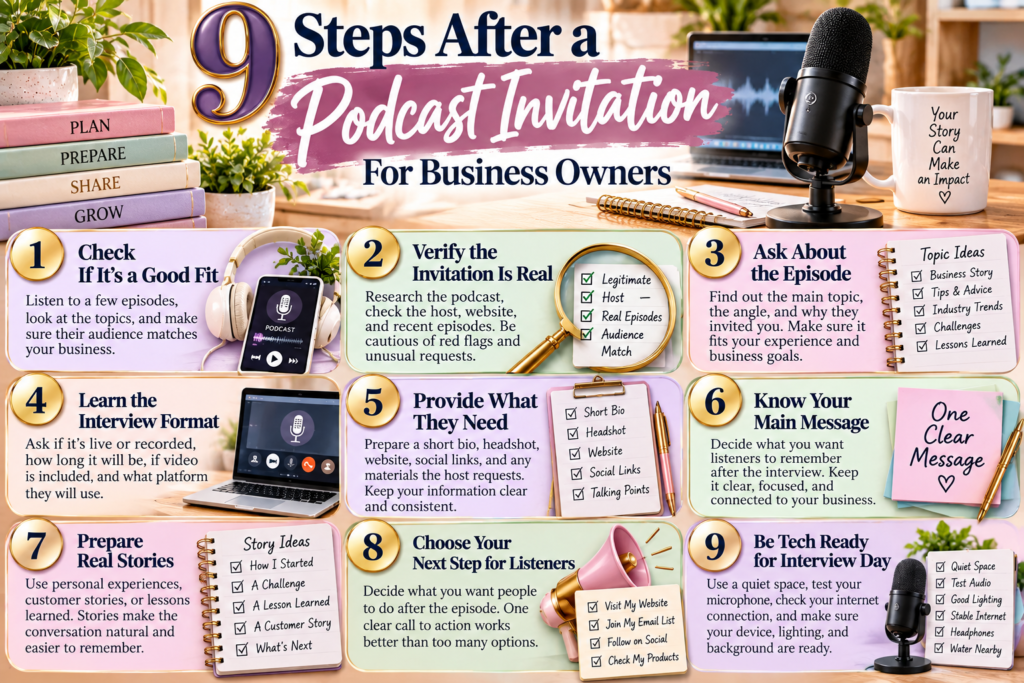
5. Find Out What the Host Needs From You
Many hosts will ask guests to send a few items before the interview. This may include a short biography, a headshot, your business name, website, social links, product information, or a few suggested talking points.
Have those materials ready, but keep them clear and simple. Your short business description should explain what you do without turning into your entire company history.
This is also where branding becomes important. If your website says one thing, your social media says something different, and the bio you send the host tells another story, listeners may leave the interview confused about what your business actually does. Our Small Business Branding guide can help you tighten that message and keep it consistent.
6. Decide What You Want People to Remember About You
Before the interview, decide on the one thing you want listeners to remember when the episode ends. This is one of the most important steps in preparing for a podcast invitation.
You do not need to make people remember everything about your business. In fact, trying to explain everything usually makes the message weaker. Choose the main idea you want to leave with them.
Maybe you want them to remember that your business helps new entrepreneurs start without overspending. Maybe you want them to remember your product solves a specific problem. Maybe you want them to remember your story of starting over after a setback.
Whatever it is, know your main message before the conversation begins. If you are still working on how to explain your business clearly, our guide on How to Find Your First Customers Without Spending a Fortune can help you think more clearly about who you are trying to reach.
7. Prepare Stories Instead of Memorizing Answers
Trying to memorize an entire interview can make you sound stiff, even when the information is good. Instead of writing out every answer word for word, prepare a few stories and examples you can naturally use during the conversation.
Think about how your business started, a mistake that taught you something important, a customer interaction that changed how you operate, or a challenge that forced you to make a better decision. Stories make interviews easier to listen to and easier to remember.
You can absolutely keep notes nearby. Write down important numbers, names, dates, website information, or key points you do not want to forget. Just use the notes as reminders instead of turning the entire interview into a script.
Spotify for Creators also recommends preparing questions and an interview structure ahead of time while still leaving room for a natural conversation. Spotify for Creators podcast preparation guide
8. Decide What You Want Listeners to Do Next
Before the interview begins, decide what you want an interested listener to do after hearing you speak. Do not give people five or six different instructions because too many choices can make it easier for them to do nothing.
Choose one main next step. Maybe you want people to visit your website, download a free guide, join your email list, follow one primary social account, or look at a particular product or service.
This is where your marketing strategy matters. If you are unsure where people should go after discovering you, the article on Choosing the Right Social Media Platform for Your Business can help you think through which platform deserves your attention.
A good podcast invitation should not end when the episode ends. You want listeners to have an easy way to continue the relationship.
9. Prepare Your Technology Before Interview Day
Do not wait until five minutes before the interview to test your setup. That is one of the easiest ways to create unnecessary stress.
Choose a quiet room, silence notifications, make sure your device is charged, and test your microphone and internet connection ahead of time. If you have headphones, they can help reduce echo and make it easier to hear the host clearly.
If the interview includes video, check your lighting, camera angle, and background before the call begins. Keep water nearby and have the host’s contact information available in case there is a technical problem.
You do not need expensive equipment to do a good interview. You do need equipment that works and a setting that allows people to hear you clearly.

Questions to Ask Before You Accept a Podcast Invitation
You do not need to treat the host like they are being interrogated, but you do need enough information to understand the opportunity. Asking a few questions before you agree can save you from confusion later.
You may want to ask who the primary audience is, what topic they want you to discuss, how long the interview will be, whether it is live or prerecorded, whether video is involved, whether questions are provided in advance, when the episode is expected to air, and whether you will receive a link once it is published.
It is also reasonable to ask whether you can share clips from the episode and whether the host needs anything from you before the interview. A professional podcast invitation should be able to handle basic questions like these.
Podcast Invitation Red Flags to Watch For
Not every opportunity is automatically a good opportunity. Be cautious if the message is extremely vague, does not clearly identify the podcast, or gives you no way to find previous episodes.
You should also question pressure to act immediately, unusual requests for personal information, or unexpected fees that were never mentioned until after you showed interest. A legitimate business opportunity should still make sense when you take the time to research it.
Some podcasts do charge for sponsored interviews or promotional placements. That does not automatically make them dishonest, but the arrangement should be explained clearly so you know exactly what you are paying for.
Should You Pay to Be on a Podcast?
This is where business owners need to understand the difference between a guest interview and paid promotion. Some podcasts invite guests because they believe the person has something useful to say. Others sell sponsored interviews, advertising packages, or promotional placements.
If money is involved, ask what is included. Find out where the episode will appear, what promotion the show will provide, whether the content is labeled as sponsored, and what kind of audience information they can share.
Then decide whether the cost makes sense for your business. Do not pay simply because someone called you an expert or made the opportunity sound exclusive.
The same thinking applies here that we discuss in Know Your Worth in Business. Knowing your value does not mean saying yes to everything. Sometimes it means asking better questions before you commit your time or money.
Do Not Turn the Interview Into a Commercial
A podcast interview should feel like a conversation, not a thirty-minute advertisement. If every answer circles back to “buy my product” or “visit my website,” listeners may lose interest very quickly.
Instead, focus on being useful. Share lessons, experiences, mistakes, examples, and stories that help the audience understand the topic.
Your business can still come up naturally throughout the conversation. In fact, listeners may become more interested in your business when they feel they learned something valuable from you first.
That is another reason your one clear call to action matters. You can spend most of the interview being helpful and then give listeners a simple way to learn more about you afterward.
What Should You Do After the Podcast Interview?
Do not finish the interview and forget about it. Thank the host afterward, and if you do not already know the release date, ask when the episode is expected to go live.
Once it is published, share it. Post the episode on your social media, mention it to your email subscribers, and add it to your website if it makes sense for your business.
If the host provides approved clips, graphics, or quotes, use them too. One podcast invitation can create several pieces of content if you repurpose it carefully.
You may be able to turn the conversation into a blog post, a short video, a quote graphic, a Facebook discussion, a newsletter topic, or another educational post. The episode does not have to disappear after one day of promotion.
Keep the Relationship Going After the Episode
The host has introduced you to their audience, so do not treat the relationship as finished the moment the episode is published. Thank them, share the episode, and tag the podcast appropriately when you promote it.
If the relationship makes sense, stay connected. You never know whether one conversation could lead to another interview, a referral, collaboration, speaking opportunity, or useful professional connection later.
A lot of business growth happens through relationships that develop over time instead of one immediate transaction. A podcast invitation can be the beginning of one of those relationships if you handle it professionally.
What If You Are Nervous About Being Interviewed?
Being nervous does not mean you are unprepared. Most people feel some level of nervousness when they are being interviewed, especially if it is their first time.
Instead of trying to prepare for every possible question, focus on the things you know best: your own story, your business, your customers, your experience, and what you have learned.
You do not need to sound like a professional broadcaster. You need to sound like yourself and be able to explain what you know clearly.
If you need a second to think, take it. A short pause is better than rushing into an answer that does not really say what you mean.
What If the Podcast Is Very Small?
Do not automatically reject a podcast because the audience is small. A smaller but highly relevant audience may be much more valuable than a large audience that has no connection to your business.
Imagine a podcast with 500 regular listeners who are exactly the type of people your business serves. Now compare that with a show reaching 50,000 people who are unlikely to ever need what you offer.
The larger number may look impressive, but relevance still matters more. When you evaluate a podcast invitation, think about the audience, the topic, and whether the opportunity supports your actual business goals.
Liz’s Note
When someone invites you onto a podcast, it can feel like one of those moments when you want to say yes immediately because someone noticed your business. There is nothing wrong with being excited about that. Recognition feels good, especially when you have been working hard.
But excitement should not stop you from doing your homework. I would want to know who I am talking to, what we are talking about, who their audience is, and what they expect from me before I agree to anything.
I would also want to know what I want people to remember when the interview ends. You do not have to accept every opportunity to prove your business is growing.
Sometimes the smartest decision is saying yes. Sometimes it is asking more questions first. And sometimes it is deciding the opportunity simply does not fit where you are trying to go.
Frequently Asked Questions About a Podcast Invitation
Should I accept every podcast invitation I receive?
No. A podcast invitation should make sense for your business, your audience, and your current goals. Research the podcast, host, topic, and expectations before agreeing to participate.
What should I send the podcast host before the interview?
The host may ask for a short biography, professional photo, business name, website, social links, and information about your products or services. Ask what they need so you do not send unnecessary information.
Should I ask for the podcast questions ahead of time?
You can ask, but not every host provides them. Some prefer a natural conversation while others send questions or talking points in advance. Even if exact questions are not available, you should still know the main topic before the interview.
What should I talk about during the podcast?
Stay focused on the agreed topic and use your real experiences to support your answers. Talk about your business naturally when it fits, but do not turn every response into a sales pitch.
Should I promote the episode after it airs?
Yes. Sharing the episode benefits both you and the host, and it gives your existing audience another way to hear your story and learn more about your business.
What if I make a mistake during the interview?
Keep going. If the episode is prerecorded, the host may be able to edit a major mistake. If it is live, simply correct yourself and continue.
Most listeners are much more interested in the overall conversation than whether every sentence comes out perfectly.
Let’s Talk About Podcast Opportunities
A podcast invitation can be exciting, but the invitation itself is only the beginning. The real opportunity comes from choosing the right show, preparing a clear message, giving the audience something useful, and making it easy for interested listeners to stay connected with you afterward.
If you were invited tomorrow, think about what you would want a new audience to remember once the episode ends. That answer can help you prepare not only for podcasts, but also for videos, interviews, networking events, and everyday business conversations.
If you were invited onto a podcast tomorrow, what is the one thing you would want listeners to remember about your business?
Share your answer in the comments. Knowing that one message can make every future conversation about your business much clearer.
Your Next Step
Before accepting your next podcast invitation, create a simple guest checklist. Write down the podcast name, host, audience, topic, interview date, format, materials requested, your main message, and the one place you want listeners to go afterward.
Then prepare two or three stories you can naturally use during the conversation. You do not need to memorize the interview or sound rehearsed.
The goal is to walk into the conversation knowing who you are talking to, why you are there, and what you want people to remember when the interview is over.