
You pay your vendor fee, prepare your inventory, pack your vehicle, arrive early, set up your booth and wait for customers.
Then the event is slow.
Afterward, the organizer says, “The vendors didn’t promote the event enough.”
Hold on.
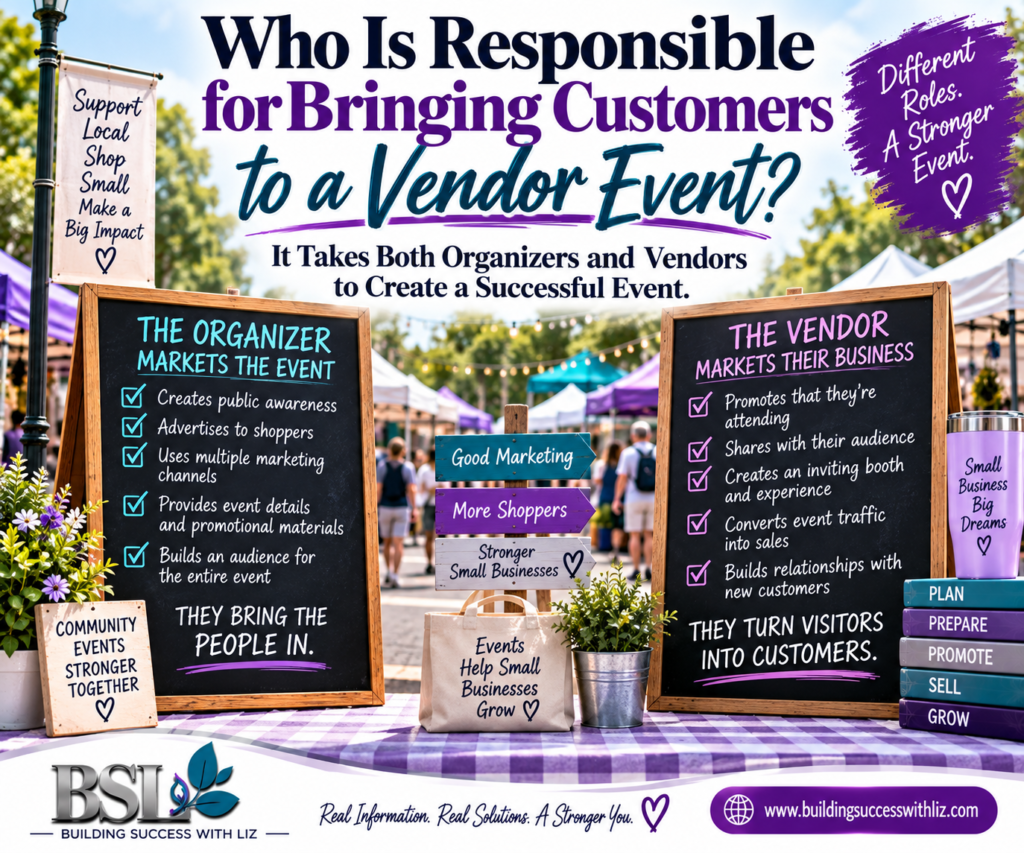
Vendor event marketing works best when organizers and vendors both participate, but their responsibilities are not the same. An organizer shouldn’t depend on vendors’ Facebook followers to create an audience, and a vendor shouldn’t pay a booth fee, arrive at the event and assume they have no responsibility for promoting their own business.
So who is responsible for bringing customers to a vendor event?
The organizer is primarily responsible for marketing the event and attracting potential shoppers. The vendor is responsible for marketing their participation, attracting people to their individual business and converting event traffic into customers.
Those responsibilities work together, but they aren’t interchangeable.
Vendor Event Marketing Starts With the Organizer
When someone decides to organize a craft fair, farmers market, festival, pop-up or vendor event, they’re creating more than a collection of booths. They’re creating an event that needs an audience.
That makes public event promotion part of the organizer’s job.
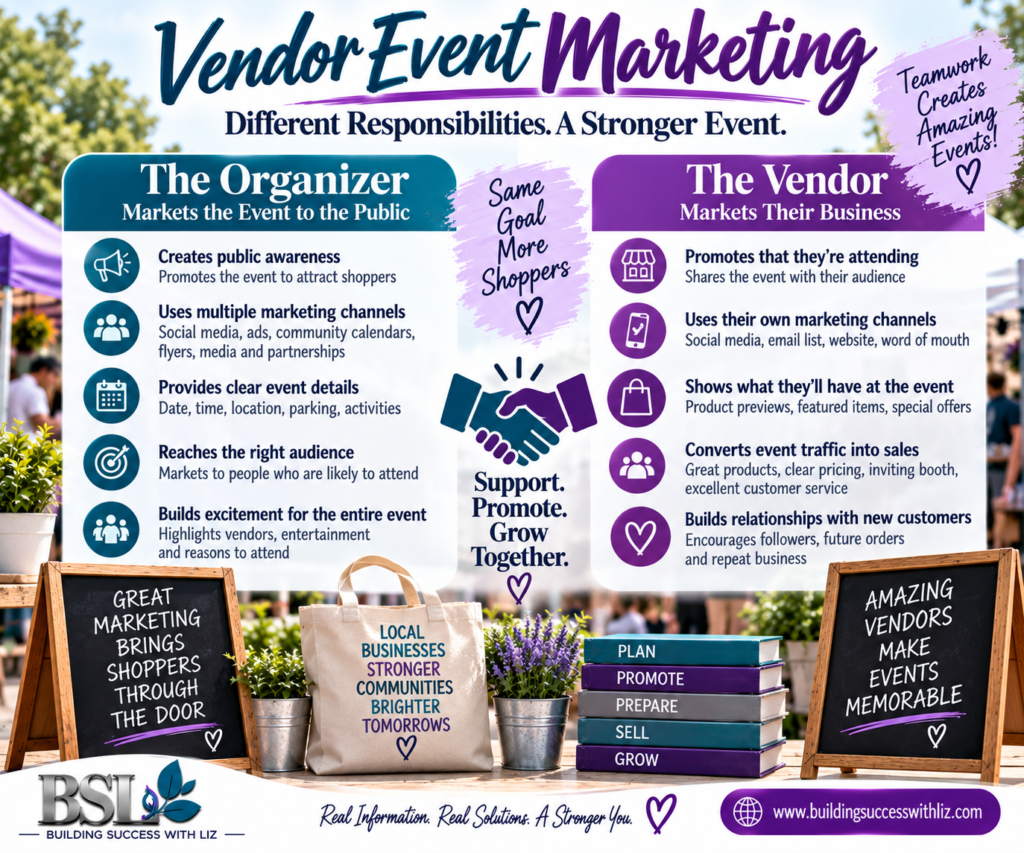
Good vendor event marketing might include social media promotion, paid advertising, community calendars, local groups, email marketing, flyers, signs, partnerships, media outreach and promotion through the venue or participating organizations. The exact strategy will vary depending on the event, audience, location and budget.
The important part is that there is a strategy.
Telling vendors, “Here’s the flyer. Everybody share it,” can be part of that strategy, but it shouldn’t be the entire strategy.
This is one reason I encourage vendors to ask about advertising before paying a vendor fee. In Before You Pay a Vendor Fee: Questions Every Vendor Should Ask, I explain why vendors should ask how an event will be promoted instead of assuming a full vendor roster means there will be a full crowd.
1. Organizers Are Responsible for Marketing the Event
If you’re charging businesses to participate in an event, shoppers need to know the event exists.
That doesn’t mean an organizer can guarantee attendance. Advertising doesn’t control weather, competing events, family emergencies, traffic or whether someone who clicked “Interested” on Facebook actually gets off the couch Saturday morning.
It does mean the organizer should make a reasonable effort to reach the event’s intended audience.
If you’re organizing a holiday shopping market, your advertising should reach people interested in holiday shopping. If you’re hosting a pet event, reach pet owners. If you’re hosting a family festival, market to families in the geographic area who can realistically attend.
Selling vendor spaces is not the same thing as marketing to shoppers.
Both matter.
Organizers who are building that strategy can also use the SBA’s guide to marketing and sales to think through their target market, marketing plan and the different ways they will reach potential customers. The specific promotion will look different for every event, but the basic business principle is the same: know who you’re trying to reach and have a plan for reaching them.
2. Vendors Should Promote That They’re Attending
Now vendors, we don’t get to sit this one out either.
If you’ve built an audience on Facebook, Instagram, TikTok, an email list or another platform, tell people where you’ll be.
Post the event date and location. Show products you’re preparing. Share a sneak peek of something customers can purchase there. Remind local customers a few days before the event and again on event morning.
That’s not doing the organizer’s job.
That’s marketing your business.
Someone may have no interest in attending a generic “Fall Vendor Market,” but they may decide to go because they know their favorite candle maker, baker, jewelry designer or crafter will be there.
Vendors can help strengthen an organizer’s promotion. That’s a good thing.
The problem starts when vendor participation becomes the organizer’s primary customer-acquisition strategy.
3. A Vendor’s Follower Count Is Not an Attendance Guarantee
This one deserves its own conversation.
I’ve seen situations where vendors are asked how many followers they have, almost as though their follower count predicts how many shoppers they’ll bring to an event.
It doesn’t.
A business might have 10,000 followers and only 300 of them live anywhere near the event. Some followers may be customers from other states. Others may be fellow business owners, friends, family members or people who simply enjoy the content.
And even local followers have jobs, children, appointments, transportation issues and other plans.
A social media follower isn’t a guaranteed body walking through the event entrance.
Follower count can tell you something about a business’s online audience. It should not become a substitute for the organizer developing an actual vendor event marketing plan.
4. Vendors Are Responsible for Converting Traffic Into Sales
Here’s where I think some vendors get frustrated and place too much responsibility on the organizer.
The organizer can bring 2,000 people through the gate.
They cannot make those 2,000 people buy from your booth.
Once shoppers arrive, vendors have work to do.
Your product selection matters. Your prices matter. Your signs matter. Your booth needs to be reasonably easy to shop. Your customer service matters. Your ability to explain what you sell matters.
That doesn’t mean you need a $2,000 Pinterest-perfect booth before attending your first event. Beginners can spend so much time trying to recreate elaborate displays they see online that they postpone the part that actually teaches them the most: selling to real customers.
Start clean. Make your pricing easy to understand. Bring enough sellable inventory. Pay attention to what customers pick up, ask about and purchase. Improve your setup as your business grows.
The organizer provides an opportunity for customer traffic.
You still have to earn the sale.
5. Organizers Should Market to Shoppers, Not Just Other Vendors
This is an important distinction.
An organizer can have excellent vendor recruitment and still have weak customer marketing.
Think about what happens when nearly every promotional post says:
“VENDORS WANTED!”
“Applications are open!”
“Only 10 spaces left!”
“Three spaces remaining!”
“Vendor registration closes Friday!”
Who has been seeing the advertising?
Vendors.
Now compare that with shopper-focused promotion:
“Come shop 75 local businesses.”
“Free family activities from 11–3.”
“Holiday shopping, food trucks and live entertainment.”
“Meet local makers and find gifts you won’t see everywhere else.”
Those messages speak to potential attendees.
Successful vendor recruitment is useful, but filling every booth doesn’t automatically fill the parking lot.
6. Vendors Should Build Their Own Audience Too
There’s another side to this.
A small business shouldn’t depend entirely on event organizers for customer acquisition.
Events can introduce your business to new people, but your goal should be to keep building relationships after the event ends.
Encourage interested shoppers to follow your business. Have business cards or another simple way for them to find you again. If appropriate for your business, build an email list. Make it easy for customers to know where you’ll be next.
If you’re still working on building that first audience, How to Find Your First Customers Without Spending a Fortune walks through practical ways to find customers without assuming you need a huge advertising budget.
A good event gives you access to people.
A good business finds ways to turn some of those people into customers who remember you after the tent comes down.
7. Both Sides Need Realistic Expectations
This may be the most important part of vendor event marketing.
An organizer shouldn’t promise vendors that they’re going to make hundreds or thousands of dollars. No organizer controls what individual shoppers purchase.
Vendors shouldn’t assume that paying a booth fee guarantees sales either.
But organizers also shouldn’t accept vendor fees and then transfer responsibility for creating event attendance onto the businesses that paid to participate.
The healthiest relationship looks more like this:
Organizer: “We’re marketing the event to the public. Here are the ways we’re promoting it, and here are graphics you can share with your audience.”
Vendor: “Great. I’ll tell my customers where I’ll be and promote my booth too.”
That’s teamwork.
What About a Sold-Out Vendor Event?
A sold-out vendor roster can sound impressive.
It tells you that the organizer successfully recruited vendors.
That’s all it tells you.
It doesn’t tell you how many shoppers know about the event, whether the organizer’s advertising reached the right audience or whether attendees intend to spend money.
This is why I don’t believe vendors should judge an event solely by how quickly booth spaces sell.
A vendor event needs vendors and customers.
Filling only one side of that equation doesn’t create a successful marketplace.
What Should Vendors Look for Before Registering?
Before paying, look at how the event is being presented publicly.
Search the organizer’s social media. Are most posts recruiting vendors, or are there also posts designed to attract shoppers? Search for previous events and look at photos, comments and community engagement. Ask how the organizer is advertising and whether they have historical attendance information.
Then evaluate whether the event audience makes sense for what you sell.
A huge crowd of the wrong customers may be less valuable than a smaller crowd filled with people who genuinely fit your target market.
This is why vendor event marketing should never be reduced to one number.
Followers aren’t attending.
Attendance isn’t sales.
Sales aren’t automatically profitable.
Each number tells you something different.
What Should Organizers Expect From Vendors?
Organizers can reasonably ask vendors to help spread the word.
Provide vendors with professional graphics, correct event details, hashtags, social media accounts to tag and promotional information early enough for them to actually use it.
You can encourage vendors to introduce themselves to the event audience or share their products.
But I would be careful about judging a vendor’s value based primarily on follower count.
A vendor with 400 followers could have a fantastic product, excellent customer service and a loyal local audience. A vendor with 40,000 followers could have an audience located all over the country.
Choose vendors because they contribute to the quality and variety of the event, not because you’re hoping they’ll supply your attendance numbers.
How Do You Know Who Did Their Part?
Don’t judge everything based on whether one vendor had a good sales day.
Look at the bigger picture.
For organizers, evaluate your advertising reach, actual attendance, shopper feedback, vendor feedback, parking and traffic flow, event layout and whether your marketing attracted the audience you intended.
For vendors, evaluate sales, product costs, booth fee, travel, payment-processing fees and other event expenses. Also consider new followers, future orders, customer conversations and whether the audience was a good match.
An event can have strong attendance and still be a poor fit for one particular vendor.
Likewise, one vendor having a slow day doesn’t automatically mean the organizer failed.
The goal is to evaluate the evidence instead of immediately deciding whose fault it was.
Liz’s Note
I believe organizers and vendors should support each other. If I’m attending your event, I have no problem telling my audience where I’ll be. I want the event to succeed too.
But I don’t believe an organizer’s marketing plan should depend on how many followers each vendor can bring through the gate.
I’m paying for the opportunity to sell at the event. I’m going to prepare my products, show up, set up my booth, talk to customers and promote my business. The organizer should also be working to make sure the community knows there’s an event worth attending.
That’s not one side doing everything.
That’s both sides doing their actual jobs.
Frequently Asked Questions
Who is responsible for vendor event marketing?
The organizer has primary responsibility for marketing the overall event and attracting potential attendees. Vendors should also promote their participation and individual businesses. The strongest events usually have both sides promoting, but vendor promotion shouldn’t replace the organizer’s public marketing strategy.
Should vendors be required to promote an event?
Organizers can reasonably encourage vendors to share event information, especially when they provide ready-to-use promotional materials. However, requiring vendors to generate the event’s audience is different from asking them to participate in promotion.
Does a vendor with more followers bring more customers?
Not necessarily. Followers may live outside the event area or may not be available on the event date. Follower count alone isn’t a reliable measure of how many people a vendor will bring to a physical event.
Is the organizer responsible if I don’t make sales?
Not automatically. Organizers are responsible for reasonably promoting and operating the event, but they can’t guarantee individual vendor sales. Product selection, pricing, booth presentation, customer service and audience fit can all affect a vendor’s results.
How can vendors tell whether an organizer is marketing an event?
Look at the organizer’s public advertising, social media activity, community partnerships and shopper-focused promotion. Ask directly what advertising is planned before paying your vendor fee.
A Successful Event Needs Both Sides
Good vendor event marketing isn’t a competition over who should work harder.
The organizer markets the event.
The vendor markets their business.
The organizer works to create traffic.
The vendor works to convert appropriate traffic into customers.
And both sides benefit when shoppers have an event worth attending.
The next time an event is slow, don’t immediately ask, “Whose fault was this?”
A better business question is:
“What actually happened, what did each side control, and what should we do differently next time?”
That’s how better events are built.
Let’s Talk About It
I know vendors and organizers may see this differently, and that’s exactly why I think this conversation is worth having.
Who do you believe is responsible for bringing shoppers to a vendor event, and where should the organizer’s responsibility end and the vendor’s begin?
If you’ve organized events or sold them, share what you’ve seen work. Keep the conversation respectful because there’s something both sides can learn from each other.