AI can be incredibly useful when you need help understanding something, comparing options, brainstorming an idea, or organizing information. The problem is that a good-sounding answer is not always a correct answer.
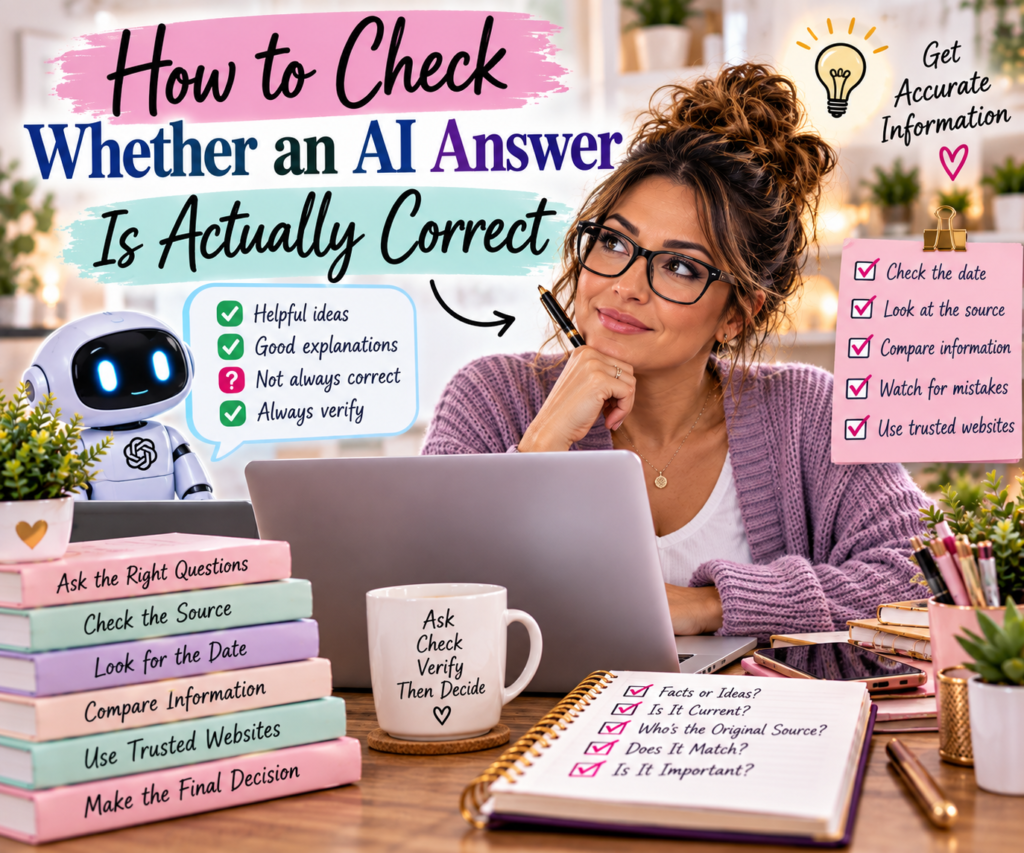
That is one of the most important things beginners need to understand about artificial intelligence. AI can give you an answer that sounds polished, detailed, and confident while still getting part of it wrong. Sometimes the information is outdated. Sometimes the AI misunderstands the question. Sometimes it fills in missing information with something that sounds reasonable but is not true.
That does not mean AI is useless. It means we need to learn how to verify AI answers before depending on them, especially when the information could affect our money, business, health, legal decisions, taxes, customers, or safety.
NIST, the National Institute of Standards and Technology, uses the term confabulation for situations where generative AI confidently produces false or incorrect information. In everyday conversation, people often call these AI hallucinations. The important part is not the terminology. The important part is understanding that confident wording is not proof that an answer is accurate. NIST Publications
So how do you check an AI answer without turning every question into a three-hour research project? That is what we are going to walk through.
Why You Need to Verify AI Answers
When a person gives us information confidently, we sometimes assume they know what they are talking about. AI can create the same impression. It can produce neat paragraphs, professional language, numbered steps, and even explanations that appear logical from beginning to end.
That polished presentation can make incorrect information harder to notice.
For example, you might ask AI about a business license requirement, tax deadline, product regulation, government program, or current fee. The answer may look completely reasonable, but if the information changed recently, the AI may be working from older information or may simply be mistaken.
That is why learning to verify AI answers is just as important as learning how to ask AI better questions.
This is something we already talk about in the AI for Beginners section on Building Success with Liz. AI can help you understand information, organize your thoughts, and identify what to research, but your judgment still matters. Building Success with Liz
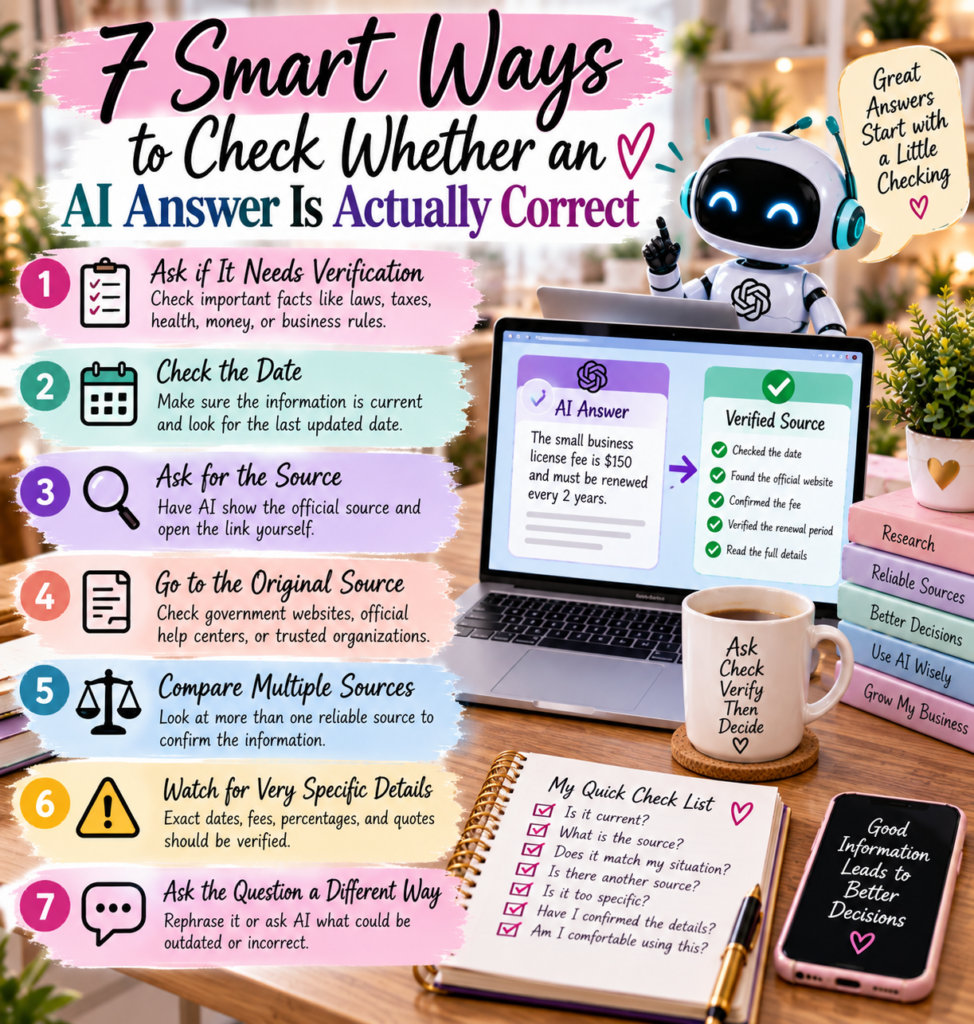
1. Ask Yourself Whether the Answer Actually Needs Verification
Not every AI answer needs the same level of checking.
If you ask AI for ten birthday-party themes, a meal-planning idea, or suggestions for organizing your desk, there is usually little risk if one suggestion is imperfect. You can simply decide whether you like the idea.
The situation changes when the answer involves facts that could affect an important decision.
You should slow down and verify AI answers when they involve things such as taxes, laws, medical information, government benefits, business registrations, product regulations, contracts, current fees, deadlines, safety instructions, financial decisions, or anything else where being wrong could cost you money or create a serious problem.
A simple rule is this: the greater the consequence of being wrong, the more carefully you should verify the answer.
2. Check the Date Before You Trust the Information
One of the easiest ways an AI answer can become wrong is simply by being out of date.
Imagine asking about a filing fee that changed three months ago. The AI may remember the older fee. The same thing can happen with tax limits, government programs, platform rules, shipping rates, software features, licensing requirements, and many other topics that change over time.
When you verify AI answers, always ask yourself whether the information depends on the current date.
If it does, look for a source that clearly shows when the information was published or last updated. Government agencies, official company help centers, professional organizations, and current policy pages are usually better choices than an old blog post with no visible date.
You can also make your original AI question better by adding a time requirement. Instead of asking, “What is the fee?” ask, “What is the current fee as of October 2026, and what official source confirms it?”
That does not guarantee perfection, but it tells the AI that current information matters.
3. Ask AI Where the Information Came From
One simple way to verify AI answers is to ask for the source behind a factual claim.
For example, instead of stopping after an AI tells you about a business requirement, ask:
“Can you show me the official source for that information?”
Or:
“What government agency or official website should I check to confirm this?”
This helps in two ways. First, it may point you toward a trustworthy source. Second, it forces you to separate the AI’s explanation from the actual authority responsible for the information.
But there is an important warning here. Do not assume that every source an AI names actually exists or says what the AI claims it says.
Open the source yourself.
Check whether the page exists, whether it is current, and whether the source actually supports the claim you were given.
That extra step is what turns “AI gave me a source” into actual verification.
4. Go to the Original Source Whenever Possible
This is one of the most useful habits you can develop.
If the question is about federal taxes, go to the IRS. If it is about a federal small-business program, go to the SBA. If it is about a state business license, go to the appropriate state agency. If it is about a platform’s current rules, check the platform’s official help center.
The closer you can get to the original source, the stronger your verification usually becomes.
This matters because information can change as it gets repeated from website to website. One blog may copy another. Another may summarize the information incorrectly. A social media post may leave out an important exception. Before long, five websites are repeating the same mistake.
When you verify AI answers, an original source helps you get as close as possible to the person, organization, agency, or company responsible for the information.
This is especially important for business owners because small details can matter. A requirement that applies in one state may not apply in another. A federal rule may have exceptions. A platform policy may have changed last month. AI may give you a general answer when your situation requires something more specific.
5. Compare More Than One Reliable Source
Sometimes one source is enough, particularly when it is the official authority. Other times, comparing two reliable sources can help you understand whether you are interpreting the information correctly.
Suppose AI tells you something about marketing statistics, consumer behavior, or an emerging business trend. There may not be one government page that gives you a simple yes-or-no answer. In that case, check another credible source.
You might compare a government agency, university, established research organization, industry association, or original study.
When you verify AI answers, you are not looking for five websites that copied the same sentence. You are looking for independent evidence that points in the same direction.
This becomes even more important when the question involves estimates, opinions, forecasts, or research findings. Two trustworthy sources may not use exactly the same numbers, but seeing how they reached their conclusions can help you understand the issue much better.
6. Look for Details That Sound Too Specific
Oddly enough, very specific answers can sometimes be the ones you need to check most carefully.
Suppose an AI tells you:
“You must file this form within exactly 14 days.”
Or:
“The fine is $2,750.”
Or:
“Eighty-three percent of small businesses do this.”
Those statements sound authoritative because they contain precise numbers. But precision does not automatically mean accuracy.
Whenever an answer gives you an exact date, percentage, fee, law number, quotation, study, statistic, or regulation, that is a good moment to verify AI answers rather than simply assuming the details must be correct.
Ask where the number came from.
Search for the original study.
Check the government page.
Look at the actual regulation.
Specific facts should have specific evidence behind them.
7. Ask the Same Question in a Different Way
This is a simple test that can sometimes reveal a problem quickly.
Ask the AI the question again using different wording. You might also ask it to challenge its previous answer.
For example:
“Is there anything about your answer that might be outdated?”
“Are there exceptions to this?”
“What part of your answer should I verify independently?”
“Could there be another interpretation?”
“If this answer were wrong, what would be the most likely mistake?”
This does not replace outside verification, but it can expose assumptions or uncertainty that were not obvious in the original response.
When you verify AI answers, you are not trying to catch the AI doing something wrong. You are trying to understand where the weak points might be before you rely on the information.
That is a much healthier way to use AI.
A Confident Answer Is Not the Same as a Correct Answer
This deserves its own section because it is one of the easiest mistakes to make.
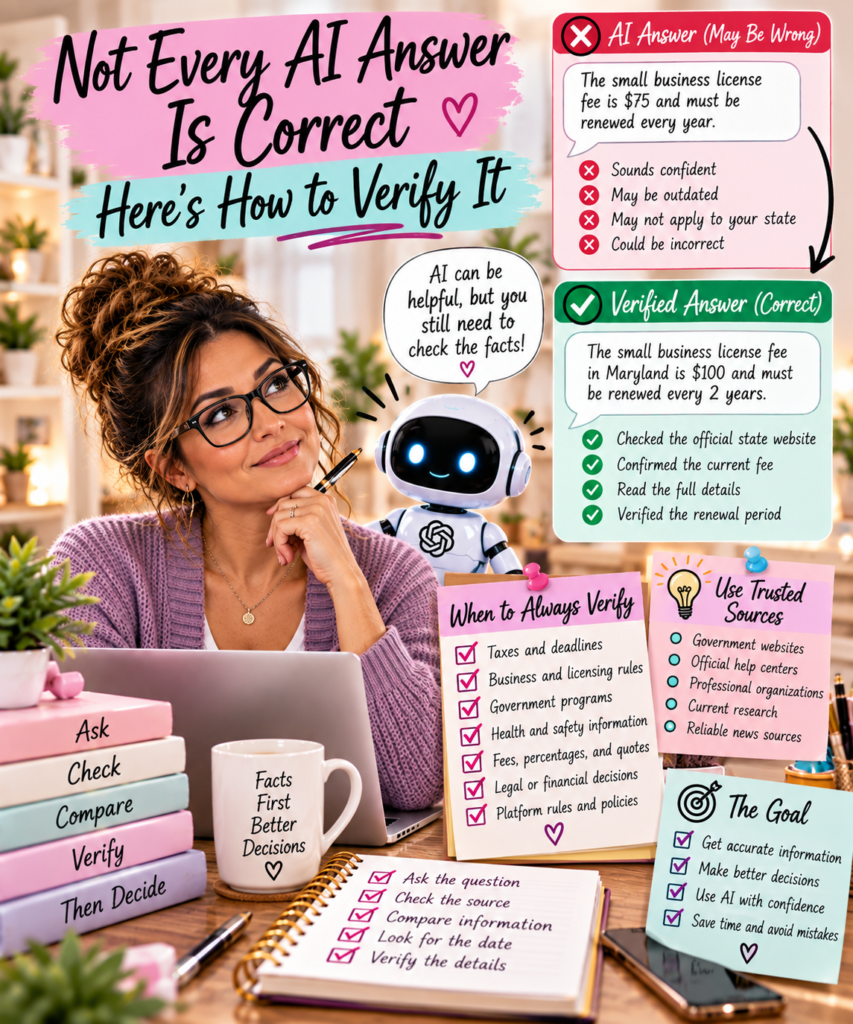
AI does not need to “feel uncertain” before giving you a wrong answer. It can write an incorrect statement in exactly the same confident tone it uses for a correct one.
NIST specifically warns that generative AI systems can produce erroneous or false content and present it confidently. That is why appearance alone is not enough to judge reliability. NIST Publications
Do not use tone as your fact-checking system.
The answer can sound professional and still need verification.
Learn the Difference Between an Idea and a Fact
This is another distinction that can save you a lot of unnecessary checking.
If you ask AI, “Give me five ideas for packaging handmade soap,” you are asking for ideas. You can evaluate those ideas yourself.
If you ask, “What labeling information is legally required on this soap?” you are asking for factual information that may involve regulations.
Those are two completely different types of questions.
AI is often very helpful for brainstorming, organizing, drafting, comparing possibilities, and explaining concepts. The stakes become higher when you ask it to provide facts that you plan to act on.
That is why I encourage people learning AI to separate creative assistance from authoritative information.
You can use AI to help you prepare a list of questions to ask an accountant. You should not automatically treat the AI as your accountant.
You can use AI to help you understand language in a contract. You should not assume that explanation replaces legal advice.
You can use AI to brainstorm ways to reduce business expenses. You should verify any tax, regulatory, or financial claims before acting on them.
That distinction helps you verify AI answers without becoming afraid to use AI at all.
Watch for Information That Does Not Quite Fit Your Situation
AI often gives general answers.
Your situation may not be general.
Suppose you ask about registering a business. The answer may describe the typical process in the United States. But your state, county, city, profession, or type of business may have additional requirements.
The information may not be completely wrong. It may simply be incomplete for your situation.
This is why context matters when you verify AI answers.
Ask yourself whether location, age, business structure, industry, income, product type, licensing, or another detail could change the answer. If it could, verify the information using a source that applies specifically to your situation.
A national article about business licenses may be a helpful background. Your state’s official registration page is what tells you what applies where you live.
Be Careful With Quotes, Studies, and Statistics
AI can sometimes produce a very convincing reference to a study or quote. That is exactly the type of information I would check before publishing it.
If an AI says, “A Harvard study found…” go find the study.
If it gives you a quotation, confirm that the person actually said it.
If it provides a percentage, find the original report.
If it gives you the name of a law or court case, verify it through an authoritative source.
This is particularly important for bloggers, content creators, teachers, and business owners because repeating incorrect information can damage credibility.
If you are using AI to help create content, verify AI answers before you publish them as facts.
That includes captions, blog posts, presentations, ebooks, worksheets, newsletters, and social media content.
AI Should Help You Research, Not End the Research
One of my favorite ways to think about AI is as a starting point.
Suppose you are trying to understand something complicated. AI can explain the terminology, give you questions to investigate, identify agencies that may be responsible, summarize different possibilities, and help you organize what you find.
That can save a lot of time.
But the AI answer should not automatically become the final authority.
Building Success with Liz already takes the same approach in our guide to ChatGPT business privacy. AI can help organize information and prepare questions, but important matters still need careful review and verification. Building Success with Liz
We also discuss this in our guide to creating an AI business profile. Giving AI better context can improve an answer, but better context does not guarantee that every factual statement will be correct. Building Success with Liz
The skill we really want to build is not blind trust or constant suspicion.
It is judgment.
A Simple Five-Step Check Before You Use an AI Answer
You do not need a complicated research system every time. For important factual information, use this quick check:
- What exactly is the factual claim? Separate the fact from the explanation or opinion.
- Does the information need to be current? If yes, check the date.
- Who is the original authority? Find the government agency, company, research organization, or professional source responsible for it.
- Does the source actually say what the AI said? Read the source yourself instead of relying on the AI’s summary.
- What happens if this information is wrong? The higher the risk, the stronger your verification should be.
That process can take only a few minutes for many everyday questions.
For something more serious, take more time.
When You Should Talk to a Professional
Sometimes verification means more than finding a website.
If the issue involves a complicated tax situation, lawsuit, contract, diagnosis, financial investment, regulatory problem, or another decision where your individual circumstances matter, a professional may be the appropriate source.
AI can still help.
It can help you organize documents, understand terminology, make a list of questions, compare general concepts, or prepare for the conversation.
But knowing when to stop researching on your own is part of learning how to verify AI answers responsibly.
The Building Success with Liz disclaimer also reminds readers that AI-generated information can be incomplete, inaccurate, outdated, or inappropriate for a particular situation and should be reviewed before important business decisions. Building Success with Liz
Liz’s Note
I use AI a lot, and I think it can be an incredible tool when we understand what it is and what it is not.
What I do not want people to do is become so impressed by a well-written answer that they stop asking questions.
If I am brainstorming ideas, I do not need to investigate every sentence. If I am dealing with something involving money, taxes, legal requirements, business rules, or another decision that matters, I want to know where the information came from.
That is not distrust. That is responsible use.
Learning to verify AI answers actually makes AI more useful because you stop expecting it to be perfect and start using it for what it does well. You let it help you think, organize, explain, and research, while you keep control of the final decision.
Frequently Asked Questions About How to Verify AI Answers
Can AI give completely wrong information?
Yes. Generative AI can sometimes produce incorrect or fabricated information while presenting it confidently. NIST identifies this risk as confabulation, which is also commonly called hallucination. NIST Publications
That is why important factual claims should be checked before you rely on them.
How can I verify AI answers quickly?
Start by identifying the exact claim, checking whether the information needs to be current, and finding the original authoritative source.
For many questions, checking one official page can resolve the issue quickly.
Are sources provided by AI always trustworthy?
No. A source may be outdated, irrelevant, incorrectly summarized, or occasionally nonexistent.
Always open the source yourself and confirm that it actually supports the information.
Should I trust AI more if it sounds confident?
No. Confidence in the writing style does not tell you whether the information is correct.
Treat confidence as presentation, not proof.
What types of AI answers should I always verify?
You should be especially careful with information involving laws, taxes, health, safety, government programs, regulations, contracts, current fees, deadlines, financial decisions, and other high-impact matters.
The more serious the consequence of being wrong, the more important it is to verify AI answers.
Is AI still useful if I have to verify information?
Absolutely. AI can save time by helping you understand complicated subjects, organize information, identify questions, compare options, and point you toward areas that need more research.
Verification does not make AI less useful. It makes the way you use AI more reliable.
Let’s Talk About It
Think about the last factual question you asked about an AI tool.
Did you check the answer somewhere else, or did the answer sound believable enough that you accepted it?
There is no need to feel embarrassed if you have done that. Most of us have. The important part is developing a better habit going forward.
What kind of AI information are you most likely to double-check before you use it?
Your Next Step
The next time AI gives you an important factual answer, do not immediately copy it, publish it, spend money based on it, or make a major decision from it.
Take five minutes and verify the AI answer.
Check the date. Find the original source. Read what the source actually says. Look for exceptions that might apply to your situation. If the consequences are serious, get additional confirmation.
You do not have to stop using AI because AI can make mistakes.
You simply have to use it with the same common sense you would use with any other source of information.
Ask. Check. Verify. Then decide.