
An annual business check-in gives you a chance to stop running on autopilot and look closely at what actually happened in your business over the past year. It helps you see which products made money, which expenses were worth it, where customers came from, what kept going wrong, and which parts of the business deserve more attention next year.

The purpose of an annual business check-in is not to judge yourself for every mistake or disappointing month. It is to use real information to make better decisions. A business can have a difficult year and still make important progress by improving profit margins, building repeat customers, simplifying products, cutting unnecessary expenses, or learning what is no longer worth doing.
A useful annual business check-in should answer four basic questions: what worked, what did not, what needs to change, and what comes next. If you can answer those honestly, you can begin the next year with more direction instead of simply repeating the same habits and hoping for a different result.
Why an Annual Business Check-In Matters
It is easy to remember the dramatic moments of the year and forget the patterns. You may remember one terrible vendor event or one excellent sales weekend, but neither one tells you the full story about your business.
An annual business check-in forces you to look beyond individual moments and examine the year as a whole. That means comparing revenue and expenses, reviewing products and sales channels, looking at customer behavior, and identifying problems that happened repeatedly.
The U.S. Small Business Administration recommends maintaining accurate financial records because they help business owners understand revenue, expenses, cash flow, and the overall financial health of the business. SBA guidance also notes that comparing different parts of the business can help owners understand where money is being made and spent. Small Business Administration
The IRS makes a similar point about recordkeeping. It says good business records can help you monitor progress, identify which items are selling, track income and expenses, and determine what changes may need to be made. IRS
That is exactly what we want from an annual business check-in.
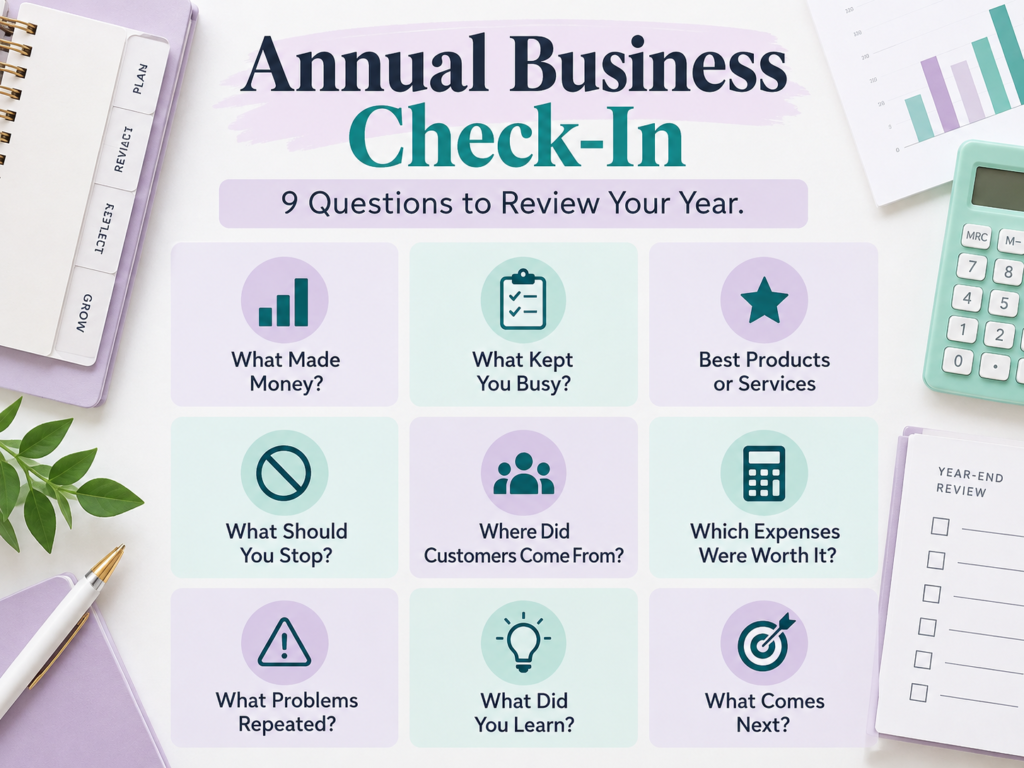
1. What Actually Made Money This Year?
The first question in your annual business check-in should be straightforward: which parts of the business actually made money?
Look at your products, services, events, bundles, custom orders, online sales, seasonal offers, and any other revenue streams you used during the year. Do not stop at the product that sold the most because the highest-selling item is not always the most profitable one.
A product may generate a lot of revenue while also requiring expensive materials, high selling fees, a lot of labor, complicated packaging, or frequent discounts. Another product may sell fewer units but leave you with significantly more profit after the real costs are paid.
This is where our Product Profitability: 7 Costs to Check Beyond the Selling Price article becomes especially useful. During your annual business check-in, compare what sold with what actually contributed money to the business.
Ask yourself whether your strongest revenue-producing products are also your strongest profit-producing products. If they are not, that difference deserves attention before you decide what to promote next year.
2. What Kept You Busy but Did Not Move the Business Forward?
One of the hardest things to recognize in business is that being busy does not automatically mean you are making progress.
During an annual business check-in, look at the work that consumed time without creating enough return. That might include vendor events that barely covered their fees, products that required hours of labor but rarely sold, social media content that produced almost no traffic, or routines that continued simply because you had always done them.
Some activities may still have value even if they do not immediately produce sales. Customer service, bookkeeping, inventory management, and business maintenance are necessary. The problem is when optional activities continually consume time, money, and attention without supporting the business.
Ask yourself which tasks helped increase revenue, improve profit, strengthen customer relationships, simplify operations, or reduce future work. Then compare those with the activities that simply filled the calendar.
Your annual business check-in is the right time to decide whether some of those busy tasks need to be reduced, changed, or eliminated altogether.
3. Which Products or Services Performed Best?
Your best-selling product deserves attention, but it is only one part of the story.
During your annual business check-in, identify your best sellers, highest-margin items, fastest products to produce, repeat-purchase products, seasonal winners, and products customers consistently request. You may discover that several different products are valuable for different reasons.
For example, one inexpensive product may attract new customers and lead to larger purchases later. Another may have a high profit margin but sell less frequently. A third may be extremely popular during the holidays but make little sense during the rest of the year.
Looking at those differences can help you decide which products deserve more inventory, more promotion, better placement, or stronger bundling next year. It can also prevent you from treating every product as though it contributes equally to the business.
An annual business check-in should help you identify the products that deserve to become a bigger part of your strategy.
4. Which Products, Services, or Ideas Should You Stop Carrying?
Some business owners struggle to remove products because they remember how much money, time, or excitement went into creating them.
But keeping a weak product does not recover the money you already spent.
During your annual business check-in, look for products or services that consistently underperformed, required too much labor, tied up inventory, created customer confusion, or produced very little profit. If something has been given a fair opportunity and continues to struggle, keeping it indefinitely may only create more cost.
Stopping something does not mean the idea was worthless. Sometimes the value of an idea is what it taught you.
This is where our When Business Plans Fall Apart: How to Adjust Your Business Plan Without Losing Direction article fits naturally. Business owners need to be willing to adjust when the numbers and customer response show that the original plan is no longer working.
An annual business check-in should help you carry fewer weak decisions into the next year.
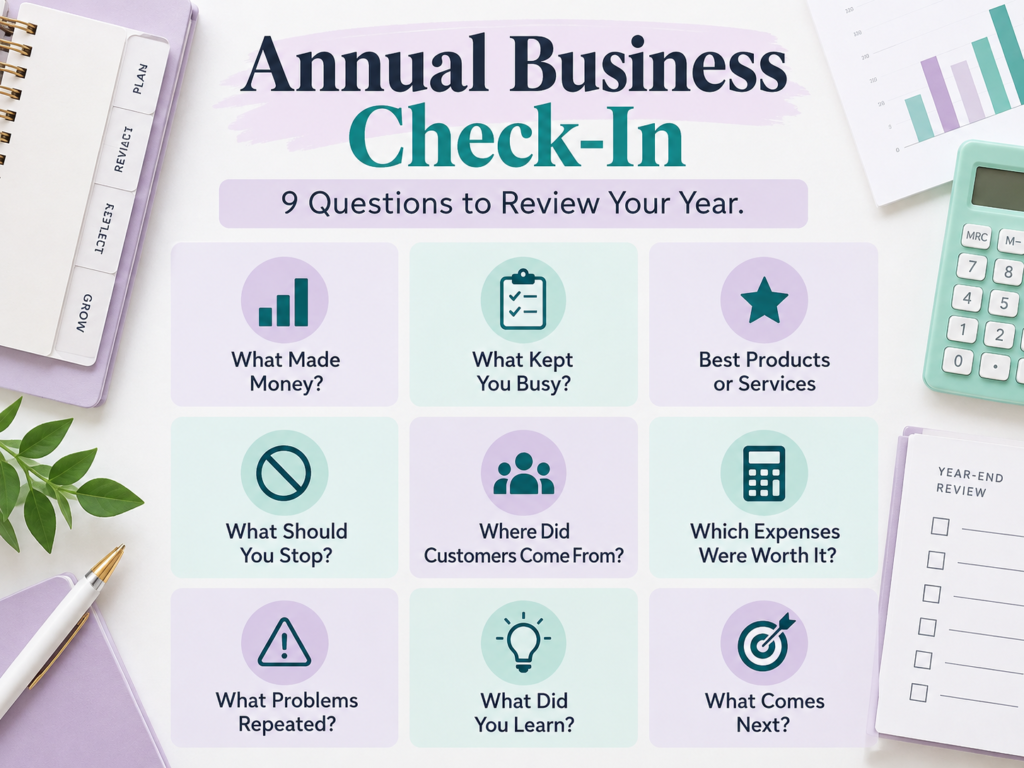
5. Where Did Your Customers Actually Come From?
Marketing becomes much easier when you know which channels are already bringing customers into the business.
During your annual business check-in, look at where customers found you. That might include Facebook, Instagram, Etsy, Google, email marketing, vendor events, referrals, repeat business, local partnerships, or word of mouth.
Then compare the results with the amount of time and money you spent on each channel.
You may discover that a platform you spend hours maintaining generates very little business while a channel you barely use consistently produces sales. That is valuable information because it tells you where your marketing effort may need to shift.
Do not build next year’s marketing plan entirely around what other business owners say you should be doing. Use your annual business check-in to identify what your own customers are already responding to.
If one sales channel clearly outperformed the others, ask what would happen if you gave it more consistent attention next year.
6. Which Expenses Were Actually Worth It?
A proper annual business check-in should include more than sales. You also need to look closely at the money leaving the business.
Review subscriptions, vendor fees, software, equipment, advertising, packaging, supplies, website expenses, courses, memberships, apps, and any other recurring or one-time costs. Ask whether each expense improved sales, saved time, reduced mistakes, improved quality, strengthened customer service, or made the business easier to operate.
The SBA recommends reviewing money coming in and going out and using cost-benefit analysis to evaluate whether a business decision makes financial sense. Small Business Administration
The IRS also emphasizes the importance of keeping records of business expenses because those records help owners understand the business and support tax reporting. IRS
Not every worthwhile expense will produce an immediate sale. Some expenses support organization, security, compliance, or efficiency. The question is whether you can explain why the expense still belongs in the business.
Your annual business check-in should help you identify the expenses worth keeping and the ones that should stop following you into another year.
7. What Problems Kept Repeating?
A one-time problem may simply be bad luck. A problem that keeps appearing usually needs a system.
During your annual business check-in, write down the problems that happened more than once. Maybe you repeatedly ran out of supplies, shipped orders late, forgot to promote events, struggled with pricing, overspent on inventory, or felt overwhelmed by too many products.
Once you identify the repeated problem, look for the process behind it.
If packaging supplies continually run out, you may need reorder points. If events are constantly promoted at the last minute, you may need an event marketing checklist. If customers keep asking the same questions, the problem may be unclear product descriptions rather than difficult customers.
An annual business check-in should help you stop treating recurring problems as isolated incidents. The goal is to identify where the business needs a stronger system so the same issue does not keep costing you time and money.
8. What Did You Learn About Yourself as a Business Owner?
Not every useful lesson comes from a sales report.
An annual business check-in should also include what you learned about yourself. Maybe you discovered that you enjoy making products but dislike selling at events. Perhaps you work better when you batch similar tasks, need more structure, or have been trying to manage too many products at once.
You may also have discovered strengths you did not recognize before. Maybe you became better at talking with customers, negotiating with vendors, tracking money, creating content, or making quicker decisions when something was not working.
Those lessons matter because your next business plan needs to fit the person actually running the business.
There is little value in building next year around a strategy you already know you cannot maintain. Your annual business check-in should help you create a business that works better financially and personally.
9. What Should Happen Next Year?
The final part of an annual business check-in should turn reflection into decisions.
Do not finish the review with a list of observations and then return to business as usual. Decide what should continue, what should stop, what needs improvement, and what you want to test next.
Maybe next year needs fewer products and stronger promotions around the best ones. Perhaps you want to attend fewer vendor events but research them more carefully. You may need to raise prices, improve inventory tracking, build an email list, reduce subscriptions, or create stronger customer follow-up.
Then narrow those ideas into a small number of priorities.
Trying to fix everything at once creates the same lack of focus you are trying to solve. An annual business check-in should help you enter the next year with clearer priorities, not a longer to-do list.
Do Not Judge the Entire Year Only by Revenue
Revenue matters, but it should not be the only measurement in your annual business check-in.
A business can have flat revenue and still become healthier. You may have improved margins, reduced unnecessary expenses, developed stronger systems, increased repeat customers, eliminated weak products, or improved how quickly orders are produced.
Those improvements may not produce dramatic results immediately, but they can make future growth easier.
The IRS notes that good records allow owners to monitor business progress and determine which items are selling and what changes may need to be made. IRS That is another reason your year-end review should look beyond one headline number.
Ask whether the business is more organized, profitable, efficient, and understandable than it was at the beginning of the year. That answer may tell you more than revenue alone.
What If the Year Did Not Go the Way You Planned?
Not every annual business check-in is going to feel encouraging at first.
Maybe sales were slower than expected. Perhaps you chose the wrong events, launched products that did not sell, overspent on equipment, or simply had less time available for the business than you expected.
The purpose of reviewing the year is not to pretend those things did not happen. It is to understand why they happened and whether they should change your next decision.
A one-time setback may not require an entirely new strategy. A repeated pattern probably deserves more attention.
That difference matters because business improvement comes from understanding what happened, not simply labeling the year as successful or unsuccessful.
Download the Annual Business Check-In Worksheet
If you want to work through your own annual business check-in, I created a separate fillable worksheet to make the process easier.
The worksheet helps you review your strongest products, sales channels, expenses, repeated problems, business decisions, and priorities for next year. You can complete it online, save your answers, and return to it whenever you need.
Download the free Annual Business Check-In Worksheet and use it alongside this article as you review your year.
This also gives you something you can keep from year to year. Over time, comparing your completed worksheets may reveal patterns that are difficult to notice when you are focused only on the current month.
Liz’s Note
An annual business check-in is not about beating yourself up over everything that did not work. It is about looking at the year closely enough that you do not keep paying for the same mistakes with your money, time, inventory, and energy.
A product can fail. A vendor event can be disappointing. A marketing idea can completely miss the mark. None of those things automatically make the entire year a failure.
Sometimes one of the most valuable things you learn in business is what you do not need to keep doing.
I would rather know that something does not work than spend another year trying to force it simply because I already invested time or money into it.
At the same time, make sure you recognize the things that did work. If customers returned, referrals increased, profit margins improved, or you finally created a system that saved time, those wins deserve just as much attention.
The purpose of an annual business check-in is to leave the year with better information than you had when it started.
Frequently Asked Questions About an Annual Business Check-In
What is an annual business check-in?
An annual business check-in is a structured review of your business performance over the past year. It looks at sales, profit, products, expenses, customers, marketing, systems, problems, and major decisions so you can determine what should continue and what should change.
The review does not have to be complicated. What matters is that you use the information to make better decisions going forward.
When should I do an annual business check-in?
Many owners complete an annual business check-in near the end of the calendar year or early in the new year. However, a seasonal business may find it more useful to complete the review after its busiest season or at the end of its fiscal year.
The most important thing is reviewing enough of the year to see meaningful patterns.
What numbers should I review during an annual business check-in?
Start with revenue, profit, expenses, product sales, average order value, sales channels, marketing performance, and repeat customers. You may also want to examine inventory, refunds, event performance, production capacity, and any recurring operational problems.
Good records make this process much easier. The IRS recommends keeping records that clearly show income and expenses because they help owners monitor business progress and prepare accurate financial information. IRS
Should I remove products that did not sell well?
Not automatically. Your annual business check-in should help you understand why a product underperformed before you remove it.
The problem may be pricing, weak promotion, poor placement, seasonal demand, or lack of customer awareness. However, if a product repeatedly performs poorly and ties up money, inventory, and time, removing it may be the better decision.
What if revenue increased but profit did not?
That is a sign that you need to look more closely at expenses, pricing, product costs, discounts, and fees. Revenue growth does not automatically mean the business is becoming more profitable.
Use your annual business check-in to identify where the additional revenue went and whether certain products or activities are costing more than expected.
What should I do after my annual business check-in?
Choose a few clear priorities for next year.
Your annual business check-in should tell you what to continue, what to stop, what to improve, and what to test. Turn those findings into specific business decisions instead of leaving them as general observations.
Let’s Talk About Your Business Year
Every business owner will discover something different during an annual business check-in. One person may realize they need to raise prices. Another may decide to stop attending certain events. Someone else may discover that a small product they barely promoted is actually one of the most profitable things they sell.
That is exactly why this review matters.
It forces you to look beyond assumptions and pay attention to what actually happened.
What is one thing your business did this year that you definitely want to continue next year, and one thing you are ready to stop doing?
Share your answer in the comments. Your experience may help another small-business owner recognize something they need to review in their own business.
Your Next Step
Set aside time for your annual business check-in before you begin building next year’s goals. Review your products, profit, expenses, customers, marketing, sales channels, repeated problems, and major business decisions.
Then use the fillable Annual Business Check-In Worksheet to organize what you found and identify your top priorities for the year ahead.
Do not carry everything forward simply because it existed this year. Keep what worked, improve what has potential, and give yourself permission to stop investing money and energy into things that repeatedly fail to support the business.
A strong annual business check-in is not about creating a perfect report. It is about making sure the next year begins with better information, clearer priorities, and stronger decisions than the last one did.