
You see the announcement on social media: “SOLD OUT! Every vendor space has been filled!” It sounds impressive, and for an organizer, filling every available booth is certainly an accomplishment. But if you’re a vendor trying to decide whether an event is worth your money, a sold-out vendor list doesn’t answer the question that matters most: Will there be enough of the right shoppers there to make this opportunity worthwhile?
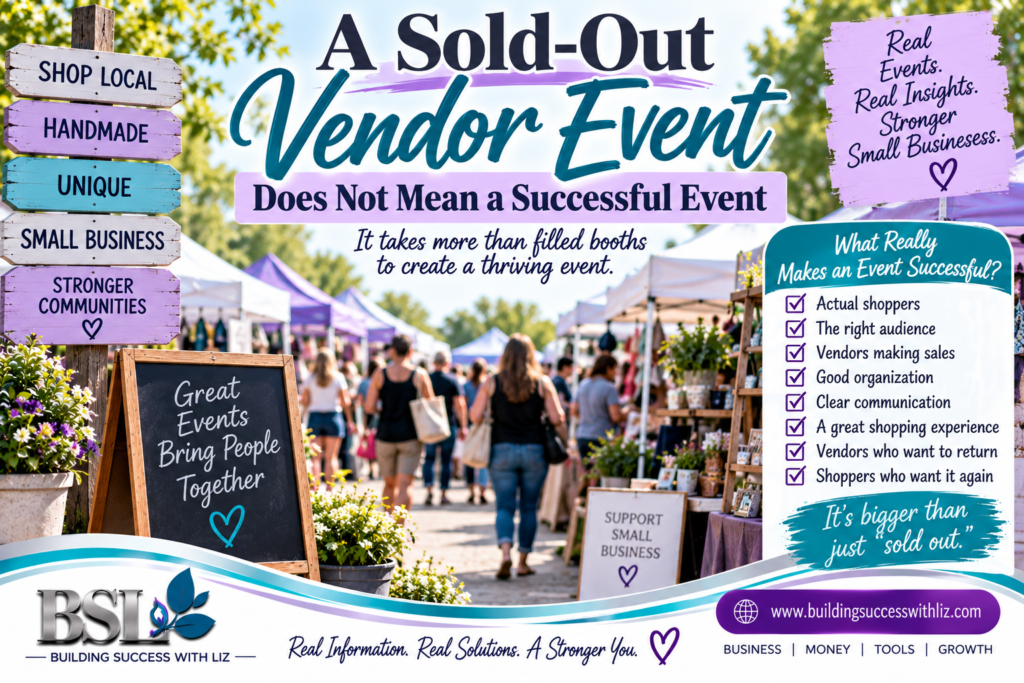
A successful vendor event needs more than vendors. It needs shoppers, appropriate marketing, good organization, clear communication and an audience that has a reason to spend money with the businesses participating. An organizer can successfully sell every vendor space and still have vendors sitting behind their tables wondering where all the customers are.
That’s why I don’t think vendors should automatically interpret “sold out” as “successful.” Selling vendor spaces is one part of organizing an event. Creating an event that shoppers want to attend and vendors want to return to is something much bigger.
Selling Vendor Spaces and Attracting Shoppers Are Two Different Jobs
Think about the advertising you often see before a vendor event. There may be weeks of posts announcing that applications are open, vendors are wanted, only 20 spaces remain, registration closes Friday or just three booths are left. Those messages can work very well, but they’re primarily designed to reach business owners looking for places to sell.
Now imagine the organizer successfully fills 100 vendor spaces. That’s good vendor recruitment, but it doesn’t tell us whether the organizer also reached the people expected to shop those 100 businesses. A full vendor roster tells you there was demand from vendors to participate. It does not automatically tell you there is equal demand from shoppers to attend.
This connects directly to what we discussed in our article about vendor event marketing. Organizers and vendors can both promote an event, but filling vendor spaces and building shopper attendance are different marketing goals. A strong event needs attention on both sides.
1. A Successful Vendor Event Attracts Actual Shoppers
Attendance is an obvious part of evaluating an event, but the number alone doesn’t tell the entire story. A smaller event with 500 well-matched shoppers could be much more valuable to a particular business than a festival with 10,000 people who have little interest in what that business sells.
Pay attention to what attendees are actually doing. Are people walking through the vendor area, stopping at booths, asking questions, carrying shopping bags and returning to businesses they visited earlier? Or are most attendees primarily there for entertainment, food, children’s activities or another attraction while barely entering the shopping area?
A crowd can make an event look successful in photographs, but crowds and customers aren’t always the same thing. Vendors need to consider both the amount of traffic and the quality of that traffic.
2. The Event Attracts the Right Audience
Suppose you sell handmade pet accessories. You have the choice between an event with 5,000 general attendees and a pet-focused event with 1,000 attendees. The larger number may sound more impressive, but the smaller event could potentially put your products in front of far more people who are actually interested in what you sell.
This is why vendors should ask about the intended audience before registering. I discuss this more deeply in Before You Pay a Vendor Fee: Questions Every Vendor Should Ask. Knowing who an event is designed to attract can help you decide whether the opportunity fits your business before you spend money on the booth fee, inventory and travel.
A successful vendor event creates a reasonable match between participating businesses and the people being encouraged to attend. That doesn’t guarantee that every shopper will buy or that every vendor will have the same results, but it gives businesses a better opportunity to reach appropriate customers.
3. Vendors Are Actually Making Sales
We have to talk about money because an event can look beautiful on social media and still perform poorly for the businesses that paid to participate. If hundreds of vendors repeatedly report very little buying activity, that’s information worth paying attention to.
At the same time, one vendor having zero sales doesn’t prove the entire event failed. Their products, prices, booth presentation, customer interaction, inventory or audience fit could have contributed to their results. Another vendor at the same event could have had an excellent day.
This is why vendors need more than one data point before judging an event. Talk to other vendors when appropriate, observe whether shoppers are actually purchasing and compare the experience with your previous events. Looking at the overall environment gives you much better information than assuming your own sales total tells the entire story.
4. Vendors Have a Reasonable Opportunity to Cover Their Costs
Suppose one vendor makes $600 and another makes $400. At first glance, the $600 vendor appears to have had the better event, but we can’t actually know that until we understand what each business spent to participate.
The first vendor may have paid a $300 booth fee, spent $100 on a hotel, used $60 in gas and incurred substantial product costs. The second vendor may have paid a $50 booth fee and driven 15 minutes from home. Once expenses are considered, the vendor with lower gross sales could potentially have kept more money.
This is why gross sales don’t tell the whole story. A successful vendor event should provide businesses with a reasonable opportunity to recover their costs and earn a profit, although no legitimate organizer can guarantee that every participating vendor will make money. Vendors also have a responsibility to understand their own costs before deciding whether an event was financially worthwhile.
5. The Organizer Marketed to Shoppers, Not Only Vendors
One simple way to evaluate an event is to look at the organizer’s public promotion before it happens. Pay attention to how much of the advertising is designed to recruit vendors and how much is designed to give shoppers a reason to attend.
Shopper-focused promotion may introduce participating businesses, highlight products, advertise food or entertainment, explain activities, provide parking information and repeatedly communicate the date, location and event hours. The exact marketing strategy will vary depending on the type and size of the event, but potential customers should be able to understand why they would want to attend.
The SBA’s marketing and sales guidance emphasizes understanding your target market and developing a strategy for reaching that audience. The same basic principle matters when promoting an event. An organizer needs to know who the intended attendees are and have a realistic plan for reaching them.
Successfully selling every booth is good vendor recruitment. It shouldn’t be mistaken for customer marketing.
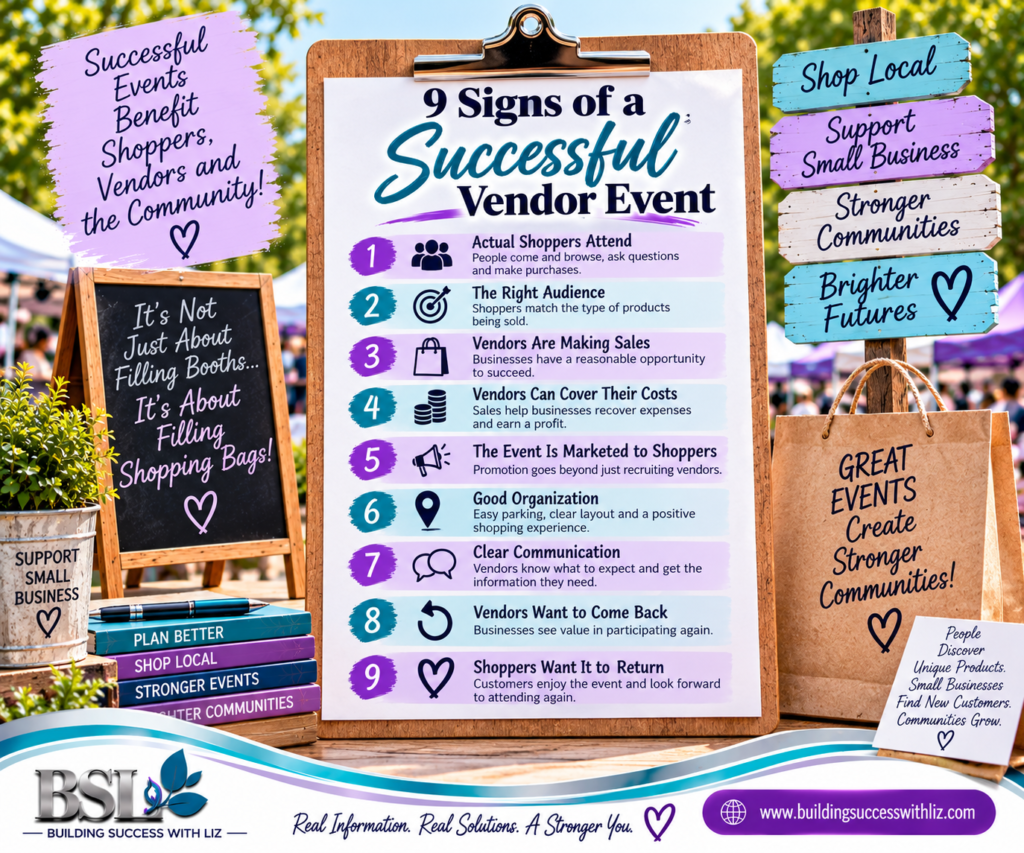
6. The Event Is Organized Well Enough for People to Shop
Marketing gets people to the event, but organization affects what happens after they arrive. Shoppers need to be able to find parking, locate the entrance, move through the vendor area comfortably and understand where different activities are taking place.
An event doesn’t need an enormous budget or fancy decorations to be well organized. Sometimes the basics matter more than anything else. Clear signs, reasonable booth placement, accessible walkways, appropriate parking instructions and a layout that allows customers to shop without unnecessary confusion can make a major difference.
If customers become frustrated trying to park, can’t figure out where the vendor area begins or leave early because navigating the event is difficult, all the advertising used to attract them can’t undo the experience they’re having once they arrive.
7. Communication With Vendors Is Clear
Good organization also happens behind the scenes. Vendors should know where to go, when setup begins, where they’re expected to park, when vehicles need to be moved, what equipment they must bring, what rules apply and who to contact when there’s a problem.
Last-minute changes sometimes happen because events involve weather, venues, people and circumstances organizers can’t always control. That’s different from vendors receiving conflicting instructions, missing important information or constantly trying to figure out what they’re supposed to do.
Communication also works both ways. Organizers should provide clear instructions, but vendors need to actually read those instructions before sending an email asking something that was written in bold on page one. A well-run event requires cooperation from both sides.
Organizers who are growing larger events may also find the SBA’s business management resources useful when thinking about operations, planning and managing responsibilities.
8. Vendors Want to Come Back
One of my favorite ways to evaluate an event is surprisingly simple: ask vendors whether they would pay to participate again. That question often tells you more than asking whether everything was perfect.
One vendor may want to return because sales were excellent. Another may have had moderate sales but received several custom orders afterward. Someone else may have met customers who followed the business and purchased online later. There can be value beyond the money collected at the booth that day.
Sometimes, however, the answer is simply, “No, that event wasn’t right for my business.” That doesn’t necessarily mean the organizer ran a terrible event. The audience may have been wrong for that particular vendor. But if a large percentage of experienced vendors say they would never return, I would want to understand why before paying for the next one.
9. Shoppers Want the Event to Return Too
We spend so much time discussing vendors that we can forget the other half of the event. Shopper experience matters because without customers who enjoy attending, it becomes much harder for an event to build long-term success.
Did shoppers enjoy the selection of businesses? Was there enough variety? Could they move around comfortably? Was parking manageable? Did they stay for a while, purchase products and tell other people about the event? Those are useful questions for organizers to consider after the tents come down.
A successful vendor event should create an experience that at least some shoppers want to repeat. Over time, that creates something much more valuable than one busy afternoon: it creates a reputation that can help the event grow.
A Sold-Out Vendor List Can Actually Create Another Problem
There is another side to selling every possible vendor space. More vendors aren’t automatically better, particularly if an organizer continues adding booths simply because businesses are willing to pay for them.
An overcrowded event can create cramped aisles, parking problems and too many businesses competing in the same categories. Shoppers can also become overwhelmed when there is so much merchandise packed into an area that nothing stands out.
Instead of asking only, “How many vendors can we fit here?”, organizers may benefit from asking how many vendors the event can reasonably support while still creating a good experience for shoppers and participating businesses. Those are two very different questions.
More Vendors Can Divide the Same Customer Spending
Imagine an event attracts approximately 1,000 shoppers. If the organizer doubles the number of vendors the following year but shopper attendance remains roughly the same, there are now more businesses competing for the same pool of customer spending.
That doesn’t mean organizers should artificially keep events small. Large events can successfully support hundreds of vendors when attendance and customer demand grow with them. The important point is that vendor growth and shopper growth need some reasonable relationship to each other.
Selling additional booths can increase event revenue in the short term. Building an event where vendors and shoppers genuinely want to return can create something more valuable over time: credibility and repeat demand.
Vendors Still Have Responsibility
I don’t want anyone reading this article and concluding that every disappointing sales day is automatically the organizer’s fault. A vendor can attend a well-promoted, well-organized event with strong attendance and still have disappointing results.
Your products, prices, booth presentation, customer service, inventory and audience fit can all affect what happens. Sometimes a vendor simply has a bad day even when the event itself performs well.
This is why vendors need to evaluate events objectively rather than immediately deciding that an organizer failed because their own sales were low. Our guide on How to Find Your First Customers Without Spending a Fortune also explains why finding customers requires understanding where your particular audience spends its time and money.
Don’t Judge an Event by Social Media Photos Alone
Event photographs can be useful when researching previous years, but they are still snapshots. A photographer can capture one crowded aisle during the busiest 15 minutes of an eight-hour event, making the entire day appear packed.
The opposite can happen too. One photograph of an empty aisle taken during setup, lunch or a slow period doesn’t prove nobody attended. That’s why I prefer looking for patterns across multiple photos, videos, comments, previous attendance information and vendor experiences.
Research the event instead of allowing one picture to make the entire decision for you. The more information you can compare, the better chance you have of understanding what the event was actually like.
What Should Organizers Measure?
If I were evaluating an event as an organizer, I wouldn’t stop at saying, “We sold all the vendor spaces.” I would want to know approximately how many shoppers attended, which advertising channels worked, what shoppers thought, what vendors thought, whether parking and traffic flow worked, whether the vendor mix was appropriate and how many businesses wanted to return.
I would also want to understand how shoppers discovered the event. Did they come because of social media, paid advertising, an email list, community promotion, another vendor, signs, word of mouth or something else? That information can help an organizer decide where future marketing money and effort should go.
Sold-out booths are certainly one measurement of an event’s performance. They simply shouldn’t be the only measurement.
What Should Vendors Measure?
Vendors need their own scorecard too. Gross sales are important, but they should be recorded alongside product costs, booth fees, payment-processing fees, travel, parking, food, lodging and other event-related expenses.
It is also useful to record which products sold, what customers repeatedly asked about, whether you received future orders, how many useful contacts you made and whether the audience seemed like a good match for your business. Those observations can help you make better inventory and event decisions later.
We’re going to go much deeper into the actual numbers in our upcoming BSL article, How to Know Whether a Vendor Event Was Actually Profitable, because saying “I made $800” and saying “I profited $800” are two very different statements. For now, the important lesson is that the sales number by itself doesn’t tell you whether an event deserves another booking.
Liz’s Note
I don’t automatically get excited when I see “SOLD OUT VENDOR EVENT!” I’m glad the organizer filled the available spaces because that’s one important part of putting together an event, but as a vendor, I still want more information before deciding whether the event makes sense for my business.
I want to know what is being done to attract shoppers, whether the expected audience fits my products, what participating will actually cost me and whether previous vendors would return. At the same time, I don’t expect an organizer to magically make people purchase from my table. Once customers arrive, I still have to offer products they want, present them properly, interact with shoppers and give people a reason to buy.
That’s the balance I think sometimes gets lost in these conversations. A good organizer creates an opportunity, and a prepared vendor has to do something with it.
Frequently Asked Questions
Does a sold-out vendor event mean there will be lots of shoppers?
No. A sold-out event tells you that all available vendor spaces were filled, but it doesn’t automatically tell you how many shoppers will attend. Vendors should also look at the event’s marketing, previous attendance, intended audience and history before making assumptions about customer traffic.
What makes a successful vendor event?
A successful vendor event usually combines appropriate shopper attendance, a good audience fit, effective promotion, clear organization and communication with an environment where vendors have a reasonable opportunity to sell. Success can also include whether shoppers and vendors want to return.
How many vendors should an event have?
There is no universal number because it depends on the venue, expected attendance, event size, customer demand and vendor mix. More vendors can create variety, but too many similar businesses or too many booths for the available customer traffic can make it harder for both shoppers and vendors.
Is an event unsuccessful if I don’t make money?
Not necessarily. One vendor’s results don’t determine whether the entire event succeeded or failed. Consider attendance, audience fit, products, pricing, booth presentation, costs and the experiences of other vendors before deciding what contributed to your results.
Should I return to an event if my sales were only average?
Possibly. Look beyond gross sales and consider actual profit, customer quality, future orders, new contacts, event organization and whether you learned something that could improve your results next time. An average first event could still become valuable if the audience fits your business.
A Successful Vendor Event Is Bigger Than “Sold Out”
A successful vendor event isn’t measured solely by how quickly vendor applications fill. The real test begins when the event opens and shoppers arrive.
Did enough customers come, and were they the right customers? Could they comfortably shop? Was the event organized well? Did the organizer communicate? Did participating businesses have a reasonable opportunity to make money? Most importantly, did the experience give both shoppers and vendors reasons to consider returning?
Those answers tell us considerably more about the health of an event than a social media graphic announcing that every vendor space has been sold.
Let’s Talk About It
When you decide whether a vendor event was successful, what matters most to you besides your total sales? Maybe it’s shopper attendance, organization, marketing, customer quality, repeat orders or communication with the organizer.
If you’re an event organizer, I’d also love to know what you measure beyond the number of vendor spaces sold. Share your experience respectfully because vendors and organizers can learn a lot from understanding what success looks like from the other side.